
Furnace Smells Like Rotten Eggs? Gas Leak or Dust Odor
Key Takeaways
- A rotten egg or sulfur smell near your furnace is a possible gas leak. Treat it as one until a professional says otherwise.
- Natural gas has no smell on its own. Many utilities add a sulfur-like odor so you can detect a leak.
- Leave on foot. Do not flip switches, use a phone indoors, or start a car in the garage.
- Call 911 and your gas utility from outside. Do not go back in until you are cleared.
- A dusty, warm, “hot metal” smell on the first run of the season is usually normal. It should fade in a few hours.
- If the dusty smell lingers, replace the filter and schedule a furnace check.
- A sounding CO alarm, headache, or nausea means leave and call 911.
What should you do first if your furnace smells like rotten eggs?
Leave the house on foot, then call 911 and your gas utility from outside. Do not stop to investigate. Do not flip a light switch, run the thermostat, or look for the source. A rotten egg smell is the signal utilities use to warn you about natural gas.
Speed matters because natural gas is odorless on its own. Many utilities add a chemical called mercaptan so leaks are easy to notice. According to HVAC.com’s furnace smell guide, sources advise leaving right away and contacting emergency services and the gas company.
You may feel the pull to “just check the furnace.” Resist it. You cannot see or smell how much gas is in the air. A spark from a switch, a phone, or a garage door opener can be enough to ignite it.
The steps, in order:
- Stop what you are doing.
- Get everyone out, including pets, if you can do so quickly.
- Walk away from the house.
- Call 911 from a safe distance.
- Call your gas utility’s emergency line.
- Stay outside until a professional says it is safe.
Each step gets more detail below. First, you need to tell a true gas smell from a harmless one.
How can you tell a gas leak from a harmless furnace smell?
Ask what the smell is, when it started, and how long it lasts. Sulfur or rotten egg means gas. Dusty or warm on the first run of the season is likely normal. Anything that lingers needs a technician. When in doubt, choose the safe path and leave.
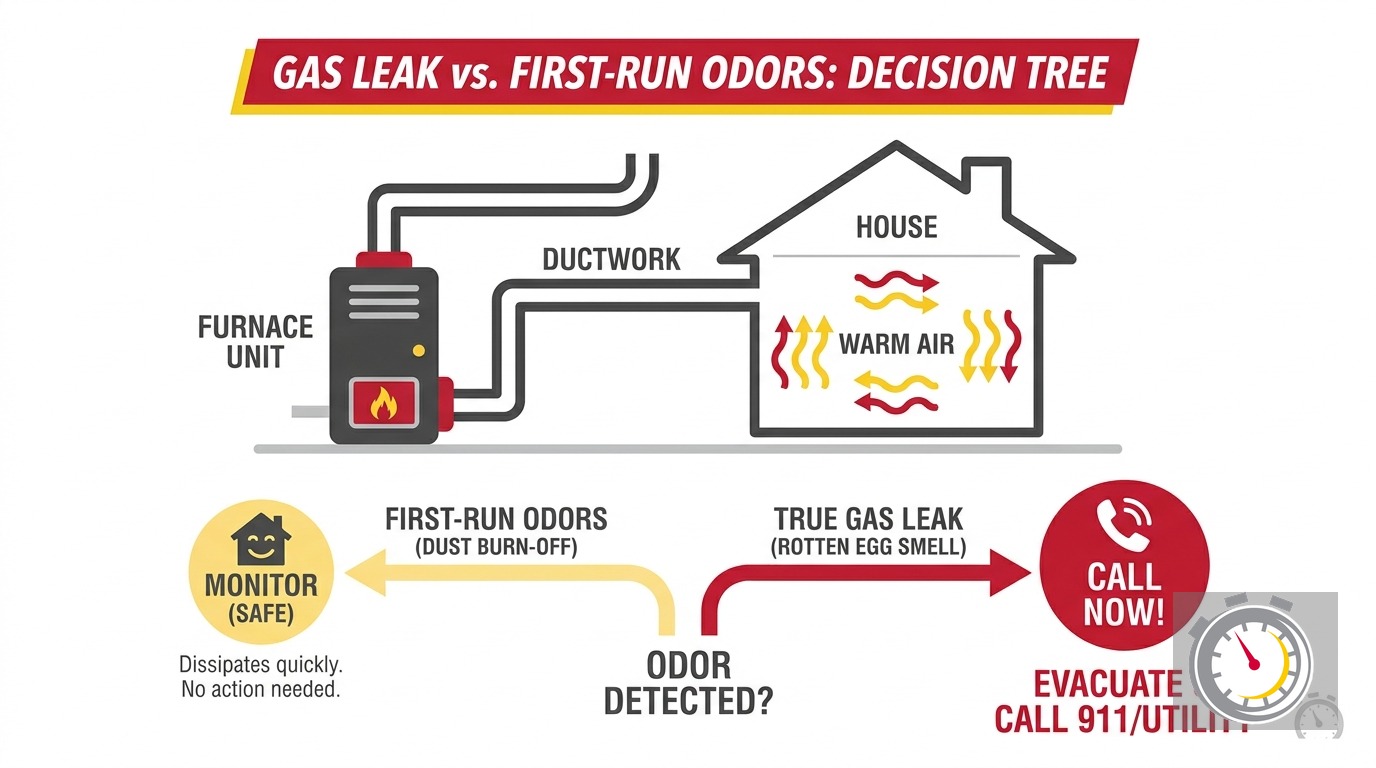
Most articles list furnace smells as separate items, which does not help you decide what to do in the moment. This decision tree does.
Step 1: Does it smell like sulfur or rotten eggs?
If yes, treat it as gas. Skip to Step 4. Do not wait to see if it fades.
If it smells dusty, warm, or like hot metal, go to Step 2.
Step 2: Is this the first run of the season?
If yes, and the smell is dusty and warm, open a window. Note the time. Dust settles on the burners and heat exchanger over the off-season, and it burns off when the furnace fires up again. HVAC.com says this smell should fade within a few hours.
If the smell fades and never has a sulfur note, it is likely normal.
Step 3: Does the dusty smell linger?
If it lasts for several hours, check the filter. HouseDigest says a smell that lingers for several hours may point to a clogged filter. Replace the filter first. If the smell persists, call for furnace service.
Step 4: Any sulfur or rotten egg smell, or a hissing sound?
Leave on foot. Avoid switches and phones while you are indoors. Call 911 and your utility from outside. Do not go back in until you are cleared.
Step 5: Does a CO alarm sound, or does anyone have a headache or nausea?
Leave and call 911. Carbon monoxide has no smell, so your nose will not warn you. More on that below.
Print this list and tape it inside a cabinet door near your furnace. Pick a spot the whole family knows.
Is it normal for a furnace to smell?
Yes, some smells are normal, mostly at the first startup of the season. A dusty or warm smell that fades within a few hours is typical. A sulfur smell is never normal. Neither are smoke, exhaust, or a smell that gets stronger over time.
Picture a stove that sat unused all summer. Dust settles on the burners and heat exchanger. When the furnace fires up, that dust burns off. The smell is brief and often described as warm or dusty.
The key words are “first run” and “fades.” These are normal signs:
- A light dusty or warm smell.
- It starts when the furnace first runs in fall.
- It fades within a few hours.
- It never smells like sulfur.
These signs call for a technician:
- The smell lasts past the first day.
- It returns every time the furnace runs.
- It smells like burning plastic, smoke, or exhaust.
- You see soot or a yellow flame.
We have written about several of these. If you smell something burning on the first cold day, read our guide to a burning smell on first use in fall. If the odor is more like a damp basement, see why a furnace can smell musty. Not sure what you smell? Our guide to identifying an unusual HVAC smell helps you narrow it down.
A new furnace has its own break-in smells. Those usually come from oils and coatings, not dust. Our post on what a new furnace smells like in its first weeks covers the timeline.
Why does my house smell like rotten eggs?
The most serious cause is a natural gas leak, because utilities add a rotten egg scent to gas. Other causes exist, such as sewer gas from a dry drain. You cannot tell them apart by smell. Treat it as gas first and let a professional clear the home.
Here are the possible causes, from most urgent to least.
A gas leak at the furnace, water heater, range, or line. Gas can leak from a fitting, a valve, a pilot assembly, or the pipe itself. The smell may be strongest near the appliance. It may also spread through the house.
A gas leak outside. A damaged line or meter can send gas into a basement through gaps in the foundation. The smell may be stronger in one room than near any appliance.
Sewer gas. A dry floor drain or an unused sink can let sewer smell back into the home. This is a real false alarm. It is also a reason not to guess. Do not decide a rotten egg smell is “just the drain” until a professional checks.
Something else in the house. Spoiled food or a dead pest in a wall can also smell sulfurous. Again, do not assume.
The safest rule: if it smells like sulfur and you are not sure why, leave first. Sort out the cause after the home is cleared.
For a deeper walkthrough, see our guide on what to do when you smell gas near your furnace.
What should you do after you leave the house?
Walk away on foot, call 911 and your gas utility from a safe distance, and wait outside. Do not re-enter for any reason, even to grab keys or a pet. Wait for a professional to tell you the home is clear.
CenterPoint’s published safety guidance is clear on this. It tells you to leave the area immediately on foot. It says not to use a cell phone or start a car near the leak. It describes the odor as “rotten eggs or sulfur.” It also says not to try to find or fix the leak yourself.
The same page says to call the utility and 911 from a safe distance. It says not to report a leak by email or online. It also warns never to assume someone else already reported it.
One catch: the phone numbers on that CenterPoint page are for Houston and Indiana. Do not use them in Minnesota. Use the emergency number on your own gas bill.
This order works best:
- Do not use switches, plugs, or appliances on your way out. Leave lights as they are.
- Do not start a car in an attached garage. Walk.
- Get well away from the house. Go to a neighbor’s yard or the street.
- Call 911. Tell them you smell natural gas.
- Call your gas utility’s emergency line. The number is on your bill.
- Keep others away. Warn neighbors, but do not go door to door in the gas cloud.
- Wait for the all-clear. Only a professional can give it.
Do not try to shut off the gas on your way out unless you know exactly where the valve is and it is safe to reach. We explain where the furnace gas shutoff valve is and how to turn it off. Read that when things are calm, not during a leak.
Which gas utility do you call in the Twin Cities?
Check your gas bill to see who serves you. In the Twin Cities metro, natural gas service is mainly Xcel Energy or CenterPoint Energy. Other parts of Minnesota are served by Minnesota Energy Resources. The emergency number is printed on your bill.
You do not want to hunt for a number during an emergency. Do this today:
- Find your latest gas bill.
- Write the emergency number on a sticky note.
- Put the note on the fridge or near your furnace.
- Save the number in every adult’s phone.
If your utility is Minnesota Energy Resources, its safety page says to leave the area immediately and call 800-889-4970 for a gas odor or a damaged gas line. For carbon monoxide, it says to leave the building and call 911.
Xcel and CenterPoint customers should use the emergency number on their bill. We do not print those numbers here because they should come straight from your utility.
When you are unsure, call 911. Dispatchers can send the fire department and contact the utility.
Why does this smell show up on the first cold snap?
Because that is when many Twin Cities homeowners run the furnace for the first time in months. In Minnesota, that is often October or November. Dust that built up all summer burns off then. That makes the first run the most common time for a harmless odor.
Our seasons set this up. A warm September can lead to a sudden cold snap. One night the windows are open. The next morning it is 30 degrees, and everyone turns on the heat at once.
That is also when a real problem can show up. A furnace that sat idle for months may have a worn part, a cracked fitting, or a dirty burner. So stay alert on the first run.
A simple first-run routine:
- Change the filter before you turn the furnace on.
- Open a window or two in the room near the furnace.
- Turn the thermostat up and note the time.
- Stay nearby for the first hour.
- Check that the smell is dusty, not sulfur.
- Make sure your CO alarms have fresh batteries.
To prep early, use our fall shutdown and startup checklist. Our pre-winter tune-up checklist lists what you can do yourself.
A tune-up before the first cold snap also gives a technician time to find small problems. Our furnace tune-up guide explains what that visit includes.
Why should you never wait for the smell to fade?
Because a gas leak does not get safer with time. A dusty smell fades because the dust burns away. A gas smell fades only if the leak stops, you lose your sense of smell, or the gas spreads. None of those is a good sign.
This is the most common mistake we hear about. A homeowner smells something odd, opens a window, and waits. If the smell was dust, waiting is fine. If it was gas, waiting is dangerous.
Smell fatigue makes it worse. Your nose can stop noticing an odor you have been around for a while. A smell that “went away” may not be gone.
That is why the decision tree starts with one question: does it smell like sulfur? If yes, you leave.
Propane follows the same rule. It also has a strong odor added so you can detect it. Do not wait for it to dissipate. Leave, call 911, and call your propane supplier from outside. To compare the two fuels, see our post on propane versus natural gas furnaces in Minnesota.
Where does carbon monoxide fit in?
Carbon monoxide, or CO, is a different danger with no smell. A gas leak smells like rotten eggs. CO does not smell at all. A working CO alarm is your only early warning. If it sounds, or anyone feels sick, leave and call 911.
Many readers mix these up, but they are separate problems.
- Natural gas leak: unburned gas. It has a rotten egg odor added. The risk is fire or explosion.
- Carbon monoxide: a byproduct of incomplete burning. It is odorless. The risk is poisoning.
A furnace problem can cause either one. A leak is a plumbing and fitting problem. CO is often a combustion, venting, or heat exchanger problem.
Signs of CO exposure include:
- Headache.
- Nausea.
- Dizziness.
- Feeling better when you leave the house.
- An alarm that sounds.
If your alarm goes off, leave first and call 911. Minnesota Energy Resources says to leave the building and call 911 for carbon monoxide. Do not stop to open windows or reset the alarm.
Put alarms in the right places. Our guide to CO detector placement near a furnace or boiler shows where they belong. For a full overview of the risks, read our carbon monoxide safety guide for furnace season.
Some alarms turn out to be false in the end. We explain when a CO alarm goes off with no real emergency. Still, treat the first alarm as real. Leave first. Sort it out later.
If you notice fumes when the furnace runs, see our post on exhaust smells or fumes when the furnace runs.
What if the smell is dusty but will not go away?
Replace the filter first, then call for service if the smell stays. A smell that lingers for several hours may point to a clogged filter. If a new filter does not fix it, a technician should check the burners and heat exchanger.
HouseDigest says to replace the filter first and then call HVAC service if the smell persists. That is sensible for a dusty or warm smell.
A simple plan:
- Turn the furnace off at the thermostat. This is only for a dusty smell, not a sulfur smell.
- Replace the filter. Check the arrow so it points toward the furnace. Our guide shows which way the filter arrow goes.
- Open a window and run the furnace again. Watch the clock.
- If the smell remains after a few hours, call for service.
A dirty filter is common. It restricts airflow, which makes the furnace run hotter. That can create a hot-metal or burning smell. If you are unsure how often to change it, see our guide on how often to change an HVAC filter.
A lingering odor can also come from a dirty blower wheel, a dirty burner, or debris near the furnace. Keep the area clear. Our post on furnace clearance and storage in a utility room explains what to keep away from the unit.
If the smell is smoky and comes from the vents, see our post on smoke smells from furnace vents.
When you schedule a visit, our furnace repair team can check the burners, the filter, and the venting. We can also run a safety check on your system.
What should you do after the all-clear?
Wait for a professional to inspect before you run the furnace again. The utility or fire department may clear the home. But a leak at or near the furnace still needs a qualified HVAC technician to find the cause and make repairs.
Here is what usually happens next:
- The utility or fire department checks the air in the home.
- They may shut off the gas at the meter.
- They tell you when it is safe to go back in.
- They may tag the appliance as unsafe to use.
Do not relight or restart the furnace yourself. If the gas was shut off at the meter, do not turn it back on yourself. Let the utility or a qualified technician do it.
Then call a licensed HVAC company. We will look at:
- The gas connection and shutoff valve.
- The gas valve on the furnace.
- The burners and ignition parts.
- The venting.
- The heat exchanger.
On an older furnace, repair may not be the best choice. A gas valve failure or heat exchanger crack can be costly. We can help you weigh a repair against a new unit. Our guide on heat exchanger replacement versus a new furnace explains the math. You can also read our guide to furnace replacement cost in the Twin Cities.
If a replacement makes sense, ask about timing. Our post on how long a new furnace and AC install takes sets expectations. Financing may also be available for larger jobs, so ask when you call.
How can you lower your risk before a problem starts?
Schedule yearly furnace service, keep CO alarms working, and know your emergency steps. A yearly tune-up catches small issues early. Working alarms warn you about CO. A family plan means nobody hesitates if gas is ever in the air.
A short prevention list:
- Book a tune-up each fall. A technician can inspect the burners, venting, and gas connections.
- Test CO alarms monthly. Replace batteries on schedule.
- Keep the furnace area clear. Do not store paint, cleaners, or boxes next to the unit.
- Change the filter on time.
- Know your gas shutoff. Learn where it is before you need it.
- Post your emergency numbers. Put the utility number and 911 near the furnace.
- Teach everyone in the home. Kids and guests should know to leave and not touch switches.
To keep visits on the calendar, consider a maintenance plan. Our furnace tune-up service covers the checks that matter most before winter.
Skipping maintenance also costs you over time. We explain what happens when you skip HVAC maintenance in more detail.
What does a Northern One Hour visit look like?
We are locally owned and operated, and we arrive within the time window you pick. We are not the gas emergency responders. For a gas smell, call 911 and your utility first. Once the home is cleared, we can find the cause and fix it.
Roles matter here. If you smell gas, do not call us first. Call 911 and your gas utility. They have the tools and training to make the home safe.
After that, we are here. We are a locally owned and operated Twin Cities heating and air conditioning company. We serve homes across the metro, including Ramsey, Blaine, Maple Grove, Plymouth, Brooklyn Park, Woodbury, Bloomington, Minneapolis, and St. Paul.
Our promise: “Always On Time… Or You Don’t Pay a Dime!(R)” That means we arrive within the time window you select. If the technician does not show up on time, you do not pay for the service. Our post on why on-time service matters for your home says more.
For a non-emergency smell, such as a dusty odor that will not go away, we can schedule a visit fast. A technician will:
- Listen to what you noticed and when.
- Check the filter and the area around the furnace.
- Inspect the burners, ignition parts, and venting.
- Test for combustion problems and leaks with the right tools.
- Explain what we found in plain language.
- Give you honest, transparent pricing before work begins.
We also back our work with a 100% satisfaction guarantee. If something does not seem right, tell us.
For odd odors elsewhere in your system, our heating repair team can look at the whole picture. If the smell turns out to be a symptom of a failing part, we will explain your options clearly.
Not sure whether something needs a call? Our post on what to prepare before a technician arrives can help you gather details first. Notes on when the smell started, how strong it is, and where it is strongest help us find the cause faster.
Next Steps: Know the Plan Before You Need It
If it smells like sulfur, leave on foot. Call 911 and your gas utility from outside. Do not return until you are cleared.
A dusty, warm smell on the first run of the season is different. Open a window and watch the clock. It should fade in a few hours. If it lingers, change the filter and call for service.
Take five minutes today to do three things:
- Find your gas bill and post the emergency number near the furnace.
- Test your CO alarms.
- Talk through the plan with your family.
When the home is safe and you need a technician, call us at (763) 260-6662 or book online. We will find a time that works, and we will show up when we say we will.
Frequently Asked Questions
How long does it take for a propane smell to go away? +
Can I keep running my furnace if I smell rotten eggs? +
How long should a first-run furnace dust smell last? +
Does a rotten egg smell always mean a gas leak? +
Who do I call for a gas smell in the Twin Cities? +
Need a technician now?