
AC Smells Like Chemicals or Gas? What to Do First
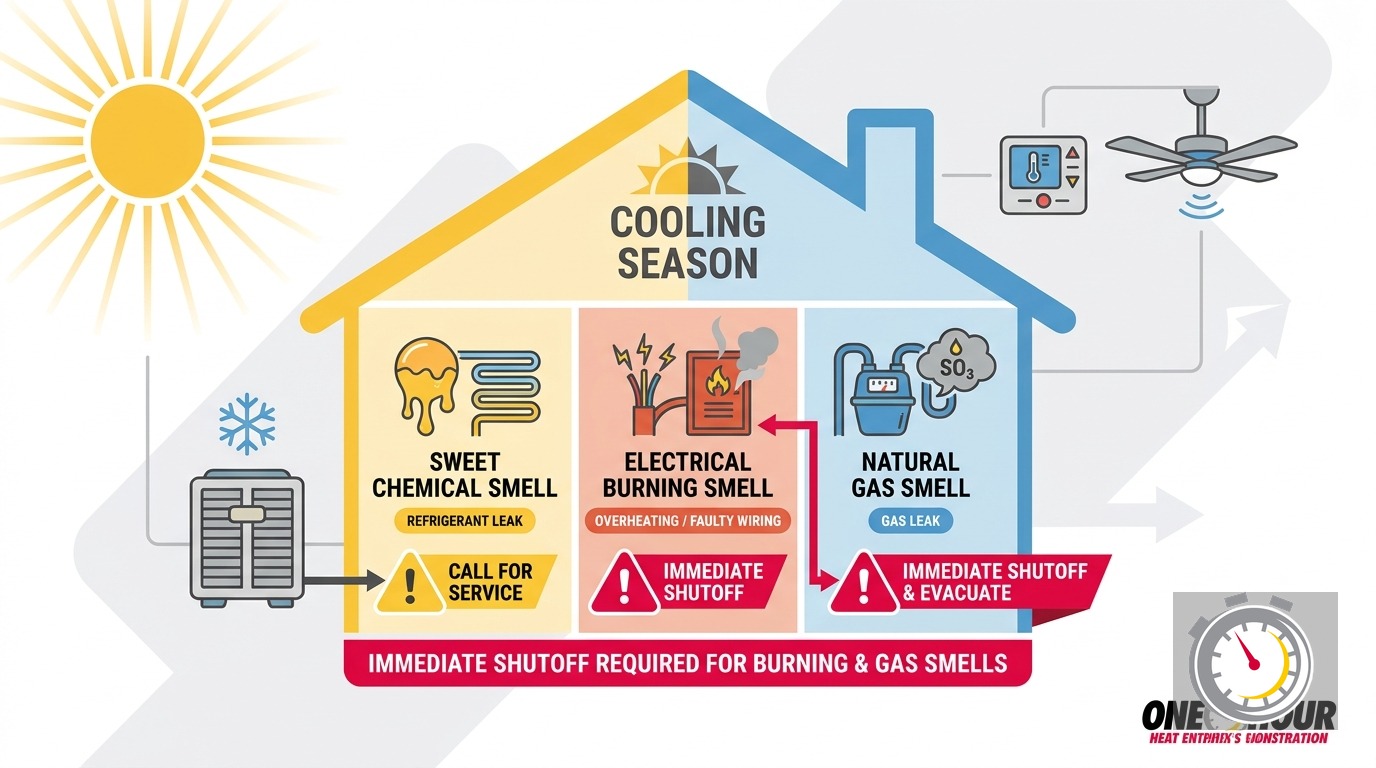
Key Takeaways
- A rotten-egg or sulfur smell is a possible natural gas leak. Leave on foot, then call your gas utility and 911 from outside.
- Your air conditioner does not burn gas. In cooling season, a gas smell near the unit points to a gas line, meter, or appliance problem.
- Burning plastic or hot electrical smells call for an immediate shutoff at the thermostat. Cut the breaker only if it is safe to reach.
- A sweet or chemical smell may be a refrigerant leak. Ventilate, stop running the system, and call a technician.
- Musty smells are usually mold or a wet drain pan. They are a service call, not an emergency.
- Carbon monoxide is odorless. Working alarms matter more than your nose.
- Minnesota law requires a working CO alarm within 10 feet of every room legally used for sleeping.
The Short Answer: Sort the Smell Before You Touch Anything
If your AC smells like chemicals or gas, sort the smell before you try to diagnose it. Put it into one of three groups.
A rotten-egg odor means natural gas. Leave the home on foot and call from outside. A burning or hot-plastic odor means shut the system off. A sweet or chemical odor, or a musty one, means ventilate and book service.
Your nose is not a safety device. Carbon monoxide has no smell at all. A system can also have a real problem with no odor you can detect.
We are Northern One Hour, a locally owned and operated HVAC company serving the Twin Cities.
Which AC Smells Need You to Leave Right Now?
Any rotten-egg, sulfur, or strong gas odor means leave now. Walk out on foot, leave the door open if you can, and call your gas utility and 911 from a safe distance. Do not flip switches, use a phone inside, or investigate the source.
Natural gas is colorless and odorless. Utilities add the smell on purpose. CenterPoint Energy notes it is often described as rotten eggs or sulfur.
The same page gives the core rules. Leave the area immediately, on foot. Do not use a cell phone or start a car near the leak. Call the utility and 911 once you are safe.
It also says never try to locate or fix a gas leak yourself. We agree. Our team would rather you walk away than be brave.
Also leave right away if anyone in the home has headaches, dizziness, or nausea along with a smell. That could be carbon monoxide, and we cover it below.
Want more on gas odors near heating equipment? Our guide on what to do if you smell gas near your furnace covers the same emergency steps.
Smell-to-Action Table
Find the closest match below, then act on that row rather than on your own guess.
| What you smell | Likely cause | What to do |
|---|---|---|
| Rotten eggs, sulfur, strong gas odor | Natural gas leak | Leave on foot. Call your gas utility and 911 from outside. |
| Burning plastic, hot wires, scorched dust | Overheating motor, wiring, or board | Shut off at the thermostat. Cut the breaker if safe. Call a pro. |
| Smoke or visible flames | Electrical or equipment fire | Leave. Call 911. |
| Sweet or chemical smell | Possible refrigerant leak | Turn the system off, ventilate, call for service. |
| Musty, dirty socks, damp basement | Mold, wet coil, clogged drain | Ventilate and schedule service. |
| Faint dusty smell at first startup | Dust on warm parts | Run the fan and watch. Call if it lingers. |
| No smell, but headache or nausea | Possible carbon monoxide | Leave. Call emergency services. |
The last row matters most. Smell cannot rule out the most dangerous problem.
What Smell Can Be Mistaken for a Gas Leak?
Several household odors can pass for a gas leak. Sewer gas, rotting food, a dead rodent, a dirty drain trap, and some cleaning chemicals all smell sulfur-like. A refrigerant leak can also smell sharp or sweet. If you cannot tell the difference, treat it as gas.
Common lookalikes in a Twin Cities home:
- Sewer gas. A dry floor drain or basement trap lets sewer odor rise. It smells like rotten eggs.
- A dead mouse in the ductwork. Rodents move into ducts in fall. In summer, a dead one can smell very bad.
- Mildew on the evaporator coil. It smells sour and damp. People sometimes call it a sulfur smell.
- Cleaning products. Bleach, ammonia, and solvents can all smell chemical.
Two of these show up often in our service calls: a dry floor drain and a drain line that never got cleaned.
Still, do not use this list as a reason to stay inside. Check the lookalikes only after a utility or technician clears the home.
In cooling season your furnace is idle, so a rotten-egg smell near the air handler usually points elsewhere. It may be a gas line, pilot light, water heater, or meter. It is rarely the AC itself. Our post on a furnace room that smells like rotten eggs explains how to tell dust from a real leak.
Why Does My AC Smell Like Chemicals?
A sweet or chemical smell can come from a refrigerant leak, but the odor is not a reliable test. Other causes include cleaning products, new duct sealant, off-gassing from renovations, or overheated parts. Stop running the system, open windows, and have a technician check it.
EPA refrigerant safety guidance says risks can include toxicity, flammability, asphyxiation, and physical hazards. That page gives no homeowner odor guidance.
Some homeowners do report a smell. Bob Vila says customers have described a sweet or chemical smell from refrigerant-related leaks. Treat that as an anecdotal report, not a rule.
Other signs of low refrigerant often come first:
- Warm air from the vents
- Ice on the indoor or outdoor lines
- Hissing or bubbling near the coil
- Cooling that slowly gets worse
Our guide to refrigerant leak signs in Minnesota lists these in more detail.
The EPA’s homeowner FAQ says major leaks rarely develop in properly installed and regularly maintained units. It also says to ask your service technician to locate and repair the leak. Topping off the charge alone does not fix anything.
We handle it the same way. We find the leak first, then explain the options before any work starts.
What Does Mold in AC Smell Like?
Mold in an AC system usually smells musty, damp, or like dirty socks. The smell often peaks when the system first turns on. Common sources are a wet evaporator coil, a clogged drain line, a full drain pan, or dirty ducts. It is a service issue, not an emergency.
Cooling season in Minnesota is humid. Warm, wet air meets a cold coil, and water collects. If the drain slows down, that water sits, and mold and bacteria grow in the damp, dark space.
Signs it is mold:
- The smell is strongest when the AC starts
- It fades after the fan runs a while
- You see water near the indoor unit
- The smell is worse in humid weeks
- Musty odor shows up in rooms far from the air handler
You can do a few safe things while you wait for service:
- Replace a dirty filter
- Check the drain pan for standing water
- Run the fan to dry the air handler
- Open a window in the affected room
Do not pour mixed cleaners into the drain pan. Bleach and ammonia, or bleach and vinegar, can create toxic fumes. Use one product at a time, or let a technician do it.
We cover this in depth in our post on the musty smell when your AC first turns on. If you see visible growth on duct surfaces, read our guide on mold in HVAC ducts.
What Should I Do If My AC Smells Like Burning Plastic or Electrical?
Turn the system off at the thermostat right away. Burning or hot-plastic smells point to an overheating motor, loose wiring, a failing capacitor, or a control board problem. If the smell continues, cut the breaker if you can reach it safely. Leave and call 911 if you see smoke or flames.
Not every burning smell means danger. A faint scorched-dust smell can appear the first time a system runs after a long rest. That dust burns off quickly and should disappear within minutes.
Treat these as urgent:
- A sharp plastic or fishy electrical smell
- A smell that gets stronger the longer the unit runs
- Buzzing, humming, or clicking near the unit
- A tripped breaker that trips again
- Discolored or melted wire insulation
We did not find a current official source to cite for the breaker step. This is general safety advice, not a quote from any agency. Use common sense. If reaching the panel means walking through water or smoke, do not do it.
Do not keep resetting a breaker that trips. Resetting it again can turn a small fault into a fire. Our post on an AC that keeps tripping the breaker explains the usual causes.
Then call for service. With burning odors, a quick visit saves a lot of money later.
Can You Trust Your Nose to Catch Carbon Monoxide?
No. Carbon monoxide has no color and no smell. You cannot detect it by nose. The only reliable warning is a working CO alarm, plus yearly checks on any fuel-burning appliance.
The Minnesota Department of Health describes carbon monoxide as an odorless, colorless gas formed by incomplete combustion of fuels. A smell test can never be the whole plan.
Your AC does not make CO. Your furnace, water heater, fireplace, or a garage vehicle can. In summer, a water heater or gas dryer may still be running. Fumes can travel through ducts and living spaces.
The same health page says Minnesota Statute 299F.50 requires at least one working CO alarm within 10 feet of every room legally used for sleeping. It also says fuel-burning appliances like a furnace should be checked by a qualified heating contractor every year.
Check your alarms now:
- Press the test button on every alarm
- Replace any alarm past its printed expiration date
- Put alarms near bedrooms, not in the kitchen
- Change batteries on a schedule you remember
Our guide on CO detector placement near furnaces and boilers shows where alarms work best.
How Do I Know If My AC Is Making Me Sick?
Look for symptoms that ease when you leave the house. Headaches, dizziness, fatigue, and nausea can come from carbon monoxide. Coughing, sneezing, and stuffy sinuses can come from mold or dust. If anyone feels ill, leave the building and call emergency services.
For carbon monoxide, the Minnesota Department of Health lists a mild headache and breathlessness with moderate exercise as first signs. Dizziness, fatigue, nausea, and confusion follow. Symptoms resemble the flu, and you may feel better away from home.
The same page gives a clear rule. If someone has symptoms, leave the building right away and call emergency services. If nobody feels ill, contact your gas utility or a qualified technician.
Patterns that suggest air quality, not CO:
- Allergy-like symptoms that get worse near vents
- Symptoms that flare after the AC starts
- A musty smell in the same rooms
- Relief during trips away that returns at home
Do not wait to see which cause it is. When symptoms are present, act first and sort out the source after everyone is safe.
If air quality is the pattern, we can help with filtration and purification. Our indoor air quality services cover filters, UV, and whole-home options.
Should You Keep Running Your AC With a Suspected Refrigerant Leak?
No. Turn it off, ventilate the area, and call a technician. Running a system that leaks wastes energy and can damage the compressor. It may also expose your household to refrigerant fumes in a closed space. Wait for a licensed technician before restarting.
The EPA’s homeowner FAQ points to leak repair, not topping off. That advice protects your wallet as well as the environment.
A suspected leak is not the same as a gas emergency. You do not need to run outside unless you also smell rotten eggs, feel ill, or see smoke. You do need to stop running the unit.
Safe steps while you wait:
- Switch the thermostat to Off
- Open windows and doors near the indoor unit
- Keep children and pets out of the room
- Do not try to patch lines or tighten fittings
If your system is old, the repair may not make sense. Our AC replacement cost guide helps you compare. We also offer financing on larger jobs like a new AC or heat pump.
What Does a Northern One Hour Technician Check?
We start with safety, then move to the cause. We test for combustion gases where fuel-burning equipment is nearby. We inspect wiring and electrical parts, check the drain system and coil, and look for refrigerant leaks.
A typical visit for a smell complaint includes:
- Questions about when the smell started and when it is strongest
- A walk-through of the furnace room, water heater, and ductwork
- Inspection of the air handler, drain pan, and condensate line
- Electrical checks on the capacitor, contactor, and wiring
- Refrigerant system inspection for signs of a leak
- A plain-language explanation of what we found
We do not guess. If the smell turns out to be gas, we stop, step back, and send you to the utility. Gas service lines belong to the utility, and our focus is heating and cooling.
You can learn more about our air conditioning repair work. We also offer maintenance that catches many smell problems before they start.
How Do Twin Cities Summers Make AC Smells Worse?
Humid summers keep coils wet, and wet coils grow mold. Sealed homes trap fumes. Long idle winters let dust, rodents, and moisture settle into equipment. Then the first hot week puts the whole system under load. Many smell calls land in the first warm spell of the year.
A few local patterns we see:
- First startup of the season. Dust and cobwebs burn off. A short, mild smell is normal.
- Humid July weeks. Drain lines clog and musty odors show up.
- Heat waves. Overworked motors and capacitors overheat. Burning odors appear.
- Garage and basement storage. Paint thinners, gasoline, and fertilizers leak fumes into return air.
Your return vents pull air from the whole house, so a chemical smell may come from the garage and not the AC at all. Check storage areas before you assume the worst.
Fresh air helps too. When you air the house out, do it on a dry day. Our post on when to open windows versus run AC can help you decide.
What Should You Do in the First Five Minutes?
Follow this order. It keeps you safe even when you are unsure.
- Do you smell rotten eggs or sulfur? Leave on foot. Call your gas utility and 911 from outside.
- Does anyone feel ill? Leave the building. Call emergency services.
- Do you see smoke or smell burning? Turn the AC off at the thermostat. Leave and call 911 if there is smoke or fire.
- Is the smell sweet or chemical? Turn the system off. Open windows. Call for service.
- Is the smell musty? Run the fan, check the filter and drain pan, and schedule service.
Keep the number for your gas utility saved in your phone. We could not verify a current Minnesota emergency number from an official utility page. Check your own bill or your utility’s website, and save it today.
When Should You Call Northern One Hour?
Call us after the smell is sorted and the home is safe. We handle the heating and cooling side. That includes refrigerant leaks, electrical faults in the AC, clogged drains, dirty coils, and mold in the system.
We are locally owned and operated. Our technicians live and work in the Twin Cities. We know our homes, our humidity, and our long cooling season.
We stand behind our on-time promise: “Always On Time… Or You Don’t Pay a Dime!(R)” We arrive within the time window you select. If the technician does not show up on time, you do not pay for the service.
You also get a 100% satisfaction guarantee and honest, transparent pricing. We explain the problem and the options before any work begins.
For a gas leak, call your gas utility and 911 first. For anything else, call (763) 260-6662 or book online. We serve Minneapolis, St. Paul, Ramsey, Blaine, Maple Grove, Plymouth, Brooklyn Park, Woodbury, Bloomington, and nearby communities.
Frequently Asked Questions
Can a different smell trigger a natural gas detector? +
Does a refrigerant leak smell like natural gas? +
Is it safe to sleep in a house where the AC smells odd? +
Should I turn off my AC if it smells like burning? +
Need a technician now?