
New Furnace Smell Plastic Burning How Long: Normal or Not
Key Takeaways
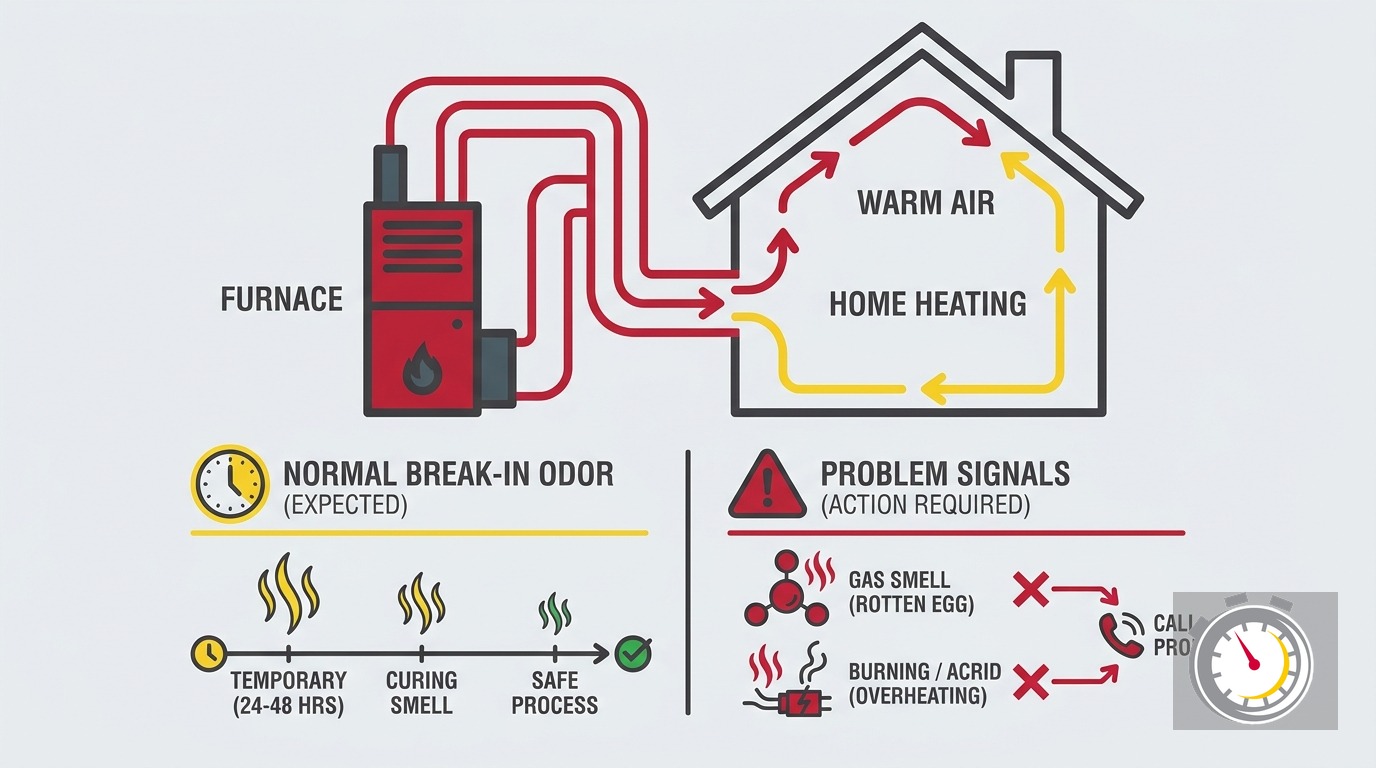
- A mild, dusty, or chemical smell on the first heating runs is normal. It should fade within hours.
- Normal odors get weaker each cycle. A smell that grows stronger is a warning.
- A plastic, electrical, or metallic smell means you should shut the furnace off and call your installer.
- A rotten-egg smell means leave on foot and call your gas utility and 911 from outside.
- Carbon monoxide has no smell. Working alarms and symptom awareness are your only warning.
- Minnesota law requires a working carbon monoxide alarm within 10 feet of every sleeping room.
- Open a few windows and run the furnace through several full cycles during the first day.
New Furnace Smell: The Quick Answer
A mild hot-dust or hot-paint smell is normal on a new furnace. It should fade after the first hour or a few hours of run time. It should also get weaker each time the furnace cycles on.
A sharp plastic smell is different. So is an electrical, metallic, or rotten-egg smell. Those are not break-in odors. Any smell that lasts past the first day or gets stronger needs a call to your installer.
We are Northern One Hour Heating & Air Conditioning, a locally owned and operated Twin Cities company. Below, we show you how to sort a harmless smell from a real problem. We also cover the one danger you cannot smell at all.
A Four-Step Ladder for Any New Furnace Smell
Most guides say “call a pro if it lingers.” That leaves you guessing at 9 p.m. in January. We use a simple ladder instead. Find the smell, then follow the step.
- Normal: A mild hot-dust or hot-paint smell. It lasts about an hour to a few hours and fades each cycle. Ventilate and keep watching.
- Call your installer: A plastic, electrical, or metallic smell. Also any smell that persists or gets stronger. Shut the furnace off first.
- Leave and call from outside: A rotten-egg or sulfur smell. Do not stop to investigate.
- Treat carbon monoxide separately: It has no smell. Alarms and symptoms are the only warning.
How Long Does It Take for a New Furnace to Stop Smelling?
Most new furnace odors fade within the first hour to a few hours of run time. One major manufacturer says a new furnace’s odors “should dissipate in about an hour”. Another recommends running the unit “for a few hours in a well-ventilated home”.
The two answers differ, and that is fine. Every furnace and every home is different. Think of the range as one hour to a few hours of total burn time.
The clock matters less than these three things:
- Direction: The smell should get weaker, not stronger.
- Type: It should smell like hot dust or warm paint, not melting plastic.
- Spread: It should not come with smoke, a haze, or a visible flame problem.
Some websites claim a new furnace can smell for up to 72 hours. We have not found a trustworthy source for that number. Treat it as a claim, not a rule.
Our shop guidance is simple. A mild odor on day one is expected. A plastic smell that lasts past the first day, or gets stronger, is not.
What Is That Smell Coming From a New Furnace?
Most break-in smells come from factory coatings and dust. Both burn off the first time the furnace gets hot.
Factory coatings. Furnaces ship with protective finishes, oils, and paint on the metal parts. One manufacturer explains that on first heat-up the “protective finish starts to burn, which can cause a mild, chemical-like smell.” Once the coating is gone, so is the smell.
Construction dust. Your installers worked in a home full of drywall dust, sawdust, and sheet metal shavings. Some of it settles in the ducts and on the new heat exchanger. When the furnace fires, that dust cooks off. It smells like a hot toaster or a hot iron.
Sealants and insulation. New cabinet insulation, gaskets, and duct sealants can also give off a faint odor when heated. This is usually short-lived.
If you recently did a remodel, dust may linger longer in your ducts. Our post on changing filters after construction dust covers that case. You may also want to read about off-gassing after a renovation.
Why Plastic Smells Are Tricky
People often call the break-in odor “burning plastic.” That describes how a chemical or hot-paint smell feels. It does not always mean something is melting.
Here is how we tell the difference in the field:
- Break-in smell: Light, dry, dusty, or like warm paint. It comes through the vents. It gets better each cycle.
- Real melting plastic: Sharp, acrid, and hard to ignore. It makes your nose and eyes sting. It does not fade, and it may come with a hot-wire or electrical edge.
No manufacturer page we reviewed draws this line clearly. So we offer our own rule. A plastic smell that lasts past the first day, or gets stronger, should be checked.
Why would real plastic burn in a new furnace? A few common causes:
- A wire or wiring harness touching a hot surface.
- A plastic part pushed too close to the heat exchanger during install.
- A loose electrical connection that is overheating.
- A foreign object, like a plastic bag or packaging, left inside the cabinet or ducts.
All of these are install-quality problems. Fixing them is the installer’s job. That is why the next step is a call, not a DIY fix.
Is It Bad to Breathe the Smell of Burnt Plastic?
Yes, it can be. Break-in odors from a coating or dust are usually mild and short. Real burning plastic is another matter. One manufacturer notes that burning plastic releases harmful fumes. Another calls it a possible electrical problem and a major safety hazard.
Treat the two smells differently:
- Mild dust or paint smell: Open windows and keep an eye on it. Move anyone sensitive to the smell, like infants or people with asthma, to another room.
- Sharp plastic or electrical smell: Turn the furnace off at the thermostat. Open windows. Call your installer. Stay out of the area if the smell is strong.
- Smoke or haze: Leave the home and call 911.
If someone has a headache, dizziness, or nausea, do not assume it is just the smell. Those symptoms can also point to carbon monoxide. We cover that below.
Sensitive to odors, or have a newborn at home? Our guide on indoor air quality for a nursery has more tips.
Why Does the First Firing of the Season Matter in the Twin Cities?
Minnesota homes stay closed up from October through April. Windows stay shut. Weatherstripping works hard. That changes how a break-in smell feels.
In a closed Twin Cities home, a small amount of odor has nowhere to go. It lingers and spreads. A smell that would vanish in a drafty house can hang around for hours in a sealed one.
Then there is the cold-start effect. If your new furnace goes in during summer or early fall, it may sit idle for weeks. The first cold night arrives, the furnace fires, the coatings burn, and the house is already shut tight.
Plan for that:
- Run the new furnace on a mild day if you can. Try a day in the 50s, not a day at 5 degrees.
- Open a few windows on opposite sides of the house. Close them again once the smell fades.
- Run the furnace through several full heating cycles in one afternoon.
- Keep the thermostat fan on “auto” unless your installer says otherwise.
Starting early means the odor happens when you can ventilate. It also gives you time to call your installer before a deep freeze, when you cannot afford to be without heat.
For more on first-fall smells, see our guide to a burning smell on the first fall use. Wondering how long a full install should take? Our post on the furnace install timeline walks through it.
Which Smells Mean You Should Call the Installer?
Call your installer if you notice any of these. Shut the furnace off at the thermostat first.
- Plastic or melting smell that is sharp, or that lasts past the first day.
- Electrical or hot-wire smell, like an overheated appliance cord.
- Metallic smell. One manufacturer warns that a metallic odor may signal a serious electrical problem.
- Any smell that gets stronger over time instead of weaker.
- Smoke, even a thin wisp from a vent or the furnace cabinet.
For smoke or odors that persist, one manufacturer advises you call your installer immediately. We agree. A new furnace should be covered by your installer’s workmanship and the manufacturer’s warranty. Do not open the cabinet and poke around yourself.
Not sure who installed it? Check your paperwork, or read our post on warranty registration. Registering the warranty early can save you stress later.
Why Does a New Furnace Smell Musty or Like Exhaust?
Not every smell is a break-in smell. Two others show up on new systems.
Musty or damp. A condensate drain that is not draining can cause this, and so can damp ductwork. It is not a burn-off smell. See our guide to a musty-smelling furnace.
Exhaust or fumes. If you smell exhaust inside the house while the furnace runs, take it seriously. It can point to a venting problem. On high-efficiency furnaces, the PVC vent pipe and combustion air intake must be sealed and clear. Our post on PVC vent pipe problems explains what can go wrong.
To narrow it down, note where the smell is strongest:
- At the vents: Likely dust or ductwork.
- Near the furnace cabinet: Likely the furnace itself, wiring, or a coating.
- Near the vent pipe or drain line: Likely a venting or condensate issue.
Tell your installer what you found. It saves diagnosis time.
What Should You Do if You Smell Rotten Eggs?
Leave the home right away. A rotten-egg or sulfur smell can mean a natural gas leak. Gas utilities add that odor on purpose so you can notice it.
Your gas utility gives clear steps. One Twin Cities-area utility says to “Leave the area immediately - on foot.” It also says not to use your cell phone or start a car near the leak. Call the utility and 911 from a safe distance. Do not try to find or fix the leak yourself.
Natural gas is often described as smelling like rotten eggs or sulfur.
Another manufacturer adds a caution. If you smell gas, avoid electrical switches and phones inside the home. Leave first, then call from outside.
The short version:
- Do not flip switches, light a match, or use a phone inside.
- Get everyone, including pets, out on foot.
- Call your gas utility and 911 from outside.
- Stay out until the utility says it is safe.
Do not call us first and wait. Get safe, then call the utility. Once the leak is fixed, we can inspect the furnace. Read more in our guide on what to do about a gas smell from your furnace.
Why Does Carbon Monoxide Need Its Own Plan?
Carbon monoxide, or CO, has no smell, color, or taste. Your nose cannot warn you. A new gas furnace with a venting fault can produce it, even when the house smells fine.
That is why we keep CO off the smell ladder. It needs its own safety net.
The Minnesota Department of Health lists the warning signs. Early signs are a mild headache and shortness of breath during moderate exercise. Later signs include more severe headaches, dizziness, fatigue, and nausea. Severe exposure leads to confusion and loss of consciousness.
Two clues point to CO:
- Symptoms that improve when you leave the house.
- Symptoms that hit everyone in the home at the same time.
What Minnesota law requires
Minnesota Statute 299F.50 requires at least one working CO alarm within 10 feet of every room legally used for sleeping. The state health department notes alarms typically last 5 to 7 years. Check the date on yours, and replace old units.
What to do if the alarm sounds
The health department gives a clear rule. If an alarm sounds and anyone has symptoms, leave and call the fire department. If everyone feels fine, call the gas utility or a qualified technician.
The same source suggests yearly inspection of fuel-burning appliances. It also lists signs to watch for:
- Soot streaks near the furnace or vent.
- Rust on flue pipes.
- An orange or yellow flame, when it should be blue.
Our post on yellow versus blue flames shows what to look for. For alarm placement tips, read our carbon monoxide detector placement guide. If an alarm trips and no one is sick, see what a CO alarm going off can mean.
How Can You Help the Break-In Odor Fade Faster?
You cannot rush the coatings, but you can make the smell less of a nuisance. Try these steps on day one.
- Open windows. Choose two on opposite sides of the house. Fresh air carries the odor out.
- Run full cycles. Set the thermostat a few degrees above room temperature. Let the furnace run a full heating cycle, rest, then run again.
- Check the filter. Make sure a clean filter is in place and facing the right way. Our post on filter direction helps.
- Keep the area clear. Move boxes, rags, and chemicals away from the furnace. Our guide on furnace clearance lists what to keep clear.
- Watch and listen. Notice whether the smell fades. Note any new sounds, too.
Do not spray air freshener into the furnace or vents. It masks the smell you need to track. It can also add new fumes.
If the smell fades after a few cycles, you are likely done. If it does not, move up the ladder and call.
What Should You Tell Your Installer When You Call?
A clear report helps us find the cause fast. Before you call, jot down a few details:
- When it started: The first run, or later?
- What it smells like: Dust, paint, plastic, metal, electrical, or exhaust?
- Where it is strongest: The vents, the furnace, or the vent pipe?
- How it has changed: Weaker, the same, or stronger?
- Anything else: Smoke, noise, error codes, or alarms?
If your furnace shows a blinking light, our error code guide can help you read it. Do not reset a tripped safety switch over and over. Safety switches trip for a reason.
A technician can then check the usual causes: wiring, gas pressure, the vent system, the heat exchanger area, and stray debris. On gas furnaces, a combustion analysis can also confirm the burners and venting work as designed.
How Northern One Hour Handles a Smelly New Furnace
We are locally owned and operated. We serve homeowners across the Twin Cities, from Ramsey and Blaine to Maple Grove, Plymouth, and Woodbury. We know how fast a Minnesota cold snap can turn a small smell into a big problem.
When you call about a smell, we treat it as a safety question first. We ask what you smell, how strong it is, and whether anyone feels unwell. If it sounds dangerous, we tell you to shut the system off and, when needed, leave and call 911 or your gas utility.
Then we show up when we say we will. Our promise is “Always On Time… Or You Don’t Pay a Dime!(R)” We arrive within the time window you select. If your technician is late, you do not pay for the service.
We also stand behind our work with a 100% satisfaction guarantee. If the smell traces back to our install, we want to make it right.
Thinking about a new furnace of your own? Good places to start:
- Learn what drives the price in our furnace replacement cost guide.
- Look at your financing options for larger jobs.
- See what happens on install day.
Already have a furnace? A yearly furnace inspection checks the burners, venting, and safety controls before winter.
When Should You Stop Waiting and Call?
Use this quick check. If any line fits, do not wait.
- The smell is sharp, plastic-like, electrical, or metallic.
- The smell has lasted past the first day.
- The smell is getting stronger each cycle.
- You see smoke or haze.
- Someone has a headache, dizziness, or nausea that eases outside the home.
- Your CO alarm has sounded.
- You smell rotten eggs or sulfur.
For the last three, follow the safety steps above before you call us. Leave first, then make the calls.
For anything else on the list, shut the furnace off and call. A new furnace should not make you worry. If it does, we will check it.
Call Northern One Hour at (763) 260-6662, or book online to schedule fast. We will tell you what is normal, what is not, and what to do next.
Frequently Asked Questions
How long should the burning smell last on a new furnace? +
Should I shut off a new furnace that smells like burning plastic? +
Can a new furnace smell like gas? +
Does a new furnace need a carbon monoxide alarm? +
Need a technician now?