
How Long Does It Take to Install a New Furnace? Twin Cities
Key Takeaways
- The install itself usually takes one day. Lennox puts a professional job at 4 to 10 hours.
- Major ductwork changes can stretch the work to 1 to 2 days.
- The full project runs longer than install day. Scheduling, permits, equipment, and inspection all add time.
- Heating season is the busy period. Book early in fall if you can.
- A proper furnace replacement includes a permit. Northern handles it for you.
- If CenterPoint is your gas utility, file rebate paperwork in the same calendar year as the install.
- A rushed install costs more in the long run. Good sizing and tight ducts matter.
How long does a furnace installation take on install day?
Most furnace installs take one working day. Lennox says a professional job takes “4 to 10 hours.” HVAC.com says “about 4-8 hours” on average. Major ductwork changes push the job to 1 to 2 days.
That covers install day, which is only half of what you need to plan.
Most articles count only the hours a crew spends in your basement or utility room. That is the short part. The longer part is everything around it: scheduling, the permit, equipment availability, the inspection, and the busy season.
We are Northern One Hour Heating & Air Conditioning, a locally owned and operated Twin Cities company. Below, we cover both clocks, from the first quote to the first warm morning.
What are the two clocks on a furnace project?
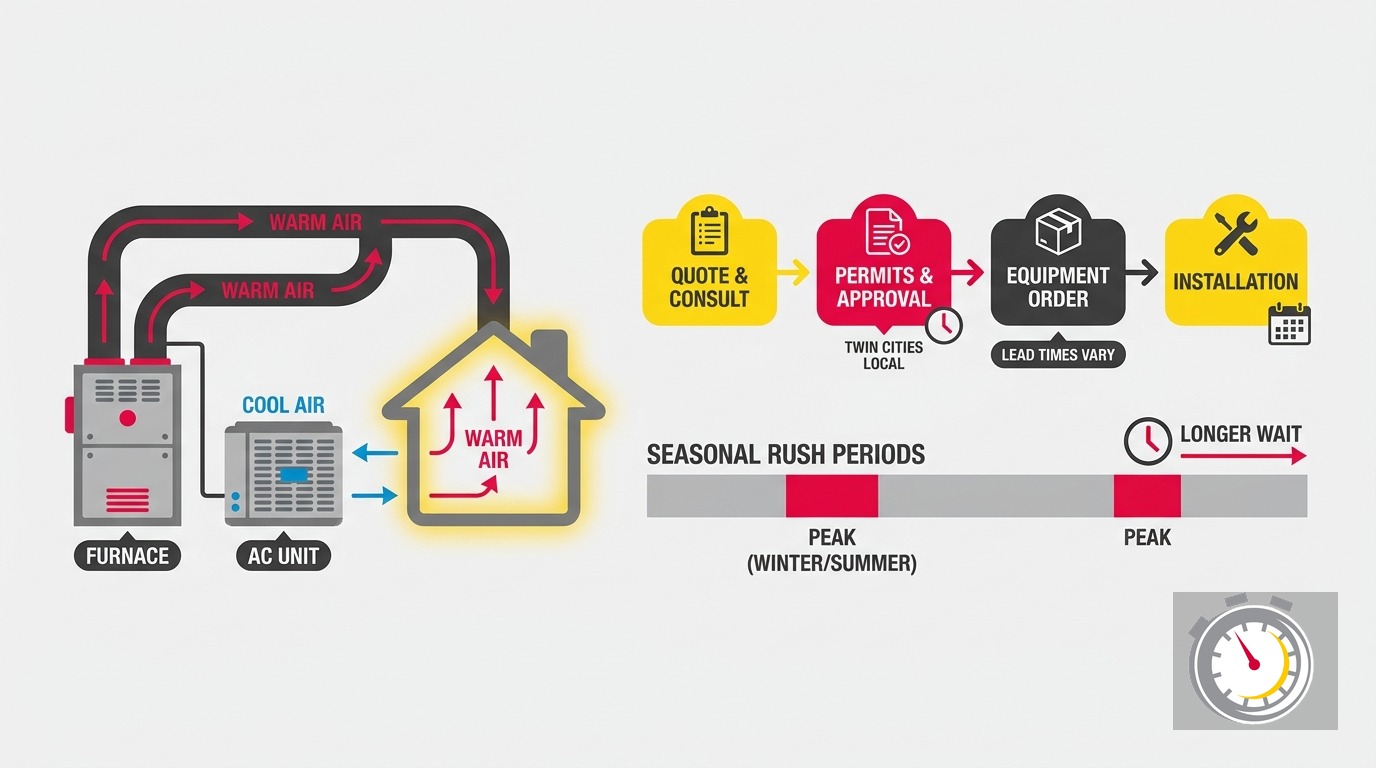
Every furnace replacement runs on two clocks. The first is install day. The second is the project timeline.
Clock one: install day. This is the time the crew spends removing the old unit and setting the new one. It also covers connecting gas, venting, electrical, and ducts, then testing the system. Lennox says removing the old unit alone takes 1 to 2 hours.
Clock two: the project timeline. This starts when you request a quote. It ends when the permit is closed and your rebate is filed. It includes waiting time that has nothing to do with labor.
The difference matters. Say your furnace dies on a January night. Install day is not your problem. Your problem is how fast you can get on the schedule and whether the right unit is on a truck.
Now say you plan a replacement in September. The second clock works for you. You have time to compare options, pick a tier, and line up rebates.
Either way, planning helps. Our install day walkthrough covers what happens hour by hour.
What does the full timeline look like, stage by stage?
Here is the path from quote to warm house. We do not publish exact wait times for permits or equipment. They vary by city, season, and model. The table shows what happens and what drives the timing.
| Stage | What happens | What drives the timing |
|---|---|---|
| Quote | A comfort advisor visits, measures, and sizes the system | How quickly you book and decide |
| Permit | Your installer files the mechanical permit with your city | City process, which differs across the metro |
| Equipment | The furnace and parts are confirmed and delivered | Model, distributor stock, and season |
| Install | The crew swaps the furnace and tests the system | Home layout, venting, gas line, and ductwork |
| Inspection | The city inspector reviews the work | Inspector schedules, which vary by city |
| Rebate filing | You submit utility paperwork with your invoice | Program rules and calendar-year deadlines |
Most competitor guides list the install row and stop. The other five rows are where homeowners get surprised.
Some stages can overlap. Your installer can order equipment while the permit is pending. You can gather rebate documents before the crew arrives. Good coordination saves days.
Poor coordination loses them. That is why we handle the permit and the paperwork for you.
Do you need a permit to install a furnace?
Yes, in most cases. Replacing a furnace is mechanical work, and Twin Cities cities generally require a permit for it. Permit steps and timing vary by city. Your installer should pull the permit, not you.
Minneapolis is one local example. The city lists “Installing or replacing heating, ventilation, or cooling (HVAC) system or components” under Mechanical on its express permits page. Express permits are only for pre-approved, city-licensed contractors. They apply to existing one- or two-family homes.
That page gives no processing time or inspection timing. We have not found an official source for how long permits take across the metro, so treat any promised number with caution.
A permit matters for three reasons:
- Safety. An inspector checks gas connections, venting, and combustion air.
- Records. A closed permit shows the work was done to code. That helps when you sell.
- Insurance and warranty. Unpermitted work can cause headaches later.
Ask any contractor one question: “Who pulls the permit, and when?” If the answer is vague, keep looking. Our guides on when an HVAC permit is required in Minnesota and what permits cost go deeper.
How long do furnace equipment lead times run?
Lead times depend on the model, the distributor, and the season. We do not have a verified 2026 furnace lead-time figure to quote. Anyone who gives you a firm number without checking your exact model is guessing.
Trade press shows how unpredictable supply can be. In April 2025, ACHR News reported that distributors had “not been provided a timeline” for backlogged orders. It called lead times “unpredictable.” The cause was a container shortage, not a lack of refrigerant.
Two cautions apply. That report covered AC equipment, not furnaces. It is also 2025 data. We cite it only to show that supply can shift fast.
What does that mean for you?
- Common furnace sizes and tiers are often easier to source than unusual ones.
- Special orders take longer. This includes odd cabinet sizes and some modulating models.
- Winter demand can tighten availability at the distributor.
We confirm availability before we schedule your install day, so the crew arrives with the right equipment. That also protects our on-time promise, covered below.
When is the busy season for furnace installs in the Twin Cities?
Heating season is the busy period. Cold snaps from roughly October through February create emergency no-heat calls. Those calls compete with planned installs for crew time. We do not publish seasonal wait numbers, because they change week to week.
Think of the year in three rough windows:
- Spring and summer. Furnace demand is lighter. You have the most choice of dates, and equipment is easy to plan around.
- Early fall. This is the sweet spot. Homeowners start thinking about heat, but the first hard freeze has not hit yet.
- Late fall through winter. Demand peaks. A failed furnace in a deep freeze goes to the front of the line.
If your furnace is old but still running, fall is the time to act. Our post on the best time to replace a furnace and AC explains the tradeoffs.
How old is “old”? The DOE and FEMP furnace page assumes “an average residential furnace lifetime of 21 years”. Our guide on how long furnaces last in Minnesota shows what to watch for as yours ages.
If your furnace has already failed, call right away. We will tell you honestly what the schedule looks like.
What makes install day run longer than expected?
A straight swap is the fast case. Several things stretch the day.
Ductwork changes. Lennox says a straight replacement with good ductwork takes 4 to 6 hours. Minor duct changes take 6 to 8 hours. Major duct work takes 1 to 2 days. HVAC.com says new ductwork “usually takes 1-4 days.”
Fuel type. Lennox gives 6 to 10 hours for a gas furnace and 4 to 6 hours for electric. Gas jobs involve venting and gas line work. Our guide to gas line sizing for furnace replacement explains why that step matters.
Venting changes. Moving from an 80% furnace to a high-efficiency model changes the vent. High-efficiency units use PVC pipe and need a condensate drain, which adds work.
Surprises behind the old unit. Rust, old duct connections, and cramped utility rooms slow a crew down. So does a chimney that needs a liner after the upgrade.
Add-ons. A new thermostat, humidifier, or air cleaner adds time. Tell your advisor up front so the day is scheduled correctly.
We walk the install path during your quote visit, which is how we spot most of these issues before install day.
Is it cheaper to replace furnace and AC together?
Often, yes, over the long run. Doing both in one project saves on labor, permits, and trips. You also get a matched system, which is designed to work together and helps efficiency and comfort.
The tradeoff is upfront cost. Starting prices for a Twin Cities furnace install run about $4,950 for an 80% AFUE model, $6,500 for 95-96%, and $9,100 for 97-98%. A mid-tier central AC replacement runs $7,500 to $10,400 installed. Doing both is a big check, so financing helps many homeowners.
Timing matters too. Furnace and AC jobs have different busy seasons. Doing both at once can fit into one install window, but a combined job may take longer than one day. We confirm that during the quote.
Replacing only one half is sometimes the right call. If your AC is young and your furnace is failing, you may not need both. Our guide to replacing just the AC or furnace covers when a mismatch causes trouble.
For a bigger picture on price, see our furnace replacement cost guide. To spread out a larger project, read about HVAC financing options.
How do utility rebates change your timeline?
Rebates add a paperwork clock. It starts after the install and often has a deadline. Missing it can cost you real money, so plan for it from the beginning.
CenterPoint Energy is one example. Its heating systems rebate page lists replacement rebates of $1,000 at 97% AFUE or higher, $400 at 96% to 96.9%, and $200 at 92% to 95.9%. Equipment must be installed “between Jan. 1 and Dec. 31, 2026.”
The application must be submitted in the same calendar year as the install. Processing takes up to 10 weeks.
Today is Nov. 3, 2026. If your furnace goes in this fall and CenterPoint is your gas utility, file your paperwork before year-end. Do not wait until January.
Other utilities have their own rules. We have not confirmed the current Xcel Energy amounts, so check Xcel’s rebate page directly before you decide. Our Xcel and CenterPoint rebate guide walks through the process.
Rebates depend on the installed AFUE rating, so the tier you pick affects both price and paperwork. Our post on AFUE ratings from 80% to 96% explains the difference.
What does a rushed install cost you?
A rushed install can cost more than a short wait. The DOE and FEMP page recommends installation per “ANSI/ACCA 2015: HVAC Quality Installation Specification.” It warns that oversizing, poorly designed distribution systems, and leaky ducts cause “efficiency losses, occupant discomfort, and shortened equipment life.”
The same page lists efficiency of 95% AFUE for an ENERGY STAR furnace and 80% for a less-efficient model. A well-chosen unit delivers that efficiency only if it is sized and installed correctly.
Proper sizing takes a visit and some math. Our post on right-sizing with a Manual J calculation explains why guessing from the old unit is risky. A shortcut on day one can mean short cycling, uneven rooms, or high bills for years. Our guide to oversized furnace problems shows what that looks like.
Speed and quality can coexist. The best way to get both is to start early. A planned replacement leaves room for a proper load calculation, a duct check, and a clean permit.
How can you shorten the wait?
You cannot control the weather or the distributor. You can control several steps. These help most:
- Start before the furnace fails. Signs of age, rising bills, and repeat repairs all say it is time. Our guide on knowing when to replace, not repair can help.
- Get a second quote early. A fair comparison takes a day or two. Our bid comparison checklist shows what to compare.
- Decide on the tier. Pick your efficiency level and add-ons at the quote. Changes mid-project cause delays.
- Clear the work area. Move stored items away from the furnace and the path to it. Our clearance guide lists the space crews need.
- Line up financing. Approval ahead of time keeps the schedule moving.
- Gather rebate documents. Keep your invoice, model number, and AFUE rating together.
- Choose a company that shows up. A crew that arrives late can wreck your day plans.
We take that last point most seriously. We are locally owned and operated. Our promise is “Always On Time… Or You Don’t Pay a Dime!(R)” In plain terms, we arrive within the time window you select. If the technician does not show up on time, you do not pay for the service.
You have a day to plan around, and we want to respect it. Read why on-time service matters for your home for more.
Plan your furnace install with Northern One Hour
Install day takes about one day for most homes, and longer if ductwork changes. The full project, from quote to rebate filing, takes more planning.
Our team serves homeowners across the Twin Cities, including Minneapolis, St. Paul, Ramsey, Blaine, Maple Grove, Plymouth, Brooklyn Park, Woodbury, and Bloomington. We size the system properly, handle the permit, and tell you honestly what the schedule looks like. Read more about our furnace replacement service.
If your furnace is failing or aging, do not wait for the next cold snap. Call (763) 260-6662 or book online to schedule fast. We will walk you through options, financing, and the timeline for your home.
If heat is out right now, start with our steps for a furnace that is out tonight. Then call us.
If you are weighing repair against replacement, our guide on heat exchanger replacement cost versus a new furnace can help you decide before you book.
Frequently Asked Questions
What fails first on a furnace? +
Will my house be cold during a furnace installation? +
Do I need to be home while the furnace is installed? +
Can a furnace be installed in winter? +
Need a technician now?