
Gas Line Size for a New Furnace in Minnesota: Cost and Code
Key Takeaways
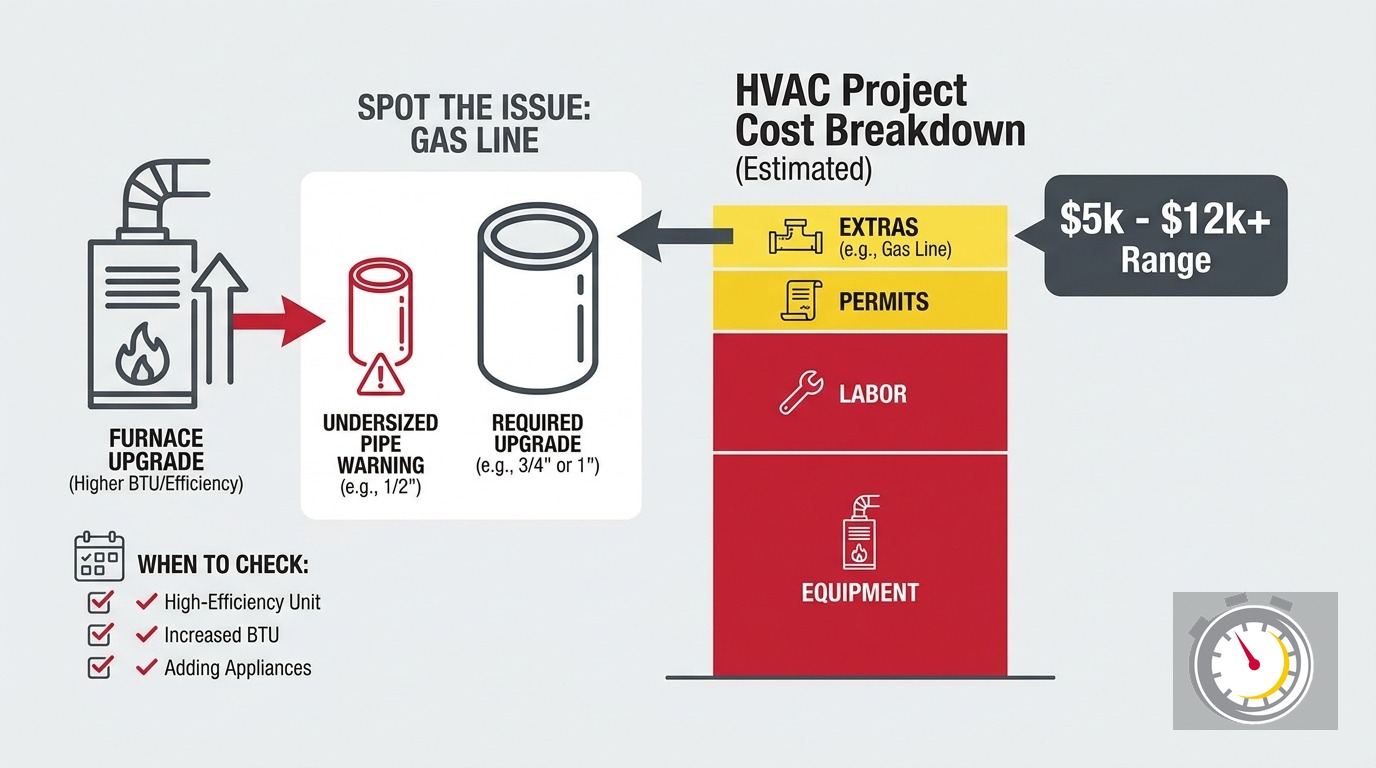
- A gas line upgrade is only needed when the new furnace’s BTU demand exceeds what the existing pipe can safely deliver.
- Two triggers can force an upgrade independently: a BTU input change and a venting configuration change on high-efficiency models.
- The combined load trap is common in Twin Cities homes. Furnace, water heater, and dryer on one ½” supply line can push combined demand past what that pipe handles.
- High-efficiency furnaces sometimes have lower BTU inputs than the units they replace. A proper upgrade can resolve an undersizing issue rather than create one.
- Typical cost: $200-$600 for a branch line upgrade; $15-$25 per linear foot for longer interior runs.
- CenterPoint meter upgrades target completion within 20 business days. Plan ahead of peak heating season.
- The federal 25C tax credit expired after December 31, 2025. CenterPoint and Xcel Energy still offer rebates in 2026.
- Minnesota requires a mechanical permit for any new or reconfigured gas line. Your contractor pulls it. Verify before work starts.
Gas Line Size for a New Furnace in Minnesota
Getting the gas line size right for a new furnace in Minnesota is a step every installer should assess before the job begins. Most homeowners know little about it. If the pipe is undersized, your new furnace cannot pull enough gas to run at full capacity. That means incomplete combustion, error codes, and reduced heat when you need it most.
This guide covers what triggers a gas line upgrade, which Twin Cities homes face the most risk, what the work costs, and how to check before the contractor shows up.
What Triggers a Gas Line Upgrade When You Replace a Furnace?
A gas line upgrade is needed when your new furnace demands more BTU per hour than the existing pipe can safely deliver. Two triggers can force this independently: a higher BTU input on the new unit, and a venting configuration change tied to high-efficiency models.
Most homeowners expect a furnace replacement to be a direct swap. Pull the old unit, install the new one. But the pipe connecting your furnace to the gas meter was sized for a specific BTU load. Change that load, and the installer must verify the pipe still qualifies.
The BTU trigger is the more common one. A 60,000 BTU furnace swapped for an 80,000 BTU unit pushes more demand through the same pipe. Pipe sizing data from Furnace Direct shows a ½” Schedule 40 black iron pipe at a 40-foot run maxes out near 82,000 BTU per hour. Add a 40,000 BTU water heater on the same supply line and that margin disappears completely.
The second trigger is subtler. High-efficiency furnaces often use two-pipe venting: one pipe for combustion air in, one for exhaust out. This configuration affects pressure in the gas train. Even when BTU numbers look unchanged, a good installer checks gas pressure as part of the job.
What Determines the Right Gas Line Size for a New Furnace in Minnesota?
Pipe diameter and run length together set the maximum BTU per hour your appliance can safely receive. At a 40-foot run, a ½” pipe handles about 82,000 BTU/hr and a ¾” pipe handles about 170,000 BTU/hr. Minnesota furnaces commonly run 100,000+ BTU input, so many homes sit on or near the capacity threshold.
Natural gas flows under pressure. A smaller pipe and a longer run both reduce pressure at the burner. Below rated operating pressure, the furnace cannot burn fuel completely. You get incomplete combustion and a carbon monoxide risk. Low-gas-pressure fault codes follow. Heat output drops. The gas valve can be damaged over time.
Run length is the variable most homeowners do not consider first. Sizing tables use 40 feet as a benchmark. In an older split-level or two-story Twin Cities home, the run from the basement meter to a first-floor equipment room can easily be 60, 80, or more feet. Every additional foot reduces carrying capacity. A line that qualifies at 40 feet may not qualify at 70.
Twin Cities homes built in the 1940s through the 1970s often have ½” branch lines from an era when furnaces were smaller. Minneapolis has a design temperature near -16°F. Furnaces sized for that load commonly run 100,000+ BTU. Many older ½” runs are on the wrong side of the capacity table as a result.
Two material issues matter under current Minnesota code. CSST, the yellow flexible pipe used in some remodels, is code-compliant but must be bonded for lightning protection. Galvanized steel pipe is not permitted for new gas work in Minnesota. If your home has galvanized supply lines, a licensed plumber must assess them before gas work proceeds.
For context on what a full furnace job costs in this market, see our guide to furnace replacement cost in the Twin Cities.
Does Upgrading to High Efficiency Always Mean a Bigger Gas Line?
No. A high-efficiency furnace can have a lower BTU input than the unit it replaces. If you are swapping an oversized older furnace for a correctly sized 96% AFUE model, gas demand may decrease. That can resolve a borderline undersizing issue rather than create one.
High efficiency describes how much heat the furnace extracts from each BTU it burns, not how much gas it uses total. A 96% AFUE furnace converts nearly all its fuel to usable heat. It does not necessarily burn more gas to do that.
Older furnaces were often oversized. Many Twin Cities homes ran 120,000 BTU furnaces at 80% AFUE for decades. A properly sized replacement for the same home might call for a 100,000 BTU unit at 96% AFUE. That replacement asks less of the gas line.
The scenario most likely to expose an undersized pipe is the opposite: replacing a furnace that was too small for Minnesota winters. The new unit, correctly sized for a -16°F design day, draws more gas. That is when the pipe math gets tight.
For a plain-language breakdown of efficiency ratings and what they cost over time, see our guide to 80% vs. 96% AFUE furnaces in Minnesota.
What Is the Combined Load Trap and Why Does It Catch Homeowners Off Guard?
The combined load trap happens when multiple gas appliances share one supply line and their total BTU demand exceeds what the pipe can deliver. In Twin Cities homes, furnace plus water heater plus gas dryer on a ½” branch is a common setup that worked for years: the problem only surfaces when a higher-BTU furnace tips the combined load past what the pipe handles.
Pipe sizing rules require the run from the meter to each branch to carry the simultaneous full load of every appliance it serves. A 60,000 BTU furnace plus a 40,000 BTU water heater is 100,000 BTU combined. A ½” line at 40 feet handles about 82,000 BTU. That line was already undersized for simultaneous full-load operation. It never caused obvious problems because both appliances rarely ran at full demand at the same moment.
Add an 80,000 BTU replacement furnace. Simultaneous full load becomes 120,000 BTU on a pipe rated for 82,000. That surfaces during the first sustained cold snap of the heating season.
The installer performs a load calculation: they tally every gas appliance on the supply, assign its BTU input, and verify the pipe handles the combined total. That calculation determines whether the existing line qualifies, needs to be upsized, or whether a separate branch is the right answer. Doing it right before the job starts prevents a no-heat call on a -10°F January night.
A licensed installer asks about every gas appliance in the home before finalizing the pipe size. If your contractor is not asking, raise it yourself before work begins.
How Do You Check If Your Gas Line Size Is Right Before the New Furnace Goes In?
Run through this five-point checklist before the installation appointment. If any item applies, flag it during the estimate. These are the signs most likely to point to a gas line sizing issue.
- Pipe diameter at the furnace connection. If it is ½” and the new furnace is 80,000 BTU or more, ask the contractor to verify the full run length and combined load before work starts.
- Run length from the meter. Runs of 60 feet or more on a ½” line are a sizing concern at higher BTU loads. Long runs from a basement meter to a first-floor equipment room are common in older Twin Cities homes.
- Other gas appliances on the same supply. List the furnace, water heater, dryer, range, and any gas fireplace. Your installer needs this list to size the line correctly for combined load.
- Pipe material. Galvanized steel is not permitted for new gas work under Minnesota code. CSST must be bonded. Either condition requires a conversation before the crew arrives.
- History of pressure symptoms. Has the furnace thrown low-gas-pressure error codes? Has a burner cycled off on a hard-cold day while other appliances ran? Those are signs the line was already marginal.
You do not need to diagnose the pipe yourself. This checklist puts you in a position to have an informed conversation at the estimate stage, not after installation begins.
What Does a Gas Line Upgrade Cost in Minnesota?
A furnace branch line upgrade typically runs $200-$600. Longer interior gas line runs cost $15-$25 per linear foot all-in. Underground exterior runs cost $15-$50 per linear foot due to trenching. A utility meter upgrade adds $400-$900 with a two-to-six-week lead time.
These numbers should not surface as surprises at the end of a job. A reputable installer identifies gas line issues during the pre-job assessment and prices any required work in the estimate before the crew arrives.
Furnace Direct’s Minnesota installation data puts typical furnace branch line upgrades at $200-$600 in this market. National averages for interior gas line work run $15-$25 per linear foot, with a typical total project near $598. Underground runs carry a premium for the trenching required.
Labor rates vary by job complexity. A straight branch line upgrade in an accessible basement lands at the low end of the range. A job that requires running new pipe through finished walls, adding fittings around a tight equipment room, or coordinating a utility meter upgrade lands at the higher end. Ask for a line-item breakdown before approving the work.
A Northern One Hour furnace replacement starts at $3,900 for an 80% AFUE unit and $6,500 or higher for a 95-96% AFUE model. A $400 branch line upgrade is a small fraction of that total. It protects the equipment investment and, more important, the people in the home.
What Does CenterPoint’s Meter Upgrade Process Look Like?
CenterPoint Energy targets completing a simple residential meter upgrade within 20 business days. If your total connected load exceeds 550 CFH (equivalent to 550,000 BTU per hour at standard delivery pressure), CenterPoint requires a formal design review before proceeding.
Most single-family furnace replacements do not reach the 550 CFH threshold. Getting there requires a large furnace, a large water heater, a range, a dryer, and a gas fireplace all running simultaneously. If you are converting multiple appliances from electric to gas at the same time as a furnace replacement, confirm the combined load before ordering equipment.
Per CenterPoint’s meter upgrade process: contact CenterPoint directly to initiate the request. If the project requires a service line resize or relocation, a licensed plumber prepares the property side first. CenterPoint handles the utility-side work after that. The 20-business-day target applies to straightforward capacity upgrades; complex projects take longer.
Timing is the key planning variable. A furnace that fails in late October with a meter upgrade pending can mean several cold weeks waiting. Book furnace work by September or early October to leave room for utility lead times without turning a planned replacement into an emergency.
What Permits Does Minnesota Require for Gas Line Work?
Every Minnesota municipality requires a mechanical permit for a furnace replacement. Any new or reconfigured gas line requires a separate mechanical permit. Your contractor pulls the permits. Ask for the permit number before work begins.
Unpermitted work voids homeowner’s insurance for fire and carbon monoxide claims in Minnesota. At resale, an inspector who finds gas line work without a permit card can delay closing until code compliance is proven after the fact.
The permit authority is jurisdiction-specific. Minneapolis, Saint Paul, and each suburb operate their own mechanical permit and inspection process under the Minnesota Mechanical and Fuel Gas Code. The contractor files the permit. Your one task: ask for the permit number before the crew starts.
Minnesota’s high-efficiency furnace installation requirements confirm this across all municipalities, covering both the furnace replacement permit and any gas line permit when the line is new or reconfigured.
For a full walkthrough of which HVAC jobs require a permit in Minnesota, see our HVAC permit guide for Minnesota homeowners.
What Rebates Are Available After a High-Efficiency Furnace Install?
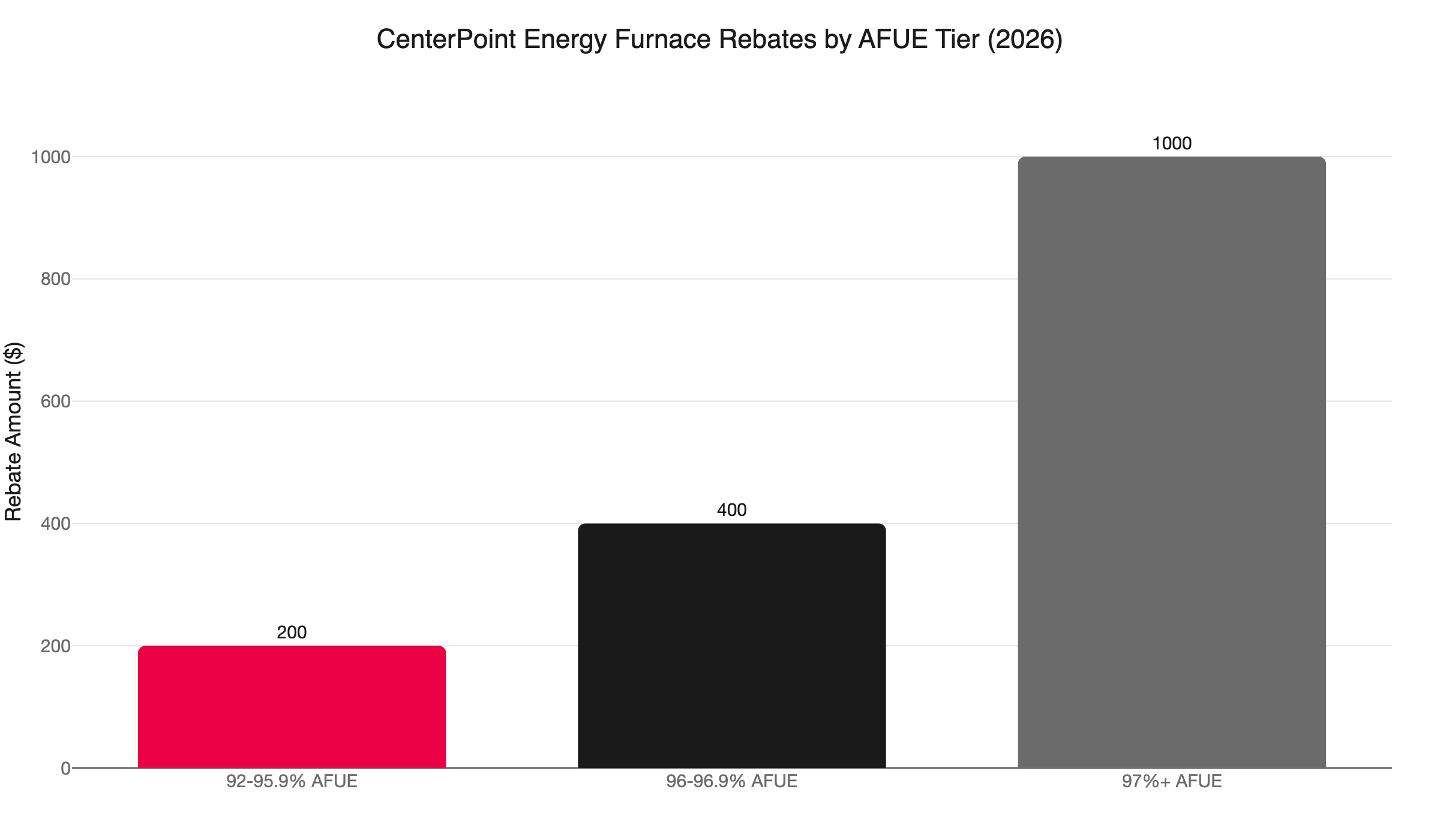
CenterPoint Energy offers rebates up to $1,000 for qualifying high-efficiency furnaces in 2026. Xcel Energy offers furnace rebates for customers in its service territory. The federal 25C tax credit expired after December 31, 2025 and is not available for 2026 installations.
Which utility handles your rebate depends on where you live:
- Minneapolis homeowners: CenterPoint handles natural gas rebates. Xcel handles electric and heat pump rebates separately.
- Saint Paul homeowners: Xcel handles both gas and electric rebates.
CenterPoint’s 2026 rebate schedule pays $200 at 92-95.9% AFUE, $400 at 96-96.9% AFUE, and $1,000 at 97% AFUE and above. Xcel Energy’s gas furnace rebates start at 95% AFUE and carry a filing deadline of September 30 of the year following installation. Any licensed contractor qualifies their customer for the rebate.
The rebate is processed after installation. It comes from your utility, not your contractor. Verify current amounts directly with your utility before selecting equipment, since tiers can change.
The federal 25C credit expired for equipment placed in service after December 31, 2025. Minnesota’s HEAR and HOMES programs funded by the Inflation Reduction Act had not launched as of mid-2026. Check before filing, but do not plan a 2026 installation around them.
Financing is available for qualifying furnace replacements. Ask when you call.
For a current look at all available programs, see our Xcel and CenterPoint rebates guide for Minnesota homeowners.
Ready to Schedule Your Furnace Replacement?
A gas line upgrade is not a surprise that shows up mid-job. It is a predictable step on certain furnace replacements, identified during a pre-job assessment by a licensed installer.
The homes most at risk are older Twin Cities houses with ½” supply lines, multiple gas appliances sharing a single branch, and a new furnace with a higher BTU input than the unit it replaces.
Northern One Hour is locally owned and operated in Ramsey, Minnesota. We serve Minneapolis, Saint Paul, Blaine, Maple Grove, Plymouth, and communities across the Twin Cities. Call us at (763) 260-6662 or book online. Our team walks you through the full scope of the job, including gas line sizing, before any work starts. We show up when we say we will: “Always On Time… Or You Don’t Pay a Dime!(R).”
Frequently Asked Questions
Does every furnace replacement require a gas line upgrade in Minnesota? +
How long does a CenterPoint meter upgrade take? +
How much does a gas line upgrade cost for a new furnace in Minnesota? +
Need a technician now?