
Smell Exhaust Fumes When Furnace Runs? What to Do Now
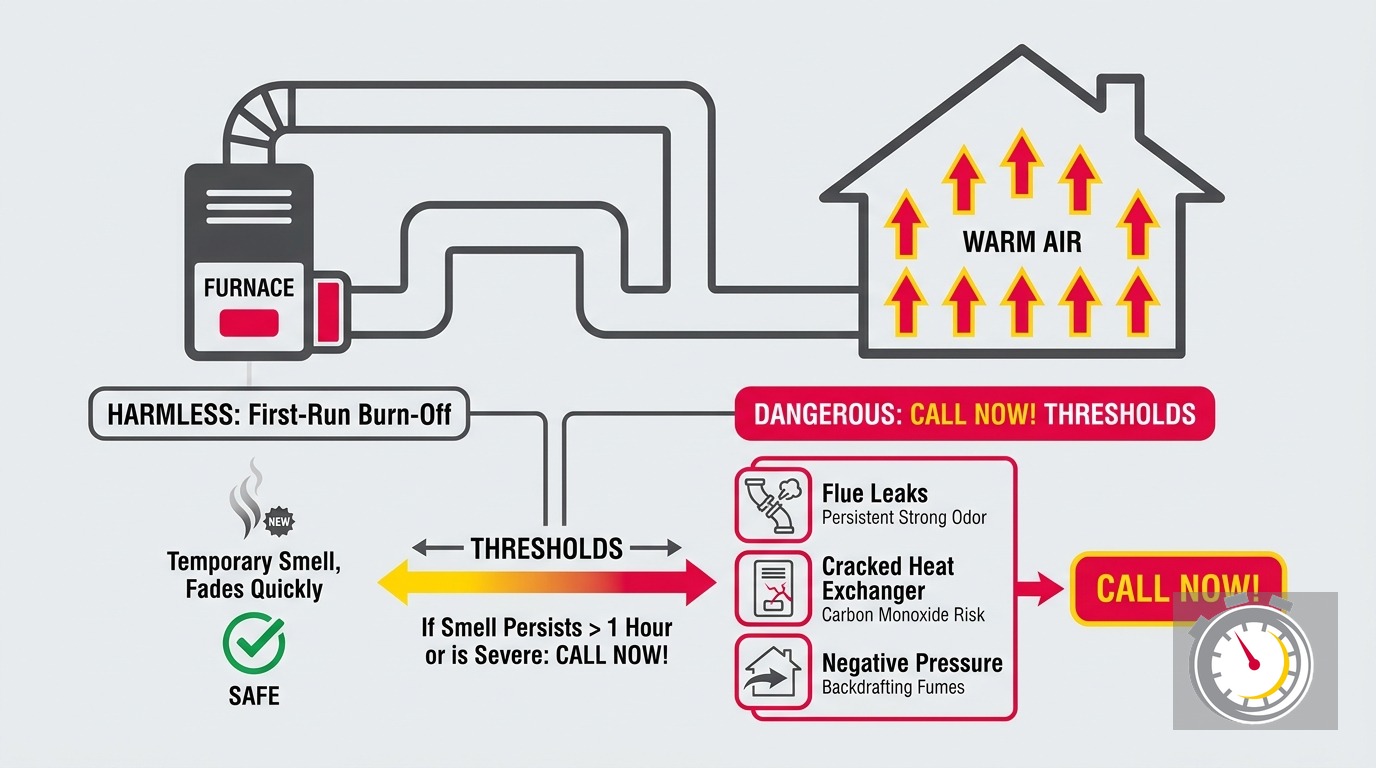
Key Takeaways
- A faint dusty smell for a few minutes on the first start of the season is usually normal burn-off.
- An exhaust smell that keeps coming back is not normal. Shut the furnace off and call a technician today.
- Soot, rust, extra condensation, or yellow or orange flames are warning signs. Do not keep running the furnace.
- Carbon monoxide (CO) has no smell. Your nose cannot tell you the air is safe.
- A sounding CO alarm or flu-like symptoms mean you leave the home and call 911 from outside.
- Tight Twin Cities homes can pull exhaust back inside when fans and range hoods run.
- Working CO alarms near every sleeping area are the law in Minnesota and your best early warning.
Why does my house smell like exhaust fumes when the furnace runs?
Most exhaust smells come from one of four causes. Dust burning off after months of rest is the harmless one. The other three need attention: a leaking flue or vent, a cracked heat exchanger, or a house that pulls exhaust back indoors.
Combustion gases are mixing with your indoor air. Sometimes that is old dust. Sometimes it is a real leak.
You can sort the causes by timing, location, and what else you see. A short, faint, dusty smell on the first cold day is very different from a sharp smell that shows up every cycle.
We are Northern One Hour Heating & Air Conditioning, locally owned and operated, and we get this call every fall in Minnesota. Furnaces sit idle all summer. Then the first cold snap hits, and everyone’s nose goes on alert.
Are new furnace fumes harmful?
A new or newly restarted furnace can give off a brief smell that is not harmful. Dust and residue burn off in the first few minutes. A strong or lasting smell points to a venting or combustion problem, and it is worth a service visit.
Two situations get lumped together. One is a furnace you have used for years and are firing up for the season. The other is a brand-new furnace.
Both can smell a little at first. A new unit may release a light odor as manufacturing oils and coatings heat up for the first time. An older unit often burns off dust that settled on the heat exchanger and burners.
CenterPoint Energy says a minor burning smell at first ignition is common. It blames dust from the off-season burning off, and says the smell should go away after a few minutes.
If it does not go away, CenterPoint says to turn the unit off and call a technician.
Short and faint is fine. Long or strong is not.
If your furnace smells more like burning plastic or hot metal than dust, our post on what a first-use burning smell means walks through those causes. Here, we focus on the exhaust smell.
What does harmless burn-off smell like?
Harmless burn-off has a few clear traits:
- It smells dusty, warm, or slightly toasty.
- It shows up on the first run of the season.
- It fades within a few minutes.
- It does not come back on the next cycle.
- You see no soot, rust, or odd flames.
Exhaust smells different. It tends to be sharp, stale, or like a car running in a closed garage. It may linger after the burners shut off. It may come back every time the furnace starts.
If you are unsure which one you smell, treat it as the serious kind until proven otherwise.
How can you tell burn-off from a real problem?
Use timing, persistence, and visible signs to sort the cause. Burn-off is brief and fades. A flue leak gives a steady exhaust smell plus soot or rust. A cracked heat exchanger can show up with no smell at all, which is why CO alarms matter.
This table gives you a quick first read. It does not replace an inspection.
| What you notice | Most likely cause | What to do |
|---|---|---|
| Faint dusty smell, first start of season, gone in a few minutes | Normal burn-off | Keep an eye on it. Change your filter if it is due. |
| Dusty smell that lingers past a few minutes | Heavy dust, dirty burners, or early trouble | Shut the furnace off and call a technician. |
| Steady exhaust smell near the furnace or vent pipe | Flue or vent leak | Shut the furnace off. Call today. |
| Soot streaks, rust on flue pipe, or extra condensation | Venting problem | Shut the furnace off. Call today. |
| Yellow or orange flames instead of blue | Combustion problem | Shut the furnace off. Call today. |
| Smell appears when the bath fan or range hood runs | Negative pressure or backdrafting | Turn the fans off. Call for a combustion check. |
| CO alarm sounds, or anyone has symptoms | Possible CO leak, such as a cracked heat exchanger | Leave. Call 911 from outside. |
Each row depends on the smell plus what comes with it.
The Minnesota Department of Health lists the same warning signs. They include soot streaks, no upward draft in the chimney, and excess condensation. They also include rust on flue pipes and orange or yellow flames when flames should be blue.
Any one of those signs is reason enough to stop and call.
What does a flue or vent leak smell like?
A flue or vent leak usually gives a persistent exhaust smell near the furnace, the vent pipe, or the chimney. You may also see soot, rust, or moisture around the joints. Because the gases escape into your home, a leak is a safety issue.
Your furnace burns gas and makes combustion gases. Those gases are supposed to travel up and out through the flue or vent pipe. If that path has a gap, a crack, or a blockage, gases can spill into the room.
The EPA says improperly installed or maintained chimneys and flues are sources of combustion products. It also warns that blocked, leaking, or damaged flues can produce fatal CO concentrations. Take that seriously.
Common causes we find in Twin Cities homes
A few patterns show up again and again in our service area:
- Rusted or corroded flue pipe. Moisture and age eat through metal vent pipes over time. Our guide to flue pipe rust and corrosion signs shows what to look for.
- Loose or separated joints. Vibration and settling can open a seam.
- Blocked vents. Birds, nests, and debris can clog a flue. Snow and ice can block a high-efficiency exhaust pipe.
- Frost buildup at sidewall vents. Cold, humid exhaust freezes at the outlet during a hard Minnesota freeze.
- Failed vent connections on older systems. Older chimney setups may no longer match a newer, more efficient furnace.
You can check a few things safely. Look at exposed vent pipe for stains, rust, or gaps. Look outside for a blocked or frosted vent. Do not touch hot components, and do not tape or patch a flue yourself.
If you see damage, shut the furnace off and call us. Vent repairs are not a DIY job.
Could a cracked heat exchanger cause the smell?
Yes, but it may not. A cracked heat exchanger can let combustion gases mix with the air your home breathes. Sometimes it gives a faint exhaust odor. Often it gives no smell at all, so a CO alarm and yearly inspection are your real protection.
The heat exchanger is the metal chamber that heats the air your blower sends through your ducts. Flames and exhaust stay on one side. Your household air stays on the other. A crack can break that barrier.
The EPA lists cracked furnace heat exchangers as a source of combustion products indoors. It recommends yearly inspection of furnaces, flues, and chimneys.
CO has no odor. A smell of exhaust may come from other gases in the mix, but you cannot count on it. A heat exchanger can leak CO while your house smells perfectly normal. Your nose is not a CO detector.
Signs that point to a heat exchanger problem
A technician looks for more than a smell. Signs that raise concern include:
- A CO alarm that sounds when the furnace runs
- Soot or a visible crack on the heat exchanger
- Flames that flicker, lean, or turn yellow or orange
- Headaches or dizziness that ease when you leave the house
- A furnace that is many years old and has skipped inspections
Our post on cracked heat exchanger signs covers the details. If a technician confirms a crack, you face a repair-or-replace decision. We explain both paths honestly, and we can walk you through financing if replacement makes the most sense.
Can negative pressure pull exhaust into your home?
Yes. Exhaust fans, range hoods, and dryers push air out of a house. In a tight home, that can pull air back down the flue and into your living space. This is called backdrafting. It can make a healthy furnace smell like exhaust.
Few homeowners know about this cause, yet it fits Minnesota well. We seal our homes up tight every winter. We add insulation, replace windows, and weatherstrip doors. All of that saves energy.
A tight house also has less outside air coming in to replace what the fans push out. When the bath fan, range hood, and dryer all run at once, the house can end up at lower air pressure than the outdoors. Air then looks for the easiest way in. Sometimes that way is down your flue.
The EPA notes that fireplace and woodstove pollutants can be back-drafted into living spaces, particularly in weatherized homes. That page does not use the term “negative pressure,” but the idea is the same. A tighter house makes backdrafting more likely.
We cannot give you a magic number for how tight is too tight. Every house behaves differently. A trained technician can test your system under real conditions instead of guessing.
Clues that point to backdrafting
Backdrafting often follows a pattern. Watch for these clues:
- The smell shows up when the bath fan, range hood, or dryer is running.
- The smell fades when you turn those fans off.
- It gets worse on very cold, windy days.
- It appears after you tightened up the house with new windows or air sealing.
- A nearby fireplace or woodstove also smells smoky.
Try a simple test. Turn off the exhaust fans and see if the smell eases. If it does, tell the technician. That one detail speeds up the diagnosis.
Learn more in our posts on exhaust fans and furnace backdrafting and how combustion air works in a sealed-up home. High-efficiency furnaces that pull outside air through a sealed pipe lower this risk, but they bring their own vent checks.
Do not fix this by cracking every window and calling it done. Backdrafting means your home’s air balance needs a professional look.
How do you tell if there is a gas leak from a furnace?
A gas leak smells like rotten eggs, not exhaust. You may also hear hissing near a gas line. If you notice either, do not touch switches or use a phone inside. Leave the house, then call your gas utility and 911 from outside.
People mix up exhaust and gas all the time. Both smell wrong, but they point to different problems.
Natural gas is the fuel. Utilities add an odor so you can notice a leak. Exhaust is what is left after the fuel burns. They call for different responses, though in both cases the safe move is to stop, get out, and call for help.
Quick comparison
- Rotten-egg or sulfur smell: treat it as a gas leak. Leave right away.
- Sharp, stale, car-in-the-garage smell: treat it as exhaust. Shut the furnace off and call.
- Hissing near a pipe or valve: treat it as a gas leak. Leave right away.
- Dusty smell for a few minutes: likely burn-off. Watch it.
For gas, do not look for the leak yourself. Do not light anything. Do not flip light switches or unplug devices. A small spark can matter in a gas-filled room.
We wrote a full guide on what to do if you smell gas near your furnace. If you use a propane furnace, the fuel and odor differ slightly, but the response is the same. Our comparison of propane and natural gas furnaces in Minnesota explains the differences.
We do not list a gas emergency number in this post. Use the number on your gas bill or on your utility’s website. Keep it somewhere you can find it fast, such as on the fridge.
What are the call-now thresholds?
Use three levels. A faint dusty smell for a few minutes is normal. A smell that lingers, or any soot, rust, or odd flames, means shut the furnace off and call today. A sounding CO alarm or symptoms mean leave and call 911.
Here is the same advice in plain steps.
Level 1: Watch and wait
Use this level only when all of the following are true:
- It is the first start of the season.
- The smell is faint and dusty.
- It fades within a few minutes.
- No alarms sound, and no one feels unwell.
Even here, check your filter. CenterPoint says standard 1-inch filters should be replaced every 30 to 90 days. A clogged filter strains the system and can add smells of its own.
Level 2: Shut off and call today
Use this level if any of these are true:
- The smell lasts past a few minutes.
- An exhaust smell comes back on every cycle.
- You see soot, rust, condensation, or yellow or orange flames.
- The smell appears when exhaust fans run.
Turn the furnace off at the thermostat. If you are comfortable, switch off the furnace power at its service switch. Open a window for fresh air if it is safe to do so. Then call us.
If it is a cold night, our guide on what to do when your furnace is out tonight can help you stay warm safely. Do not use a gas oven, a grill, or a generator indoors for heat.
Level 3: Leave and call 911
Use this level if either of these is true:
- A CO alarm is sounding.
- Anyone has symptoms such as headache, dizziness, nausea, weakness, shortness of breath, or confusion.
The EPA describes these symptoms as flu-like without fever. People sometimes blame a bug and stay in the house.
The Minnesota Department of Health gives direct advice. It says not to ignore a CO alarm that is sounding. If anyone has symptoms, it says to immediately leave the building and call your local fire department. If everyone feels fine, it says to call the gas utility or a qualified technician.
We would be more careful than that. Get everyone out, including pets. Call 911 from outside. Do not go back in until responders say it is safe.
The CDC warns that people who are sleeping or intoxicated can die before they have symptoms. That is why we never tell anyone to “wait and see” with an active alarm.
Where should CO alarms go in a Minnesota home?
Put a CO alarm on every level, including the basement, and near every sleeping area. Minnesota law requires an approved alarm within ten feet of each bedroom. The EPA also says to keep alarms at least 15 feet from fuel-burning appliances.
Alarms protect you when your nose cannot.
The EPA says to put CO alarms on every level of the home, including the basement. It says to place them at least 15 feet from fuel-burning appliances. It also recommends testing them monthly and interconnecting them if possible, so one alarm sounds all of them.
Minnesota law adds a bedroom rule. Minnesota Statutes 299F.51 requires an approved, operational CO alarm within ten feet of each room lawfully used for sleeping. It also prohibits removing batteries or making an alarm inoperable. A first violation gets a warning, and later ones are petty misdemeanors.
What counts as “approved”? Under Minnesota Statutes 299F.50, an approved alarm is one certified to UL2034. Check the box or the back of the unit for that mark.
The CDC says to replace detectors as the manufacturer instructs “or every 5 years.” Write the install date on the alarm with a marker so you do not have to guess.
A simple alarm routine
- Test every alarm once a month.
- Replace batteries on schedule, or when an alarm chirps.
- Replace the whole alarm at the manufacturer’s limit.
- Never silence an alarm and go back to bed.
- Add an alarm after any new fuel-burning appliance goes in.
Our guide to CO detector placement near furnaces and boilers shows where to put each one in common Twin Cities layouts. If an alarm goes off and you feel fine, read what to do when a CO alarm sounds but there is no emergency, then still follow the steps above.
What does a technician check when you call?
A technician checks the whole combustion path: burners, heat exchanger, flue or vent, draft, and safety controls. They also test for CO and look at how your house’s air balance affects the furnace. The goal is to find the source of the smell.
When you call us about an exhaust smell, we do not guess. Here is what a typical visit covers.
CenterPoint says an annual tune-up checks for gas leaks, cracked parts, carbon monoxide, airflow, electrical connections, and safety sensors. A smell visit includes that kind of look, aimed at your symptom.
Our usual checks
- Ask questions. When does the smell show up? How long does it last? Does it change when fans run?
- Inspect the vent path. We look at the flue, joints, and outlet for rust, soot, gaps, or blockages.
- Inspect the burners and flames. Flames should burn blue and steady. Our guide to yellow versus blue flames explains what you may see.
- Inspect the heat exchanger. We look for cracks, rust, and signs of overheating.
- Test combustion. A combustion analysis shows how cleanly your furnace burns.
- Check air balance. We look at how fans and a tight house affect draft.
- Test the safety controls. Sensors and switches must shut the furnace down when they should.
You get a plain explanation of what we found. If the fix is small, we say so. If the furnace is unsafe, we say that too. Nobody should feel pushed, and you should know exactly where things stand.
If you want a closer look at where an exhaust smell can start, our furnace repair page shows how we approach it.
Can you prevent exhaust smells before winter?
Yes. A yearly inspection catches most problems before they become smells. Change your filter on schedule, keep vents clear of snow and debris, and test your CO alarms monthly. Schedule service in early fall, before the first cold snap.
Prevention costs far less than a no-heat night in January. A few habits help.
- Book your tune-up early. Early fall slots fill up fast. The Minnesota Department of Health says to have fuel-burning appliances checked by a qualified heating contractor every year.
- Change your filter. Check it monthly during heating season.
- Keep the area clear. Do not store boxes, paint, or cleaners near the furnace.
- Clear outdoor vents. After a snowfall, check that exhaust and intake pipes are open.
- Run your first heat cycle on purpose. On the first cool day, run the furnace while you are home. Open a window slightly. Stay near the unit for the first few minutes.
- Know your normal. If you know what your furnace usually sounds and smells like, you will notice a change faster.
For a full seasonal routine, see our fall HVAC shutdown and startup checklist. Skipping service has a cost over time too, as we explain in what happens when you skip HVAC maintenance for years.
What if my furnace is too old to fix?
If a technician finds a cracked heat exchanger or a failing vent on an older furnace, replacement may beat repair. Weigh the furnace’s age, the repair scope, and your safety. We lay out the options honestly and can explain financing for larger jobs.
Not every smell ends in a new furnace. Many end with a simple repair, a cleaned burner, or a corrected vent. Some do not.
A cracked heat exchanger is the big one. It is often a signal that the furnace is near the end of its life. Our post on heat exchanger replacement cost versus a new furnace compares the paths. For a wider picture, see furnace replacement cost in the Twin Cities.
Larger jobs raise the question of how to pay. We offer financing options, and our guide on HVAC financing in the Twin Cities explains what to expect. You get the full picture before you decide.
Safety comes first. If your heat exchanger is unsafe, we will not tell you to run the furnace “just a little longer.”
Why call Northern One Hour for a furnace smell?
We are locally owned and operated in the Twin Cities. We show up when we say we will. Our promise is “Always On Time… Or You Don’t Pay a Dime!(R)” and we arrive within the time window you select. If we do not, you do not pay for the service.
A smell in your furnace is stressful. You want someone who takes it seriously and shows up fast. That is how we work.
Our team lives and works in the same winters you do. We know what a sealed-up Minnesota home does to airflow. We know which vents freeze and which flues rust. We also know that a smell at 9 p.m. in January is not a “next week” problem.
What you can expect from us:
- We arrive in your window. You pick the time window. We arrive within it. If our technician does not show up on time, you do not pay for the service.
- We explain what we find. You get plain answers, not jargon.
- We price honestly. You see the options before work starts.
- We stand behind the work. We back what we do with a 100% satisfaction guarantee.
Our post on why on-time service matters in the Twin Cities explains why that promise counts most when your heat is at stake.
What should you do next?
If your furnace smells like exhaust, do not wait it out. Match what you notice to the three levels above. A short, faint, dusty smell is usually fine. A lasting smell, soot, rust, or odd flames means shut off and call. An alarm or symptoms means leave.
Here is the short version to keep handy:
- Faint dust for a few minutes on the first run: watch it, and change the filter.
- Smell that lingers or returns: shut the furnace off and call today.
- Soot, rust, condensation, or yellow or orange flames: shut off and call today.
- Smell tied to bath fans or range hoods: turn them off and ask for a combustion check.
- CO alarm or symptoms: leave, call 911 from outside, and do not go back in.
- Rotten-egg smell or hissing: leave, then call your gas utility and 911 from outside.
If you are not sure which level fits, call us. We would rather answer a question than miss a real problem.
Call us at (763) 260-6662 or book online to schedule fast. Pick your time window, and we will be there.
Frequently Asked Questions
How do you detect natural gas leakage in any furnace? +
Can I smell carbon monoxide from my furnace? +
Should I turn off my furnace if it smells like exhaust? +
Is a dusty smell the first time I run my furnace normal? +
Need a technician now?