Furnace Burners Dirty Won't Stay Lit? Causes and Fixes
Key Takeaways
- Dirty burners can make a weak, uneven flame. A weak flame can make the furnace shut itself off within seconds.
- Burners and the flame sensor are two different parts. Cleaning one does not clean the other.
- Cleaning only the flame sensor can hide a dirty burner problem. The shutdowns then come back.
- Light surface soot may be cleanable by a technician. Heavy rust or cracks usually mean replacement.
- Dirty burners can make dangerous carbon monoxide (CO). Keep working CO alarms near every sleeping area.
- Call a pro for burner cleaning, igniter work, and any yellow flame. We can help fast and on time.
Why won’t my furnace burners stay lit when they are dirty?
Dirty burners can produce a weak, uneven flame. The furnace’s safety system watches that flame. If it looks wrong, the control board shuts the gas off within seconds. You hear the furnace start, see a flicker, and then hear silence.
The shutdown is a safety feature. The furnace is protecting your home from burning gas poorly.
Many homeowners search this exact problem in the first cold week of the year. The furnace ran fine last March. Now it lights and quits. Dust, soot, and rust had all summer to build up.
We are a locally owned and operated Twin Cities company, and we see this pattern every fall. Below you’ll find what is happening inside your furnace, what you can safely check, and when to stop and call us.
How do sooty or rusty burners cause a lazy flame?
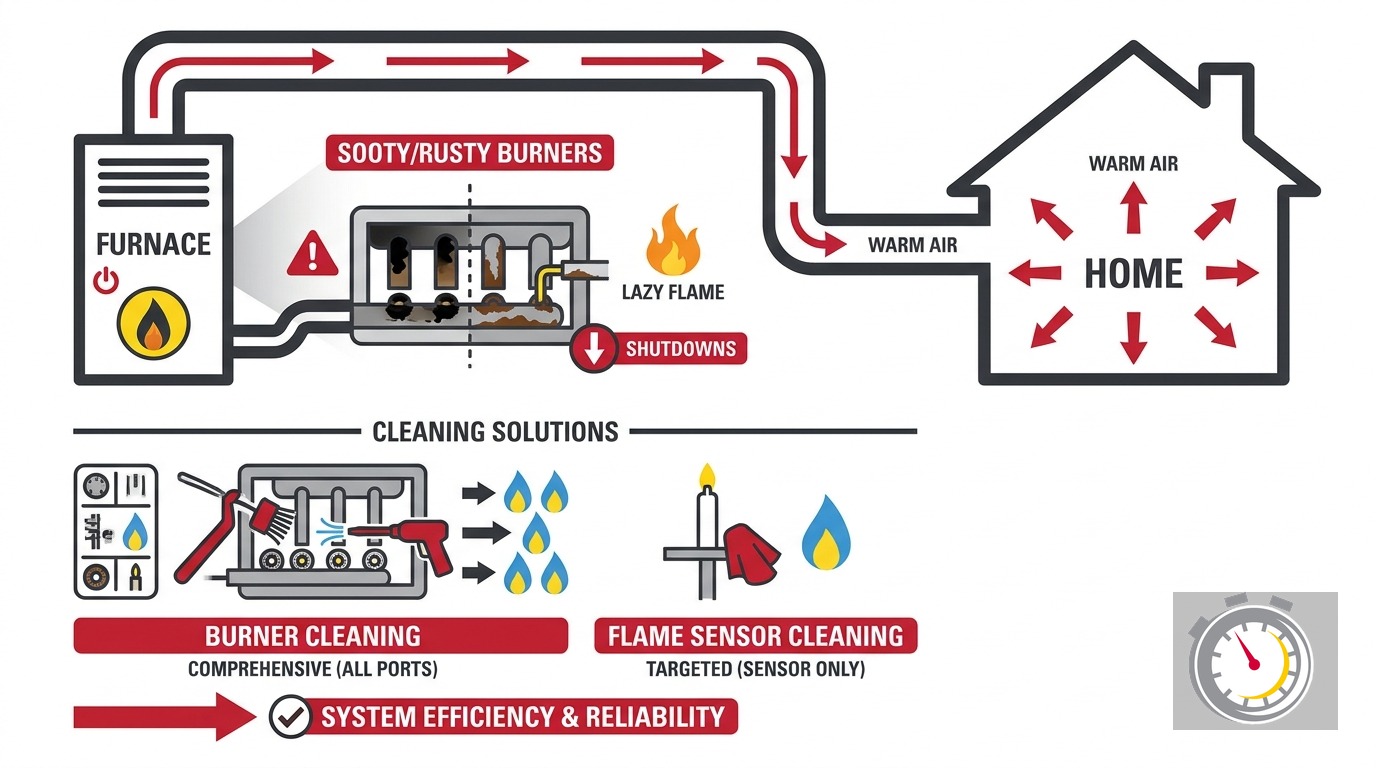
Soot and rust block the small ports where gas leaves the burner. Gas then comes out unevenly, so the flame turns lazy, yellow, or patchy. A weak flame reads poorly at the flame sensor. The control board sees a bad signal and shuts the furnace down.
Here is the chain, step by step:
- The burner collects soot, dust, or rust flakes over time.
- Some ports narrow or clog.
- Gas and air no longer mix evenly.
- The flame turns yellow, orange, or uneven instead of steady blue.
- The sensor reads a weak or flickering flame.
- The board shuts off the gas to be safe.
Picture a kitchen gas range with a few clogged ports. You get a ragged ring of flame with a few weak spots. A furnace burner works the same way, but it sits in a sealed cabinet.
Rust adds another problem. As metal deteriorates, flakes can drop into the ports. A manufacturer troubleshooting guide notes that an older furnace may have a cracked burner, rust, or other deterioration. It adds that cleaning or replacing the burners may fix the problem.
We can explain this general pattern, but we cannot cite an official source for exactly how rust flakes block each port. Every furnace is a little different, so a technician needs to look inside yours.
Our post on yellow flame versus blue flame shows what a healthy flame should look like.
What is the difference between a burner cleaning and a flame sensor cleaning?
A burner cleaning clears soot, dust, and rust from the parts that make the flame. A flame sensor cleaning wipes the thin metal rod that confirms the flame exists. One job fixes the fire itself. The other fixes the furnace’s ability to see the fire.
Most online guides say “burners light then go out, so clean the flame sensor.” That advice is half right. It skips why the two jobs differ.
Here is a side-by-side look:
| Burner cleaning | Flame sensor cleaning | |
|---|---|---|
| What the part does | Mixes gas and air and holds the flame | Tells the control board a flame is present |
| What dirt does to it | Blocks ports and weakens the flame | Coats the rod so it cannot read the flame |
| Typical symptom | Yellow flame, delayed ignition, popping | Burners light, then shut off in seconds |
| Safety impact | Can raise CO and cause delayed ignition | Usually a nuisance shutdown |
| Who should do it | A trained technician | A technician, or a careful homeowner who knows the risks |
| Fix if damaged | Replace burners | Replace the sensor |
A manufacturer guide lists these as separate causes of a burner that shuts off after ignition. It says a faulty or dirty flame sensor can turn off the furnace prematurely. Cleaning or replacing the sensor is the fix it gives for that cause.
The same guide lists a clogged filter and a failing control board as other causes. The sensor is only one suspect.
Our full guide to cleaning a flame sensor covers that part in detail.
Can a dirty burner make a flame sensor look dirty?
Yes. A weak, lazy flame does not touch the sensor the way a strong flame does. The sensor then reads low, and the furnace shuts off. The symptom looks like a dirty sensor, but the root cause is the burner.
That is why cleaning only the sensor can mask the problem. You wipe the rod. The furnace runs for a week or two. Then the shutdowns return.
Here is how to tell the two apart:
- Sensor problem first: the flame looks steady and blue, yet the furnace still quits.
- Burner problem first: the flame looks yellow, uneven, or lazy, and may roll or flicker.
- Both at once: common in older furnaces that have gone several seasons without service.
Don’t try to diagnose this by staring into a hot furnace. A technician can check flame quality, sensor signal, and burner condition in one visit. That saves you a second visit for the same symptom.
If the shutdowns keep returning after a quick fix, treat it as a burner or combustion question as well as a sensor one.
What do the symptoms tell you about the cause?
Different flame behavior points to different causes. Use this table to sort what you see and hear. It is a guide for talking with a technician, not a repair manual.
| What you notice | Likely cause | What to do |
|---|---|---|
| Burners light, then drop out within seconds | Dirty flame sensor, weak flame from dirty burners, or a clogged filter | Replace the filter, then call for service |
| Yellow or orange, lazy flame | Dirty or rusty burners, poor combustion | Turn the furnace off and call right away |
| Delayed ignition or a popping or boom sound | Dirty burners or ignition trouble | Stop using the furnace and call |
| Furnace clicks but never lights | Igniter or gas supply problem | Call for service |
| Soot streaks near the furnace | Poor combustion | Shut it down and call right away |
| Rust on burners or flue pipe | Age, moisture, or venting trouble | Schedule an inspection |
Delayed ignition deserves extra respect. One home-services guide lists it as a symptom of dirty burners and says it can be dangerous because gas can accumulate. If you hear a loud boom when the furnace starts, read our post on a loud boom from delayed ignition.
Is surface soot different from rust?
Yes. Light surface soot can sometimes be cleaned by a technician. Rust is different. Heavy rust, flaking metal, or cracks mean the burner is wearing out. Replacement is usually safer than another cleaning.
Here is a simple way to sort it:
- Light soot or dust: a technician can often clean it during a tune-up.
- Heavy soot buildup: points to a combustion problem that needs a cause, not just a cleaning.
- Surface rust: a warning sign that needs an expert look.
- Flaking or deep rust: usually means replace the burners.
- Cracks: replace the part and check the heat exchanger.
One home-services guide says severe corrosion can mean burners can’t function safely or efficiently. That matches what we see in the field.
Moisture is a common rust cause in Minnesota homes. Humid basements, a leaky vent, or a condensation problem can all feed it. Our post on flue pipe rust and corrosion explains the venting side.
Rust can also hint at a bigger repair-or-replace decision. If a technician finds cracks near the combustion area, see our guide on heat exchanger replacement versus a new furnace.
Why is carbon monoxide the real concern with dirty burners?
Dirty burners can burn gas poorly, and poor burning makes more carbon monoxide. CO is a colorless, odorless gas. You cannot see or smell it. A dirty burner is a safety problem.
The Air-Conditioning, Heating, and Refrigeration Institute (AHRI) says dirty burners can produce “deadly amounts” of CO. It says clean burning produces only trace CO. It also advises keeping the burner area clear of dirt and debris.
Here is what the Minnesota Department of Health (MDH) tells homeowners:
- Minnesota law requires at least one working CO alarm within 10 feet of every room legally used for sleeping (MN Statute 299F.50).
- Warning signs include streaks of soot around fuel-burning appliances and rust on flue pipes or appliance jacks.
- Approximately 300 people visit an emergency department each year for symptoms linked to unintentional CO exposure.
Sooty burners and soot streaks go together. If you see black marks around your furnace, treat that as a stop sign.
Know the symptoms of CO exposure: headache, dizziness, nausea, and feeling worse at home but better away. If anyone feels these, get outside and call 911.
Read our guides on CO safety in furnace season and where to place CO detectors. If your alarm sounds, see what to do when a CO alarm goes off.
Why is the pilot light on but the heat isn’t working?
If your pilot is lit but you get no heat, the problem is usually downstream of the pilot. The main burners may not be lighting, the gas valve may not be opening, or a safety switch may be blocking the cycle. A dirty burner can also be involved.
This question mostly applies to older furnaces with a standing pilot. Newer furnaces use an electronic igniter instead, so there is no pilot flame to watch.
With a standing pilot, a steady pilot only proves the small flame works. The main burners still need gas, clean ports, and a good signal. Possible causes include:
- A thermostat that is not calling for heat.
- A gas valve that is not opening.
- A tripped limit or rollout switch.
- Dirty or blocked main burners.
- A weak or failing thermocouple.
Do not keep relighting a pilot that will not stay on. Repeated tries can hide a real fault. Our posts on pilot lights that keep going out and lighting a pilot versus a hot surface igniter walk through the basics.
If you smell gas at any point, leave the house and call your gas utility. Our guide on what to do if you smell gas covers the steps.
How do you clean a dirty igniter on a furnace?
Most homeowners should not clean an igniter. A hot surface igniter is a fragile ceramic part that can crack from a light touch. Skin oil can also shorten its life. A technician should inspect and test it. Often, replacement is the better fix.
An igniter is neither a burner nor a flame sensor. It lights the gas. Here is how the three differ:
- Igniter: lights the gas. If it fails, you get clicks or a glow, but no flame.
- Burner: holds the flame. If dirty, you get a weak or yellow flame.
- Flame sensor: proves the flame. If dirty, the flame lights and then drops out.
If the igniter glows and gas comes on, but the flame dies, look at the burner and sensor. If the igniter never glows, the igniter itself may be the problem.
Our guide to igniter or flame sensor trouble helps sort out which one you have. The cost of an igniter replacement depends on your furnace.
How long should a furnace stay lit?
There is no single number. A furnace stays lit until your home reaches the thermostat setting. In a Minnesota cold snap, that can mean long cycles. On a mild fall day, cycles are shorter. The red flag is a flame that dies within seconds, or cycles that repeat every few minutes.
Run time depends on:
- Outdoor temperature.
- Your home’s insulation and air leaks.
- Furnace size and stage.
- Thermostat setting.
- Filter and airflow condition.
A furnace that runs a long time on a subzero night may be doing its job. One that lights and quits repeatedly is a different story. That points to a flame, airflow, or control problem.
For short, repeated cycles, see our posts on furnace short cycling causes and a furnace that cycles on and off every few minutes. Sometimes the cause is as simple as a dirty filter.
What can you safely check before you call?
You can safely check the thermostat, the filter, and your CO alarms. Do not open the burner compartment or remove furnace parts. These quick checks take about ten minutes and often save a service call.
Try these steps in order:
- Check the thermostat. Make sure it is set to heat and calling for a temperature above the room reading. Swap the batteries if the screen is dim.
- Check the filter. A clogged filter can choke airflow and trip the limit switch. ENERGY STAR says to inspect, clean, or replace filters once a month.
- Check the furnace switch and door. Make sure the power switch is on and the blower door is closed tight.
- Check the breaker. A tripped breaker can stop the whole cycle.
- Look at the vents outside. Snow or ice can block a sidewall vent.
- Test your CO alarms. Do this before you run the furnace again.
Then watch one cycle from a safe distance. Note how long the burners stay on and what you hear. Tell the technician. Those notes speed up the diagnosis.
If the furnace still shuts off, stop. Do not reset it again and again. Our post on a furnace ignition lockout that won’t reset explains why.
When should you stop and call a technician?
Call a technician when you see a yellow flame, soot, rust, or a boom at startup. Call if the burners drop out after every attempt. Call if any CO alarm sounds. These signs mean the problem is past a filter swap.
Stop using the furnace and call if you notice any of these:
- Burners light, then go out repeatedly.
- A yellow, orange, or lazy flame.
- Soot streaks on or around the furnace.
- Visible rust or flaking on burners or vent pipes.
- A loud boom, pop, or delayed ignition.
- A smell of gas, smoke, or exhaust.
- A CO alarm that sounds or keeps chirping.
- Headaches or dizziness when the furnace runs.
If you smell gas or an alarm sounds, leave first and call from outside. Our guide on emergency furnace repair warning signs and our furnace repair service page can help you decide how fast to act.
If the furnace is out on a cold night, see what to do when your furnace is out tonight.
How does a yearly tune-up prevent dirty burner shutdowns?
A yearly tune-up catches soot, rust, and weak flames before they strand you in January. The technician inspects the burners, the sensor, and the combustion area. Small problems get fixed in the fall, not during a cold snap.
Both industry and government sources point to yearly service:
- AHRI says a NATE-certified technician should clean and inspect the furnace every year, before heating season.
- AHRI also says the technician should check the combustion chamber for small cracks too fine to see, because they can let CO leak into the home.
- ENERGY STAR says the contractor should check all gas connections, gas pressure, burner combustion, and the heat exchanger.
- ENERGY STAR also says to have the heating system checked in the fall.
- MDH says to have fuel-burning appliances such as a furnace checked by a qualified heating contractor every year.
A good tune-up covers burner condition, flame quality, sensor signal, igniter health, and airflow. It also checks venting and safety switches. We explain the visit in what’s included in a furnace tune-up. You can also book our furnace tune-up service directly.
Skipping service does not save money for long. See what happens when you skip HVAC maintenance for years.
Why do Minnesota winters raise the stakes?
A failed furnace in Minnesota is urgent. Our heating season is long, and cold snaps arrive fast. A furnace that quits at night can leave a house cold in hours. Pipes, pets, and people all feel it.
Fall adds its own risk. Furnaces wake up after months off. Dust and soot that settled over summer burn off or clog ports. You may smell it, as we explain in furnace burning smell on first use in the fall.
We do not have a sourced number for how much Minnesota winter strains a furnace. The best time to find a dirty burner is before the first hard freeze.
Twin Cities homes bring their own wrinkles:
- Older homes may have older furnaces with more wear.
- Tight, well-sealed homes need good combustion air. See furnace room ventilation and combustion air.
- Humid basements can speed up rust.
- Heavy snow can block vents.
Use our fall startup checklist to prepare. If you want the whole picture, read preventing winter breakdowns.
Should you repair or replace a furnace with rusty burners?
It depends on age, damage, and what else is wrong. Rusty burners alone are often a repair. Rust plus cracks, repeated failures, or an old furnace may point to replacement. A technician can lay out both options clearly.
Several things drive the repair-or-replace decision, and every home differs:
- Furnace age and how long similar units last.
- Whether the heat exchanger shows cracks.
- Burner and venting condition.
- How often it has failed before.
- Efficiency compared to a newer model.
- Venting, gas line, and electrical needs for a new unit.
- Access, permits, and equipment size.
Call us and we will explain the repair and replacement options in plain language. You can read more in repair or replace: which should you do and how long furnaces last in Minnesota.
If replacement makes sense, ask about financing. Our HVAC financing guide explains the basics. You can also review our furnace replacement service.
How Northern One Hour helps
We are locally owned and operated in Ramsey, and we serve homeowners across the Twin Cities. We know our winters, our older homes, and our fall furnace rush.
When you call, we aim to get a technician to you fast. We also stand behind our promise: “Always On Time… Or You Don’t Pay a Dime!(R)” In plain terms, we arrive within the time window you select. If the technician does not show up on time, you do not pay for the service.
Here is what a visit looks like:
- We listen to what you saw and heard.
- We inspect the burners, flame, sensor, igniter, and venting.
- We explain what we found in plain language.
- We show you the options, then you decide.
- We back our work with a 100% satisfaction guarantee.
Ready for help? Call (763) 260-6662 or book online. Whether your furnace burners are dirty and won’t stay lit, or you want a fall check before the cold arrives, our team is ready. See all of our heating services to learn more.
Frequently Asked Questions
What affects the cost of replacing a furnace igniter? +
Can I clean furnace burners myself? +
Is a yellow or orange furnace flame dangerous? +
Will cleaning the flame sensor fix a furnace that lights and then shuts off? +
Need a technician now?