
Air Filtration Systems in Minneapolis MN: Who Needs One
Key Takeaways
- Yes, you can hire an HVAC professional to install a whole-house air filtration system. Most homes need a site visit first.
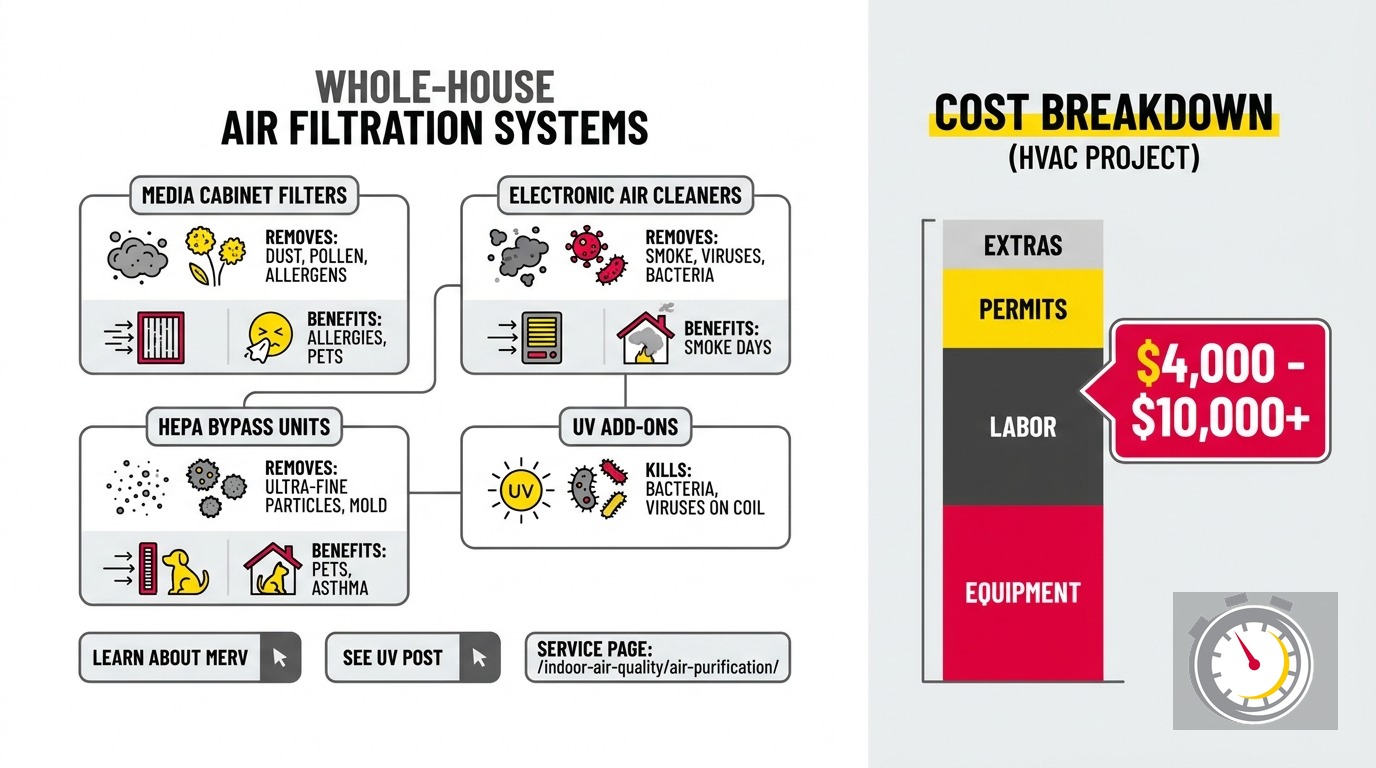
- There are four main types: media cabinet filters, electronic air cleaners, HEPA bypass units, and UV add-ons. Each does a different job.
- UV lights are not particle filters. They address a different problem than a filter does.
- Filtration only works while your blower runs. In a sealed-tight Minnesota winter home, fan settings matter.
- Allergies, wildfire smoke days, and pets are the three best reasons to upgrade.
- Some electronic devices can emit ozone, a lung irritant. Ask about this before you buy.
- Cost depends on your home, not just the product. A technician needs to see your equipment and ductwork.
What Is a Whole-House Air Filtration System?
A whole-house air filtration system cleans the air that moves through your ducts. It connects to your furnace or air handler. When the blower runs, the system treats the air going to every room.
A portable purifier cleans one room. A central system works on the whole home. The EPA notes that central furnace or HVAC filters are designed to filter air throughout a home.
If you live in Minneapolis, St. Paul, or the suburbs, you have probably searched for air filtration systems in Minneapolis MN. Many results sell a single product. You should see all the options side by side first.
We are a locally owned and operated Twin Cities HVAC company. We install these systems, and we tell homeowners when they do not need one. Below, you will find what each type does and what it cannot do.
How Do the Four Main Types of Whole-House Air Filtration Compare?
Whole-house systems fall into four groups. Media cabinets trap particles on a thick filter. Electronic air cleaners charge particles to collect them. HEPA bypass units pull air through a very fine filter. UV add-ons treat the air or the coil with light, not with a filter.
Here is each type in plain terms.
Media cabinet filters
A media cabinet is a deep filter box that sits beside your furnace or air handler. The filter inside is much thicker than the thin one you slide into a standard slot. More surface area means more room to catch dust, pollen, and pet dander.
Many homeowners start here because it is the simplest upgrade. It uses your existing blower and ducts, and it has no electrical parts that create byproducts.
Media filters carry a MERV rating. The EPA says filters with a MERV of 13 and above are required to demonstrate at least 50% removal efficiency for the smallest particles tested. We break down the ratings in our guide to choosing a furnace filter MERV rating.
What a media cabinet does well:
- Captures dust, pollen, mold spores, and pet dander as air passes through
- Protects your blower and coil from buildup
- Needs only a filter swap on a regular schedule
What it does not do:
- Remove odors or gases in a meaningful way
- Kill germs
- Work when the blower is off
Electronic air cleaners
An electronic air cleaner uses an electrical charge to pull particles out of the air. Some models use a washable collector cell. Others use a charged field plus a filter.
These units can catch very small particles. They also need regular cleaning, and a dirty cell loses performance. We cover upkeep in our electronic air cleaner maintenance guide.
There is one caution. The EPA says air cleaners with electrostatic precipitators, ionizers, or UV lights without adequate lamp coatings may have the potential to emit ozone. The same page says ozone is a lung irritant. Ask any installer about ozone output before you choose a model.
HEPA bypass units
A HEPA bypass unit is a separate box connected to your ducts. It pulls a portion of your home’s air through a very fine HEPA filter, and the cleaned air returns to the duct system.
HEPA filters are the finest filters most homeowners will meet. The word “bypass” matters, though. The unit does not filter all of your airflow. It works on a share of it, over time.
Be careful with big claims. Some sellers state exact removal percentages with no test standard attached. We do not repeat those numbers here. Ask any seller which test standard backs a claim.
The health evidence is also modest. The EPA reports that several studies using portable HEPA air cleaners have shown small improvements in cardiovascular and respiratory health. Those studies used portable units, not bypass units. Treat HEPA as a helpful tool, not a cure.
UV add-ons
UV lights install inside the duct or near the coil. They do not catch dust, pollen, or dander.
A UV light treats what passes by it or what grows on a surface. Many homeowners add one to help keep the coil cleaner. Others hope it will clean the air itself. Those are different goals.
The EPA states that research has not yet shown that other technologies such as plasma or photocatalytic oxidation can remove gases effectively in portable residential air cleaners. That finding covers portable units, so we do not stretch it to in-duct lights. It is still a reason to ask hard questions.
For a full look at this option, read our UV light air purifier guide for Twin Cities homes.
Quick comparison
- Media cabinet: best for dust, pollen, and dander. Simple and steady.
- Electronic air cleaner: catches fine particles. Needs cleaning. Ask about ozone.
- HEPA bypass: very fine filtration on a share of your airflow. Needs duct space.
- UV add-on: not a particle filter. Used for coil and duct surfaces.
Many homes use one main filter plus one add-on. Few need all four.
Do You Need More Than a Good Furnace Filter?
Maybe not. A well-fitted MERV 13 filter, changed on schedule, is enough for many homes. Upgrade if you have allergies, smoke concerns, or heavy pet dander and a standard filter is not keeping up.
The EPA says most furnaces and HVAC systems can accommodate a MERV 13 filter without creating equipment problems. The page ties that to frequent replacement.
So start by checking the filter you have now. Make sure it fits the slot with no gaps, because air that leaks around a filter skips the filter entirely. Our guide on air leaking around the filter explains how to spot it.
Dense filters can also restrict airflow in some systems. Our post on MERV 13 and airflow restriction covers what to watch for. If your blower struggles, a media cabinet is often the better path. Its larger surface area lets air pass more easily.
Which Twin Cities Homes Benefit Most?
Three situations come up again and again: allergies, wildfire smoke days, and pets. A fourth, the tight winter home, affects almost everyone here.
Allergy households
Pollen, mold spores, and dust drive many allergy symptoms. A better filter catches those particles before they circulate again. Spring and fall are the hardest seasons here.
A filter is one part of the answer. The EPA says filtration can be an effective supplement to source control and ventilation. Source control means removing what causes the problem, such as cleaning, humidity control, and fixing leaks.
Our posts on air filters for allergies and spring allergy relief go deeper on seasonal timing.
Smoke days
Wildfire smoke has reached Minnesota in recent summers. Smoke carries very fine particles. A fine filter helps most when your windows stay closed and your system runs.
MPR News reports the EPA’s advice for central air: install a high-efficiency filter (MERV 13 or higher). The same story says purifiers cannot remove all pollutants from the air.
It also explains the Air Quality Index. A reading of 50 or under is healthy, and the scale runs from 0 to 500. Check the index before you decide to open windows.
For a full smoke plan, read our wildfire smoke and HVAC guide for Minnesota homes.
Pet homes
Dogs and cats shed hair and dander all year. Hair clogs a filter quickly. Dander is much smaller and travels farther.
A media cabinet gives pet owners more filter surface, which often means a longer interval between changes. You still need to check it often. We cover this in our guide to HVAC filters for pet hair and dander.
Asthma and sensitive households
If someone at home has asthma, talk with their doctor first. Then talk with us about equipment. Our post on HVAC and asthma triggers covers what the system can and cannot do.
Why Does Fan Run-Time Matter in a Minnesota Winter?
A filter only cleans air that passes through it, so your furnace blower must be running. In a closed-up winter home that matters a lot, because the windows stay shut for months.
The EPA says furnace and HVAC filters work to filter the air only when the system is operating. It adds that HVAC systems run usually less than 25% of the time during heating and cooling seasons.
A top-tier filter does little while the blower sits idle. Two practical levers help:
- Fan setting: Running the fan more often moves more air through the filter. Check your thermostat’s fan options.
- Furnace run-time: A variable-speed blower runs longer at lower speeds. That can pair well with a finer filter.
The fan setting has trade-offs for comfort and energy use. Our guide on thermostat fan auto versus on explains them. For variable-speed options, see our post on variable-speed furnace blower motors.
Winter homes have another issue, stale air. Tight houses hold onto dust, odors, and moisture. Filtration helps with particles. Ventilation handles the rest. Read our post on sealed winter homes and ventilation for the full picture.
What Are the Limits of Air Filtration?
Filtration has real limits. It does not remove every pollutant. It does nothing when the blower is off. Some devices can create ozone. Filters only help if you replace them on time.
Filters cannot catch everything. The EPA says filters cannot remove all pollutants from the air. Gases, odors, and many chemicals pass through particle filters.
The EPA takes no position on in-home devices. It states that it has not taken a position either for or against the use of these devices in the home. We take that seriously. A system should fit a real need.
Some devices carry risk. Ozone is the main one. The EPA says no federal government agency has approved ozone generators sold as air cleaners for use in occupied spaces. We do not recommend those.
Filters clog. The EPA says all filters need regular replacement. It adds that manufacturers typically recommend replacement every 60 to 90 days. A clogged filter hurts airflow and can strain your blower.
Source control still comes first. Some problems start in the home itself. Renovation dust, new materials, and moisture are common sources. Our post on VOCs after renovation shows why filters cannot fix everything.
If a seller makes a claim that sounds too good, ask for the source. A good installer welcomes that question.
Can You Hire an HVAC Professional to Install an Air Quality System?
Yes. A licensed HVAC company can install, size, and connect a whole-house air quality system. The unit ties into your ducts, your blower, and sometimes your electrical supply, and a bad fit can hurt airflow.
Before recommending anything, a professional looks at these things:
- Your equipment: the age and type of your furnace or air handler
- Your blower: whether it can handle a denser filter without strain
- Your ductwork: space for a cabinet or bypass connection, and any leaks
- Your goals: allergies, smoke, pets, odors, or all of the above
- Your electrical and venting needs: some devices need power at the unit
DIY filter swaps are fine. Adding a cabinet, a bypass unit, or a UV light is different. It means cutting into ductwork and wiring components. Mistakes can leak air, reduce airflow, or create safety issues.
Permit rules vary by city. Our post on HVAC permits in Minnesota explains what Minneapolis and the suburbs often require. Your installer should handle that paperwork.
Airflow should be checked after installation, since added filters change how air moves through the house. Our guide on HVAC air balancing after installation explains why.
Our air purification service page lists what we install. When you are ready, call (763) 260-6662 or book online.
How Do You Choose the Right System for Your Home?
Start with your problem, not the product. Dust and pollen call for a good filter. Smoke calls for a fine filter and steady fan use. Coil growth calls for a UV light. Odors may need ventilation or source removal.
Use this simple decision path:
- Check your current filter. Make sure it fits well and is changed on time.
- Name your main concern. Allergies, smoke, pets, or stale air.
- Check your blower. Ask whether it can handle a finer filter.
- Pick the simplest tool that fits. A media cabinet solves many cases.
- Add only what you need. Layer a second device only for a clear reason.
- Plan for upkeep. Every system needs filter swaps or cleaning.
Ask these questions of any installer:
- What does this device remove, and what does it not?
- Does it produce ozone?
- What test standard supports your performance claims?
- How often do I replace or clean it?
- Will it change my airflow or my furnace’s performance?
If an answer is vague, keep asking. You are making a long-term choice for your home.
You might also consider a home air quality check. A monitor or a professional test can show what you actually have. Our post on IAQ testing versus DIY monitors explains the difference.
What to Expect on Install Day
A typical visit follows a clear order. The technician confirms the plan, protects your floors, and makes the connection. Then they test airflow and show you how to maintain the unit.
Most visits include these steps:
- A walk-through of the equipment location and ductwork
- Setup and protection of the work area
- Connection to the duct system or the air handler
- Electrical or control work if the device needs it
- Testing of airflow and operation
- A walk-through of filter changes and cleaning
Our guide to what to expect on HVAC install day covers the general process. Your technician will explain anything specific to your system.
Where Costs and Rebates Come In
Many homeowners ask what a system costs and whether a rebate applies. The honest answer starts with your home. Equipment size, filter type, duct changes, venting, electrical work, access, and permits all play a part.
We do not guess from a distance. A technician reviews your equipment and ductwork, then gives you a firm quote. You know the scope before any work begins. If financing helps with a larger project, we can walk through options with you.
Rebates change often. We found no current, confirmed program for air filtration equipment, so we will not promise one. Check your utility’s website before you buy. Our guide to Xcel and CenterPoint HVAC rebates shows how to look for what is current. The federal 25C and 25D credits ended for installs after 2025.
Why Choose Northern One Hour for Air Filtration
We are locally owned and operated in Ramsey, and we serve homeowners across the Twin Cities. We know how our winters seal up a house. We know what smoke days and spring pollen do to a home’s air.
We back our service with our promise: “Always On Time… Or You Don’t Pay a Dime!(R)” That means we arrive within the time window you select. If the technician does not show up on time, you do not pay for the service.
You also get a 100% satisfaction guarantee and honest, transparent pricing. We will tell you if a simple filter swap solves your problem. We will also tell you if you need more.
Here is how to get started:
- Tell us your goal. Allergies, smoke, pets, or stale air.
- Schedule a visit. Call (763) 260-6662 or book online.
- Get a clear plan. We explain your options in plain language.
- Choose what fits. You decide, with no pressure.
A well-matched system can help you breathe easier through every Minnesota season. Call (763) 260-6662 or book online, and we will help you find the right fit.
Frequently Asked Questions
How much does an air filter system cost in Minneapolis? +
Are there Minnesota state rebates for energy-efficient HVAC in Minneapolis? +
Can a whole-house air filter fit any furnace? +
Do I still need to change my furnace filter with a whole-house system? +
Need a technician now?