Central Heating Repair in Minnesota: What Usually Breaks
Key Takeaways
- Central heating in Minnesota homes usually means a furnace, a boiler, or a heat pump. Each one fails in its own way.
- Check your thermostat, filter, and breaker first. Leave gas, venting, and refrigerant work to a licensed pro.
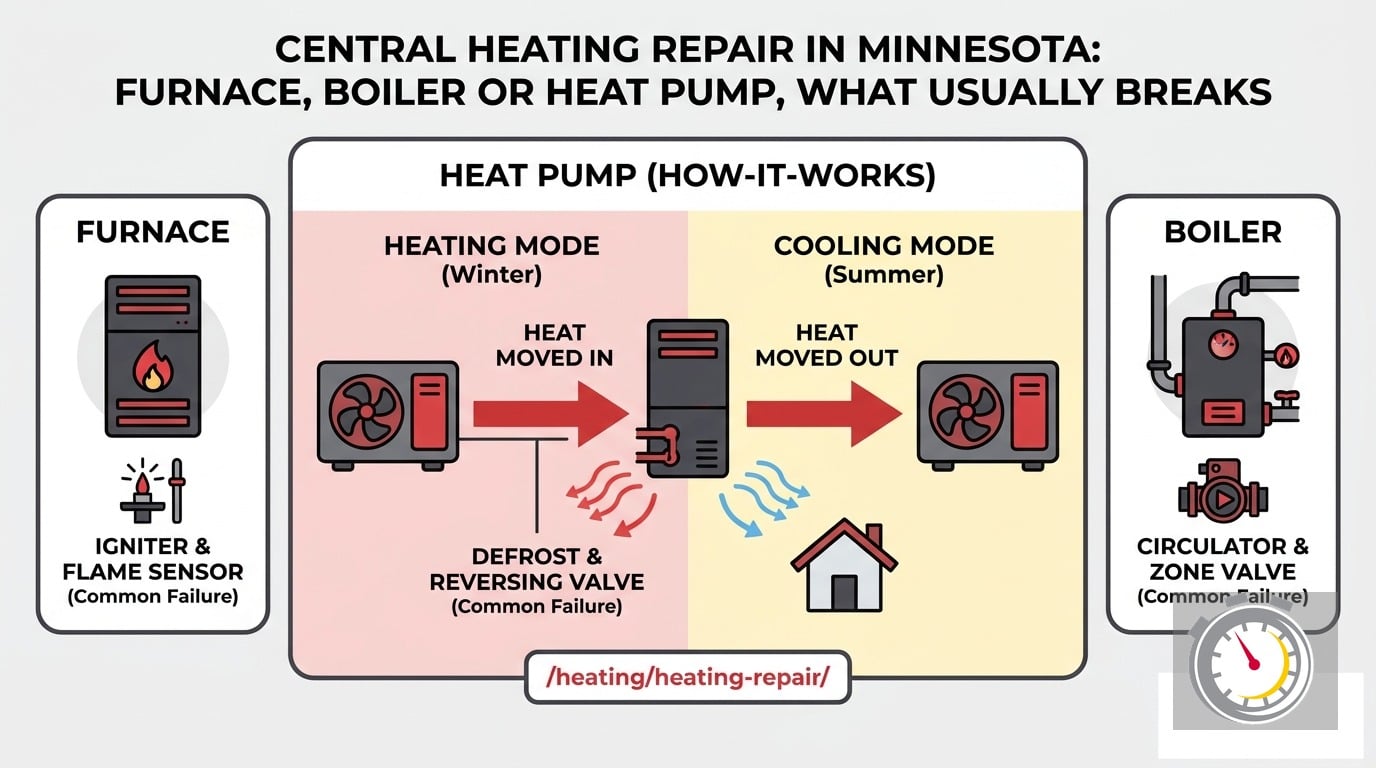
- Furnaces most often fail at the igniter or flame sensor. Boilers often fail at the circulator or a zone valve. Heat pumps often fail at the defrost control or reversing valve.
- Heat pumps are tested to work at low temperatures, but ask whether your home needs a backup heat source.
- Minnesota’s state heat pump rebate has not launched yet, and approval is required before you buy.
- We are locally owned and operated, and we can help you find the problem fast.
How do I know if I have a furnace, a boiler, or a heat pump?
Look at how the heat reaches your rooms. Vents and ducts mean a furnace or ducted heat pump. Radiators or baseboard units mean a boiler. An outdoor unit that also cools in summer usually means a heat pump.
Many homeowners search for central heating repair without knowing which system they own. That is normal. A few quick checks sort it out.
Check the delivery method
Walk through your home and look at how warm air or water arrives.
- Floor or ceiling vents with air blowing out: You have a forced-air system. That is either a furnace or a heat pump.
- Metal radiators, baseboard fins, or in-floor tubing: You have a hydronic system. That means a boiler.
- Wall-mounted indoor units with no ducts: You likely have a ductless heat pump. Our guide to ductless versus ducted heat pumps explains the difference.
Check the equipment itself
Next, find the main unit. It is usually in the basement, a utility room, a closet, or the attic.
- A furnace is a tall or wide metal cabinet with a vent pipe, a gas line, and ductwork leaving the top or side.
- A boiler has water pipes, a pressure gauge, and often a small pump. It may be wall-hung or floor-standing.
- A heat pump has an outdoor unit that looks like an air conditioner. Inside, you may see an air handler instead of a furnace.
Read the label
Every system has a data plate listing the model number, the fuel, and the install date. The plate often says “furnace,” “boiler,” or “heat pump” right on it.
If the label is worn or hard to read, take a photo and send it to us. We can identify it quickly. Our post on finding your HVAC system’s age shows where to look.
Why it matters
The system name changes the repair. A clicking noise from a furnace points to ignition. A clicking noise from a boiler may point to air or a pump. Knowing which system you own saves time on the phone and on the visit.
How do I fix a central heating system myself?
Start with the safe checks: thermostat, power, filter, and fuel. Many “no heat” calls trace back to a simple setting or a tripped breaker. Anything involving gas, flue gases, high voltage, or refrigerant belongs to a licensed technician.
You can solve some problems in ten minutes. This short list works for every system type.
The safe homeowner checklist
- Check the thermostat. Confirm it is set to heat and the temperature is above the room reading. Replace dead batteries.
- Check the breaker and the service switch. Furnaces and boilers have a switch that looks like a light switch. Someone may have flipped it by accident.
- Check the filter. A clogged filter restricts airflow and can trip safety limits on a furnace or heat pump air handler.
- Check the boiler pressure gauge. If it reads very low, the system may have lost water. Do not keep adding water without learning why.
- Clear the outdoor unit. Remove snow and ice from around a heat pump so air can move.
- Check for a gas smell. If you smell gas, leave and call your gas utility from outside.
Our guide to what to do when a furnace will not turn on walks through these steps in more detail.
What not to do
Do not open gas valves, bypass safety switches, or jump wires on a control board. Do not scrape a flame sensor if you are unsure how. Do not add refrigerant, and do not keep resetting a tripped limit switch.
Those safeties protect your home. A system that keeps locking out is telling you something is wrong. ENERGY STAR says to “perform regular maintenance of your heating and cooling system to prevent future problems and unwanted costs”. A trained tech does that work safely.
What usually breaks in a gas furnace?
The igniter and the flame sensor. A furnace lights its burners with a hot surface igniter. A flame sensor then confirms the fire is burning. If either part fails, the furnace shuts down to stay safe.
Furnaces are the most common central heating system in Twin Cities homes. They also have the most moving parts. The two most frequent trouble spots are small and easy to overlook.
The igniter
The igniter is a fragile ceramic part that glows white-hot to light the gas. It heats and cools every cycle. In a Minnesota winter, that adds up to thousands of cycles.
Signs of a failing igniter:
- The furnace clicks and the inducer fan runs, but the burners never light.
- The furnace starts only after several tries.
- You see no glow at all through the sight glass.
A cracked igniter often looks fine to the eye. A technician tests it with a meter. See our deeper post on igniter failure signs and replacement.
The flame sensor
The flame sensor is a thin metal rod that sits in the burner flame. It tells the control board the burners are lit. Over time, it gets coated with a thin film of carbon.
When the rod is dirty, the board cannot see the flame. The burners light for a few seconds, then shut off. This repeats until the furnace locks out.
Signs of a dirty flame sensor:
- The burners light, then go out after a few seconds.
- The furnace cycles on and off without producing steady heat.
- The control board shows a flame or lockout code.
A tech cleans the rod with fine abrasive and checks the reading. If the rod is worn, we replace it. Read more in our post on cleaning a dirty flame sensor.
Other furnace parts we see
The inducer motor, pressure switch, and control board also fail. Blocked vent pipes and frozen condensate lines are common in high-efficiency models during cold snaps. A thorough diagnosis checks the whole start-up sequence, not just one part.
For the full list of furnace services, see our furnace repair page.
What usually breaks in a boiler?
The circulator pump and the zone valves. A boiler heats water, and a circulator pump moves it through the pipes. Zone valves open and close to send hot water to each part of the house. When either fails, the boiler may run while rooms stay cold.
Boilers deliver quiet, even heat, and many older Twin Cities homes use them. They fail differently than furnaces, so the symptoms can be confusing.
The circulator pump
The circulator is a small electric pump on the boiler piping. It runs whenever the home calls for heat. Bearings wear, seals leak, and motors burn out.
Signs of a failing circulator:
- The boiler is hot, but the radiators or baseboards stay cool.
- You hear grinding, humming, or a loud whine near the pump.
- Water drips from the pump flange.
A pump that hums but does not spin is often seized. Our post on circulator pump failure signs shows what a tech looks for.
The zone valve
Many boilers split the house into zones. Each zone has a thermostat and a valve. When a zone calls for heat, its valve opens. The valve actuator is a small motor that can burn out or stick.
Signs of a failing zone valve:
- One zone stays cold while the others work fine.
- A zone stays hot and will not shut off.
- The thermostat calls for heat, but the pump never starts.
Only one zone is affected, so the fix is often limited to one valve or actuator. See our guide on zone valve failure symptoms.
Other boiler issues
Low pressure, trapped air, a waterlogged expansion tank, and sludge in the system also cause cold spots. Annual service catches many of these early. Our boiler repair and maintenance page covers what we handle.
Efficiency matters if you replace
If a boiler is past repair, efficiency is worth a look. ENERGY STAR certified boilers have AFUE ratings of 87% or greater for oil and 90% or greater for gas. Ask your tech how a new unit would compare with your current one.
What usually breaks in a heat pump?
The defrost control and the reversing valve. In winter, a heat pump pulls heat from outdoor air. Frost builds on the outdoor coil, so the unit must defrost itself. The defrost control and the reversing valve manage that cycle.
Heat pumps are now a real option in Minnesota. ENERGY STAR cold climate heat pumps are third-party verified and tested down to 5°F. The same page notes they continue working at temperatures below 5°F.
The Department of Energy says cold climate air-source heat pumps can reduce household energy use by up to 40%. It also notes some newer units can heat in extremely cold regions, such as the upper Midwest.
Even so, heat pumps work hard in our winters. That stress shows up in two places.
The defrost control
Frost on the outdoor coil is normal. The unit melts it by briefly running in reverse. A defrost control or sensor decides when to start and stop that cycle.
When that control fails, the coil can freeze into a solid block of ice. Airflow drops and the heat pump delivers less heat each hour.
Signs of a defrost problem:
- The outdoor unit stays covered in ice for hours.
- The house warms slowly, even on moderate days.
- Backup heat runs far more than it should.
A light fog or steam during defrost is usually normal. Our post on heat pump ice and the defrost cycle helps you tell normal from not normal.
The reversing valve
The reversing valve switches the refrigerant flow direction. That lets one machine heat in winter and cool in summer. It also lets the unit run the defrost cycle.
When the valve sticks or leaks internally, the system may blow cool air in heat mode. It may also fail to switch into defrost.
Signs of a reversing valve problem:
- The heat pump blows cool air while set to heat.
- You hear a loud hiss or whoosh that does not stop.
- The system never seems to shift modes.
Reversing valve diagnosis takes gauges and training. It is not a DIY job. Learn more in our post on reversing valve failure symptoms.
Ask about backup heat
Performance below 5°F is the main Minnesota question. ENERGY STAR notes that pairing a heat pump with a backup energy source heats most efficiently at lower temperatures. Ask your tech whether your setup needs one.
Our heat pump repair page lists what we service. For an overview, read about whether heat pumps are a good fit in Minnesota.
What does each central heating repair involve?
Every repair starts with a diagnosis, then a clear explanation of the fix. Your technician confirms the cause, shows you what failed, and explains your options before work begins. Our heating repair service follows that same process for every system type.
Here is what to expect on the visit.
A typical furnace repair
- The tech checks the thermostat, power, and filter.
- They run the start-up sequence and watch each step.
- They test the igniter, flame sensor, inducer, and pressure switch.
- They clean or replace the failed part.
- They run the furnace through a full cycle to confirm it holds.
A typical boiler repair
- The tech checks pressure, water level, and the aquastat.
- They test the circulator and the zone valve motors.
- They look for air, leaks, and a waterlogged expansion tank.
- They replace the failed pump, valve, or actuator.
- They bleed air as needed and confirm every zone heats.
A typical heat pump repair
- The tech checks the thermostat settings and outdoor unit.
- They watch a full heating and defrost cycle.
- They test the defrost control, sensors, and reversing valve.
- They check refrigerant levels and electrical parts.
- They repair the fault and confirm the unit heats and defrosts.
What drives the scope of a repair
Some jobs are quick. Others take more time. The scope depends on:
- Which part failed, and whether it is in stock.
- How easy it is to reach the equipment.
- Whether the failure damaged other parts.
- The age and condition of the whole system.
A good tech explains these factors in plain language. You should never feel rushed into a decision.
How do I find a licensed and insured heating repair technician in St. Paul?
Ask for the license number and proof of insurance in writing. Then check reviews, ask about arrival windows, and confirm who will pull permits when they are needed. A reputable company answers these questions without hesitation.
St. Paul and the rest of the Twin Cities have plenty of heating contractors, and quality varies. These steps help you sort the good from the rest.
What to ask before you book
- Is your company licensed in Minnesota? Ask for the license number and verify it.
- Do you carry liability insurance and workers’ compensation? Ask for proof.
- Are your technicians employees of the company? You want to know who is coming to your door.
- Will you explain the problem before you start? The answer should be yes.
- Do you pull permits when required? A good company handles it.
What the code says
Minnesota’s mechanical code is Minnesota Rules chapter 1346. Cities in the Twin Cities metro handle HVAC permits and inspections locally. Confirm requirements with your city. Our post on when an HVAC permit is required explains the basics.
Red flags to avoid
- A tech who will not show a license or insurance.
- Pressure to decide on the spot.
- A vague diagnosis with no explanation.
- A request for full payment before work starts.
Our guide to HVAC contractor red flags covers more warning signs. If you feel unsure, a second opinion is always fair.
Who can repair a home heating issue?
A licensed heating contractor is the right choice for furnaces, boilers, and heat pumps. That is true for any home, in St. Paul or elsewhere. We are a locally owned and operated Twin Cities company. We serve St. Paul, Minneapolis, Ramsey, Blaine, Maple Grove, Plymouth, Brooklyn Park, Woodbury, and Bloomington.
Can I get same-day emergency heating repair in the Twin Cities?
Often, yes, depending on the day and the problem. Call early and describe your symptoms. Safety issues like gas smells or carbon monoxide alarms come first and may need a call to your utility or 911. Otherwise, we work to get a tech to you fast.
A heating failure in January is more than an inconvenience. Pipes can freeze, and families can get cold fast. Knowing what to do while you wait helps.
First, handle safety
- Gas smell: Leave the house. Call your gas utility from outside. Do not use switches or flames.
- Carbon monoxide alarm: Get everyone outside and call 911. Our post on CO alarms and furnaces explains the next steps.
- No heat but no danger: Follow the safe checklist above, then call us.
What to do while you wait
If your furnace is out tonight, see our guide to emergency steps when the furnace is out. The basics:
- Close doors to unused rooms.
- Open cabinet doors under sinks on exterior walls.
- Let faucets drip slightly during extreme cold.
- Use safe supplemental heat only as directed by the manufacturer.
If you have a boiler, our post on emergency boiler repair covers what to check.
Our on-time promise
When you book with us, you pick an arrival window. We arrive within the time window you select. If the technician does not show up on time, you do not pay for the service. That is the meaning behind “Always On Time… Or You Don’t Pay a Dime!(R)“
Is it time to repair or replace?
Repair makes sense when the failed part is small and the system is otherwise healthy. Replacement deserves a look when repairs stack up, the system is old, or comfort has slipped for years. Your tech should lay out both paths honestly.
A single igniter or circulator is rarely a reason to replace a whole system. Repeated failures are different.
Questions to weigh
- How old is the system? Our guide on how long furnaces last in Minnesota gives a general picture.
- How often has it failed? Back-to-back repairs are a warning sign.
- Is the problem major? A cracked heat exchanger, for example, is a serious safety issue.
- Is comfort or efficiency suffering? Cold rooms and rising bills are signs.
Our post on whether to repair or replace a failing system offers a clear way to decide. If you replace, ask about financing for larger jobs. We can walk you through the options.
Heating bills as a clue
An aging system can also push up your monthly costs. Our look at typical monthly heating and cooling bills in the Twin Cities helps you see whether your bills fit your system type.
Does Minnesota have a heat pump rebate I can use?
Not yet. The state’s heat pump rebate program has not launched. The Minnesota Commerce page says there is “no estimated program launch date.” Do not count on it for a current repair or replacement.
If you are thinking about a heat pump, the state page lists these rules.
- Heat pumps must be approved through HEAR before purchase.
- The unit must be an ENERGY STAR certified, cold climate rated air-source heat pump.
- It must be installed by an approved contractor.
- The homeowner needs an energy audit within the last 18 months.
- Amounts vary by income against 80% or 150% of Area Median Income.
Because the program has not launched, check the state page before you plan around it. Our post on Minnesota heat pump rebates tracks what is available. For utility programs, see our guide to Xcel and CenterPoint HVAC rebates.
Why heat pumps draw interest
ENERGY STAR says an air-source heat pump can deliver up to three times as much heat energy as the electricity it consumes. The same page says a contractor should verify system size with a “Manual J” calculation. Sizing affects comfort in our climate.
How can I prevent central heating breakdowns?
Schedule yearly maintenance before winter and replace filters on time. Most breakdowns start as small, fixable problems. A tune-up finds worn igniters, dirty sensors, weak pumps, and iced coils before the first cold snap.
Minnesota winters leave no room for a surprise failure. A little planning helps.
A simple prevention plan
- Fall: Book a tune-up for your furnace, boiler, or heat pump. Our fall HVAC startup checklist helps you prepare.
- Monthly: Check your filter and swap it when it looks dirty.
- After storms: Clear snow and ice from outdoor units and vent terminations.
- Anytime: Replace dead thermostat batteries.
- Always: Test your carbon monoxide alarms.
Why maintenance pays off
Regular service keeps parts clean, safe, and working as designed. It also gives your tech a chance to flag aging parts early. You can plan for repairs instead of facing them at midnight.
Our post on what happens when you skip HVAC maintenance shows how small problems grow. If you want a regular schedule, ask us about heating maintenance.
Call Northern One Hour for central heating repair
We are a locally owned and operated Twin Cities heating and cooling company. We stand behind our work with a 100% satisfaction guarantee. We also stand behind our schedule: “Always On Time… Or You Don’t Pay a Dime!(R)” means we arrive within the window you choose, or you do not pay for the service.
Whether you have a furnace, a boiler, or a heat pump, our team can find the cause and explain your options in plain language.
Call (763) 260-6662 or book online to schedule fast. Learn more about our heating repair service today.
Frequently Asked Questions
Who can repair a home heating issue? +
Why does my heat pump have ice on it in winter? +
Do I need a permit for a heating repair? +
Is it safe to keep running a furnace that smells like gas? +
Need a technician now?