
Average Monthly Heating and Cooling Bill Minneapolis
Key Takeaways
- No trustworthy single average exists for the average monthly heating and cooling bill Minneapolis homes pay. Ranges and drivers tell you more.
- Sampled Minneapolis homes use roughly 1,290 kWh of electricity a month. All-electric homes can run well above that.
- Gas bills climb in winter because furnaces run more. Fixed charges stay flat all year.
- Summer electric rates are higher, and a hot summer can push a bill up fast.
- Your system type, home envelope, and thermostat habits move your bill more than the city average does.
- Compare your bill to your own past months, not to a neighbor’s.
What Is the Average Monthly Heating and Cooling Bill in Minneapolis?
There is no single reliable number. The best public figures cover electricity only, and none split heating from cooling. Your bill depends on your fuel, your system, and the season. A January gas bill and a July electric bill look nothing alike.
We looked at what the top search results offer. Most give one flat number and skip the “why.” That does not help you judge your own bill.
We are Northern One Hour Heating & Air Conditioning, a locally owned and operated Twin Cities company. We see these bills through our customers’ eyes every week.
What Is the Average Monthly Utility Bill in Minnesota?
For Minneapolis electricity, EnergySage reports roughly 1,290 kWh a month in sampled bills.
The same page puts the Minneapolis rate below the national figure. Good news for Twin Cities homeowners.
Read the number with care. It rests on bills shared with EnergySage, not a representative survey. The page itself says all-electric homes “could be a lot higher.”
A second source uses a different setup. Utility-rates.com prices a fixed bundle of 1,000 kWh of electricity and 5,000 gallons of water, so water charges are part of its total.
The two figures do not conflict. One is a sample of real electric bills. The other is a calculator with set usage.
Neither includes natural gas, and most Twin Cities homes heat with gas. So neither gives your full heating and cooling cost.
Why a single average falls short
An average hides the spread. A small condo and a large two-story home share the same city. So do a gas furnace home and an all-electric home.
Your own bills beat any citywide number. Pull the last 12 months from your utility account and look at the pattern.
Bills by System Type: What Changes and Why
We found no clean Minneapolis dollar figure for each system type, and we will not make one up. Here is how each setup behaves and where your money goes.
Gas furnace plus central AC
This is the most common Twin Cities setup. Winter bills come mostly from natural gas. Summer bills come from electricity, mainly the AC compressor and fan.
Your gas bill peaks in January and your electric bill peaks in July. The two rarely overlap.
Furnace efficiency matters here. An 80% AFUE furnace wastes more fuel than a 95% or higher model. Our guide to furnace AFUE ratings explains the gap in plain terms.
Cold climate heat pump
A heat pump moves heat instead of burning fuel. It heats and cools with one system, and your winter cost shifts from gas to electricity.
The U.S. Department of Energy says cold climate air-source heat pumps can reduce household energy consumption by up to 40%. Treat that as a ceiling.
DOE also says homes using electric resistance (baseboard) heat or fuel oil are likely to see the most cost savings. It does not put a number on savings against gas furnaces.
That gap matters. Compare your own gas and electric rates before you assume savings. Our post on heat pump versus gas furnace operating cost walks through the math.
Dual-fuel systems
A dual-fuel setup pairs a heat pump with a gas furnace. The heat pump handles mild weather. The furnace takes over when it gets very cold.
You use the cheaper fuel at each temperature. Our dual-fuel guide explains how the switchover works.
Electric resistance heat
Baseboard and electric furnaces turn every kWh into heat at a one-to-one rate. That is simple, but costly at Minneapolis electric rates.
Homes with electric resistance heat often see the biggest winter bills. They also see the biggest gains from a switch. See our look at electric baseboard upgrade options.
What Is a Normal Gas Bill Per Month?
A normal gas bill swings by season. Summer bills are mostly fixed charges, and winter bills include much more gas. We found no sourced Twin Cities average in dollars, so use your own history as the benchmark.
The Minnesota Public Utilities Commission explains that gas bills carry fixed charges every month. The cost of the gas itself is more than half of a residential bill.
The same page notes that utilities may not mark up the gas. Bills rise in winter because homes use more gas for heating.
What to look for on your gas statement
Find the therms used. Then compare this month to the same month last year. If therms are flat but dollars rose, rates drove the change. If therms rose, your home or the weather drove it.
Weather is easy to check. A colder month means more therms, and that is normal.
Why Is My Electric Bill So High in Minnesota?
Four things usually push a Minnesota electric bill up: hot weather, higher summer rates, rate increases, and heavy equipment use. Central AC and electric heat are the biggest loads. Check your kWh first, since usage and price are separate problems.
Summer rates run higher
Utility-rates.com notes that Minneapolis rates are higher in summer, from June through September. They drop from October through May.
MPR News names higher summer rates at Xcel and Otter Tail as a reason bills jumped this year. The same article describes one of the warmest summers on record, with a mid-July heatwave above 90°F.
It also reports that a St. Paul resident’s July Xcel bill was more than double the prior year’s. That is one story, not a typical case. It does show how heat and rates can stack.
Rate cases are moving bills
On the electric side, MPR reports the Public Utilities Commission allowed 2.3% for 2025 and an additional 3.4 for 2026. A 5.2% interim increase has been on bills since January 2025.
Xcel estimates residential bills will rise an average of 2.85%. Xcel also says its 2025 average residential bill was well below the national average.
The average increase is modest. Your bill can still jump if your usage does.
Your AC works harder in a heatwave
A hard-working AC is often the biggest electric load in summer. A system that struggles in heat runs longer, and longer run time means more kWh.
Our post on AC struggling on extreme heat days covers the common causes. Dirty coils, low refrigerant, and a clogged filter top the list.
Heat pumps shift winter load to electricity
If you have a heat pump, your winter electric bill will look bigger than it did with gas. That is expected, and your gas bill should shrink to match.
Backup heat strips can push the bill higher. Read our guide on why a heat pump electric bill spikes in winter if your December statement shocked you.
Why Is My Heating Bill So High This Winter?
Most high winter heating bills come from four causes: colder weather, higher rates, a home that leaks heat, or a furnace that runs poorly. That holds in Minneapolis and in north metro towns like East Bethel, where winters run long and cold.
Start with the rates. Gas rates are changing right now.
The 2026 gas rate case
The Public Utilities Commission approved an Xcel gas rate increase of about 4.8%. The commission’s release says Xcel asked for 8.2%.
Interim rates of 6.8% have applied since January. Because the final number is lower, customers get a refund.
The release is dated November 6, 2026, and gives no average-bill dollar impact. MPR News reports the same 4.8% final increase. It says the refund amount will be calculated “in the coming months.”
Expect a credit on a future bill, but do not count on a specific amount yet.
Weather and use
A colder January means more therms. That is the simplest reason for a high bill. Check the therms line before you blame rates.
Heat loss through the home
A leaky home sends heat outside. Attics, rim joists, and old windows are common culprits. Many Twin Cities homes built before the 1990s have thin insulation.
CenterPoint says drafty windows can account for up to 25% of heating loss, as FOX 9 reported. That article is dated, so treat the figure as a general tip.
Our post on why older Twin Cities homes struggle with winter comfort explains the pattern. Our guide to air sealing before an HVAC upgrade shows where to start.
A furnace that is losing efficiency
A dirty filter, a worn blower, or a weak burner makes a furnace work harder. It burns more gas for the same heat. Our piece on rising January heating bills covers the signs.
A yearly furnace tune-up catches many of these early. It costs less than a mid-winter breakdown.
How Do Seasons Change Your Monthly Bill?
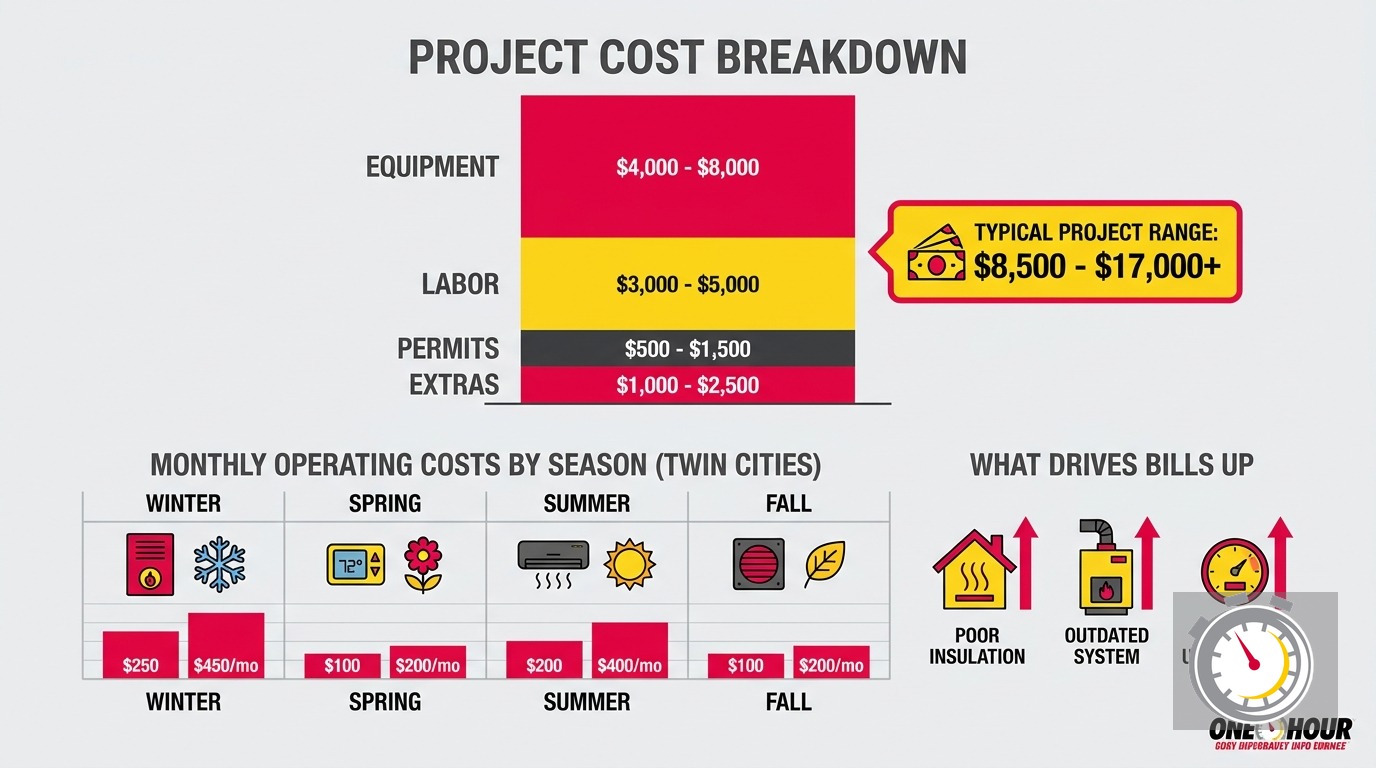
Your bill follows a seasonal curve. Winter is gas-heavy and summer is electric-heavy. Spring and fall are the cheapest months for most homes.
For a gas furnace and central AC home, the pattern looks like this:
- December through February: Gas use peaks. Electric stays near its base level.
- March through May: Gas use falls. Electric stays low.
- June through September: Gas drops to fixed charges. Electric rises with AC and higher summer rates.
- October and November: Both bills sit near their lows.
A heat pump home flips that picture. Electric use stays high in winter and summer. Gas may disappear from your bill entirely, except for water heating or a stove.
Why shoulder seasons matter
Spring and fall bills show your base load: lights, appliances, and water heating. Use those months as your baseline.
Then compare January and July to it. The gap shows what heating and cooling cost you.
When Does a Heat Pump Beat a Furnace on Cost?
A heat pump wins when electricity is cheap compared to gas, per unit of heat. It loses when electricity is expensive and gas is cheap. The answer depends on the price ratio between the two fuels.
A heat pump delivers more than one unit of heat per unit of electricity. A gas furnace delivers less than one unit of heat per unit of gas, because some goes up the flue.
If your electric rate is high, the heat pump’s advantage shrinks. If your gas rate rises, it grows.
What this means for Minneapolis
Minneapolis electric rates sit below the national figure, per EnergySage. That helps heat pumps. But gas is often cheap in Minnesota, which helps furnaces.
For many gas homes, the savings are modest. For homes on electric baseboard or fuel oil, they are larger. That matches what DOE says.
Check rate programs too. Our post on Xcel time-of-use rates and heat pump savings explains one way to shift costs. Our guide to gas versus electric heat cost adds more context.
Equipment cost counts too
Monthly bills are only part of the picture. A furnace or AC replacement is a larger, one-time cost.
We offer financing for larger jobs. See our overview of HVAC financing options to compare payments against savings.
How Can You Lower Your Monthly Bill?
You can cut your bill with habits, small repairs, and smart controls. Start with the free and cheap steps. Save the big equipment decisions for when a system needs replacing anyway.
Use a thermostat setback
CenterPoint says setting the thermostat back 10 degrees for at least 8 hours can reduce space heating use by up to 10%. FOX 9 reported that tip in 2021, so view it as a general guide.
Real savings vary. Our post on thermostat setback savings digs into realistic numbers. A smart thermostat can automate the schedule.
Change your filter on time
A clogged filter chokes airflow, so your furnace and AC both run longer. Check your filter monthly in peak seasons.
Seal and insulate
Air sealing and attic insulation cut heat loss in winter and keep heat out in summer. One fix helps both bills.
Use zone heat where it makes sense
A gas fireplace can warm one room without running the whole furnace. It works best where you spend most evenings. Read how to use a gas fireplace to reduce your heating bill.
Look for rebates
Utility rebates can lower the cost of efficient equipment. Programs and caps change, so confirm current amounts with your utility before you buy. Our guide to Xcel and CenterPoint HVAC rebates is a good place to start.
Keep the system tuned
A tuned system uses less energy. A yearly visit for your AC and furnace catches small problems. Our AC maintenance service covers the cooling side.
How Do You Know If Your Bill Is Normal?
Compare your bill to your own history first. Then compare usage, not dollars. If kWh or therms jumped without a weather reason, your system or home may need a look.
Use this quick checklist:
- Pull the last 12 months of bills from your utility account.
- Find the same month from last year.
- Compare usage (kWh or therms), not just dollars.
- Check the weather. A colder or hotter month explains many jumps.
- Look for a rate change on the statement.
- If usage rose with no clear cause, call for a system check.
Red flags that point to your equipment
- A bill that climbs while the weather stays mild.
- A furnace or AC that runs nearly nonstop.
- Rooms that stay too hot or too cold.
- New noises, smells, or short cycling.
Any of these can mean wasted energy. Our post on what happens when you skip HVAC maintenance shows how small issues grow.
What Should You Do Before the Next Rate Change?
Do not wait for the next statement to act. Rate cases keep moving. Xcel’s gas case is settled and CenterPoint has a pending filing, so bills may keep shifting.
Take three steps now:
- Save your last 12 bills in one folder.
- Book a tune-up before the deep cold arrives.
- Ask about equipment options if your system is over 15 years old.
If you are weighing a replacement, our guide to the best time to replace a furnace and AC can help you plan.
Check for assistance programs
Minnesota runs an Energy Assistance Program for heating bills. Limits change, so verify current details on the state’s website before you apply. If you struggle to pay a winter bill, ask your utility about payment plans too.
Why Choose a Local Team for a Bill Check?
A local team knows how Twin Cities homes behave. We know our winters, our humid summers, and the older housing stock. We also know the utilities and programs that serve you.
Northern One Hour is locally owned and operated. We back our work with a 100% satisfaction guarantee and honest, transparent pricing. We never guess at a fix.
Time matters when your furnace is struggling in January. That is why our promise is simple: “Always On Time… Or You Don’t Pay a Dime!(R)” We arrive within the time window you select. If the technician does not show up on time, you do not pay for the service.
Learn why that matters in our post on why on-time service matters for your home.
The Bottom Line on Twin Cities Energy Bills
Sampled Minneapolis homes use roughly 1,290 kWh of electricity a month, and gas bills swing with the seasons. Your system, your home, and your habits decide the rest.
Rates are moving. Xcel’s gas increase came in at 4.8%, with a refund on the way. Electric bills are rising modestly, and hot summers add pressure.
Track your usage, fix leaks, and tune your equipment. Match your system to the fuel that costs you least.
Want a clear answer on your own home? Call (763) 260-6662 or book online. We will check your system, explain what drives your bill, and show you your options.
Frequently Asked Questions
How much electricity does a typical Minneapolis home use each month? +
Will a heat pump lower my monthly bill in the Twin Cities? +
Does a thermostat setback really lower the heating bill? +
Where can I find my real monthly usage? +
Need a technician now?