
Duct Booster Fan: Does It Actually Work? HVAC Guide
Key Takeaways
- A booster fan moves air that already exists in the duct. It does not add airflow to the system.
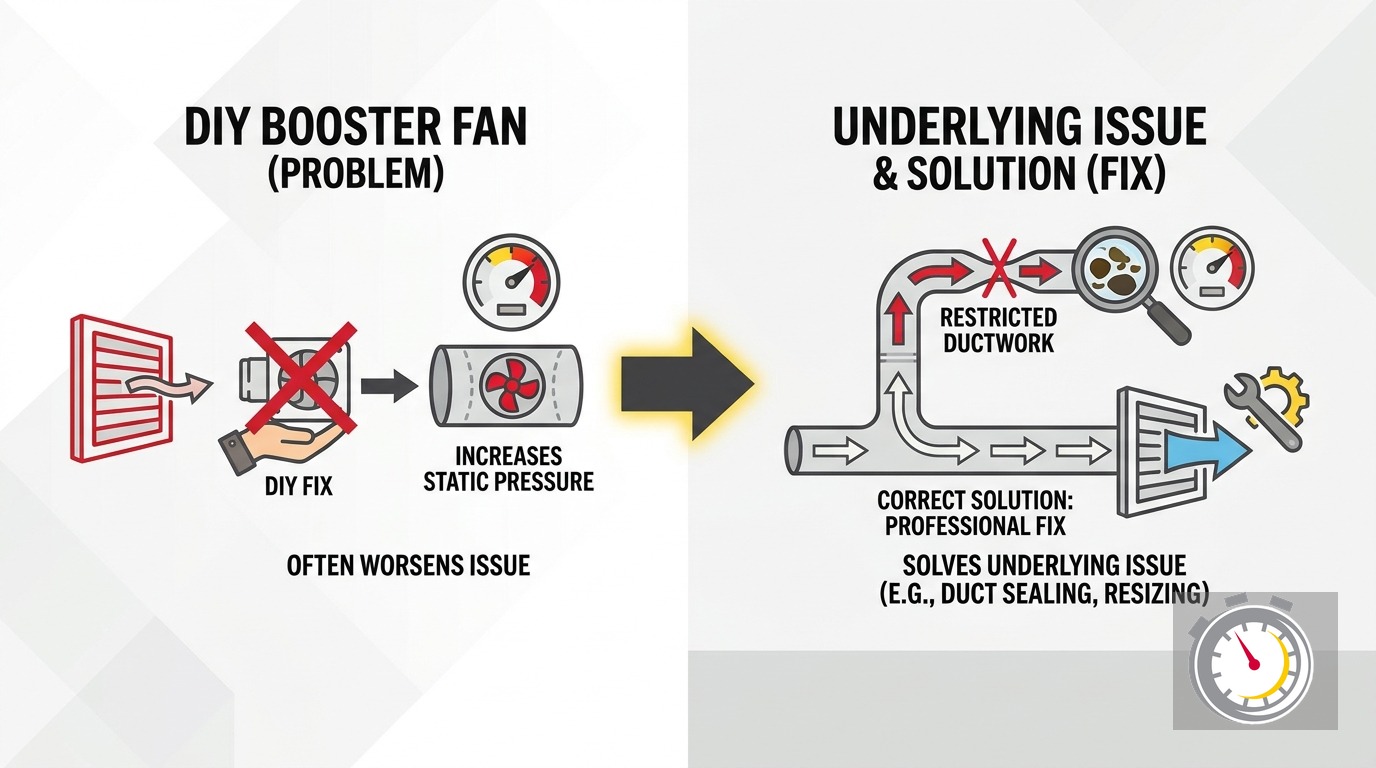
- Your blower, ducts, filter, and coil share one “pressure budget.” A booster can strain that budget.
- Leaky, kinked, or undersized ducts are the most common cause of weak rooms.
- Blocked return air starves the whole system and often causes the same symptoms.
- A technician can measure total external static pressure with a manometer. That number shows the real bottleneck.
- Check your filter, registers, and coil before you buy any fan.
- Sealing, return-air fixes, duct changes, and balancing solve the cause. A booster treats a symptom.
- Call (763) 260-6662 or book online, and we will find the actual bottleneck.
Does a Duct Booster Fan Actually Work?
Sometimes, but only in narrow cases. A duct booster fan can push more air into one branch of your ductwork. It cannot create air your system does not have. In most homes with weak rooms, the real problem is a leak, a restriction, or a design flaw that a booster hides or worsens.
Your furnace or air handler has one blower. That blower pushes air through every duct, filter, coil, and register in the house. A booster fan adds a second small fan to one duct, and the two compete.
Think of a garden hose with a kink. A second pump near the nozzle will not fix the kink. It just strains the hose.
We are a locally owned and operated Twin Cities HVAC company. We hear about booster fans every winter and summer. Homeowners buy them because a bedroom, bonus room, or basement feels off. Some are glad they did. Many are not.
What Is Static Pressure, and Why Does It Matter?
Static pressure is the resistance air meets as it moves through your ducts. It is measured in inches of water column. Higher resistance means the blower works harder and delivers less air. Every part of the system adds resistance: filter, coil, ducts, bends, and registers.
Most homeowners never hear this term. Yet it explains almost every airflow complaint.
Picture breathing through a straw. A short, wide straw is easy. A long, narrow, pinched one is hard. Your blower feels the same way about your ducts.
Every furnace and air handler is built to push air against a limited amount of resistance. That limit is the pressure budget. A dirty filter shrinks it. So do ducts that are too small, and so does a blocked return.
The range can be wide. A Building America report measured external static pressure of 0.12 to 1.22 in. w.c. in one small-diameter duct system. The same report says traditional systems are expected to run about 0.41 to 0.50.
That is a big gap. A system running far above its design range moves less air and uses more fan energy. The report notes that fan energy depends on fan and motor efficiency and on the static pressure restriction in the duct system.
Our guide on high static pressure symptoms and fixes covers the warning signs in detail.
Why Can a Booster Fan Make Airflow Problems Worse?
A booster fan can make things worse because it shares the same duct system as your blower. In many homes, it pulls air away from other rooms or raises resistance elsewhere. It may fix one room while quietly weakening three others. The right fix depends on why the room was weak.
No government or utility source states this outright. It is engineering reasoning based on the pressure facts above, so we say “can” and “often,” not “always.”
Here are the main ways boosters backfire.
They can rob other rooms. One duct often serves more than one room. Boost one register and you may pull air away from the rest of that branch. The room you fixed gets better. The room next door gets worse.
They fight the blower. The blower pushes air in, and the booster pulls it through. If the two are not matched, the duct can get noisy or airflow can turn uneven.
They hide leaks. If a duct leaks in the attic, a stronger fan pushes more conditioned air out through the leak. You may feel a little more air in the room. You also waste more energy.
They do not fix return air. If the return side is starved, the blower cannot pull enough air in. A booster on the supply side cannot change that. Our guide on return air problems explains this common cause.
They add noise and failure points. A booster is another motor, switch, and wire. Some hum. Some rattle the duct. Many go in with no way to adjust them or measure their effect.
Guessing wrong costs you the fan, the install, and the extra electricity. Then you still have a cold room.
Where Does a Duct Booster Fan Go?
A booster fan is installed inside a supply duct, usually close to the weak room’s register or on the branch that feeds it. Some models mount in the register boot itself. Placement is the easy part. Knowing whether the duct can support a fan is harder.
Common spots include:
- Inline in a round or rectangular branch duct, between the trunk and the register.
- Inside a register boot, replacing a standard grille.
- On a long run to a far room, such as a bonus room over a garage.
Each spot has trade-offs. An inline fan needs a clear stretch of straight, accessible duct. A register fan is easy to fit but small. Neither one measures what your system is doing.
A better question is why the duct is weak. If it is crushed, disconnected, or leaking in an attic, the fan is working on a broken pipe. If it is simply too small for the room, a fan only helps a little.
Flexible duct causes many of these problems. Sags, kinks, and tight bends choke airflow quickly. Our article on flex duct problems shows what to look for.
Bonus rooms and additions follow the same logic. A long run over a garage often loses air before it arrives. We cover that setup in our guide to heating and cooling a bonus room over a garage.
Check These Four Things Before You Buy a Booster Fan
Check four simple things before you spend a dollar on a fan. Each one can restore airflow for free or for a small cost. Many “weak room” calls end here.
1. The air filter. A clogged filter is the most common cause of poor airflow, and it adds resistance to the whole system. High-efficiency filters can help your air, but they also add pressure drop. The Building America duct systems guide notes that they can cause low airflow or higher fan electricity use. Check your filter now. Our post on how often to change your HVAC filter can help you set a schedule.
2. Closed or blocked registers. Walk through the house. Look for registers covered by furniture, rugs, or curtains. Make sure supply and return grilles are open. Closing vents in unused rooms does not save energy and can raise pressure. We explain why in our article on the myth of closing vents.
3. Closed bedroom doors. A closed door with no return path traps air in the room. The room pressurizes and airflow drops. This is a common cause of a bedroom that is too warm at night. Read more about closed doors and airflow.
4. A dirty evaporator coil or blower wheel. Dust and debris on the coil or blower wheel choke airflow at the source. You cannot see these parts without opening the unit. A tune-up visit checks them.
If all four look fine, the cause is likely in the ducts. That is when a measurement helps most.
How Does a Pro Measure What Is Really Wrong?
A technician uses a manometer to read total external static pressure. That number shows how hard your blower fights the duct system. Combined with a visual duct check, it tells you where air is lost. It is the most useful single test for weak-airflow rooms.
A duct retrofit guide from the Department of Energy calls total external static pressure a key health indicator for duct airflow. It says the reading should be taken with a manometer. It also says duct leaks cost the average home 20-30% of heating and cooling energy.
The guide makes a point most homeowners miss. Duct compressions of just 15% can increase pressure loss by 400-800%. A flattened or pinched duct does far more damage than it looks.
A good diagnostic visit usually covers:
- Static pressure readings on both the supply and return sides.
- A look at the filter, coil, and blower.
- A walk through accessible ducts in the attic, basement, or crawlspace.
- Checks for disconnected, crushed, or poorly sealed sections.
- Airflow checks at the rooms that feel wrong.
Once you have the numbers, the fix becomes clear.
What Actually Fixes a Weak-Airflow Room
The fix depends on the cause. In most Twin Cities homes, one of five repairs solves the problem. Each treats the root cause instead of adding a fan.
Seal the leaks. ENERGY STAR says about 20 to 30 percent of the air that moves through a duct system is lost through gaps, openings, and loose connections. It lists rooms that are difficult to heat and cool as a sign of poorly performing ducts. It recommends sealing leaks, insulating accessible ducts, and sealing vent and register connections where they meet floors, walls, and ceilings. We cover the process in our guide to duct sealing and energy loss.
Fix the return air. Many homes have too little return capacity. Adding or enlarging a return can lower pressure across the whole system. This often helps more than any supply-side change.
Resize or reroute weak runs. Some ducts are too small for the room they feed. Others are too long or have too many tight bends. A technician can resize a run, shorten it, or replace a section of flex duct with a smooth, correctly sized one.
Repair crushed or disconnected duct. A duct knocked loose during an attic project can leak for years. Reconnecting and sealing it restores flow right away.
Balance the system. After repairs, a technician adjusts dampers and registers so each room gets its share. You can try a basic version yourself. Our guide on balancing HVAC registers walks through the steps.
Sometimes the cause is the original design. The system may have been sized without a proper load calculation, called a Manual J. Our post on right-sizing your HVAC system explains why it matters.
Can a Heat Pump Work With Existing Ducts?
Often yes, but your ducts must handle the airflow a heat pump needs. Heat pumps move more air at lower temperatures than a gas furnace. Leaky, undersized, or restricted ducts can limit comfort and efficiency. A duct check before installation avoids a costly surprise.
Many homeowners are weighing a switch, and a weak room today may become a bigger problem after the change.
A gas furnace delivers very hot air. A heat pump delivers warm air in larger volume. If your ducts already struggle, the new equipment will struggle too.
You do not necessarily need all new ducts. Test first. A technician can measure static pressure, check the return, and find the weak runs before the install. Then you can fix those points at the same time.
Our guide on whether your existing ductwork will work with a heat pump walks through the checks, the warning signs, and the common fixes for Minnesota homes.
A booster fan is a poor way to prepare for a heat pump. It adds noise and uneven airflow to a system that needs smooth, balanced flow.
Why Do Weak-Airflow Rooms Show Up in January?
Ducts in unconditioned attics and crawlspaces lose the most heat in deep cold. When outdoor air drops well below freezing, any leak or uninsulated run costs you more. Weak rooms that seemed fine in October become obvious in January.
This is our field experience, not a published statistic. It matches what we see across the Twin Cities every winter.
A long duct through a cold attic loses heat on the way. A leak dumps warm air into the attic instead of the room. When the furnace runs longer to keep up, the duct problems get worse.
Common January trouble spots include:
- A bedroom at the end of a long attic run.
- A finished basement with ducts in a cold crawlspace.
- A second-floor room that is always cooler than the first floor.
- A room over an unheated garage.
If your upstairs is the problem, our guide on upstairs rooms that run too cold in winter covers the usual causes.
Winter is also when a booster fan looks most tempting. You feel the cold room right now, and a fan seems like a quick fix. But a cold room in January is a clue. It points to a duct issue that also wastes money in July.
Insulating accessible ducts is one of the lowest-cost improvements. Seal leaks first, then insulate. Together, they help more of the heat you pay for reach the room.
What the Real Fix Costs
The real fix costs more than a booster fan, but it solves the cause. Duct sealing starts around $1,300. Full ductwork replacement runs $6,500 to $13,000. Your price depends on access, duct condition, and home size. A diagnostic visit tells you which path fits.
A booster fan itself is a low-cost part. The full picture is wider than the sticker price. Add installation, electricity, noise, and the chance that the room still feels wrong.
Here is how the options compare:
- Booster fan: Lower upfront cost. May help one room. Can unbalance others. Leaves leaks and design problems in place.
- Duct sealing: Starts around $1,300. Cuts air loss. Often improves several rooms at once.
- Return-air fix or duct reroute: Cost varies with the job. Lowers system pressure. Treats the cause.
- Ductwork replacement: $6,500 to $13,000. Best when ducts are crushed, undersized, or failing across the home.
For larger jobs, we offer financing. Our post on HVAC financing options explains what to ask.
We tell you what we find and show you the readings. Then we recommend the smallest fix that solves the problem.
Are There Minnesota Programs That Help?
Yes, but be careful about what they cover. The Home Energy Squad is a good first step. It helps you find air leaks. We have not found a dedicated duct-sealing rebate from Xcel Energy or CenterPoint Energy, so confirm any rebate before you count on it.
The Home Energy Squad offers two visit types. The Energy Planner Visit is for homes built before 2000 and costs $100. The Energy Saver Visit is for homes built in 2000 or later and costs $70. It is free for income-qualified households. Both take 2 to 3 hours.
The Planner visit includes a blower door air-leak measurement. That test finds leaks in the house shell. The program page does not mention duct sealing, so do not expect it. Any Minnesota resident with a CenterPoint Energy or Xcel Energy account is eligible.
Shell leaks and duct leaks are different problems, and both waste energy. A shell leak test can still point you to bigger comfort issues. It pairs well with a duct check from a heating and cooling pro.
Utility offers change often. Read the current terms before you plan a project around a rebate. Our guide to Xcel and CenterPoint HVAC rebates is a good place to start. You can also review how programs combine in our post on CEE heat pump rebates and what stacks in 2026.
When Is a Booster Fan the Right Call?
A booster fan makes sense in a few narrow cases. The duct must be sound, the system must have spare capacity, and a pro should confirm both. Outside those cases, it is usually the wrong tool.
A booster may be reasonable when:
- Your static pressure is within the system’s design range.
- The duct to that room is sealed, clear, and correctly sized.
- The room is far from the unit and the run is long but healthy.
- A technician has checked that other rooms will not lose air.
Even then, a better answer may exist. A zoning damper or a duct modification can do the job with more control. If your home has uneven comfort across floors, see our article on HVAC zoning for two-story homes.
Order matters. Measure first. Fix leaks and restrictions second. Consider a fan last, and only if the numbers support it.
Ready to Fix the Room That Never Feels Right?
We find the actual bottleneck, show you the numbers, and recommend the smallest fix that works. Call (763) 260-6662 or book online, and we will schedule your visit fast.
Northern One Hour Heating & Air Conditioning is locally owned and operated in Ramsey, Minnesota. We serve Minneapolis, St. Paul, Blaine, Maple Grove, Plymouth, Brooklyn Park, Woodbury, Bloomington, and nearby Twin Cities communities. We know how our winters stress ducts. We also know how humid summers expose weak cooling.
Our on-time promise is simple. We arrive within the time window you select. If our technician does not show up on time, you do not pay for the service. That is our “Always On Time… Or You Don’t Pay a Dime!(R)” promise.
We also stand behind our work with a 100% satisfaction guarantee. Our pricing is honest and transparent, so you know the cost before work begins.
Before you buy a booster fan, let us look at the ducts. The real fix may be smaller, cheaper, and longer lasting than you expected. Call (763) 260-6662 or book online today.
Frequently Asked Questions
Will a booster fan fix a room that stays cold in winter? +
Is a duct booster fan loud or expensive to run? +
How do I know if my ducts are leaking? +
Should I turn the system fan to ON to help weak rooms? +
Need a technician now?