
CEE Heat Pump Rebate Minnesota: What Stacks in 2026
Key Takeaways
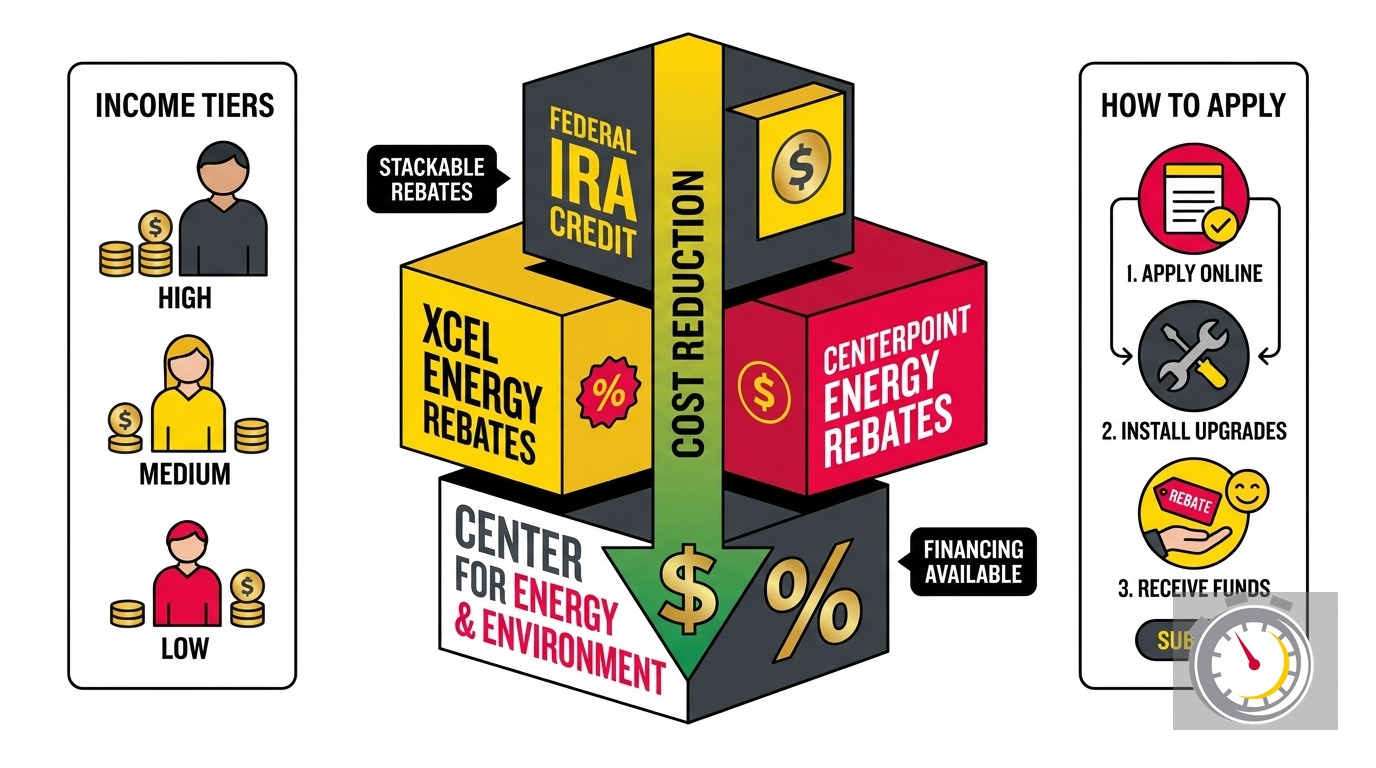
- The CEE heat pump rebate Minnesota homeowners ask about is the Minneapolis bonus rebate. It covers Minneapolis homes only.
- The bonus tops out at $20,000 for Green Zone residents and $6,000 for everyone else in Minneapolis.
- Finish the work first, then apply. Funds are first come, first served.
- The federal tax credit is gone for new installs. The state’s income-based rebates have not launched.
- CEE and MHFA loans work today. One has no income limit. The other caps income at $196,600 in the metro.
- The right order is install, utility rebate, then the CEE bonus.
What Is the CEE Heat Pump Rebate in Minnesota?
The Center for Energy and Environment (CEE) runs the Minneapolis bonus rebate program. It adds money on top of a utility rebate. There is no separate statewide version.
We looked for any other CEE rebate for heat pumps and found none outside the Minneapolis bonus. CEE does help with loans, and those reach more of the Twin Cities.
Here is the short version for fall 2026:
- Live now: The Minneapolis bonus, Xcel and CenterPoint rebates, and CEE and MHFA loans.
- Gone: The federal 25C tax credit for new installs.
- Pending: The state’s income-based rebate programs.
We are Northern One Hour, a locally owned and operated Twin Cities HVAC company, and we install heat pumps every year. This guide covers what you can use today and what you should not count on.
Does the Minneapolis Bonus Rebate Stack on Utility Rebates?
Yes, but it does not replace them. Your project must qualify for a CenterPoint or Xcel rebate first. The bonus and the utility rebate together cannot exceed your total project cost, according to CEE’s Minneapolis bonus page.
That cap bites on small jobs. If the rebates add up to more than the invoice, you lose the extra.
Who qualifies
The program covers 1-4 unit residential properties in Minneapolis. Co-ops, manufactured homes, and new construction are not eligible. Work must be completed after December 15, 2025. Funds go out first come, first served, per the same CEE page.
CEE lists no income tiers for this bonus. Your address sets the amount, and Green Zone residents get the higher figure.
Current bonus amounts
CEE lists these amounts for each upgrade. The utility rebate comes first, and the bonus sits on top.
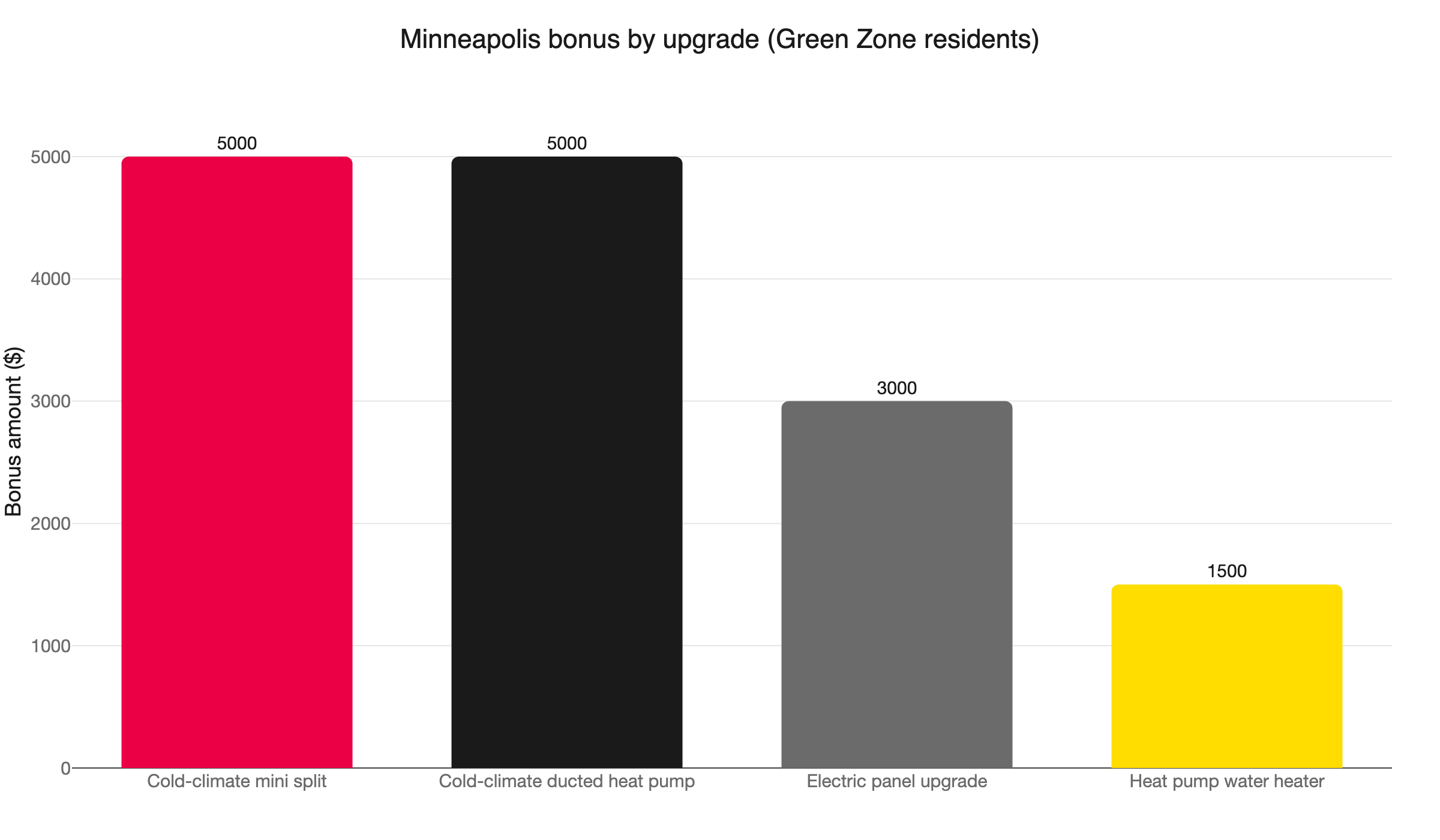
- Cold-climate mini split (non-ducted): utility rebate of $2,000. Bonus of $5,000 in the Green Zone or $1,000 outside it.
- Cold-climate ducted heat pump: utility rebate of $1,100 for gas customers or $900 for electric. Bonus of $5,000 or $1,000.
- Electric panel upgrade: utility rebate of $1,500. Bonus of $3,000 or $800.
- Heat pump water heater: utility rebate of $400. Bonus of $1,500 or $400.
All of these figures come from CEE’s bonus table. The chart above shows the Green Zone bonus by upgrade.
The program also lists a maximum of $20,000 for Green Zone homes and $6,000 for others. Those are program caps. Your real bonus depends on what you install.
Your equipment must meet cold-climate specs. For a mini split, CEE lists 16 SEER2, HSPF2 of 9.5, and a COP of at least 1.75 at 5°F. For a ducted system, it lists 15.2 SEER2 and HSPF2 of 8.1. Our guide to how HSPF2 and cold-climate ratings work explains those labels.
One note on the water heater. CEE’s energy disclosure page shows a different utility figure for that item. We use the $400 from the bonus table. Confirm the number when you apply.
What Utility Rebates Come First?
Utility rebates are the base layer, and the bonus depends on them. CEE says its energy disclosure page lists up to $2,000 from Xcel and CenterPoint for air source heat pumps. It also lists up to $1,500 from Xcel for panel upgrades.
CenterPoint is the gas utility for much of Minneapolis. For a ducted system, the bonus table lists a $1,100 utility rebate for gas customers. Your dealer files that application, not you. Processing can take weeks, so plan for the wait.
Xcel amounts can change at any time. Check your utility’s current page before you sign anything. Our Xcel and CenterPoint rebate guide covers the utility side in more detail.
We keep utility rules out of our quotes on purpose. Those numbers belong to the utilities. We tell you what we see today and point you to the source.
What Is Gone and What Is Still Pending?
The federal credit is gone for new installs. CEE says no energy efficiency tax credits are currently available. Improvements installed on or before December 31, 2025 can be claimed in the 2026 tax season. If your heat pump went in before that date, see our walkthrough on claiming the credit with Form 5695.
The state’s income-based rebates have not started. The Minnesota Commerce page says Save Energy Minnesota “has not launched yet”. The state is waiting on formal DOE approval, and there is no estimated launch date.
Here is what is planned:
- Eligibility is household income at or below 80% or 150% of county Area Median Income.
- HOMES rebates can offer meaningful savings per home, per the same Commerce page.
- HEAR caps are $14,000 per household at or below 80% AMI and $7,000 at or below 150% AMI, per CEE’s IRA FAQ.
Do not build your budget on those numbers. They exist only on paper.
HEAR is also not retroactive. If you install before it launches, you may not qualify for it later. That is the trade-off. If your furnace or AC is failing, waiting on an unlaunched program is a risky bet.
Some older articles still say the federal credit stacks with state money. That is no longer true. Treat any “stacking with the IRA credit” claim as out of date.
What Loans Can Cover a Heat Pump Today?
Two CEE and MHFA loans can cover a heat pump now. They differ on income limits, size, and security.
MHFA Home Energy Loan
This loan goes up to $60,000, with terms up to 20 years, and a mortgage secures it. CEE lists no income limits for solar, air source heat pump, insulation, and heat pump water heater projects.
The rate is 7%. The APR runs from as low as 7.553% on a 5-year term to 7.171% on a 20-year term.
You need a 1-4 unit, owner-occupied primary residence. The home cannot be in a trust’s name. You also need one bid from a licensed or registered contractor.
Unsecured Home Energy Loan
This loan goes up to $30,000 for 3 to 10 years and finances up to 100% of project costs. It is not secured by a mortgage.
It does have an income limit. The cap is $196,600 for the 11-county Twin Cities metro, plus Dodge and Olmsted counties. The metro counties are Anoka, Carver, Chisago, Dakota, Hennepin, Isanti, Ramsey, Scott, Sherburne, Washington, and Wright. The cap is $177,800 in all other counties.
The loan page lists a 7% rate. The APR is 7.21% for 5 years and 7.113% for 10 years. Another CEE page may show a different starting rate, so confirm the current rate with CEE before you commit.
Other loan options
CEE notes that some city programs offer 0% APR. Apply at application.mncee.org or call 612-335-5884, per CEE’s heat pump page. We have not verified a specific Minneapolis 0% loan, so ask CEE whether any are open.
We also offer financing for larger jobs. Our HVAC financing guide explains how to compare options. Call us and we will walk through them with you.
How Do You Apply, and in What Order?
Order matters here. Getting it wrong can cost you money.
- Pick a licensed or registered contractor. CEE requires one for the Minneapolis bonus.
- Confirm permits. CEE says to ask City inspections whether your project needs a permit.
- Confirm your equipment meets the specs. Cold-climate ratings drive every program above.
- Install the system. The work must be finished before you apply for the bonus.
- File the utility rebate. With CenterPoint, the dealer files it for you.
- Apply for the CEE bonus. Use the online portal at application.mncee.org/minneapolis-bonus-rebate-program and complete the Supplemental Application PDF.
All of these steps come from CEE’s Minneapolis bonus page. Keep your invoice, equipment model numbers, and rebate approvals together. You will need them.
For loans, start at application.mncee.org or call 612-335-5884.
One practical tip: do not sign a contract until you know who files what. Ask your contractor to put it in writing.
Are Heat Pumps Worth It in Minnesota?
For many homes, yes. A cold-climate heat pump can heat and cool your home with one system. Rebates and loans lower the upfront cost. The best fit depends on your home, your fuel, and your budget.
Where heat pumps pay off
Heat pumps move heat instead of making it, which makes them efficient in shoulder seasons. They also replace your AC, so one system does two jobs.
Rebates help most when you pair them with a needed replacement. If your AC is failing anyway, the incentive covers part of the gap. Our guide on whether heat pumps are a good fit in Minnesota goes deeper. Our heat pump vs. gas furnace operating cost comparison covers running costs.
Where they may not
If your home leaks air, a heat pump works harder than it should. Sealing and insulation often come first. Xcel lists a $600 bonus when insulation and air sealing come first and a qualifying heat pump follows within two years, per a search summary of its rebate sheet. We have not confirmed that figure on the Xcel page, so verify it before you plan around it.
Our air sealing guide shows why that step pays off.
Do Heat Pumps Work in Northern Minnesota Winters?
Yes, if you choose a cold-climate model. These systems are built to keep heating at low outdoor temperatures. Every program above keys on performance at 5°F. Sizing, installation, and backup heat still matter.
Why the 5°F spec matters
The programs require a COP of at least 1.75 at 5°F. They also require heating capacity at 5°F of at least 70% of the 47°F rating. That screens out models that struggle in our winters.
Real performance depends on your home too. A well-sealed home with proper sizing holds up better. See how systems behave in deep cold in our post on heat pump performance below zero.
Hybrid systems for backup
Many Twin Cities homeowners keep the gas furnace and add a heat pump. That is a hybrid or dual-fuel setup. CenterPoint’s path and the Minneapolis gas-customer path both fit it. Our dual-fuel guide explains how the two systems share the load.
CEE also notes a catch. A household that heats with gas and later applies for the federal rebate must pair the heat pump with a gas furnace or boiler, per CEE’s energy disclosure page. Ask about that before you remove a furnace.
What Is the Major Disadvantage of a Heat Pump?
The biggest drawback is upfront cost. A heat pump often costs more to install than a basic AC. In deep cold, it may also need backup heat, which raises operating cost. Good design and rebates reduce both problems.
Other trade-offs to know:
- Electric bills. Winter electric use rises. Our post on winter electric bill spikes explains why.
- Panel capacity. Some homes need an electrical upgrade, which takes a licensed electrician. We handle HVAC only. Our guide on panel upgrade requirements shows when it comes up.
- Air feel. Heat pump air feels cooler than furnace air, though it is still warm. See our warm air comparison.
- Snow and ice. Outdoor units need clear space in winter.
Panel work is one place the Minneapolis bonus helps. It lists $3,000 for a panel upgrade in the Green Zone and $800 elsewhere.
Can Heat Pumps Use Existing Ductwork?
Often, yes. Many ducted heat pumps use the same ducts as a furnace and AC. The ducts must be sealed, sized well, and in good shape. A bad duct system wastes the savings.
Heat pumps move air at different rates than furnaces. Leaky, undersized, or crushed ducts cause noise and weak comfort. We check ducts before we quote.
Read our guide on whether your existing ductwork works with a heat pump. You can also compare ductless and ducted options. Homes without ducts may suit a mini split, which our heat pumps page covers.
If your ducts need work, that cost is part of the project. Ask for it in the bid so rebates apply to the whole job where allowed.
How Does Staging Affect Your Bill and Comfort?
Staging controls when the heat pump and backup heat run. Poor settings burn extra electricity. Good settings lean on the heat pump and call the backup only when needed.
This is where installers earn their keep. A system with the wrong staging can cost more than it should. Our explainer on how heat pump staging works shows what to ask your installer. Our thermostat setback guide shows how to avoid triggering backup heat.
How Do You Avoid Losing Rebate Money?
Most lost rebates come from small mistakes. Watch for these:
- Applying too early. The Minneapolis bonus needs finished work.
- Skipping the utility rebate. The bonus depends on it.
- Wrong equipment. Models that miss the cold-climate specs do not qualify.
- Missing paperwork. Keep every invoice and approval.
- Waiting too long. Funds are first come, first served.
- Relying on old info. Programs change. Utilities say amounts can change at any time.
Check each program page the week you sign. Numbers in this post reflect what we found on October 26, 2026. They may have changed since.
Why Choose Northern One Hour for Your Heat Pump?
We are locally owned and operated. Our crews live and work in the Twin Cities. We know our winters and how these systems behave in them.
We also stand behind our schedule. Our promise is “Always On Time… Or You Don’t Pay a Dime!(R)” We arrive within the time window you select. If the technician does not show up on time, you do not pay for the service.
We give honest, transparent pricing and a 100% satisfaction guarantee. We will tell you if a heat pump is the wrong fit. Sometimes a high-efficiency furnace or a repair is the better move.
We cover HVAC only: heating, cooling, indoor air quality, heat pumps, and thermostats. For electrical work like a panel upgrade, you will need a licensed electrician. We can coordinate timing with your HVAC install.
Next Steps
Start with three questions:
- Do you live in Minneapolis? If so, the bonus may apply.
- Is your equipment failing now? If so, do not wait on unlaunched programs.
- Do you want financing? CEE and MHFA loans exist today, and we offer financing too.
Then get a bid. A written bid also helps with the MHFA Home Energy Loan, which asks for one bid from a licensed or registered contractor.
Call us at (763) 260-6662 or book online. We will review your home, explain what applies, and give you a clear quote. Apply in the right order, and the rebates pay out.
Frequently Asked Questions
Can I get the Minneapolis bonus if I live in St. Paul or a suburb? +
Does the federal tax credit still apply to a heat pump? +
Can I wait for the state income-based rebates before I install? +
Do I need a permit for my heat pump install? +
Who files the utility rebate paperwork? +
Need a technician now?