HVAC Settings When Leaving House for Extended Trip
Key Takeaways
- In winter, use 55 to 58°F. Do not go below 55°F in a Twin Cities home.
- Do not shut the furnace off for a winter trip. A cold, silent house is a frozen-pipe risk.
- In summer, raise the setting 7 to 10 degrees above normal. Do not turn the AC fully off.
- Keep indoor humidity under 60%. Turn the humidifier off or down before you leave.
- A remote temperature sensor or smart thermostat alert is your best early warning.
- Book a furnace tune-up and change the filter before you go.
- Name a neighbor or house checker who can get inside if the alert goes off.
- Have a power-outage plan. A dead furnace in subzero weather can freeze pipes within a day or two.
The Short Answer for Twin Cities Homeowners
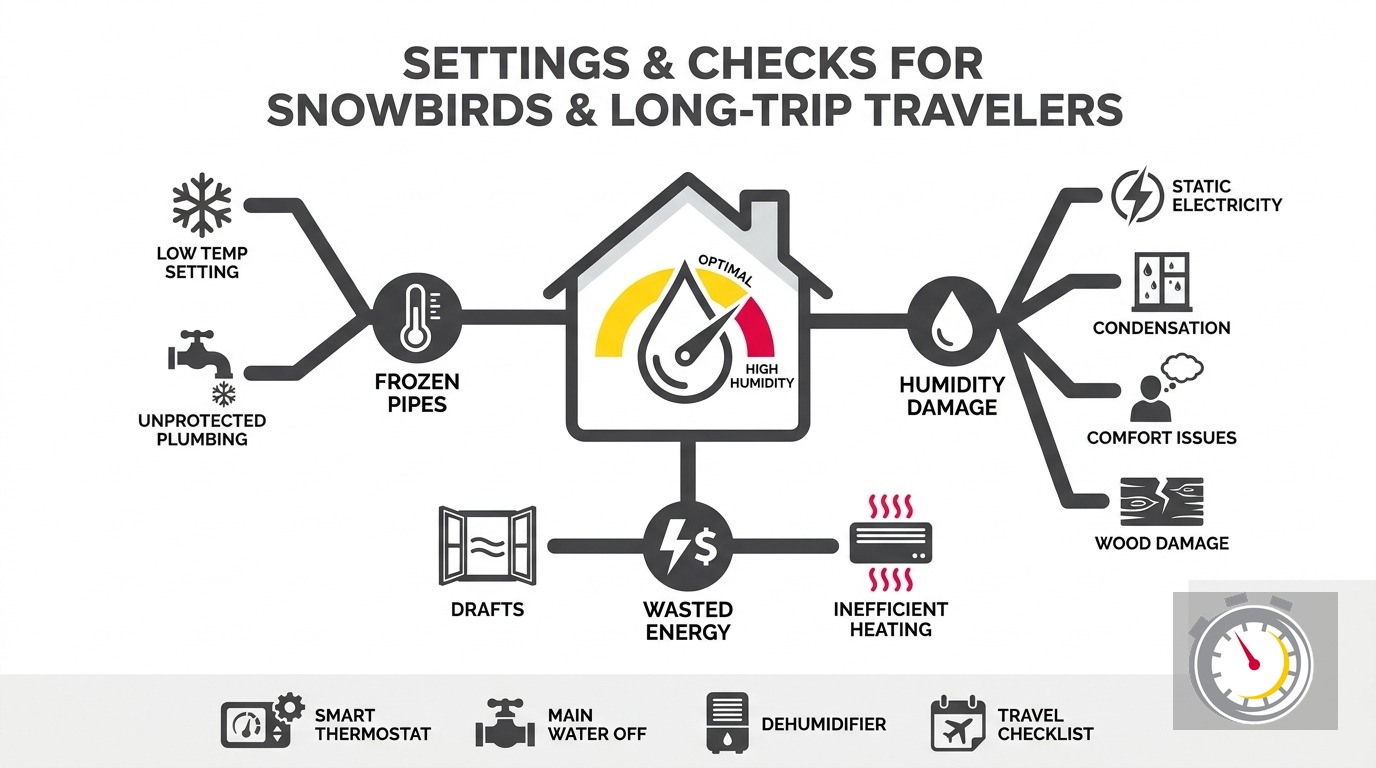
For a winter trip, set your thermostat to 55 to 58°F and leave the furnace on. For a summer trip, raise the setting several degrees above normal and keep humidity in check. Add a few checks and alerts, because the number on the thermostat does not protect a house by itself.
We are a locally owned and operated Twin Cities HVAC company. We have seen what an empty house goes through in a Minnesota January. Most problems trace back to a failed furnace, a power outage, or humidity nobody noticed. They rarely come from the thermostat number.
The advice below works for snowbirds who are gone for months and for anyone leaving for two weeks.
What temperature should I leave my heat on in winter?
Set the thermostat to 55 to 58°F for a winter trip in the Twin Cities. That range protects pipes during subzero stretches and still saves real energy. Going lower leaves little margin if the furnace struggles or the power blinks. Do not set it below 55°F.
Published advice varies a bit. Trane says to set it between 50°F and 65°F and not to go lower than 50 degrees. HVAC.com says to lower the setting 5 to 10 degrees and not go much below 55°F. Xcel Energy, a Minnesota utility, suggests 58 degrees when you’re away.
Those sources were written for the whole country, and our winters are harder than average. A Minnesota cold snap can hold below zero for days. A furnace that falls behind in that weather can lose ground fast in an empty house.
So we land on 55 to 58°F. A 50°F setting works in a mild climate. In the Twin Cities, it leaves you roughly five degrees from a trouble zone. The extra few degrees cost little. A burst pipe costs a lot.
What does the setback actually save?
Xcel Energy says that reducing the temperature by one degree can lower energy bills by up to 3%. That is a utility estimate, not a promise for your house. Your savings depend on your home’s insulation, your weather, and how long you are gone.
Most of the savings come from the first several degrees. Dropping from 70°F to 56°F captures much of the benefit. Dropping further adds little savings and a lot of risk.
For a deeper look at this exact question, read our post on what temperature to leave your house in a Minnesota winter.
Why do the experts disagree on the number?
Advice differs because the right number depends on your house. Pipes on exterior walls, an unheated crawl space, or a drafty older home all need a warmer setting. A tight, well-insulated newer home can sit a few degrees cooler. When in doubt, go warmer.
Here is how we pick a number for Twin Cities homes.
- Pipes on exterior walls or in a crawl space: Use 58°F. These pipes lose heat first.
- Older home with a drafty or poorly insulated attic: Use 57 to 58°F. Cold air finds the weak spots.
- Tight, newer home with pipes inside the heated envelope: Use 55 to 56°F.
- Finished basement with plumbing along the foundation: Use 57°F. Basement walls stay cold.
- Long absence of two months or more: Lean toward the warmer end. More days means more chances for a cold snap.
If you are unsure, pick the warmer number. Over a few months, the cost difference between 55°F and 58°F is modest. The cost of a frozen pipe is not.
Open the cabinet doors under sinks on exterior walls before you leave. HVAC.com also advises opening cabinet doors if you’ve had frozen pipes. Warm room air can then reach the pipes behind them.
Should I turn the furnace off completely?
No. Do not shut the furnace off for a winter trip in Minnesota. A system that is off cannot respond when the house gets cold. Leave it on with a low setpoint so it runs only when it needs to and protects your pipes.
You may see conflicting advice. Rheem says that for a week or longer you should turn the system off. That may make sense in a mild climate. It does not fit a Twin Cities winter.
Once the house cools to outdoor temperatures, pipes freeze. A shut-off furnace gives you no backup. A low setpoint gives you a safety net that costs very little.
There is one exception. If you winterize the home completely, a plumber drains the water lines, and the house holds no water to freeze. That is a bigger job, and it suits a seasonal cabin more than a primary home. Our post on seasonal lake homes and cabins covers that case.
What about humidity while I’m away in winter?
Keep indoor humidity under 60% and turn your humidifier off or down before you leave. A cold, empty house can let moisture condense on cold surfaces like windows and exterior walls. A humidifier running unattended makes that worse. Low humidity is safer than high humidity for a vacant home.
Most vacation advice treats humidity as a summer issue. In Minnesota it matters in winter too. The EPA says that the way to control indoor mold growth is to control moisture. It also says to reduce indoor humidity to 30-60% to decrease mold growth.
An empty winter house has no activity. Nobody opens doors, runs a bath fan, or cooks, and the furnace cycles rarely. A whole-home humidifier can keep adding water to air that is not moving. Over weeks, that can leave damp spots on cold walls and window frames.
Do these things before you leave:
- Turn the whole-home humidifier off, or set the humidistat low.
- Close the humidifier’s water supply valve if it has one.
- Run a bath fan and open the shower curtain so nothing stays wet.
- Empty any portable humidifiers and dry them out.
- Check window glass for fog or frost before you go. If you see it, lower the humidity setting.
The EPA also advises that you clean and dry any damp or wet building materials within 24-48 hours. That is another reason to have someone check the house. A small leak found in two days is a cleanup. Found in two months, it is a remodel.
If your home already runs damp in winter, see our guide to high humidity in winter in Minnesota homes. Our humidistat settings post explains how to set the control before you leave.
What should I set my AC to when I leave for vacation?
Raise the setting 7 to 10 degrees above your normal level and leave the AC on. For most Twin Cities homes, that means the high 70s to low 80s. Do not turn the system fully off. The AC also removes humidity, and an empty house needs that.
For a few days away, a constant setpoint somewhat higher than normal works better than shutting the system off. If you usually cool to 74°F, set it near 82°F.
Why not shut it off? HVAC.com warns that turning the system off in summer can let indoor humidity exceed 50%, which risks mold. Our summers are humid. A sealed house that heats up and stays sticky is a mold setup.
A few more summer tips:
- Close blinds and curtains on sun-facing windows. This cuts the heat the AC must fight.
- Set the fan to auto, not on. A constantly running fan can push moisture back into the house.
- Check the condensate drain line before you go. A clogged line can overflow while you are away. Our guide to a clogged AC condensate drain line shows how to spot trouble.
- Clear the outdoor unit of weeds, leaves, and debris.
- Skip the extremes. Do not set the AC above the mid 80s. Heat damages wood, electronics, and finishes.
Our post on the best AC thermostat setting for a humid Minnesota summer goes deeper on humidity targets. You can also use it to set your normal daily temperature.
Which pre-trip checks matter more than the thermostat setting?
Most of what keeps a house safe is a set of checks, not a setting. A furnace tune-up, a fresh filter, a humidifier shutoff, and a way to hear about trouble matter most. Do these one to two weeks before you leave, so you have time to fix anything you find.
Furnace tune-up and filter
A tune-up finds worn parts before they fail in the cold. A furnace that has not been checked in years is the most likely one to quit while you are gone. Our furnace tune-up service covers the checks that matter before a long absence.
Change the furnace filter before you go too. A clogged filter strains the system, and over a long absence a strained system has more time to fail.
Water heater
Lower the water heater setting before you leave. Xcel Energy says that lowering your water heater’s temperature 10 degrees can save 3-5% on water heating costs. Many tanks also have a vacation mode.
In winter, we do not recommend turning the unit fully off. A tank in a cold basement can freeze. Use the lowest setting that keeps it running.
Smoke and carbon monoxide detectors
Test them and replace dead batteries. You do not want to learn an alarm is dead after a long absence.
Doors, windows, and drafts
Close and lock every window. Check that the garage door and any basement door seal well. Cold air coming through a gap can chill pipes faster than the thermostat can answer.
Condensate lines on a high-efficiency furnace
A high-efficiency furnace drains water as it runs. In winter, a frozen or blocked drain can shut the furnace down. Our post on a frozen condensate drain on a high-efficiency furnace explains the signs. Check it before you go.
Heat Pump Homes: A Setback Caution
If you have a heat pump, do not use a big setback in winter unless your thermostat is built for heat pumps. A large temperature drop can trigger backup electric heat when the system tries to recover. That can run up your power bill and work against your savings.
Heat pumps recover differently than gas furnaces. A big swing from 56°F back to 68°F can call on the backup heat strips, which use much more electricity than the heat pump itself.
For a trip, a modest, steady setpoint is cleaner. Our post on the heat pump thermostat setback schedule for Minnesota winters explains how to set it. If you are unsure, call us before you go. We can look at your thermostat and tell you what works.
Plan the return too. Start warming the house the day before you arrive, not the hour you walk in. A smart thermostat recovery mode can handle that for you.
What if the power goes out while I’m gone?
A power outage is the biggest risk to an empty winter house. Without power, even a perfect thermostat setting does nothing. Set up a remote sensor that alerts you when the house gets cold, and name someone who can check on it.
Most furnaces cannot run without electricity. That includes gas furnaces, because the blower, controls, and igniter need power. In a Twin Cities cold snap, a house can drop toward freezing within a day or two, depending on how well it holds heat.
Here is a simple outage plan:
- Know your breaker panel. Make sure your checker knows where it is and which breaker feeds the furnace.
- Add a battery-backed sensor that alerts you when power drops. Some smart thermostats do this.
- Consider a standby generator if you travel for months every winter. It restarts the furnace on its own.
- Leave a printed card with the plan on the fridge or near the furnace.
For more detail, read our post on what to do when the power goes out and the furnace is off. If you are away for long stretches each year, ask us about a standby generator for a furnace or heat pump.
Who should check on your house while you’re away?
Name a neighbor, friend, or house checker who can walk through the home every week or two. Give them a key, the alarm code, and a short list of things to look at. A person on the ground catches what an alert cannot, like a drip, a smell, or a tripped breaker.
Smart devices tell you the temperature. They do not tell you why it is wrong. A person can see a puddle, hear a furnace short-cycling, or notice a smell.
Give your checker this short list:
- Confirm the thermostat shows the setpoint you chose.
- Feel for warm air at a vent while the furnace runs.
- Look under sinks and around the water heater for leaks.
- Check the basement and crawl space for damp spots.
- Look at windows for fog, frost, or condensation.
- Check that the furnace flue and vent outside are clear of snow and ice.
- Make sure no one left a door or window open.
Tell your checker whom to call. Give them our number, (763) 260-6662, and your own. Add the name of your plumber and your home insurance contact.
How do you set up alerts and a who-to-call plan?
Use a smart thermostat or a Wi-Fi temperature sensor that texts you when the house drops below a set temperature. Set the alert at 50°F. Then write down who calls whom when it fires. A fast, clear plan turns a possible disaster into a service call.
An alert only helps if it triggers action, so decide in advance what each one means.
- Indoor temperature falls below 50°F: Call your house checker. Ask them to go in and check the furnace and the thermostat. Call us if the furnace is not running.
- Power loss alert: Call the utility, then your checker. If the outage looks long, plan for pipe protection.
- Thermostat goes offline: Check your Wi-Fi first. A router glitch looks like a dead system. Have your checker confirm in person.
- High-temperature alert in summer: Call your checker and then us. The AC may have failed.
Set the alert threshold at 50°F, not at your setpoint. A working furnace will often dip a little, and you want a warning that means something, not a text every night.
If you do not have a smart thermostat, this is a good time to add one. Our post on smart thermostats in the Twin Cities explains what to look for. You can also browse our thermostat options.
Check that the thermostat has the wiring it needs. Our guide on C-wire compatibility for smart thermostats covers the common snag.
Smart thermostat or remote sensor?
Both work. A smart thermostat controls the system and reports the temperature. A standalone sensor only reports. If you want one device, pick the smart thermostat. If your current thermostat is fine, a cheap Wi-Fi sensor in the basement or a cold room adds a layer of warning.
Place the sensor where cold shows up first, such as a far corner of the house, near an exterior wall, or in the basement. Do not put it next to the thermostat, where it only repeats what the thermostat already knows.
What can a burst pipe do in Minnesota?
A burst pipe can soak floors, walls and belongings before anyone notices, and a vacant house gives it time.
A CBS Minnesota report covered Minnesota’s property damage from frozen pipes. The same report says State Farm advises that you keep your thermostat set above 55 degrees Fahrenheit.
Keeping some heat on while you are away protects against a large, messy claim.
An empty house makes it worse. When you are home, you notice a burst pipe in minutes. When you are away, water can run for days. That is why a checker and an alert matter as much as the setting.
Our post on frozen pipes and HVAC failure risk in Minnesota explains how a heating failure leads to frozen plumbing. If a pipe does freeze, do not thaw it with an open flame. Call a licensed plumber.
Your Pre-Trip Checklist
Print this and check it off. It takes about an hour.
Two weeks before:
- Schedule a furnace tune-up if it has been a year or more.
- Replace the furnace filter.
- Check the humidifier and plan to turn it off.
- Test smoke and carbon monoxide detectors.
- Order a smart thermostat or sensor if you need one.
One week before:
- Set up alerts and test that they reach your phone.
- Brief your house checker and hand over keys and numbers.
- Clear snow and ice from the furnace vent outside.
- Check the condensate drain line.
- Review your power-outage plan.
Day of departure:
- Set the thermostat to 55 to 58°F in winter, or raise it 7 to 10 degrees in summer.
- Turn the humidifier off or low.
- Lower the water heater setting.
- Open cabinet doors under sinks on exterior walls in winter.
- Close blinds in summer.
- Lock windows and doors.
- Confirm your phone shows the thermostat reading.
Before you return:
- Start warming or cooling the house about 12 hours ahead. Trane recommends warming the house about 12 hours before you return.
- Ask your checker for a quick report.
How Northern One Hour Can Help
We are a locally owned and operated Twin Cities HVAC company. We serve Minneapolis, St. Paul, Ramsey, Blaine, Maple Grove, Plymouth, Brooklyn Park, Woodbury, Bloomington, and the surrounding area. We know what a Minnesota winter does to an empty house.
Before you leave, we can tune up your furnace, check your thermostat, and set up a plan for alerts. If your system is aging, a pre-trip visit is a good time to find out. Our furnace tune-up service covers the checks that matter most.
When you book with us, we stand behind our on-time promise: “Always On Time… Or You Don’t Pay a Dime!(R)” We arrive within the time window you select. If the technician does not show up on time, you do not pay for the service. We also back our work with a 100% satisfaction guarantee.
Heading out soon? Call (763) 260-6662 or book online. We will get your system ready so you can enjoy the trip.
Frequently Asked Questions
How hot is too hot to leave your house while on vacation? +
Can I leave my AC off for a two-week trip in summer? +
Need a technician now?