
HVAC Runs Constantly Never Shuts Off: Causes and Fixes
Key Takeaways
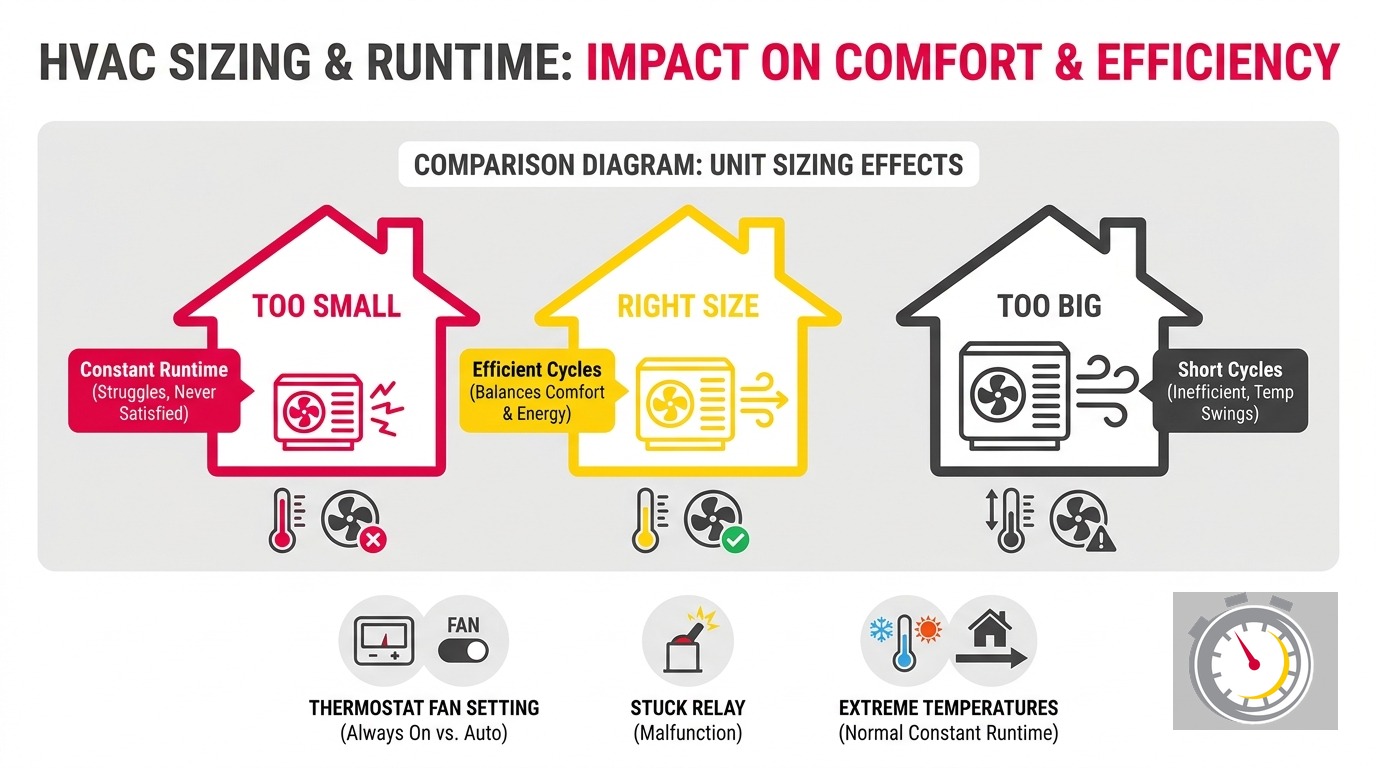
- Find out which part is running first: the blower alone, or the burners or compressor too.
- A thermostat fan set to ON is the most common harmless cause. Switch it to AUTO and wait.
- A stuck relay or contactor can keep equipment running. Turn the system off at the thermostat and the breaker, then call us.
- On the coldest or hottest days, long run times can be normal for a healthy system.
- An undersized system never catches up. An oversized system usually does the opposite and shuts off too soon.
- If the house is not reaching the set temperature, or you smell anything unusual, call (763) 260-6662.
Why Does My HVAC Run Constantly and Never Shut Off?
Most often the cause is a thermostat setting, a stuck relay or contactor, a bad thermostat, a clogged filter or dirty coil, low refrigerant, or equipment too small for the home. Extreme weather can also make long run times normal. The fix depends on which part is running.
If your hvac runs constantly never shuts off, you are probably worried about two things. One is your energy bill. The other is whether something is about to fail.
Both worries are fair. Still, constant running is not always a breakdown. Sometimes it is a setting. Sometimes it is just a very cold night in Minnesota.
Most online guides cover air conditioning only. In the Twin Cities, many of us notice this problem in January, with a furnace. So this guide covers both seasons.
We are Northern One Hour, a locally owned and operated Twin Cities HVAC company. We get this call all year, and this is how we sort it out.
Which Part of the System Is Actually Running?
The blower alone moves air without making heat or cold. The burners, heat pump, or compressor do the real work. Each points to a different cause, so this one check saves time and money.
Stand near a supply vent and ask three questions.
- Is air moving?
- Is the air warm, cool, or room temperature?
- Is the outdoor unit (in summer) or the burner flame (in winter) active?
Here is how to read the answers.
- Air moves, but it is room temperature. Only the blower is running. Look at the thermostat fan setting or a stuck fan relay.
- Air is warm and the furnace is burning. The furnace is heating. Think about cold weather, thermostat settings, or a heat loss problem.
- Air is cool and the outdoor unit is running. The compressor is on. Think about extreme heat, an undersized unit, a dirty coil, or low refrigerant.
- Outdoor unit runs, but the house never cools. That is a different problem. See our guide on why your AC keeps running but your home still feels warm.
Write down what you find. It helps us diagnose faster by phone.
Is the Thermostat Fan Set to ON?
If the fan is set to ON, the blower runs nonstop by design. Switch the thermostat to AUTO. The blower should then run only when the system is heating or cooling. This is the easiest fix and the most common reason a system seems to never stop.
Look at your thermostat. Most have a fan setting with two choices: AUTO and ON. Some also have a CIRC or circulate mode.
Here is what each does.
- AUTO: The blower runs only during a heating or cooling cycle.
- ON: The blower runs all the time, even when no heat or cold is being made.
- CIRC: The blower runs on a schedule, often a set number of minutes each hour.
Some homeowners choose ON on purpose. They want steady airflow to even out temperatures between floors. That is a fair choice. It does use more electricity, and in summer it can blow humid air back into the house.
We explain the tradeoffs in our guide to the thermostat fan AUTO vs. ON setting.
If the fan is already on AUTO and the blower still runs, the problem is deeper. A stuck relay, a bad thermostat, or a wiring fault may be holding the blower on. Our article on a furnace blower that runs constantly and won’t shut off walks through these causes.
Can a Stuck Relay or Contactor Keep the System Running?
Yes. A relay or contactor is an electrical switch. When its contacts weld or stick closed, the equipment gets power even when the thermostat says stop. In summer, this can keep the outdoor unit running. In winter, a fan relay can keep the blower on.
Think of a relay like a light switch. It should click open when the thermostat calls for the system to stop. If the contacts fuse together, the switch stays on.
Signs of a stuck switch:
- The outdoor unit keeps running after you set the thermostat well above room temperature.
- The system keeps running after you switch the thermostat to OFF.
- You hear a buzzing or chattering sound from the outdoor unit.
- The blower runs even with the fan on AUTO and the thermostat off.
A stuck switch is not a DIY fix. Parts carry high voltage. A running compressor with no control can also overheat or freeze up.
Here is a safe step. Switch the thermostat to OFF. If the equipment keeps running, turn off the system’s breaker. Then call us.
A failed capacitor can also cause odd behavior. A capacitor repair usually runs about $195 to $500, parts and labor. A control board is often around $750 installed. A technician can tell which part is at fault before you spend anything on a guess.
Could My Thermostat Be the Problem?
Yes. A thermostat that is miscalibrated, poorly placed, wired wrong, or failing can send a constant call for heat or cooling. Check the set temperature, the mode, and the screen first. If the display is blank or acts strangely, the thermostat may need service.
Check these simple items first.
- Is the mode set to HEAT, COOL, or AUTO as you expect?
- Is the set temperature far from the room temperature?
- Is a schedule or hold overriding your setting?
- Is the display working, or are the batteries low?
Placement matters too. A thermostat on a sunny wall, near a vent, or above a lamp can read wrong. It may think the room is warmer or cooler than it is, which can cause long run times or odd cycles.
Our thermostat troubleshooting guide covers the basics. Our team can also test, move, or replace a thermostat.
Why Does My Furnace Run All Day in a Minnesota Cold Snap?
In deep cold, a healthy furnace can run for long stretches. Heat leaves the house as fast as the furnace makes it. If the house holds its set temperature and the furnace eventually cycles off, that is usually normal. If the house keeps falling behind, something needs attention.
Furnaces are sized for the coldest weather we expect, not for a typical January day. On a night far below zero, the furnace may run almost without a break. That is the system doing its job.
Here is how to tell normal from a problem.
Likely normal:
- The house stays at or near the set temperature.
- The furnace shuts off for at least a short time now and then.
- The weather is extremely cold, and the wind is strong.
Likely a problem:
- The house slowly drops below the set temperature.
- The air from the vents feels weak or lukewarm.
- The furnace runs mild days as well as cold ones.
- You hear new noises, or smell something burning.
If the house cannot catch up, read our guide on a furnace that can’t reach the set point in extreme cold.
Common causes include a dirty filter, a blocked vent, leaky ducts, poor insulation, or a worn furnace that has lost capacity. An older home with drafty windows may simply need more heat than the furnace can supply.
If the furnace is not heating at all, treat it as urgent. A cold house in January is a real risk for your family and your pipes.
Is Constant Runtime Ever Normal?
Yes. At extreme outdoor temperatures, a correctly sized system can run for long periods. Designers size equipment for design temperatures that are not reached most days. Variable-speed and modulating systems also run long, low-output cycles by design. So long runtime alone is not proof of a fault.
Industry standards use design temperatures to size equipment. ENERGY STAR says designers should use the ACCA Manual J 8th edition 1% cooling and 99% heating design temperatures from the closest weather station.
In plain terms, a system is sized for the hottest and coldest weather a home usually sees. On those days, it may have little room to spare. That is when constant running is expected.
Two kinds of equipment run long on purpose.
- Variable-speed systems change output to match the load. They often run for a long time at low speed. That keeps temperatures steady and air moving.
- Modulating furnaces adjust the flame up and down. They run longer, quieter cycles than a basic furnace.
If you have one of these, long runtime is likely part of the design. Our guide to variable-speed AC benefits explains why. Our article on whether a modulating furnace is worth the cost covers the winter side.
Ask one question: does the home reach and hold the set temperature? If yes, long runtime is likely fine. If no, keep reading.
Can a Wide Thermostat Setback Cause Long Run Times?
Yes. If you set the temperature back by a large amount, the system has a long recovery run to bring the house back up. That can look like nonstop running on a cold morning. It is normal, but it may cost more than you expect with some systems.
The U.S. Department of Energy says you can save as much as 10% a year on heating and cooling by turning your thermostat back 7°-10°F for 8 hours a day from its normal setting.
That advice is sound for most furnace homes. A deep setback does mean a long recovery, though. If you drop the house far overnight, the furnace may run for hours in the morning to catch up.
Heat pumps need extra care. The same DOE page says programmable thermostats have generally not been recommended for heat pump systems, though some newer models make setting back cost effective. A big setback can trigger backup heat strips, which cost more to run.
Try a smaller setback for a week. If the “runs all morning” problem goes away, you have your answer. For more detail, see our guide on heat pump thermostat setback schedules.
Can an Undersized System Cause This?
Yes. An undersized system is too small for the home’s heating or cooling load. It runs nonstop on hot or cold days because it never catches up. You may see rooms that never reach the set temperature, even though the system runs for hours.
Undersizing can happen for several reasons.
- The original system was sized with a rule of thumb, not a load calculation.
- The home had an addition, a finished basement, or new rooms added later.
- The ductwork was changed or has too many leaks.
- The equipment has aged and lost capacity.
One clue: the system runs constantly on the hottest or coldest days, and the house still misses the set point. On mild days, it cycles normally.
The right way to size a system is a load calculation called Manual J. It looks at your home’s size, insulation, windows, air leaks, and local weather. We cover it in our guide to HVAC sizing and Manual J.
If a load calculation shows the system is too small, replacement may be the right move. A new furnace in the Twin Cities typically runs $3,900 to $7,800 installed. A mid-tier central AC replacement typically runs $7,500 to $10,400 installed. We offer financing on larger jobs, so you can spread out the cost.
Do not guess. A bad fix, like adding a bigger unit without checking ducts, can make things worse.
Does an Oversized System Cause Nonstop Running?
Usually not. Oversizing tends to cause the opposite problem: short cycles and poor humidity control. An oversized unit cools the air fast, then shuts off before it can pull much moisture from the house. The result can be a cool but clammy home and extra wear on parts.
Many homeowners assume a bigger unit is better. It is not.
ENERGY STAR notes that an oversized unit cools the room quickly but removes only some of the humidity. The Department of Energy’s Building America program adds that short cycling can cause poor humidity control and faster wear.
Signs of oversizing include these.
- The system turns on and off in short bursts.
- The house feels cool but sticky in summer.
- Some rooms are comfortable and others are not.
- The equipment is loud when it starts.
In Minnesota, humidity swings make this more noticeable in summer. See our article on oversized AC problems for more.
An oversized system can still run nonstop in one case. If the thermostat or a relay has failed, even an oversized unit can run without stopping. That is a fault, not a sizing issue.
A rule of thumb helps here. Nonstop running on extreme days points toward undersizing or normal design behavior. Short bursts point toward oversizing. Running with the thermostat off points toward a stuck part.
What Else Can Keep an HVAC System Running?
Several maintenance and airflow problems can force long run times. A dirty filter, dirty coils, low refrigerant, leaky ducts, and blocked vents all make the system work harder. These problems are common, often fixable, and worth checking before you assume the equipment is too small.
Here are the most common ones.
- Dirty filter. A clogged filter chokes airflow. The system runs longer to move the same heat or cold. Check it monthly in heavy-use seasons.
- Dirty coils. A dirty evaporator or condenser coil cuts heat transfer. Our guides on dirty evaporator coil symptoms and outdoor AC unit cleaning explain what to look for.
- Low refrigerant. A leak means the AC cannot move heat well. It runs and runs, but cooling is weak. Do not top it off without finding the leak.
- Leaky or crushed ducts. Air escapes before it reaches the rooms. The system runs longer to make up the loss.
- Closed or blocked vents. Blocked supply or return vents raise static pressure and cut airflow.
- Poor insulation or air leaks. The house loses heat or gains it faster than the system can handle.
- Open windows or doors. It sounds obvious, but it happens during a busy day.
Start with a fresh filter. A furnace filter that is too restrictive can also hurt airflow. We cover that in our guide on how often to change your HVAC filter.
What Does It Cost to Fix?
Costs vary by part. Simple fixes, such as a thermostat setting or a filter, cost little or nothing. A capacitor or flame sensor repair runs in the low hundreds. Larger parts, such as a blower motor or control board, cost more. A new system is the biggest expense.
Here are typical Twin Cities ranges, parts and labor.
- Single tune-up visit: $95 to $250.
- Flame sensor or igniter service: $95 to $325.
- Capacitor repair: $195 to $500.
- Control board, installed: around $750.
- Blower motor, installed: about $1,100 for a standard motor and $2,200 for a variable-speed one.
- AC compressor replacement: $1,950 to $4,500.
- After-hours or emergency premium: $180 to $270 per hour on top of standard rates.
These ranges depend on the brand, the model, and what else is found on the visit. Your technician will give you a clear price before work starts.
A maintenance plan can catch many of these problems early. Annual plans typically run $195 to $390. Our article on whether a maintenance plan is worth it breaks down the value.
You should know the cost before you say yes.
A Quick Checklist Before You Call
These steps take about ten minutes. They fix a surprising number of nonstop-running calls, and they give us useful information if you still need service.
- Check the thermostat mode and fan setting. Set the fan to AUTO.
- Raise or lower the set temperature by a few degrees. See if the system shuts off.
- Check for a hold or schedule override. Cancel it if you find one.
- Replace the filter if it is dirty. Make sure it is the right size.
- Open blocked vents and returns. Move furniture or rugs away.
- Look at the outdoor unit. Clear leaves, snow, or debris. Leave a few feet of space around it.
- Note what is running. Blower only, burners, or compressor?
- Note the weather. Is it an extreme day?
- Turn the system off at the thermostat. If it keeps running, turn off the breaker and call us.
Do not open panels or touch electrical parts. Do not try to bypass a safety switch. If you smell gas, leave the house and call your gas utility and 911 from outside.
When Should You Call a Professional?
Call when the system will not shut off with the thermostat off, when the house cannot reach its set temperature, or when you notice smells, noises, or ice. These point to a real fault. A technician can find the cause quickly and give you a clear price.
Call right away if any of these apply.
- The equipment runs even with the thermostat set to OFF.
- The house is cold in winter, or too hot in a heat wave.
- You see ice on the outdoor unit or refrigerant lines.
- You hear grinding, buzzing, or banging.
- You smell burning or gas.
- Your energy bill jumped with no change in weather.
Northern One Hour is a locally owned and operated team that knows Twin Cities homes. We know our winters, our humid summers, and the way older houses leak heat.
We also stand behind our schedule. Our promise is “Always On Time… Or You Don’t Pay a Dime!(R)” That means we arrive within the time window you select. If the technician does not show up on time, you do not pay for the service.
We also offer a 100% satisfaction guarantee. For larger jobs, such as a furnace or AC replacement, we can walk you through financing.
Is your hvac running constantly and never shutting off? Call us at (763) 260-6662 or book online. We will find out which part is running, why, and what it will take to fix it.
Frequently Asked Questions
Why does my HVAC run constantly and never shut off? +
Is it bad if my furnace runs all day in winter? +
Should my thermostat fan be on AUTO or ON? +
Can an oversized AC cause constant running? +
How do I tell if only the blower is running? +
Need a technician now?