Best Thermostat Setting Heat Pump Below Zero: Twin Cities
Key Takeaways
- Hold a flat setpoint. Big overnight drops force a hard morning recovery, and that recovery is when aux heat kicks in.
- Keep setbacks to two or three degrees at most. In a true deep freeze, skip them entirely.
- Stay in Heat mode. Emergency Heat is for a broken or frozen heat pump, not for cold weather.
- Know your balance point. This is the outdoor temperature where your heat pump needs help. Every home is different.
- Check your aux settings. Some thermostats let an installer set a lockout temperature. Have a pro confirm yours.
- Call early. A system that cannot hold the setpoint in a cold snap needs a technician, not more tinkering.
What Is the Best Thermostat Setting for a Heat Pump Below Zero?
The best setting is a steady 68°F in Heat mode, held all day and night with no big setbacks. A flat setpoint keeps the heat pump running at a calm, even pace. It avoids the hard recovery push that triggers electric backup heat.
The answer is simple. The reasoning changes how you use your thermostat all week, so it’s worth a minute.
A heat pump moves heat from the outdoor air into your home. It does this well in mild weather and works harder as the temperature falls. Below zero, it has less heat to pull from outside, and your house loses heat faster.
Your thermostat controls how hard the system works. A flat setpoint asks for a small, steady output. A big jump asks for a lot at once. The heat pump can’t deliver that, so it calls for help.
One equipment manufacturer recommends 68°F in winter while you are awake and home. That is a good anchor. Most Minnesota families can live with it in a sweater.
To apply it:
- Set the thermostat to Heat, not Auto or Emergency Heat, if your model offers those choices.
- Pick 68°F as your starting point.
- Leave it there for the full cold snap.
- Adjust by one degree at a time, and wait several hours before judging the change.
We are a locally owned and operated Twin Cities company. We see the same mistake every January. Homeowners chase comfort with big thermostat jumps, and the backup heat does the work. The utility bill shows it a month later.
How Cold Does the Twin Cities Really Get?
Cold enough to test any heat pump. Minneapolis-St. Paul hit 28 below zero on Jan. 30, 2019, and wind chills reached as low as 53 below. Your thermostat plan should be built for that kind of event, not for an average January day.
Many thermostat guides use a generic “very cold climate” row. We prefer real numbers from our own winters.
CBS Minnesota reported that MSP hit “28 below zero” on Jan. 30, 2019. That nearly matched a daily record of “30 below” set in 1887. The same report said wind chills reached “as frigid as 53 below zero.”
Nor was it a one-time event. The same report notes the Twin Cities hit 27 below in January 1996. Deep cold returns every few years.
Wind chill doesn’t change the air temperature your heat pump sees. It does change how your home feels and how fast it loses heat. Wind pushes cold air through gaps around windows, doors, and rim joists. That adds load on your system on top of the cold itself.
So plan for the worst week, not the average one. In practice:
- Your heat pump may run for hours without stopping. That is normal.
- Your house may lose heat faster on windy days than on calm days at the same temperature.
- Your backup heat may run more than you expect, even with good settings.
A deep-freeze plan can’t eliminate backup heat. What it can do is stop you from asking for it when you don’t have to.
Why Does Aux Heat Spike During a Deep Freeze?
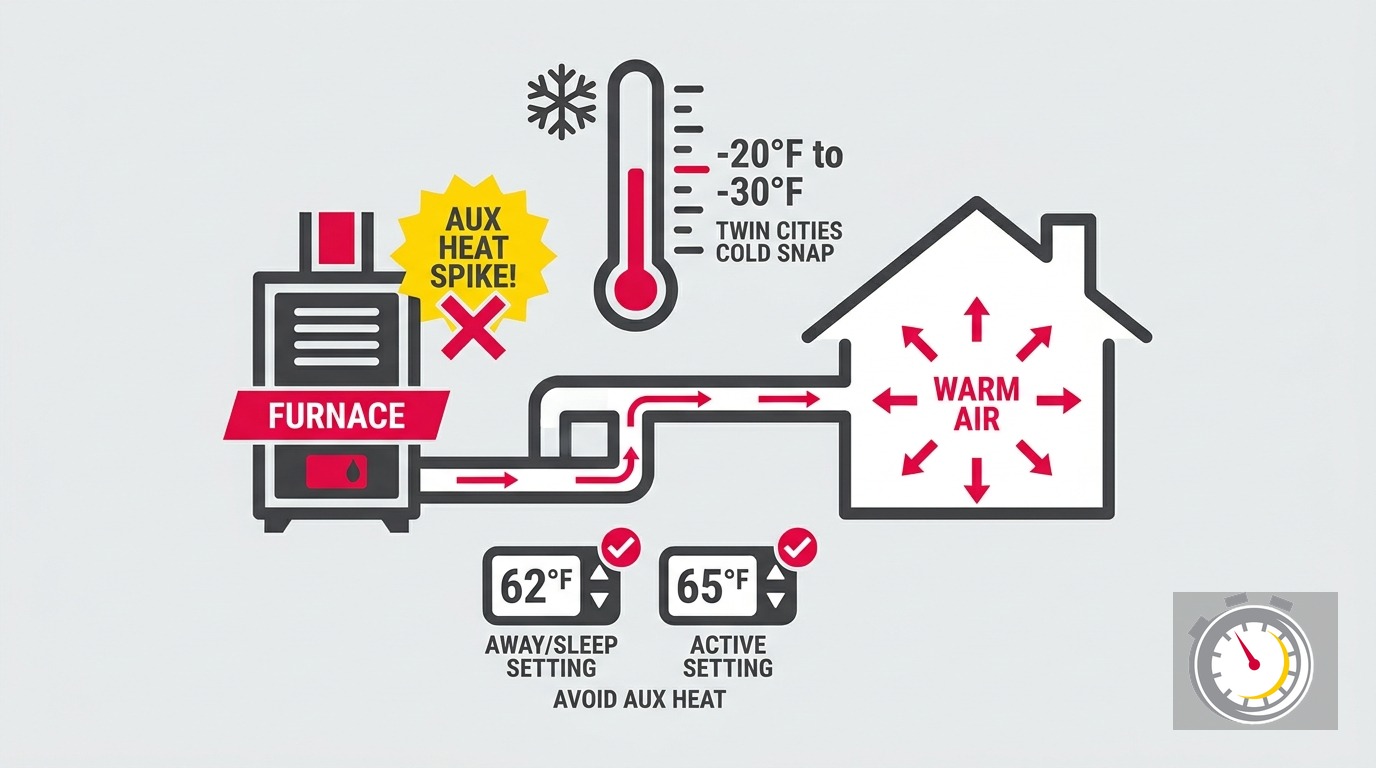
Aux heat spikes when the thermostat sees your home falling behind its setpoint. A big setback, a cold-soaked house, or extreme outdoor cold can all trigger it. The heat pump cannot catch up fast enough, so electric strips switch on to close the gap.
Auxiliary heat, or aux heat, is backup heating. In most homes it is a set of electric resistance strips inside the air handler. They work like a giant toaster. They heat the air quickly, but they use much more electricity than a heat pump moving heat.
The manufacturer’s guidance explains the trigger. If the indoor temperature falls two to three degrees below the setpoint, the thermostat calls for auxiliary heat. That detail is the key.
Say your setpoint is 68°F and your house drifts to 65°F or lower. The thermostat decides the heat pump isn’t keeping up. Aux heat comes on.
Three things cause that drift:
- A deep overnight setback. You drop the setpoint at bedtime and raise it in the morning. The gap is large, so aux heat joins in.
- Extreme outdoor cold. At some point, the house loses heat faster than the heat pump alone can supply. That point is your balance point.
- Wind and air leaks. Wind raises heat loss, so the house drifts below the setpoint even with no setback at all.
You can control the first cause. You can only partly control the third. The second depends on your equipment and your home.
The manufacturer also warns that “drastic temperature setbacks, such as lowering the heat by 10 degrees at night, can actually waste money.” That advice covers heat pumps in general. It matters even more when the outdoor reading is below zero.
For a deeper look at what those strips cost to run, see our guide to heat pump aux heat strips and operating cost.
How Do You Run a Heat Pump in Cold Weather?
Run it in Heat mode at a steady setpoint, keep the outdoor unit clear of snow and ice, and change your filter. Avoid Emergency Heat unless the heat pump is broken. Let the system run long cycles instead of fighting it with big thermostat changes.
Mostly, you stay out of the way. The system is built for winter. Your job is to remove obstacles.
Use this checklist before the cold arrives:
- Check the filter. A clogged filter cuts airflow. Less airflow means less heat delivered and more strain.
- Clear the outdoor unit. Snow, drifts, and ice can block airflow. Gently brush off snow after storms.
- Keep vents open. Closed vents and blocked returns raise pressure and cut performance.
- Seal obvious leaks. Weatherstrip doors and close the damper on an unused fireplace.
- Confirm Heat mode. Make sure nobody switched the thermostat to Emergency Heat by accident.
During the cold snap, follow these habits:
- Make one change at a time, and give it hours to work.
- Don’t crank the thermostat when the house feels cool. It won’t heat faster.
- Don’t turn off the system to “save” it. Cold-soaked walls and floors make recovery harder.
- Listen for new noises, and watch for ice on the outdoor unit.
Defrost cycles are normal in cold weather. The outdoor unit may steam or shed ice for a few minutes while it clears frost from its coil. Constant ice that doesn’t clear is a different story, and it needs a technician.
If you are in your first winter with a heat pump, our first-winter heat pump owner guide walks through what to expect.
A Deep-Freeze Week Plan, Day by Day
A flat setpoint is the core idea. This template carries it through a full week of dangerous cold. Adjust the numbers to your comfort.
Before the Cold Arrives (2 to 3 Days Out)
When the forecast shows a deep freeze, get ahead of it.
- Replace the filter if it is dirty.
- Clear snow from around the outdoor unit.
- Set the thermostat to Heat mode and your flat setpoint.
- If you normally use a schedule, switch it to hold. Let the house settle at your target before the cold hits.
- Close storm windows, seal drafts, and keep garage doors shut.
Preheating doesn’t mean running higher temperatures. You want the freeze to start with warm walls, floors, and furniture. Those materials hold heat and help your system.
Day 1 and Day 2: Hold Steady
Stay at the same setpoint around the clock. No bedtime drop. No “away” mode when you leave.
Expect long run times. Expect the system to feel less “blasty” than a gas furnace. Heat pump air often feels milder at the vents. That is normal and doesn’t mean something is wrong. We cover that in more detail in our post on how heat pump air feels compared with a gas furnace.
If aux heat runs, write down the outdoor temperature at that moment. That number is a clue to your balance point.
Day 3 and Day 4: Watch the Pattern
By now, the deepest cold has usually arrived. Check the thermostat a few times a day.
- Is the indoor temperature holding within a degree or two of the setpoint?
- Does aux heat run constantly, or only during the coldest hours?
- Is the outdoor unit clear of ice and snow?
If the house holds temperature and aux heat runs only at the coldest times, your plan works. If the house keeps falling, the system is undersized for that cold, or something is wrong. Call us.
Don’t try to fix a falling temperature by raising the setpoint. That usually increases aux heat use without making the house warmer.
Day 5 Through 7: Resist the Urge to Recover Fast
When the cold finally breaks, many people jump the thermostat up or down by several degrees. Resist that. Keep the setpoint flat until the outdoor temperature climbs well above zero.
Then make small moves. If you want to try a gentle setback again, keep it to a couple of degrees. Our heat pump thermostat setback schedule guide shows how to build one for Minnesota winters.
If Aux Heat Runs Anyway
Some aux heat in a deep freeze is normal. It shows the system is doing its job. Worry when it runs nonstop and the house still falls behind.
Try these steps in order:
- Check the filter and the outdoor unit for ice or snow.
- Confirm the thermostat is in Heat mode, not Emergency Heat.
- Confirm no one set a large setback in a schedule.
- Make sure vents and returns are open.
- Call a technician if the house still cannot hold temperature.
How Efficient Are Heat Pumps at Low Temperatures?
Heat pumps become less efficient as outdoor temperatures drop, because they have less heat to draw from outside. Cold-climate models are designed to hold up much better in Minnesota winters. Even so, efficiency below zero is lower than in mild weather, and backup heat costs more.
Efficiency is the trade-off in deep cold. At 40°F, a heat pump moves a great deal of heat for each unit of electricity it uses. At 0°F or below, it moves less.
The heat pump keeps working. It just works harder for each unit of heat, which is why the balance point matters.
The balance point is the outdoor temperature where the heat pump alone can no longer meet your home’s heat loss. Below it, aux heat helps. Above it, the heat pump handles the load alone.
Your home’s balance point depends on:
- How well your house is insulated and sealed
- The size and type of your heat pump
- Your setpoint
- Wind exposure and window quality
No single number fits every home. Some published guides give broad ranges, but your house isn’t average. A simple method can give you a practical estimate:
- Pick a calm, cold day, and hold a flat setpoint.
- Watch the outdoor temperature on a weather app.
- Note when aux heat first starts and stays on.
- Repeat on a few days and compare.
That estimate is a clue, not a measurement. A technician can use equipment documentation and a load calculation to confirm it. We would rather you verify with a pro than guess.
For more on this topic, read our guide on heat pump balance point and backup heat in Minnesota.
Why Cold-Climate Ratings Matter
Not all heat pumps handle deep cold equally. Minnesota’s state program uses a specific definition. Under the Minnesota Commerce Department’s program, a heat pump means “an ENERGY STAR certified, cold climate rated air-source heat pump.”
That wording makes a useful buying filter. If you are shopping for a heat pump in the Twin Cities, look for a cold-climate rating. It tells you the unit was designed for conditions like ours.
Should You Ever Use Emergency Heat?
Use Emergency Heat only if your heat pump is broken or frozen. It shuts off the outdoor compressor and runs backup heat alone. That costs more to run. Cold weather by itself is not a reason to switch it on.
Emergency Heat is the most misunderstood button on a heat pump thermostat. Many homeowners think it means “extra warm.” It doesn’t.
Per the manufacturer, Emergency Heat “manually disables the outside heat pump compressor”. It is meant for situations where “the main heat pump is broken or frozen.”
In Emergency Heat, the electric strips do all the work. They use far more electricity than the heat pump. The bill climbs fast, and the house may not feel any better.
Use Emergency Heat only when:
- The outdoor unit has failed or will not run.
- The unit is encased in ice that does not clear.
- A technician tells you to use it as a temporary measure.
Don’t use it just because the temperature is below zero. The heat pump still works at those temperatures. Leave the thermostat in Heat mode.
Our full explainer is in when to use heat pump emergency heat. If the unit has actually failed, call us right away. We cover heat pump repair across the Twin Cities.
Aux Lockout: A Setting to Ask About
Some thermostats offer an “auxiliary lockout temperature.” The manufacturer notes that some models offer an “auxiliary lockout temperature.” That setting blocks aux heat above a chosen outdoor temperature.
It can save money in mild weather. It can also leave you cold if it is set wrong. We don’t recommend a do-it-yourself number. Equipment varies, and the right number depends on your home.
Ask your installer to confirm your lockout and staging settings. Have them explain the numbers in plain English, then write them down for your records.
Do Minnesota Rebates Help if Your Heat Pump Struggles?
They can help if you are replacing or adding a cold-climate heat pump. Minnesota has a state rebate program, but as of its Oct. 12, 2026 update, the program had not launched. Check the state page for current status before you plan around it.
Sometimes the best fix for a struggling system is better equipment. A cold-climate heat pump, properly sized, handles deep freezes better than an older standard unit. Incentives can soften the cost.
The state program is the one to watch. According to the Minnesota Department of Commerce, the rebate amount depends on the cost of the project and any other rebates received. Income tiers apply, at 80% or 150% of area median income.
The same page carries a timing warning. Its latest update says Save Energy Minnesota “has not launched yet,” with no estimated launch date. Don’t count on the money until the state says it is open.
Utility programs vary by location. Minnesota Power, which serves northern Minnesota rather than the Twin Cities, lists 2026 rebates for cold-climate ducted or ductless heat pumps and for standard ones, through a participating contractor. That shows how much utilities favor cold-climate models.
Rebate rules change often. Confirm the details with your utility before you sign anything. Our overview of Minnesota heat pump rebates and tax credits is a good place to start.
If a replacement makes sense, ask us about financing. We can walk you through monthly payment options before you commit to a larger job.
Common Mistakes That Trigger Aux Heat
Most aux heat spikes come from habits, not equipment failure. These are the mistakes we see most often in Twin Cities homes.
- Deep overnight setbacks. A 10-degree drop sounds thrifty. In a deep freeze, it can cost more than it saves.
- Cranking the thermostat. A higher setpoint doesn’t heat the house faster. It only asks for more backup heat.
- Leaving Emergency Heat on. Some people switch it on during one cold snap and forget it.
- Ignoring the filter. A dirty filter cuts airflow and makes every cold day harder.
- Blocked outdoor units. Snow drifts and ice choke the coil.
- Closed vents in unused rooms. This raises pressure and can hurt airflow. Our post on closing vents in unused rooms explains why.
- Smart schedules left on. Many smart thermostats set their own setbacks. Review yours before winter.
Walk through that list before the next cold snap. Most homes fix several items in an afternoon.
When Should You Call a Pro?
Some problems aren’t a thermostat issue. Call a technician if you see any of these during a cold snap:
- The house falls more than a few degrees below the setpoint, even with aux heat running.
- The outdoor unit is covered in ice that does not clear.
- The system blows cool air in Heat mode.
- You hear grinding, banging, or loud vibration.
- The electric bill jumps far beyond what you expect.
Don’t wait for a worse day. Cold snaps stack up service calls fast, and a small problem becomes a no-heat emergency.
We are a locally owned and operated Twin Cities company, backed by the national One Hour Heating & Air Conditioning name. Our crews live in the communities we serve, from Ramsey and Blaine to Maple Grove, Plymouth, Woodbury, and Bloomington. We know what a January week at 20 below does to a home.
We also keep our promise on timing: “Always On Time… Or You Don’t Pay a Dime!(R)” We arrive within the time window you select. If the technician doesn’t show up on time, you don’t pay for the service.
When your heat is struggling in a deep freeze, that matters. You shouldn’t have to wait around and wonder.
To get started:
- Call (763) 260-6662 or book online to schedule fast.
- Tell us your thermostat model, your setpoint, and when aux heat runs.
- Share any outdoor temperatures you noted.
- Let us confirm your balance point, aux settings, and equipment health.
Good notes help us fix the problem faster. If you tracked outdoor temperatures during the cold snap, bring those too.
Your Deep-Freeze Thermostat Plan in One Page
Print this, or save it on your phone.
- Mode: Heat. Not Emergency Heat.
- Setpoint: Start at 68°F. Adjust one degree at a time.
- Schedule: Switch to hold during the freeze. No big setbacks.
- Outdoor unit: Clear snow. Watch for ice that does not clear.
- Filter: Fresh before the cold arrives.
- Notes: Write down the outdoor temperature when aux heat starts.
- Aux settings: Ask an installer to confirm lockout and staging.
- Help: Call (763) 260-6662 if the house cannot hold temperature.
There is no magic number for a heat pump below zero. Hold a steady setting, keep the equipment clear, and let the system do the work it was built to do.
Twin Cities winters are tough, and some years are tougher than others. If your system needs a closer look, we are ready to help. Call (763) 260-6662 or book online today.
Frequently Asked Questions
Is 72 too high to set your thermostat in the winter? +
Is it normal for my heat pump to run nonstop during a deep freeze? +
Need a technician now?