
Do Heat Pumps Work Below Zero in Minnesota? The Real Answer
Key Takeaways
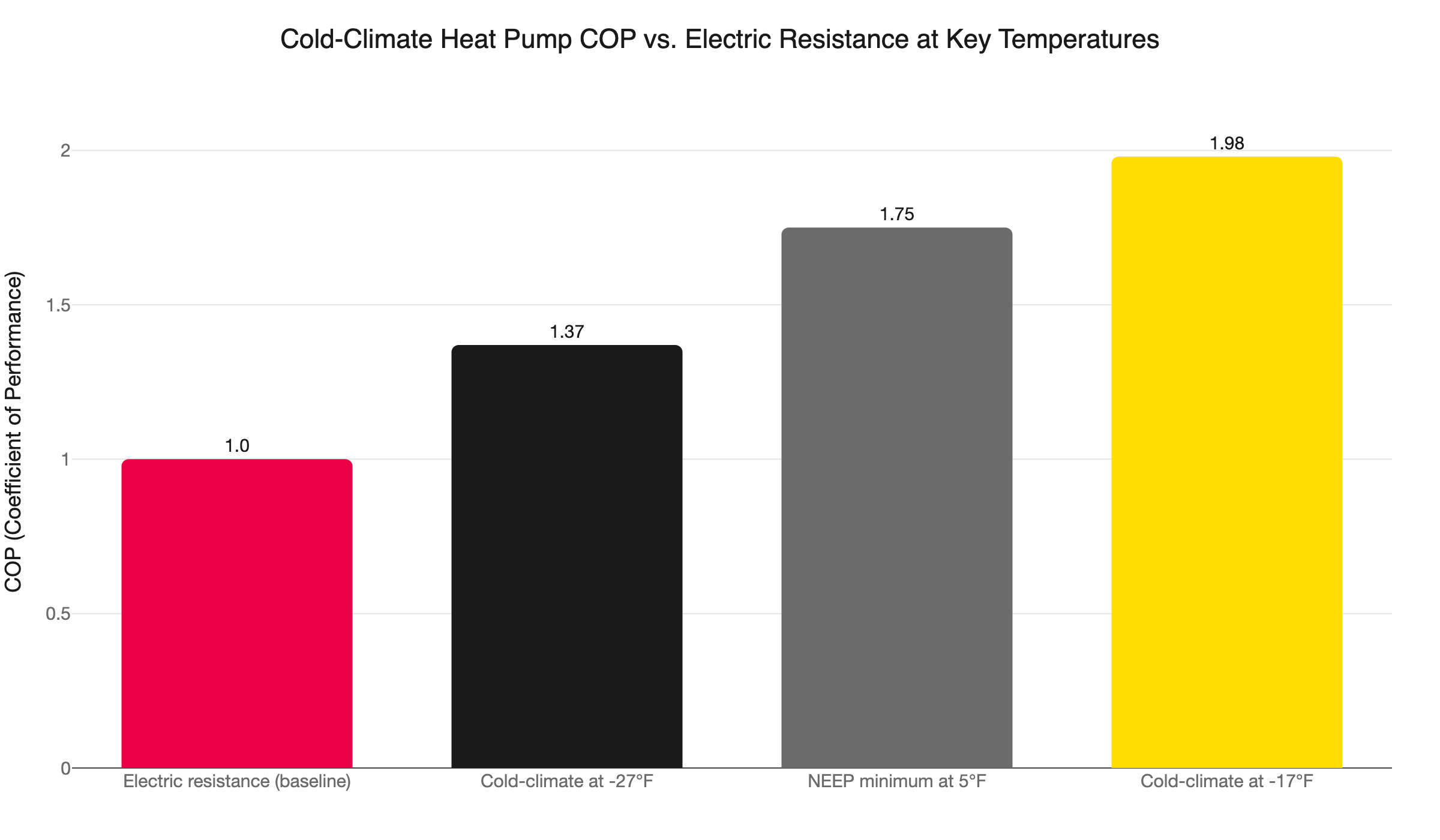
- Cold-climate heat pumps produce real heat well below zero. A Minneapolis system measured a COP of 1.98 at -17°F - nearly twice the output of electric resistance heat at the same temperature.
- At -27°F, that same system held a COP of 1.37: still 37% more efficient than electric baseboard heat.
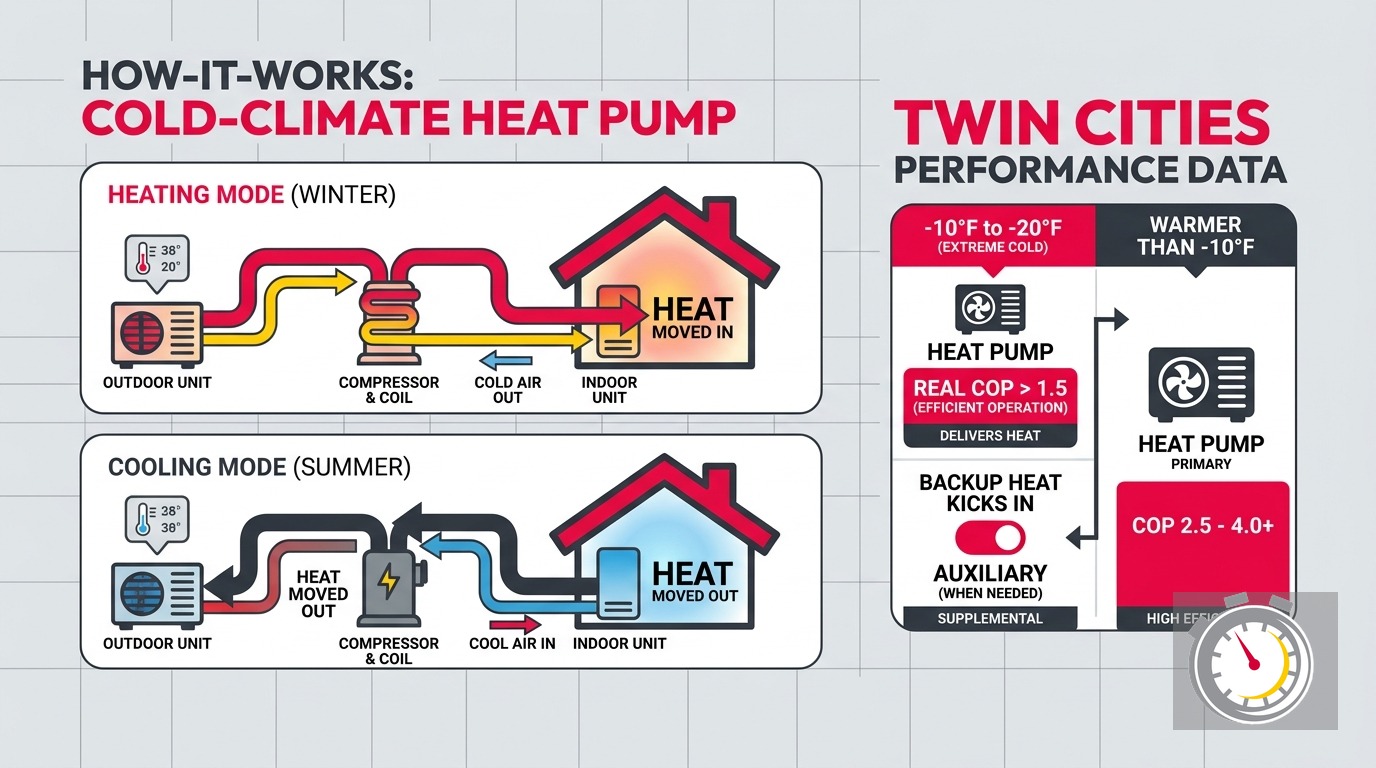
- Backup heat is designed in from the start. A dual-fuel system is programmed to hand off to the gas furnace around 0°F to 5°F. That is a thermostat setting, not a sign the heat pump quit.
- Natural gas homes: a full replacement to a heat pump rarely makes financial sense at current Minnesota gas prices. A dual-fuel hybrid is the honest recommendation for most Twin Cities homes.
- Propane and electric resistance homes have a clearer case. Cold-climate heat pumps can cut heating costs 30-55% for homes replacing those fuel sources.
- 2026 rebate update: the federal 25C tax credit expired December 31, 2025. Xcel Energy offers up to $2,000. CenterPoint Energy offers $1,100 for dual-fuel installs. The state HEAR program has not yet launched.
The most common objection to heat pumps in Minnesota comes down to one question. Will it actually work when the temperature hits -20°F?
The short answer is yes. The longer answer involves real performance data from a real Minneapolis home, an honest look at where natural gas still wins on cost, and a clear breakdown of what backup heat actually means. That is what this post covers.
Do Heat Pumps Work Below Zero in Minnesota?
Yes, and measured data from a Minneapolis installation backs that up. Cold-climate heat pumps produce useful heat at -17°F and beyond. Efficiency drops as temperatures fall, but the system keeps running. In a dual-fuel setup, the gas furnace takes over at the very bottom of the range by design, not by failure.
That answer surprises most Twin Cities homeowners. The “heat pumps don’t work in Minnesota” objection made sense a decade ago. Standard heat pumps from that era lost most of their capacity below 30°F and leaned heavily on electric resistance backup strips. Cold-climate models are a different product category built for northern climates.
Mitsubishi H2i, Daikin, and Bosch cold-climate models are rated to operate as primary heat down to -13°F. Below that threshold, backup heat picks up the remainder. In a typical Twin Cities winter, nights below -13°F are uncommon. The heat pump handles the large majority of your annual heating hours.
What Is COP and Why Does It Matter?
COP stands for Coefficient of Performance. It tells you how much heat you get per unit of electricity consumed. A COP of 2.0 means two units of heat for one unit of electricity: twice the output of electric resistance heat, which always has a COP of 1.0.
Any heat pump running above COP 1.0 beats electric resistance on efficiency. In practical terms: a higher COP means lower electricity costs for the same amount of heat delivered. The Minnesota question is how far COP drops at extreme cold - and whether it stays high enough to matter.
How Does a Cold-Climate Heat Pump Perform at -17°F and Below?
Better than most homeowners expect. A cold-climate Mitsubishi mini-split, tested over four winters in Minneapolis, delivered meaningful heat at temperatures well below zero. COP stayed above 1.0 throughout.
Here is what that Minneapolis installation measured at the temperatures Minnesota homeowners worry about most:
- At -17°F: COP 1.98. The unit drew 1,959 watts and delivered 13,000 BTU/hr of heat.
- At -27°F: COP 1.37. The unit drew 1,834 watts and delivered 8,597 BTU/hr of heat.
At -27°F, the system was still running. Still making heat. Still 37% more efficient than electric baseboard heat at the same outdoor temperature. Those conditions are also colder than most Minneapolis winters ever reach.
The Northeast Energy Efficiency Partnerships sets a minimum qualifying COP of 1.75 at 5°F for cold-climate heat pumps. Units on the NEEP approved list must also deliver at least 70% of their rated 47°F capacity at 5°F. These are verified, testable thresholds, not marketing language.
Standard heat pumps are a different product. Those units typically lose meaningful capacity below 30°F and lean heavily on electric resistance backup strips for a large share of the Minnesota heating season. If someone in your neighborhood had a poor heat pump experience years ago, they likely had a standard unit. Cold-climate designation is a meaningful engineering distinction.
When Does Backup Heat Actually Kick In?
Backup heat activates at a pre-programmed “balance point,” a temperature threshold your installer sets during commissioning. It is not the heat pump struggling. It is a deliberate handoff to the cheapest available heat source for the current conditions.
In most Twin Cities dual-fuel installs, the balance point is set between 0°F and 5°F. Above that temperature, the heat pump runs. Below it, the gas furnace takes over. The crossover is calculated on cost per BTU. At very low temperatures, the heat pump’s COP has dropped enough that natural gas costs less per BTU than the electricity the heat pump draws. The system stages to the cheaper fuel automatically.
This framing is what most heat pump articles miss. Your furnace running on a -15°F night is not evidence the heat pump gave up. It is evidence the system is working correctly - using the right fuel for the right conditions.
Cold-climate models are rated for primary heat down to -13°F. Below that limit, backup is recommended. Your installer sets the balance point to match the equipment’s rated operating range and your local electricity and gas rates.
Is a Heat Pump Worth It If I Already Have Natural Gas?
Probably not as a whole-home replacement. A dual-fuel hybrid, however, may be a strong option. This distinction is the honest answer most utility company content sidesteps, because the all-electric pitch does not favor natural gas homes at current Minnesota prices.
[The Center for Energy and Environment notes that replacing a gas furnace entirely with a heat pump is not cost-efficient for most Minnesota homes at current natural gas prices.](https://www.mncee.org/cold-climate-heat-pumps) Gas in Minnesota is inexpensive on a per-BTU basis. A heat pump has to outrun that cost advantage on enough heating hours to justify the equipment investment.
A dual-fuel hybrid changes the math. The heat pump handles mild fall days, cool spring nights, and moderate cold stretches. That covers the bulk of your annual heating hours - the period when outdoor temperatures stay above the balance point and the heat pump is the cheapest fuel source. The gas furnace covers the handful of deep-cold nights below the cutoff. You run electricity when it is efficient and gas when it is cheap. That split typically reduces both operating cost and total emissions compared to running the furnace alone all season.
The propane and electric resistance picture is much clearer. Cold-climate heat pumps can cut heating costs 30-55% for homes replacing propane or electric resistance heat. A NEEP study found roughly 3,000 kWh per year in savings when replacing electric resistance heat - and approximately 6,200 kWh per year when replacing oil heat. For those homeowners, the payback math is straightforward.
If you want a side-by-side annual cost breakdown for your specific fuel type, our post on gas vs. electric heat cost in Minnesota walks through the numbers in detail.
What Rebates Are Available for Heat Pumps in Minnesota in 2026?
The rebate picture changed at the end of 2025. The federal 25C tax credit expired December 31. Utility rebates from Xcel and CenterPoint are still active. A new state program is in development but not yet available. Here is the current status as of July 2026.
Federal 25C tax credit: Expired December 31, 2025. The credit offered up to $2,000 for qualifying cold-climate heat pumps. If you installed a qualifying unit during 2025 and have not yet filed your return, you may still claim this credit for that tax year. Check irs.gov or consult a tax professional. Installs completed in 2026 do not qualify.
Xcel Energy: Up to $2,000 for a qualifying cold-climate heat pump. The unit must appear on the NEEP approved list at ashp.neep.org, meet a minimum COP of 1.75 at 5°F, and retain at least 70% of rated 47°F capacity at 5°F. A $600 bonus is available when the install is paired with a qualifying insulation and air-sealing project. Verify current amounts at xcelenergy.com/rebates before scheduling, as program terms can change.
CenterPoint Energy: $1,100 for a ducted cold-climate heat pump installed in dual-fuel configuration alongside a gas furnace. Verify current terms at centerpointenergy.com before committing.
Minnesota HEAR program: Up to $8,000 for households under 80% of area median income. Up to $4,000 for 80-150% AMI. A maximum of $14,000 per household across all program rebates. As of July 2026, this program had not yet launched. Monitor mn.gov/commerce for updates.
Stacking utility rebates with the state HEAR program when it launches may be possible, depending on program rules. Our post on Minnesota heat pump rebates and tax credits covers stacking rules, income documentation requirements, and eligibility details.
Financing is available for larger heat pump installs. Ask our team about current options when you call.
What Is the Difference Between a Cold-Climate and a Standard Heat Pump?
A standard air-source heat pump performs efficiently down to about 30°F, then loses capacity rapidly. A cold-climate ASHP maintains useful output at much lower temperatures. In Minnesota, cold-climate designation is the minimum standard for any primary heating application.
Standard units below 30°F typically rely almost entirely on electric resistance backup strips. In a Minnesota winter, that means running electric resistance heat for a large share of the season. The cost advantage of a heat pump disappears when backup strips are doing most of the work.
Cold-climate models use a different compressor design and refrigerant cycle to maintain COP and capacity in deep cold. The NEEP qualifying threshold draws a clear, measurable line between the two categories. Ask any contractor quoting you a heat pump whether the specific unit appears on the NEEP approved list at ashp.neep.org. If they cannot confirm it, ask them to find a unit that does.
Should I Replace My Furnace With a Heat Pump, or Add One to It?
For most Twin Cities gas homes with a functioning furnace, adding a heat pump alongside the furnace makes more financial sense than replacing the furnace outright. You keep working equipment. You add heat pump efficiency for the bulk of the season. The furnace handles the coldest nights.
Here is the practical logic. If your furnace is under 10 years old and running well, consider the add-on approach. A dual-fuel install adds the heat pump outdoor unit and a compatible air handler. The existing furnace becomes the backup and deep-cold workhorse. You do not pay to remove functional equipment. You get heat pump efficiency during the large majority of heating hours when it makes financial sense to run it.
If your furnace is approaching 15-20 years, the timing may align for a combined replacement and heat pump install. Doing both at once reduces labor costs and can simplify rebate paperwork.
Our post on heat pumps in Minnesota - are they a good fit? covers sizing, comfort, and ductwork considerations in more detail.
What About Ductless Mini-Splits in Minnesota?
The Minneapolis performance data in this post came from a ductless Mitsubishi cold-climate mini-split. Ductless units use the same refrigerant-cycle technology as central heat pumps. The difference is in delivery: no ductwork required.
Mini-splits are a strong fit for specific situations:
- Older Twin Cities homes without existing ductwork
- Room additions, sunrooms, or converted spaces
- Individual rooms that run consistently cold or hot
- Attached garages where you want controlled heat without ductwork extension
If you are adding heat to a space without ducts, a cold-climate mini-split is typically the most efficient targeted option available. Our post on ductless mini-splits in older Twin Cities homes covers installation considerations specific to older Minnesota construction, including refrigerant line routing and wall penetrations.
How Cold Does Minnesota Actually Get?
Context matters here. The temperatures that make people nervous about heat pumps - -20°F and colder - are real in Minnesota, but not the norm.
Minneapolis averages roughly 13 nights per year below 0°F, based on historical climate data for the MSP area. Out of approximately 150 nights when a heating system runs at all during the season, a dual-fuel heat pump spends most in heat pump mode. The gas furnace covers the small fraction of nights at the bottom of the range.
The practical answer to “what happens at -25°F” is simple. The gas furnace runs. The heat pump idles. Your home stays warm. The system was designed for that scenario from the beginning.
Note: the 13-night average reflects general Minneapolis climate context. For precise historical data, NOAA climate normals for MSP International Airport are the authoritative source.
Getting the Right System for Your Home
Every heat pump decision depends on home-specific variables. No single recommendation covers every Twin Cities homeowner.
Key factors to work through before any install decision:
- Current heating fuel: Gas homes need a careful dual-fuel analysis. Propane and electric resistance homes typically have a clearer financial case for a cold-climate heat pump.
- Ductwork condition: Leaky ducts reduce heat pump performance. Sealing ductwork before or during install often delivers better efficiency gains than equipment upgrades alone.
- Home insulation level: A poorly insulated home places heavy demand on any heating system. Air sealing and insulation frequently have better payback than a heat pump on their own.
- System age: A furnace under 10 years old in good condition points toward the add-on approach. A furnace at 15-20 years often aligns well with a combined install.
Our heat pump installation and repair team walks through load calculations, equipment comparisons, and current rebate eligibility as part of any consultation. We do not recommend equipment until we have looked at your home’s actual numbers.
Ready to Schedule a Heat Pump Consultation?
We are locally owned and operated in Ramsey, serving the Twin Cities metro, including Minneapolis, St. Paul, Blaine, Maple Grove, Plymouth, Brooklyn Park, Woodbury, and Bloomington.
We size systems for Minnesota winters, not mild-climate averages from a product sheet. When you schedule with Northern One Hour, we stand behind our commitment: “Always On Time… Or You Don’t Pay a Dime!(R).”
Call (763) 260-6662 or book online to schedule a heat pump consultation. We will give you a straight answer on whether a cold-climate heat pump, a dual-fuel hybrid, or a different path makes sense for your home, your current fuel source, and your budget.
Frequently Asked Questions
Do heat pumps work in Minnesota winters? +
When does backup heat kick in on a heat pump? +
Are heat pumps worth it in Minnesota if I have natural gas? +
What heat pump rebates are available in Minnesota in 2026? +
Need a technician now?