
Heat Pump Error Codes: What They Mean and When to Call
Key Takeaways
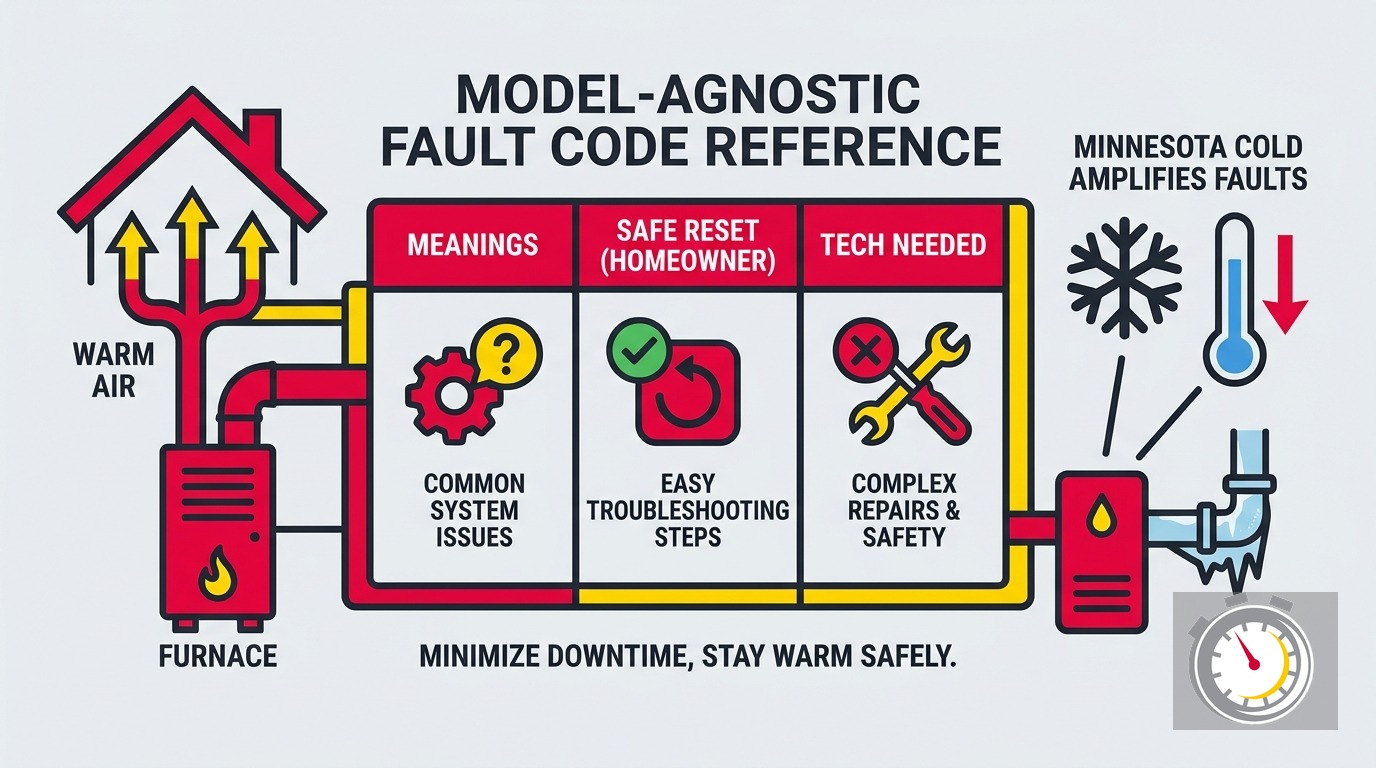
- Heat pump error codes appear on a thermostat display, the control board’s LED blink pattern, or a manufacturer app. Check all three.
- Soft lockouts clear with one reset. Hard lockouts return immediately and need a technician.
- Safe owner resets include a tripped breaker (first attempt only), a clogged filter, and a completed defrost cycle.
- Refrigerant fault codes are not sensor glitches. They usually mean the system is losing refrigerant charge.
- Minneapolis’s 99% heating design temperature is -15°F. A no-heat event overnight can freeze pipes, not just cause discomfort.
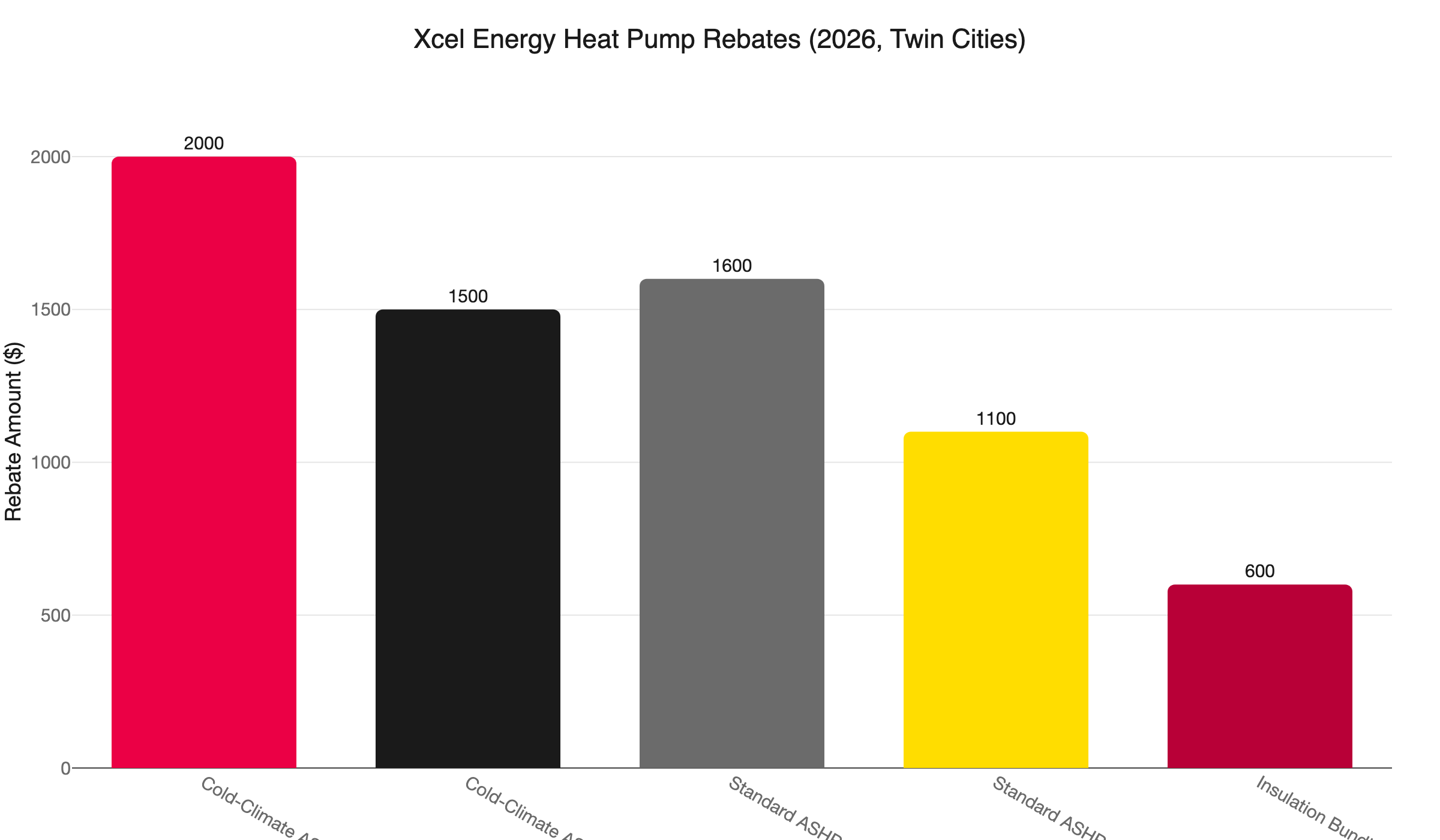
- Homeowners with qualifying cold-climate heat pumps may have up to $2,000 in Xcel Energy rebates tied to that unit. An ignored fault that kills the compressor means replacing equipment after the rebate window has closed.
- Any work involving refrigerant requires an EPA Section 608-certified technician. This is a federal requirement.
What Do Heat Pump Error Codes Mean?
Short answer: A heat pump error code tells you what your system observed, not what you should do next. The same code can point to three different root causes. This guide gives you a framework for reading any code, deciding whether to attempt a reset, and knowing when to call a technician instead.
When your heat pump displays an error, you have one decision: is this a soft lockout you can clear yourself, or a hard fault that needs a licensed tech? Getting that wrong during a Twin Cities cold snap can cost more than a service call.
Modern heat pumps run continuous self-diagnostics. When a sensor, motor, valve, or pressure reading falls outside the normal range, the system logs a fault code and often enters a lockout state to protect the compressor. The code is your starting point, not the diagnosis.
How Does Your Heat Pump Display an Error?
Short answer: Most units use a display code on the thermostat or air handler, an LED blink pattern on the control board, or a push notification from the manufacturer’s app. If one source is blank, check the other two before assuming there is no fault logged.
Display codes are the most readable. A two-digit code like “E3” or “F1” appears on the thermostat or the unit’s panel. Your owner’s manual maps each code to a fault category. If you no longer have the manual, search the model number plus “fault codes” on the manufacturer’s website.
LED blink patterns show on the control board inside the air handler or the outdoor unit. A short-and-long flash sequence corresponds to a code in the service manual. Write down the exact sequence before resetting anything. Pattern interpretation varies by manufacturer, so verify against your specific model’s documentation.
App notifications are how newer systems communicate. If your unit pairs with a manufacturer app, fault codes often appear there first with a plain-English description. Some apps log fault history, which gives a technician context on how long the fault has been active.
If your heat pump has no display and no app, and you cannot locate the service manual, do not pull components to read the LED board. That step belongs to a trained tech.
The Five Heat Pump Fault Code Categories
Manufacturers use different numbering schemes, but most heat pump faults fall into five categories. Knowing which category a code belongs to shapes your response before you open a manual.
Refrigerant and pressure faults indicate the system detected pressure outside its normal operating range. High-pressure codes often point to a blocked coil or refrigerant overcharge. Low-pressure codes usually point to low charge, a clogged filter, or a frozen coil. Both can damage the compressor if the system keeps running.
Electrical faults cover failed capacitors, failed fan motors, high-amp draws on the compressor, and communication errors between the outdoor unit and the indoor air handler. These often surface as hard lockouts.
Sensor faults mean a temperature sensor, pressure transducer, or defrost sensor is reading outside its expected range. Sometimes the sensor has failed. Sometimes the reading is accurate and the component it monitors is the real problem. A technician needs to distinguish between the two.
Defrost faults indicate the outdoor coil defrost cycle did not complete in the expected time, or the reversing valve did not switch correctly. In Minnesota, a recurring defrost fault deserves attention before severe cold arrives.
Communication faults show up when the control board loses contact with the thermostat, a remote module, or the outdoor unit. Check thermostat settings and wiring connections first. If the code returns, the control board or a wiring fault is the likely cause.
Which Heat Pump Error Codes Can You Reset Yourself?
Short answer: Codes triggered by a tripped breaker, a clogged filter, or a completed defrost cycle are within homeowner territory. The rule is one reset attempt. If the code returns, stop. It means the underlying cause is still there and the system is right to keep flagging it.
Here is what a safe owner-level response looks like:
- Tripped breaker: Reset once. If it trips again, leave it off and call. A breaker that trips repeatedly is protecting you from a wiring or motor fault.
- Clogged filter: A restricted filter starves airflow and can trigger a low-pressure or high-temperature code. Replace the filter and reset the code at the thermostat.
- Defrost cycle code: During very cold weather, heat pumps run frequent defrost cycles. If a defrost fault appeared briefly and heating resumed within 30 minutes, no action is needed.
- Post-power-outage code: A brief outage can leave a fault logged in memory. A single reset clears it.
The test is simple. Reset once, wait 15 to 20 minutes, and watch whether the code returns. If it does, you are done resetting.
Which Heat Pump Error Codes Mean You Should Call Now?
Short answer: Refrigerant fault codes, hard lockouts that return immediately after a reset, compressor fault codes, reversing valve errors, and any no-heat fault during below-freezing weather all require a licensed technician. Do not reset these more than once.
The distinction that matters: a soft lockout means the system paused because a condition temporarily exceeded its limits. It clears when the condition resolves. A hard lockout means the system shut down to prevent compressor damage or a safety hazard. It will not restart without root-cause repair.
Signs you are looking at a hard lockout:
- The code returns within minutes of a reset
- The outdoor unit is completely silent while the thermostat calls for heat
- The system blows room-temperature air with no warm-up
- Ice builds on the outdoor coil and does not clear during a 30-minute defrost cycle
If you see any of these during a cold night in the Twin Cities, this is a same-day call. With Minneapolis’s design temperature of -15°F, six or more hours without heat is a pipe-freeze risk, not a comfort issue.
Why Does Minnesota Cold Make Certain Faults More Urgent?
Short answer: Minneapolis experiences roughly 50 days per year where temperatures drop below 0°F, the threshold where most heat pump capacity falls steeply. A fault that is minor at 30°F in a warmer climate can trigger a full hard lockout at -10°F in the Twin Cities.
Air-source heat pumps can face efficiency challenges in extreme cold, and Minneapolis winters regularly include stretches cold enough to test their limits. When a unit is already working hard at 5°F, a fouled coil or low refrigerant charge pushes it from reduced output to a complete hard stop.
The indoor-to-outdoor temperature difference drives the stakes. On a -15°F night, your system must move heat across an 85-degree differential: indoor setpoint 70°F, outdoor -15°F. Any restriction compounds under that load in a way it would not in a warmer climate.
If your heat pump posts a fault code during a cold snap, treat it as urgent. Our guide on what to expect in your first Minnesota winter with a heat pump covers how to prepare your system and backup heat before cold weather arrives, including what emergency heat strips cost to run.
How Do You Diagnose a Bad Heat Pump?
Short answer: Read the fault code, check the filter and both breakers, inspect the outdoor coil for ice, confirm the thermostat settings, then attempt one reset and wait 20 minutes. If the code returns or the system still does not heat, call a technician.
A systematic owner-level check takes about 10 minutes:
- Read the code. Write it down. Note the time and the outdoor temperature.
- Check the air filter. A clogged filter triggers cascading faults. Replace it if visibly dirty.
- Check the outdoor unit. A thin frost coat is normal in cold weather. Heavy ice that covers the entire coil and does not clear during a 30-minute defrost cycle is not.
- Check both breakers. The outdoor unit and the air handler each have a dedicated breaker. Confirm both are on.
- Check the thermostat. Confirm it is set to “heat,” not “cool.” Confirm the set temperature is above the room temperature.
- Attempt one reset. Wait 20 minutes.
- If the code returns, stop. You are now at the point where a tech is needed.
Beyond step seven, diagnosis requires a refrigerant manifold gauge, a multimeter to test capacitors and motor windings, and the service manual for your specific model. If you have a dual-fuel hybrid setup, staging logic matters. See our guide on how heat pump staging works in Minnesota for the staging transition logic and what a low-stage fault looks like from the thermostat.
What Happens When a Refrigerant Fault Goes Ignored?
Short answer: A refrigerant fault code usually means the system is losing its charge, not just reading a bad sensor. Repeated resets on a low-refrigerant charge can overheat and seize the compressor. A leak repair costs far less than compressor replacement at $1,950 to $4,500 installed.
A slow refrigerant leak allows the charge to bleed out over days or weeks. The system keeps running at reduced capacity while the low-side pressure gradually drops. Eventually the pressure falls far enough to trigger a hard lockout. By that point, the compressor may have already run in a starved state and overheated its windings.
Modern heat pumps use R-410A or the newer R-454B. Both are high-pressure refrigerants. EPA Section 608 prohibits intentional venting of refrigerants while maintaining, servicing, or repairing HVAC equipment. Technicians who work on high-pressure refrigerant systems must hold an EPA 608 Type II or Universal certification. This is a federal requirement.
Do not reset the system repeatedly when a refrigerant code appears. Each restart on a low-charge system drives more heat into the compressor windings. Compressor replacement runs $1,950 to $4,500 installed. A refrigerant leak repair is a fraction of that cost.
For more on the warning signs before a compressor fails, see our post on heat pump compressor failure signs and replacement costs.
Who Can Fix My Heat Pump?
Short answer: A licensed Minnesota mechanical contractor who holds EPA Section 608 certification. Minnesota requires a $25,000 contractor bond filed with the MN Department of Labor and Industry. Ask for both credentials before authorizing any work.
Not every HVAC company works on heat pumps. The refrigeration cycle in a heat pump runs at higher pressures than a standard central AC. Diagnosing a reversing valve fault, a refrigerant leak, or a compressor issue requires training and equipment specific to heat pump systems.
Northern One Hour is locally owned and operated in the Twin Cities. Our team specializes in heat pump repair and service, covering fault code diagnosis, refrigerant work, electrical faults, and hard lockout root-cause repair. We serve Minneapolis, St. Paul, Ramsey, Blaine, Maple Grove, Plymouth, Brooklyn Park, Woodbury, and Bloomington.
We back every visit with our on-time promise: “Always On Time… Or You Don’t Pay a Dime!(R).” We arrive in the window you select. If we do not arrive on time, you do not pay for the service call.
Call (763) 260-6662 or book online to schedule a same-day diagnostic. If you have no heat during cold weather, let the dispatcher know. We prioritize no-heat calls.
How Utility Rebates Add Stakes to an Ignored Fault Code
If you installed a qualifying cold-climate heat pump in the last few years, a significant rebate may be tied to that specific unit. Ignoring a fault code that eventually leads to compressor failure means replacing equipment that already carried a rebate. The replacement unit will not qualify for the same program-cycle rebate.
Xcel Energy’s 2026 cold-climate heat pump rebate is up to $2,000 for combined gas and electric customers. Electric-only customers qualify for up to $1,500. The unit must be NEEP-listed and meet a minimum COP of 1.75 at 5°F, along with at least 15.2 SEER2 / 8.1 HSPF2.
CenterPoint Energy’s Minnesota heating rebate for qualifying ducted heat pumps in a dual-fuel configuration is available to eligible homeowners. The paired furnace must be 92%-plus AFUE, and the switchover temperature must be programmed at 40°F or lower.
The combined Xcel and CenterPoint opportunity for a qualifying dual-fuel system can reach $3,100. Deferring a fault code diagnosis and allowing compressor damage costs you the equipment and the rebate in the same event.
Does Adding a Heat Pump Require an Electrical Panel Upgrade?
Short answer: Often yes. Most cold-climate heat pumps need a dedicated 240V circuit. If your panel is near capacity, an upgrade is likely. A gas-to-all-electric conversion almost always requires additional electrical service. A load calculation before installation confirms what your current panel can handle.
Minneapolis requires both a mechanical permit and an electrical permit for heat pump installation. The mechanical permit application must name the backup heat source and its balance point. Minneapolis inspectors prefer cold-climate-rated units and may delay plan review by three to five days for non-cold-climate models. Typical permit costs: mechanical $150-$300, electrical $100-$200.
If you are planning a new install or a first-time conversion, start with a ductwork and electrical check. Our post on ductwork compatibility for Minnesota heat pump conversions covers load calculations and the questions to ask before installation day.
For a deeper look at electrical requirements, see our guide on heat pump electrical panel upgrade requirements for Minnesota homeowners.
The Bottom Line
Heat pump error codes are your system’s attempt to warn you before the problem grows. Some codes you can address in 10 minutes. Most are not in that category.
In the Twin Cities, the gap between “monitor and see” and “call now” is narrower than most of the country. A -15°F design temperature means a missed fault can turn into frozen pipes and a compressor replacement in the same week.
Reset once. Wait 20 minutes. If the code comes back, stop resetting and call.
Northern One Hour is locally owned and serves the Twin Cities metro. Call (763) 260-6662 or book online. We are built for Minnesota winters. “Always On Time… Or You Don’t Pay a Dime!(R).”
Frequently Asked Questions
How do you repair a heat pump? +
Need a technician now?