
Boiler Air Vent Leaking? What's Causing It and How to Fix It
Key Takeaways
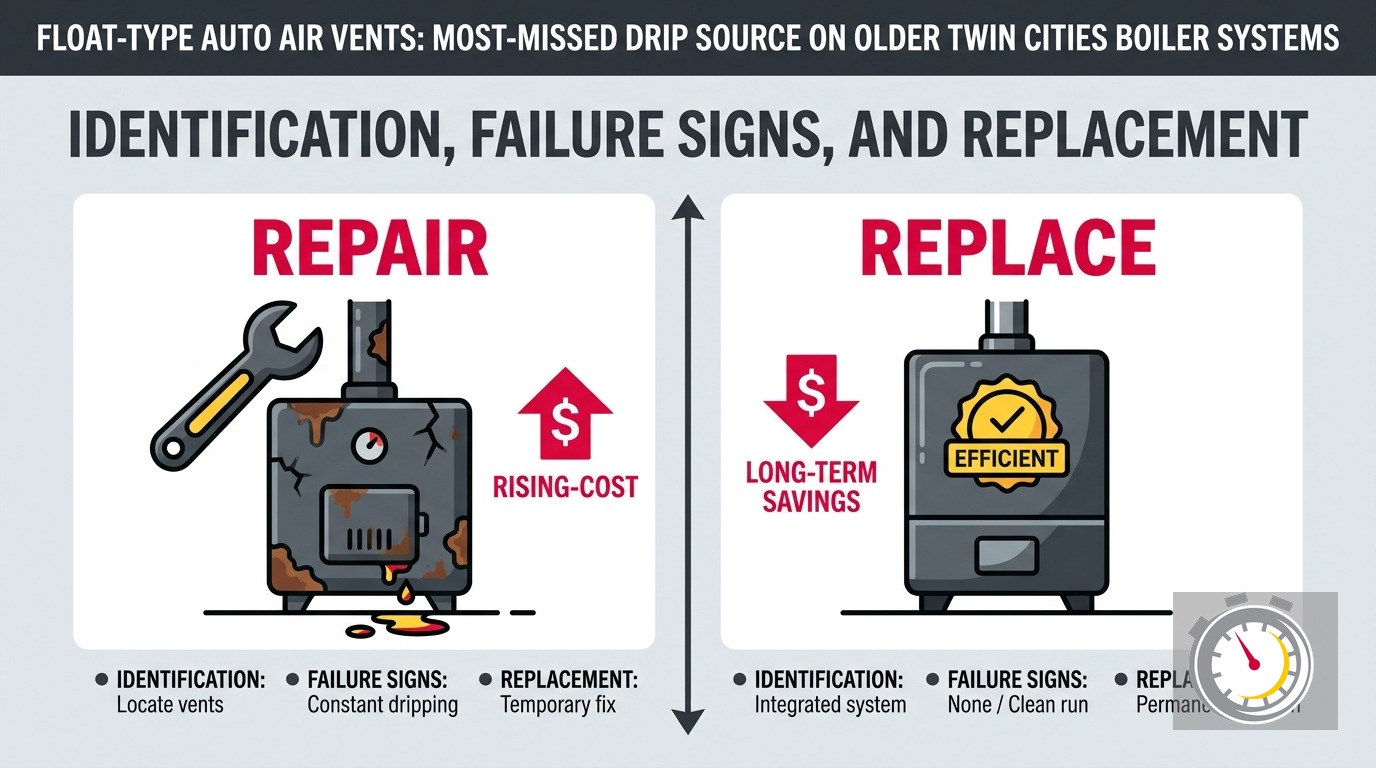
- A float-type automatic air vent is installed at the highest points in your hydronic system. The drip often lands on the floor several inches below the actual leak, so many homeowners never identify the source.
- The three main failure causes are mineral scale on the needle seat, debris from nearby pipe fittings (Teflon tape fragments are a documented culprit), and system pressure too low to hold the float fully seated.
- A dripping vent starts a chain reaction: pressure drops, the fill valve admits fresh water, dissolved oxygen enters the loop, and corrosion accelerates inside the boiler.
- A waterlogged expansion tank is a common companion failure. Replacing the vent without checking the expansion tank often means the problem returns within a season.
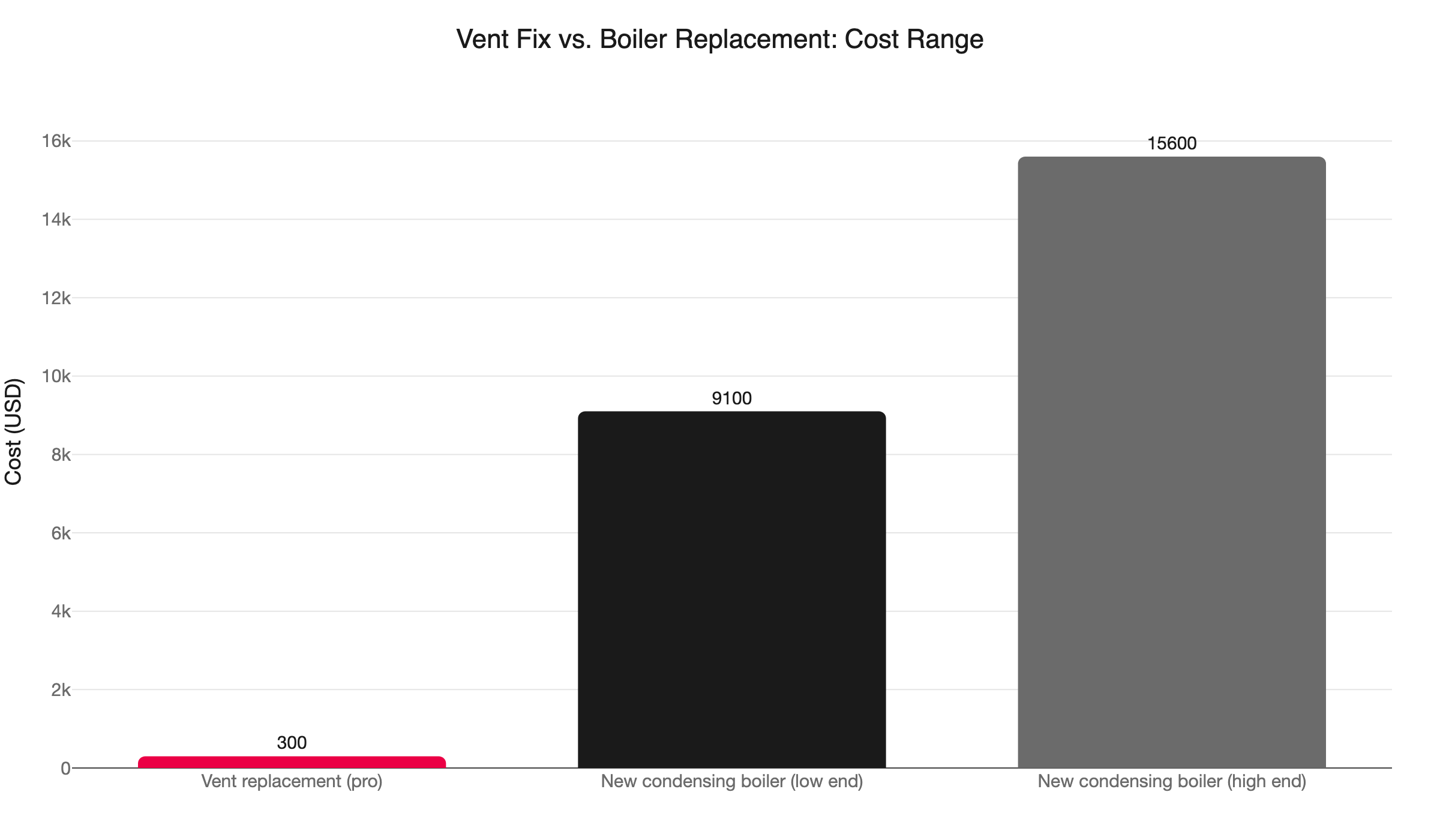
- Professional replacement costs $100 to $500. Ignoring the drip risks a boiler replacement starting at $9,100 for a condensing unit installed in the Twin Cities.
- Minnesota Mechanical Code Section 1206.12 requires that air can be completely removed from a hydronic system. The float vent is a required component, not an optional accessory.
If you have traced a drip near your boiler but cannot find exactly where it starts, look up. The float-type automatic air vent sits at the highest point of the boiler or at a peak in the piping loop. When it leaks, the water lands below it, not at the fitting itself. Many homeowners spend years assuming it is condensation.
A leaking boiler air vent is not just a nuisance. It sets off a chain reaction that accelerates corrosion inside the boiler itself. This post explains what a float vent does, why it fails, how to distinguish it from other boiler drip sources, and what to do before the damage compounds.
How Does an Air Vent Valve Work?
A float vent uses a small float connected to a needle valve inside the vent body. Air that collects there pushes the float down, the needle opens, and the air escapes. When water rises, the float rises with it and closes the needle. The cycle is automatic. In normal operation, no water escapes.
These vents are placed at the top of the boiler or at the highest points in the piping loop because air is buoyant and naturally collects there. The standard residential thread size is 1/8-inch NPT. Common models found in Twin Cities homes include the Watts FV-M1, Taco Hy-Vent 400-4, Amtrol No. 700, and Maid-O-Mist No. 67.
When the vent drips, the needle is not closing fully. That failure has predictable causes.
Why Is My Boiler Air Vent Leaking?
A leaking float vent almost always comes down to one of three causes: mineral scale coating the needle seat, debris lodged in the valve, or system pressure too low to hold the float seated. Any one of these prevents the needle from closing cleanly, and water weeps through even when there is no air to release.
Here is what each cause looks like in practice.
Mineral scale on the seat. Each time water evaporates at the vent opening, it deposits dissolved minerals on the needle seat. Over years, that buildup prevents a clean seal. In Twin Cities homes with cast-iron piping from the 1950s, 1960s, and 1970s, those deposits compound season after season without anyone cleaning the seat between vent replacements.
Debris inside the valve. HVAC technicians on Heating Help’s professional forum consistently identify Teflon tape fragments as a top cause. When plumbing or HVAC work is done near the vent and Teflon tape is used on threaded fittings, small strands can break free, travel to the vent, and lodge in the needle seat. The fragment holds the needle fractionally open. The drip begins.
Low system pressure. Float vents seal best at 5 psi or higher. In systems where the boiler sits below the first floor and serves radiators on upper levels, the cold-fill pressure needs to be at least 12 psi to maintain a water column at the high-point vent. Below that threshold, the float rides low and the needle stays slightly unseated. The result is a slow, persistent drip in a valve that is otherwise in acceptable condition.
What Causes an Intake Valve to Leak?
A boiler’s fill valve, sometimes called the intake or makeup water valve, leaks for different reasons than a float vent does. A worn diaphragm, scale on the valve seat, or a failing seat ring can each prevent it from closing after admitting water. The drip point is typically at the fitting itself, not at a high-point cap.
The distinction matters because the two components interact. If the float vent is dripping and dropping system pressure, the fill valve opens more often. That extra cycling accelerates diaphragm wear. On a system that has been dripping unnoticed for years, both components may need attention at the same visit.
The most useful detail you can give a technician is the exact drip location: high on the boiler or piping, near the ceiling (float vent), or at the supply line fitting near the boiler’s water connection (fill valve).
Why Is My Central Air Vent Leaking Water?
If the drip is coming from a small valve near the top of your boiler or at a piping peak, that is the hydronic system’s air vent. “Central air vent” is a phrase that sometimes creates confusion between heating and cooling systems. If the source is near floor level and close to an air handler, the AC condensate system is the more likely suspect.
Boiler drips and AC drips come from different systems and need different diagnoses. Our post on why AC systems drip inside the home covers the cooling side. For anything dripping near the top of the boiler or along the heat supply piping, the float vent is the primary suspect in a home with hot water heat.
Why Twin Cities Homes Face This Problem More Than Most
The float vent on a Twin Cities boiler works harder than nearly any comparable component in a warmer climate.
More than 51.3% of Minnesota homes were built before 1980, and 15.3% were built before 1940. In Hennepin and Ramsey counties, the median home age runs 49 to 56 years. The average Minneapolis home was built around 1925. Many of those hydronic systems have outlasted two or three full boiler replacement cycles while running on the same original piping.
The Twin Cities design temperature runs around -16 degrees Fahrenheit. A heating system here operates roughly seven months a year. Each heating cycle pressurizes and depressurizes the loop. Over 40 or 50 winters, that daily expansion and contraction deposits mineral scale on vent seats, stresses every fitting in the loop, and gradually waterloggs the expansion tank. This is not a generic HVAC problem. It is an accelerated-wear problem specific to high-run-hours northern climates.
There is also a location problem unique to older construction. These vents are often mounted near the ceiling, tucked behind pipe insulation, or pressed against floor joists above the boiler. The drip lands several inches away from the actual leak. Homeowners find the water on the floor and assume a pipe sweat or seasonal condensation. The float vent drips for another season, and then another.
What Happens Inside Your Boiler When the Vent Keeps Dripping?
Each time the float vent loses water, system pressure drops. The fill valve responds by admitting fresh makeup water. That fresh water carries dissolved oxygen. Every fill cycle introduces oxygen into the hydronic loop, and dissolved oxygen is the primary driver of corrosion in iron piping and heat exchanger surfaces.
A properly sealed hydronic system depletes its dissolved oxygen quickly at startup. The water circulates, the oxygen bonds to iron surfaces, and the corrosion rate falls to near zero. The system reaches a stable, low-corrosion equilibrium.
A system with a dripping float vent never gets there. The fill valve keeps cycling. Fresh, oxygen-rich water keeps entering. Iron components corrode from the inside. Heat exchanger surfaces pit. Rust particles circulate through the loop and settle into circulator pump passages and zone valves.
Heating Help professional technicians document this failure loop explicitly: vent drips, pressure drops, fill valve opens, fresh oxygen enters, corrosion builds. The drip is not just water on the floor. It is a mechanism that shortens your boiler’s working life year after year.
This is why a repair that costs a few hundred dollars deserves attention before the next heating season, not after.
How Do You Tell a Leaking Air Vent Apart From Other Boiler Drips?
Touch a dry cloth to each fitting in sequence, starting at the top of the boiler and working down. A float vent drip comes from the small cylindrical cap at the highest point in the system, often with white mineral residue around the opening. Other drip sources sit lower: at the side, the base, or along the circulator.
A boiler can drip from several locations. Here is a quick reference for each.
Float vent: Small cylindrical cap at the top of the boiler or at a piping high point. Drip comes from the cap or the fitting below it. White scale crust around the cap is a strong indicator.
Pressure relief valve: Larger valve, usually at the side of the boiler, with a discharge pipe aimed toward the floor. A weeping relief valve signals high system pressure or a worn seat. Our post on what causes a boiler to lose pressure walks through that diagnostic path in detail.
Circulator pump seal: Drip at the pump body, typically lower on the boiler assembly. A worn shaft seal lets water escape at the pump’s connection point.
Expansion tank fitting: Drip at the tank’s pipe connection. Less common than a waterlogged tank, but a corroded fitting can fail independently. See the expansion tank section below for why this component and the float vent are connected.
Drain valve: Drip at the base of the boiler. If the packing is worn or the valve is slightly open, water appears directly below the drain fitting.
Location is the fastest first diagnostic. Top of the system, near the ceiling, with possible mineral residue: start with the float vent.
Can You Replace a Boiler Air Vent Yourself?
DIY parts cost $10 to $30 and thread onto a standard 1/8-inch NPT fitting. If an isolation valve sits directly below the vent, you can swap it without draining the system. If there is no isolation valve, the system needs to be partially drained first. Many older Twin Cities boilers lack that isolation valve.
There are two additional considerations before attempting a DIY replacement.
First, identify your expansion tank type before touching the vent. Float-type automatic air vents should not be installed on systems with a conventional bladder-less steel expansion tank. A float vent on that type of system continuously bleeds the air cushion from the tank, waterlogging it and triggering the fill-valve corrosion chain. If you are not certain which type your system has, ask a technician before replacing any venting hardware.
Second, check system pressure at the gauge after the repair. If pressure stays low after the new vent seats, the expansion tank or fill valve may need separate attention. A pressure reading that does not stabilize is a signal to stop and call.
Professional replacement runs $100 to $500. The high end reflects limited access, older piping that requires care, or a job that requires draining the system. For most Twin Cities homeowners dealing with a 40- to 60-year-old system where multiple components may be involved, having a technician diagnose the full picture in a single visit usually costs less than two separate service calls.
What Does Boiler Air Vent Replacement Cost?
Parts alone run $10 to $30. Professional replacement falls between $100 and $500, depending on access and whether the system requires draining. If the job reveals a companion waterlogged expansion tank, that adds to the visit. A new condensing boiler installed in the Twin Cities starts at $9,100, which is the number that gives a three-hundred-dollar repair its context.
If a replacement boiler is ultimately the right call, CenterPoint Energy customers may qualify for a $300 rebate on a unit rated at 90% AFUE or better. Xcel Energy discontinued its residential gas boiler rebate effective January 1, 2026. The federal 25C tax credit for high-efficiency boilers expired December 31, 2025. If you are weighing a full replacement, verify current incentives before selecting a model, as program availability changes year to year.
The repair-versus-replace question has a clear answer when the system is otherwise sound: fix the vent. The math only changes when corrosion damage has already run deep.
Why Does the Expansion Tank Matter When the Vent Is Leaking?
A waterlogged expansion tank loses its air cushion and can no longer absorb pressure swings. Pressure climbs when the boiler fires, the relief valve weeps to shed it, pressure drops when the boiler cools, and the fill valve cycles to restore it. That adds a second entry point for fresh, oxygen-rich water on top of the dripping float vent.
The two failures share a root cause in older systems. Repeated pressure cycling deposits scale on vent seats and stresses every air-charged component in the loop. Heating Help’s documentation of this failure pattern shows that a waterlogged expansion tank can keep system pressure too low to seat the float vent properly, and a dripping float vent can waterlog the expansion tank by cycling makeup water through the fill valve. Each failure worsens the other.
Replacing one without checking the other often means a callback within the same heating season. More detail on expansion tank symptoms and diagnosis is at /blog/boiler-expansion-tank-waterlogged-symptoms-minnesota/. If both components are flagged in the same visit, replacing them together stops both entries for fresh water and cuts the corrosion loop at both points.
When to Think About a New Boiler Instead
Float vent replacement is usually a straightforward repair with a fast turnaround. But the vent is sometimes a symptom of damage that has already progressed further.
If fresh water has been cycling into the loop for years without anyone catching the drip, internal corrosion may have made significant progress. Signs worth flagging to a technician: rust-tinted water at the bleed valves, unexplained pressure loss between heating seasons, black sludge in the loop, or a heat exchanger running hotter than the thermostat setpoint calls for.
According to the U.S. Department of Energy, federal minimum efficiency standards apply to gas-fired hot water boilers. ENERGY STAR certification requires 90% AFUE. The most efficient models on the market reach 96.4% AFUE. An older boiler that has been running on makeup water for years may be operating well below those marks without showing obvious external signs.
Our full comparison of boilers vs. forced-air heat covers the decision criteria if you are weighing a system change. And if your home has radiators and you are thinking about how to add cooling, adding central air to a Twin Cities home with radiators walks through the practical options.
For a straightforward float vent repair on a system with no other complications, a qualified technician should be in and out in a single visit.
Schedule Service With Northern One Hour
Northern One Hour is locally owned and operated in Ramsey, Minnesota. We serve homeowners throughout the Twin Cities, including Minneapolis, St. Paul, Blaine, Maple Grove, Plymouth, Brooklyn Park, Woodbury, and Bloomington.
If your boiler is dripping and you are not certain of the source, our technicians will locate the leak, replace the vent if that is what the diagnosis calls for, and check the expansion tank in the same visit. We back every appointment with our on-time promise: “Always On Time… Or You Don’t Pay a Dime!(R).” We arrive in the window you select, or you do not pay for the service.
Call (763) 260-6662 or schedule boiler service online.
Frequently Asked Questions
Does replacing a boiler air vent require a permit in Minnesota? +
Can I use thread sealant instead of Teflon tape on the new vent fitting? +
My boiler has both a manual bleed valve and an auto float vent. Which one is leaking? +
Need a technician now?