
When to Remove Window Air Conditioners Fall Minnesota
Key Takeaways
- Remove your window AC before the first frost, or once nights stay below 62°F.
- Most window units can’t operate below 62°F, so leaving them in gains you nothing.
- If you can’t remove the unit, cover it outside and insulate around it.
- Seal the bare opening with foam and weatherstripping after the unit comes out.
- A poorly sealed unit can leak as much air as a 6-square-inch hole, per ENERGY STAR.
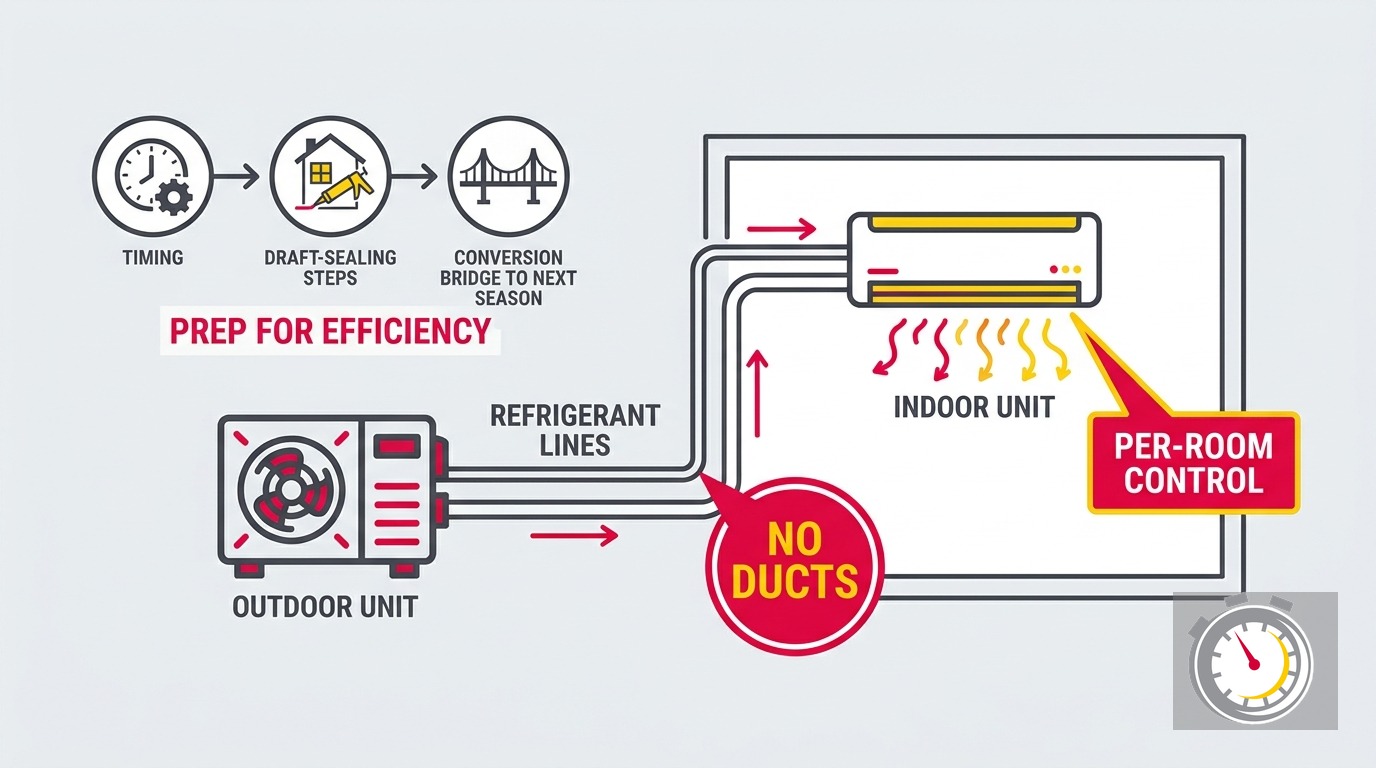
- Treat each pulled unit as a reason to price central air or a mini-split.
- Fall and winter leave time to get quotes before the next cooling season.
- Call (763) 260-6662 or book online to start the conversation.
When should you remove a window air conditioner in the Twin Cities?
Remove it before the first frost, or once your nights stay below 62°F. HVAC.com notes that most window units can’t operate below 62°F. After that, the unit only blocks your window and leaks cold air into your home.
Minnesota fall weather swings fast. You can have a 75-degree afternoon on Tuesday and a frost warning by Thursday. So we suggest a trigger, not a calendar date.
Use these two triggers:
- The first frost forecast. House Digest calls the time before the first frost of the season ideal for taking the unit out.
- A run of cool nights. When overnight lows stay under 62°F for several days, you are done cooling for the year.
If the first frost has already passed, don’t wait for spring. Pull the unit anyway. Removal still cuts drafts, and it protects both the unit and your window frame.
We are a locally owned and operated Twin Cities heating and cooling company. We see what happens when a unit sits through a January cold snap.
Can I leave my air conditioner in the window all winter?
You can, but you shouldn’t if you can avoid it. ENERGY STAR advises removing the room unit at the end of the cooling season to minimize heat loss. If removal isn’t practical, use an appropriately sized cover for winter.
A window AC isn’t built to be part of your wall. It has gaps around the sides, a thin accordion panel, and a case full of vents.
ENERGY STAR says an improperly installed room air conditioner leaks as much air as a 6-square-inch hole. Picture a hole about the size of a small index card in your wall. Now picture it open all winter at 10 below zero.
Minnesota winters add three more risks:
- Snow load. HVAC.com warns that snow can damage a unit through weight buildup, bent parts, and freeze cracks.
- Trapped water. Any water left in the unit can freeze and crack parts.
- Frame stress. A heavy unit sitting on a window sash for months can strain the frame.
Comfort suffers too. The area around a leaky unit feels cold, and that cold spot makes your furnace work harder to keep the room warm.
Some homes make removal hard. Think of a second-floor window, a casement window, or a unit built into a wall sleeve. In those cases, a good cover and tight sealing is the next best option. We cover that process below.
Is it okay to turn off AC during fall?
Yes. Once nights stay cool, shut your cooling off. Running AC in cool weather wastes energy and can stress the equipment. Switch the thermostat to heat or off, and leave the fan setting alone unless your system needs it.
The answer differs a little for each type of system.
Window units. Unplug them once you stop using them. Better yet, take them out. A unit that sits plugged in all winter can draw small amounts of power and can run by accident if someone bumps a switch.
Central AC. Your thermostat handles the changeover. Set it to heat, or to “off” if you use a manual switch. Don’t leave it in cool mode and hope the weather decides for you. A cool-mode system running on a 50-degree afternoon can freeze its own coil.
Want to know the lowest outdoor temperature where cooling is safe to run? Our guide on the minimum outdoor temperature for running AC covers it. Our team can also check your thermostat settings during a fall visit.
Fall is also a good time to think about your whole cooling plan. Window units are a short-term fix for many homes. If you are tired of lifting them twice a year, keep reading.
How do you remove a window air conditioner safely?
Unplug the unit, drain it, and lift it out with a helper. Window air conditioners are heavy and awkward, so don’t try removing one alone.
Follow these steps:
- Pick a dry day. Gizmodo suggests waiting a few days after rain, since units can hold water.
- Unplug the unit. Let it sit for a bit so it can drain.
- Recruit a helper. One person holds the unit from inside. The other supports it from the side.
- Remove the side panels and brackets. Take out any screws, L-brackets, or support rails.
- Lower the sash slowly. Keep both hands on the unit as the window comes up off it.
- Lift the unit straight in. Pull it back into the room. Set it on a towel or a flat board.
- Tilt it gently to drain. Some water may come out. Do it over a tub or outside.
Safety comes first on upper floors. If your unit sits in a second-story window, don’t lean out to guide it. Pull it straight in. If that feels risky, call a pro.
HVAC.com says some window ACs weigh 80+ lbs. That is a lot to lift near a window ledge. A bad drop can crack a sill, break glass, or hurt someone.
Check your window frame as you go. Look for rot, peeling paint, or gaps. Fall is the time to catch these, before winter wind finds them for you.
How do you seal the window after the unit is out?
Clean the frame, fill the gaps, and add weatherstripping. Most guides stop once the unit is out, which leaves you with an open window channel and a draft. A few simple steps make the window tight again.
Here is the order we suggest:
- Wipe the sash and track. Remove dust, bugs, and old foam bits. Let it dry.
- Inspect the weatherstripping. Look for flattened, torn, or missing strips. Replace them.
- Close and lock the window. A locked sash pulls tighter against the frame.
- Check the corners. Look for light or feel for air along the edges.
- Seal small gaps with caulk. Use a paintable exterior-grade caulk on the outside trim.
- Fill larger gaps with foam. Use a low-expansion foam made for windows and doors.
Look closely at the spots where the unit’s side panels sat. The accordion panels often leave dents or gaps. A strip of foam tape can fix this.
You can also add a layer of interior window film or a storm panel. These cost little and hold heat in. They also reduce cold glass in the room, which can help with the fogging we cover in our guide to window condensation in a Minnesota winter.
Test your work. On a windy day, hold a lit stick of incense or a tissue near the window edges. If the smoke or tissue moves, you still have a leak.
Do this for every window where a unit lived. The effort is small, and the payoff lasts all heating season.
How do you winterize a window AC you can’t remove?
Cover the outside of the unit, insulate around it, and seal the gaps. HVAC.com says that if removal isn’t practical, use a cover or plastic sheeting, insulate around the unit, and weatherstrip gaps.
This is a second-best approach, but it works when you have to use it. Follow these steps:
- Clean the unit first. Wipe the front grille and clear the filter. Dirt left over winter can turn into mold by spring.
- Drain the water. Tilt the unit slightly toward the outside. Some models have a drain plug.
- Install an exterior cover. Buy one made for your unit size. A cover that is too small leaves gaps. One that is too big flaps in the wind.
- Insulate the interior side. Use an indoor cover or foam board around the unit’s front.
- Weatherstrip all seams. Seal where the unit meets the sash, the frame, and the side panels.
- Seal the accordion panels. Add foam tape or caulk where those panels meet the window.
A few cautions apply. Skip any tarp that traps water against the unit, because water that freezes there can crack parts. Don’t run duct tape over vents you may need later. And remember to unplug the unit.
Even with a good cover, the unit still leaks more than a clean window would. ENERGY STAR makes this point when it advises removal where possible. Treat the cover as a backup plan.
Mark your calendar for spring, too. A unit left in all winter needs a close look before you plug it in. Check the cord, the fins, and the filter for damage.
How should you store a window AC for winter?
Clean it, dry it, and keep it upright in a dry spot. A few minutes of prep now saves you from mold, rust, and a dead unit next June.
Use this checklist:
- Wash the filter. Rinse it in warm water with mild soap. Let it dry fully.
- Wipe the case. Remove dust from the vents and fins. A soft brush works well.
- Straighten any bent fins. A fin comb is cheap and easy to use.
- Dry the unit. Leave it in a warm room for a day before you pack it.
- Cover it. Use the original box, a large trash bag, or a fabric cover. Don’t seal it airtight if the unit is damp.
- Store it upright. Laying it on its side can move oil inside the compressor.
- Choose a dry location. Basements and garages that flood or freeze are risky spots. A closet or a dry storage room is better.
Label the box with the date and the room it fits.
Take a photo of how the unit was installed, too. Brackets, sealing, and side panels all matter, and a quick photo makes spring setup easier.
If the unit is old, loud, or already failing, you may be storing a problem. Now is a good time to decide whether it is worth another summer. We cover that below.
Can you run an air conditioner in winter?
Most window units can’t, and you shouldn’t try. HVAC.com says most window ACs can’t operate below 62°F. Central AC has a similar limit, and running it in cold weather can damage the equipment.
The details differ by system.
Window units. Most are built for warm weather. Cold air can freeze the coil, and the unit may shut itself off or fail. Some models have a heat setting, but they are the exception.
Central AC. Your outdoor condenser isn’t made to run in freezing temperatures. Many systems also have a low-ambient lockout. Forcing them to run can harm the compressor. Our guide to the lowest outdoor temperature for running AC explains how it works.
Ductless mini-splits. These are different. Many mini-splits are heat pumps, which means they can heat as well as cool. A cold climate model is built to keep running in Minnesota winters. A cooling-only mini-split is not.
That last point matters if you are weighing a replacement. A heat pump mini-split can do more than cool in summer. It can also heat a room in the shoulder seasons and ease the load on your furnace. We cover options in our service page on ductless mini-split installation.
If someone tells you to “just run the AC to dry out the house” in January, say no. Call us instead. Humidity in winter is usually a different problem, and the fix is not your AC.
Why fall is the best time to price a replacement
Right after the unit comes out is the cheapest time to look at your options. The room is open, and you can see how much you used the unit. Fall and winter also leave time for quotes before the next cooling season.
Ask yourself a few honest questions:
- Did you carry a unit up and down stairs this year?
- Did one room still run too hot or too noisy?
- Did you run two or three window units all summer?
- Did your electric bill make you wince?
- Does your window unit block your view or your light?
If you answered yes to two or more, you have a case for a better system.
Window units cool one room at a time. They tend to be loud. They block a window, and they leak air in winter. Many homeowners decide that installing and removing them each year isn’t worth the work.
Two upgrades usually come up:
Central air. If your home has ductwork from a furnace, a central AC can cool the whole house quietly. It also frees up every window. Our post on replacing window units with central air walks through costs and tradeoffs. A mid-tier installed central AC replacement in the Twin Cities typically starts around $7,500, and high-efficiency models cost more. Your final price depends on your home, your ducts, and the system you choose.
Ductless mini-split. If your home has no ductwork, or the ducts can’t handle more load, a mini-split may fit better. It cools and, with the right model, heats single rooms or zones. The line set runs through a small hole in the wall, and the outdoor unit sits outside.
Neither is right for every home. A room addition, a finished attic, or an older house with radiators usually points one way. A house with good ducts points the other. We look at your layout and talk it through before we suggest anything.
Planning now has another benefit. HVAC schedules fill up in early summer when the first hot week hits. Booking a quote in winter lets you choose the install date instead of scrambling for one.
Are there rebates or tax credits for replacing window units?
Some programs exist, but the rules change often. Don’t plan around a credit or rebate until you confirm it is open. Here is what we know, based on pages we reviewed.
Federal tax credit. The IRS page on the 25C credit says the credit covers improvements made through December 31, 2025. It is allowed for property placed in service before December 31, 2025. That means you shouldn’t count on it for a 2026 or 2027 install. Talk with a tax professional about your own situation.
Minnesota heat pump program. The Minnesota Commerce heat pump program is called Save Energy Minnesota. The page says it has not launched yet and has no estimated launch date. It is awaiting federal approval.
Here is what the page says about how it would work:
- The rebate is the lesser of $4,000 or the total cost minus federal and other rebates.
- It requires an ENERGY STAR cold climate air-source heat pump.
- It requires an energy audit within the last 18 months.
- You must be approved for HEAR first, and HEAR cannot approve retroactive rebates.
That last rule matters. If you install before you are approved, you may lose out. Treat this program as pending, and don’t install a heat pump on the assumption that the rebate will arrive later.
Utility rebates. Xcel Energy and other Minnesota utilities have offered heat pump rebates in the past. Terms, amounts, and rules vary by utility and by year. We check the current terms before we quote, so you aren’t working from an old number.
Air sealing can also play a role. Some programs have rewarded sealing and insulation work done before a heat pump goes in. That gives the sealing steps in this guide a second payoff beyond comfort. If you want a deeper look at how sealing and equipment fit together, we’re happy to walk through it with you.
For bigger jobs, financing can help spread out the cost. Ask us about current financing options when you book your quote.
What should a Twin Cities fall checklist look like?
Plan your fall around three goals: get the unit out, seal the window, and decide what comes next. Here is a simple order of operations for the next few weeks.
This week
- Check the forecast for frost and low nights.
- Pick a dry day and line up a helper.
- Remove each window unit you plan to pull.
Next week
- Clean and dry each unit before storing it.
- Seal each window opening with foam, caulk, and weatherstripping.
- Run a draft test on a windy day.
This month
- Note which rooms felt too hot or too noisy this summer.
- Count how many window units you ran.
- Write down your electric bill range for July and August.
- Take photos of each window and the room around it.
This winter
- Book a quote for central air or a mini-split.
- Ask about the install timeline and current financing.
- Ask about any rebates that are open and any that are pending.
The notes you gather will help your contractor size and price a better system. They also show where a window unit was working hard and where it was not.
If you are still deciding whether to open windows or run the unit on mild days, our guide on using open windows instead of AC helps with that choice. It can help you spot which rooms truly need active cooling.
How Northern One Hour can help
We are a locally owned and operated heating and cooling company serving the Twin Cities. We know how fast Minnesota seasons change, and we know what winter does to a leaky window.
Here is how we can help this fall:
- Walk your home. We look at your rooms, your windows, and your ductwork.
- Explain your options. We compare central air and mini-splits in plain language.
- Give an honest price. You get a clear quote with no surprises.
- Check current programs. We review open utility rebates and flag anything still pending.
- Talk financing. For larger jobs, we go over payment options.
Our promise is simple: “Always On Time… Or You Don’t Pay a Dime!(R)” In plain terms, we arrive within the time window you select. If our technician does not show up on time, you do not pay for the service. We also back our work with a 100% satisfaction guarantee.
Ready for a quote? Call (763) 260-6662 or book online, and we will find a time that works for you.
Frequently Asked Questions
How heavy is a window air conditioner? +
Can I get a federal tax credit for replacing window units with a mini-split? +
Is the Minnesota heat pump rebate available now? +
Need a technician now?