
Mobile Home HVAC Options Minnesota: The Right Systems
Key Takeaways
- Standard residential furnaces are not legal in manufactured homes. Federal code requires a unit listed specifically for manufactured home use.
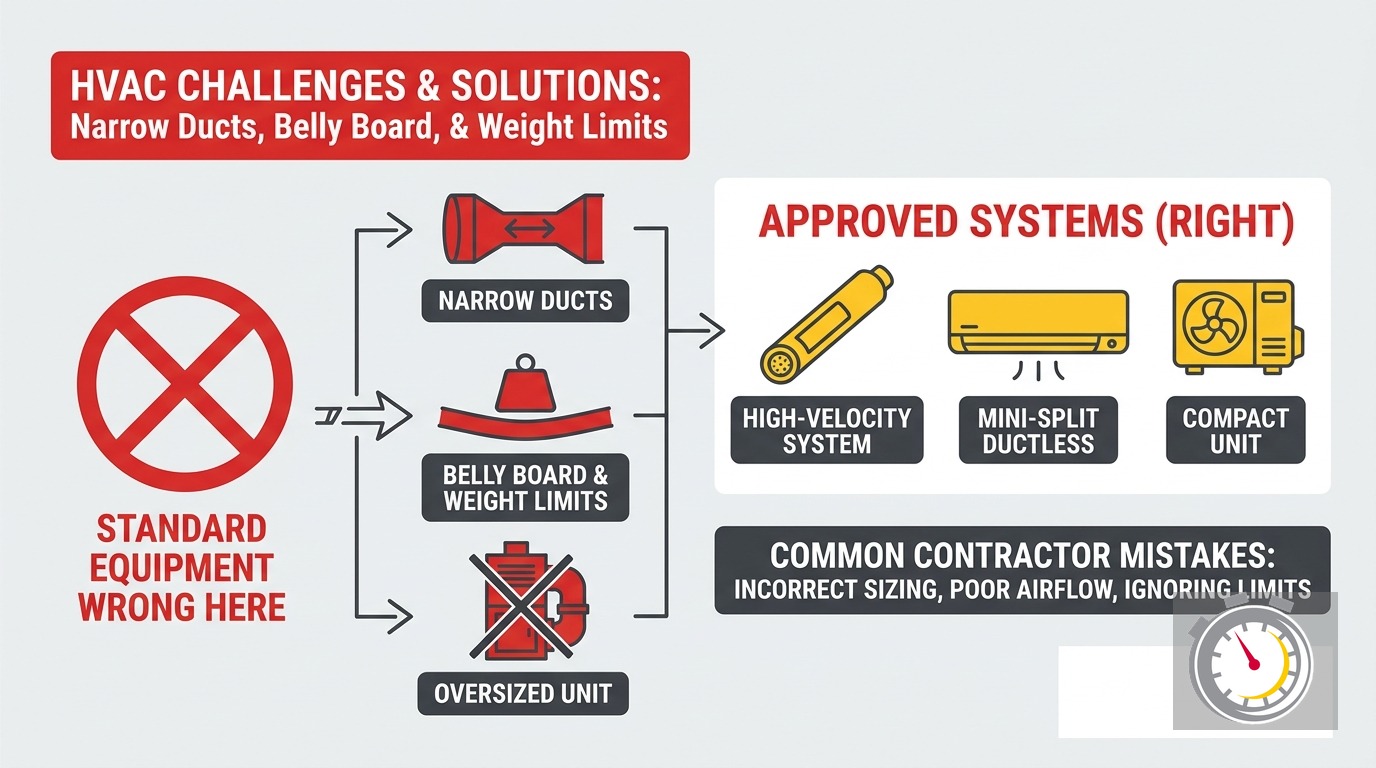
- Three structural constraints disqualify most standard equipment: narrow duct dimensions, belly board weight limits, and the data plate thermal zone requirement.
- Ductless mini-splits are the strongest fallback when existing ducts are absent, damaged, or undersized.
- Cold-climate heat pumps need a cold-climate rating or a gas backup to hold temperature at Minnesota’s -16F design condition.
- Every furnace replacement in a Minnesota manufactured home requires a permit. Inspections are mandatory.
- CenterPoint rebates reach $400 for 97%+ AFUE furnaces. Xcel offers up to $2,000 for cold-climate heat pumps, but manufactured home eligibility is not confirmed in writing. Call your utility before budgeting any rebate.
- Hire a contractor who holds a Minnesota Manufactured Home Installer license, not just a standard HVAC credential.
Why Standard HVAC Equipment Fails in Manufactured Homes
If you own a manufactured home in the Twin Cities, a contractor may have told you a furnace swap is simple. It rarely is. Standard residential HVAC is designed for site-built homes. Those homes have deep duct chases and full-depth floor joists. They also have attics or basements where a large air handler can mount securely. A manufactured home shares none of those characteristics.
Three structural realities disqualify most standard equipment before the first measurement is taken.
Narrow ducts. Manufactured home duct systems use shallower trunk lines and shorter branch runs than site-built homes. Standard residential sizing assumptions do not apply. Budget Heating’s manufactured home HVAC guide confirms that a Manual D airflow calculation is required before any HVAC replacement. A system installed without proper airflow calculations will short-cycle, waste energy, and fail early. See our Manual J sizing guide for more on what a correct load calculation covers.
Belly board weight limits. The belly board is the insulated sheathing that seals the underside of the home’s floor cavity. It holds insulation in place and keeps moisture and pests out. It is not engineered to carry a standard residential air handler or coil. Equipment mounted in the chassis must stay within the structural weight limits the home was built to handle.
The data plate thermal zone requirement. Every HUD-labeled manufactured home carries a data plate listing its heating design zone. Replacement equipment must be rated for that zone or higher. A mismatch is a code violation. It also means the system will fail to hold temperature when the Twin Cities drops to -16F on a January night in Ramsey, Blaine, or Brooklyn Park.
What Is the Belly Board, and Why Does It Matter?
The belly board is the insulated sheathing that seals the underside of a manufactured home’s floor cavity. It protects insulation and keeps moisture out. Any HVAC work that penetrates the belly board must restore the vapor barrier when the job is done. Standard residential contractors frequently skip this step, creating condensation risk and long-term heat loss.
When a technician cuts into the belly board to access duct connections and doesn’t seal the opening, moisture enters the floor cavity. Over one Minnesota winter, that moisture deteriorates insulation and creates conditions for mold. The damage compounds quietly and is expensive to remediate once it takes hold.
The belly board also limits where equipment can be placed. An oversized coil or air handler that physically doesn’t fit the chassis is a common surprise when a standard residential contractor shows up unprepared. The job stalls, and the homeowner pays for a second service trip. A qualified manufactured home installer accounts for belly board clearance and structural limits before any equipment is sized or ordered.
A properly completed installation restores the belly board’s vapor barrier at every penetration point. That detail is what separates a compliant job from one that causes problems two winters later.
Does Your Data Plate Govern Your Equipment Choice?
Yes. The data plate determines which HVAC equipment is legal for your specific home. It must be verified before any equipment is selected or ordered.
Minnesota’s DLI confirms that HUD-labeled homes must be equipped to meet their rated heating design zone. When you replace the furnace, the new unit must match or exceed that zone rating. Installing an under-rated unit is a permit violation. It also typically voids the equipment warranty.
Find your data plate inside a kitchen cabinet, bedroom closet, or utility room. If it is missing or damaged, contact the home’s manufacturer or DLI before scheduling HVAC work. Running the job without confirming zone compliance risks a failed inspection and a required reinstallation.
Homes built before HUD issued its manufactured home construction code in June 1976 are not HUD-labeled. Work on pre-1976 homes falls under different rules. If your home predates that year, mention it when you call. It changes the applicable code path and what the inspector will look for.
What HVAC Systems Are Approved for Manufactured Homes?
Four system types are viable for manufactured homes in Minnesota: HUD-listed furnaces, ductless mini-splits, cold-climate heat pumps, and packaged units. The right choice depends on your existing ductwork, lot configuration, and heating load.
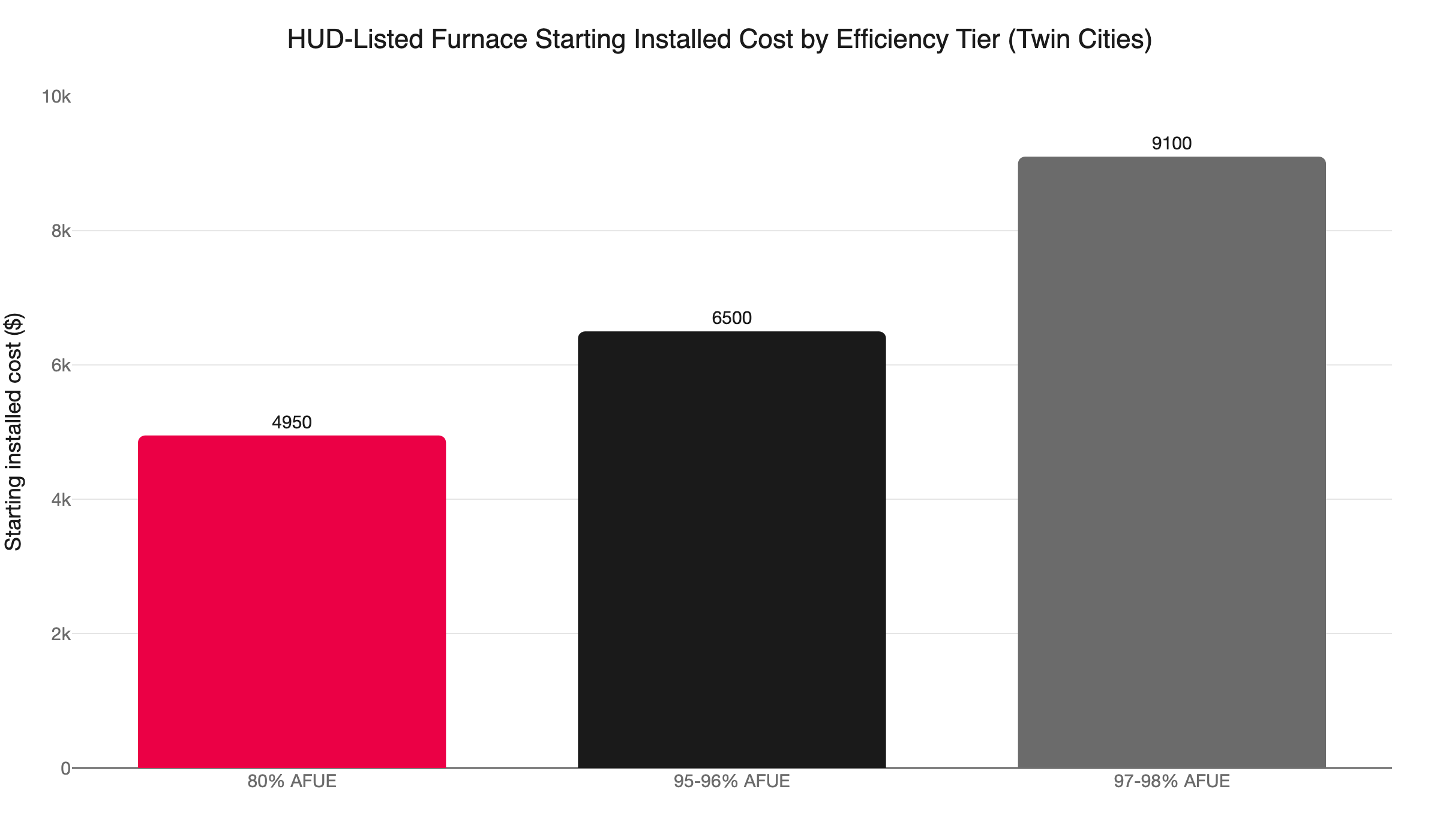
HUD-listed furnaces. Federal regulation 24 CFR 3280.709 requires that any replacement furnace be listed specifically for manufactured home use. These units use sealed or direct-vent combustion. Combustion air and exhaust are completely isolated from the home’s interior atmosphere. That isolation is not optional. Manufactured homes are tight structures. Any combustion spillage creates a carbon monoxide hazard. Installed cost in the Twin Cities starts around $4,950 for an 80% AFUE unit, $6,500 for a 95-96% AFUE model, and $9,100 or more for 97-98% AFUE high-efficiency equipment.
Ductless mini-splits. When existing ducts are absent, leaky, or undersized, a ductless system is the cleanest solution. No belly board penetration for new ductwork is required. An outdoor condenser sits beside the home. A refrigerant line set runs through a small wall penetration. One or more indoor heads mount on the wall or ceiling. A multi-zone system can serve several rooms from one outdoor unit. Our ductless mini-split guide for older homes covers sizing, placement, and what to expect during installation.
Cold-climate heat pumps. A cold-climate-rated heat pump extracts heat from outdoor air even as temperatures approach -13F and below. For Minnesota, pair it with a HUD-listed gas furnace or electric resistance backup. This combination is sometimes called a dual-fuel setup. The heat pump carries the load during moderate cold. The backup heat source handles the extreme days. Our dual-fuel heat pump guide explains how the two systems hand off at different outdoor temperatures.
Packaged units. A packaged unit houses heating and cooling components in one outdoor cabinet, connected to the home’s duct system through a crossover duct. Packaged units are common in older manufactured homes and in parks where routing refrigerant lines inside the home is difficult. Duct condition still matters: a damaged crossover duct defeats most of the unit’s efficiency.
Is a Ductless Mini-Split the Right Call?
For many Twin Cities manufactured home owners, yes. A ductless mini-split avoids new belly board penetrations for ductwork, does not require a full duct inspection before installation begins, and handles both heating and cooling in one system.
Budget Heating’s guide identifies ductless mini-splits as the best path when existing ducts are absent, leaky, or undersized. In many Twin Cities manufactured homes, that describes the actual duct condition accurately.
The main trade-off is upfront cost. A single-zone installed mini-split costs more than a HUD-listed furnace swap. A multi-zone system serving two or three rooms adds considerably more. The system still needs to be sized to the home’s actual heat load. An oversized mini-split short-cycles just as destructively as an oversized furnace.
A cold-climate-rated mini-split head also qualifies as the heat pump in a dual-fuel pairing. If you want electric heating efficiency during moderate-cold weather and gas backup for extreme cold, a mini-split plus a HUD-listed gas furnace is a workable combination for a manufactured home.
What About Cold-Climate Heat Pumps in Minnesota?
Standard heat pumps lose most of their capacity near 25F. Minnesota’s ASHRAE 99% design temperature runs approximately -16F to -20F. That gap makes a standard heat pump inadequate for a Twin Cities manufactured home without robust backup heat in place.
Cold-climate-rated heat pumps are engineered for low-ambient conditions. Top models maintain meaningful heating output at -13F and below. A backup heat source, either a HUD-listed gas furnace or electric resistance strips, handles the coldest days. The result is a system that runs efficiently through most of the heating season. It still keeps the home warm during the extreme cold events that Minnesota delivers every January.
Some manufactured home parks restrict heating to electric-only systems based on lease terms or utility connections. If your park has that rule, an all-electric cold-climate heat pump with electric resistance backup is the compliant path. Confirm your park’s rules before choosing any system type.
Also confirm that the outdoor unit can sit on a stable pad beside the home. In a park setting, placement may require management approval. Nail down access and site conditions before signing a contract.
Do Manufactured Homes Qualify for HVAC Rebates?
Possibly, but eligibility is not guaranteed for manufactured homes by either major Twin Cities utility. Call your utility before factoring any rebate into your project budget. A rebate that doesn’t apply to your dwelling type can throw off your cost comparison significantly.
CenterPoint Energy (natural gas customers) offers rebates on high-efficiency furnaces: $200 for a 95-96% AFUE unit, $400 for a 97%+ AFUE unit, and $100 more for an ECM variable-speed blower. Income-qualified households may reach $1,200 in total rebates. CenterPoint’s program targets equipment type rather than dwelling type, so manufactured home owners may qualify. Call to confirm before booking.
Xcel Energy (electric customers) offers up to $2,000 for a cold-climate ASHP and up to $1,600 for a standard ASHP. A $600 bonus applies if the installation follows qualifying insulation and air-sealing work. Xcel’s published rebate materials list single-family homes, duplexes, and fourplexes as eligible properties. Manufactured home eligibility is not confirmed in those materials. Call Xcel directly before scheduling.
Federal tax credits. The 25C and 25D federal heat pump tax credits expired December 31, 2025. No replacement credit is in effect as of September 2026. Do not count on federal incentives in your project budget.
Minnesota’s HEAR low-income rebate program has not launched as of this writing. It awaits US DOE formal approval. Ask your contractor for the current status when you call.
What Permits Are Required in Minnesota?
Every furnace or water heater replacement in a Minnesota manufactured home requires a permit. Inspections are mandatory. A contractor who skips the permit is creating code, warranty, and insurance liability for you.
Minnesota’s DLI requires permits for manufactured home installation, and separately for replacement furnaces and water heaters. The contractor pulls the permit before work begins. An inspector reviews the completed installation. If a contractor says permits aren’t needed for a furnace swap in a manufactured home, that is grounds to find a different contractor.
For alternative installation methods on private property, a licensed Minnesota engineer may need to review and approve the design. DLI’s installation Q&A outlines when DAPIA-approved alternates apply in manufactured home parks. Our Minnesota HVAC permit guide covers the general permit process and what to expect at the inspection.
Minnesota also requires HVAC contractors working on manufactured homes to hold a Manufactured Home Installer license. This is a separate credential from a standard HVAC contractor license. Ask for the license number before you sign any contract. The market for qualified manufactured home HVAC installers in the Twin Cities is thin. Credentials matter more than they do in the standard residential market.
Common Contractor Mistakes That Get Homeowners in Trouble
Three errors surface repeatedly in Twin Cities manufactured home HVAC work.
Installing a non-listed residential furnace. This is the most common mistake. A standard residential furnace is easier to source and sometimes cheaper to install. It is also not legal in a manufactured home. It will fail the permit inspection. If the work was done without a permit, your homeowner’s insurance may not cover a resulting fire or carbon monoxide event. The liability stays with the homeowner.
Skipping the duct inspection before adding AC. Adding central air conditioning without inspecting the existing ducts first is a setup for failure. Undersized ducts will short-cycle the new system and drive up energy bills. The duct inspection also surfaces belly board damage that needs repair before new equipment goes in. Skipping that step means the damage compounds under the new system.
Oversizing the equipment. A unit too large for the home heats or cools the space before running long enough to control humidity. In a tight manufactured home, that produces sticky, uncomfortable air in summer and erratic comfort in winter. A proper Manual J load calculation is required before any equipment selection. Guessing from square footage is not adequate for a manufactured home’s specific duct geometry and thermal envelope.
Ignoring park lease rules. Some parks prohibit specific fuel types or restrict where outdoor equipment can be placed. Installing a propane system in a park that requires electric-only heat, or placing a condenser where the lease prohibits it, can result in removal at the homeowner’s expense. Read the lease and call the park manager before selecting a system.
Schedule Service With Northern One Hour
We are locally owned and operated in Ramsey, MN, and we serve the full Twin Cities metro. When we evaluate a manufactured home HVAC project, we start with the data plate, the existing duct condition, and the belly board. We size to the home’s actual load, not a square-footage estimate.
Our on-time promise is exactly what it sounds like: “Always On Time… Or You Don’t Pay a Dime!(R)” We back every installation with a 100% satisfaction guarantee and transparent pricing before any work begins. Financing is available for larger replacements, including furnace swaps and heat pump installs.
If your manufactured home needs a furnace replacement, a mini-split installation, or a heat pump assessment, call us at (763) 260-6662 or book online. We will tell you what the home needs, which permits we will pull, and what it will cost. No surprises.
Frequently Asked Questions
Can you put a regular furnace in a manufactured home? +
What is the best heating system for a mobile home in Minnesota? +
Do you need a permit to replace a furnace in a manufactured home in Minnesota? +
Can a manufactured home qualify for Xcel Energy heat pump rebates? +
What is a data plate and why does it matter for HVAC? +
Need a technician now?