
Mini Split for Detached Garage in Minnesota: What to Know
Key Takeaways
- A detached garage in Minnesota needs 40-80 BTU per square foot for heating. That is three to four times the standard rule for conditioned living space.
- Insulating before you size can cut required BTU capacity in half and lower total project cost significantly.
- Any mini split used as a primary heat source in the Twin Cities must be cold-climate rated with confirmed output at -13°F or lower.
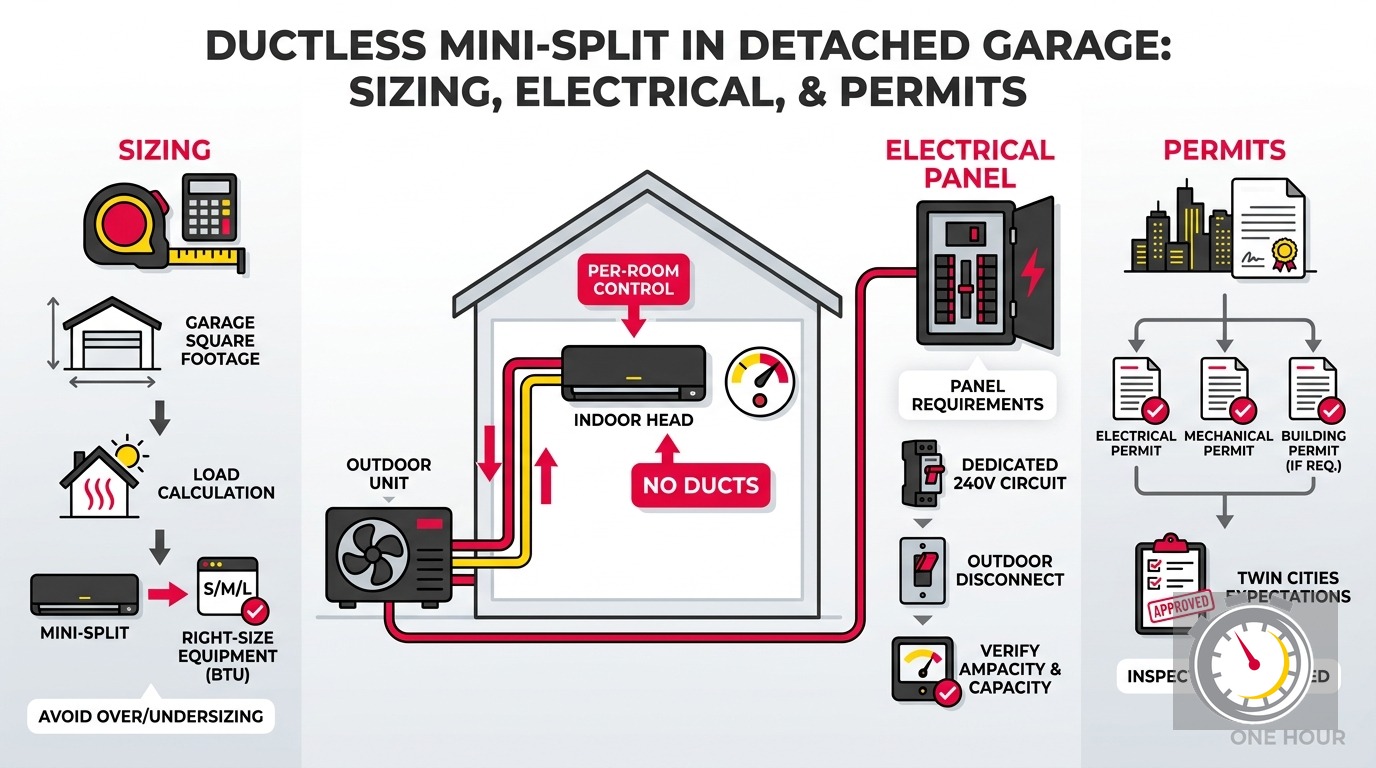
- A detached garage installation in Minnesota requires two separate permits: one mechanical, one electrical. Both require DLI-licensed contractors.
- The federal Section 25C tax credit expired December 31, 2025. Utility rebates through Xcel Energy and CenterPoint remain active.
Why a Detached Garage Is Different From a Bedroom
Most mini split sizing guides are built for bedrooms. The BTU tables, cost estimates, and efficiency figures all assume insulated walls, a floor above a heated basement, and a ceiling below an insulated attic.
A detached garage in the Twin Cities is almost never that.
A standard two-car garage has a door rated at roughly R-2. That is the insulating equivalent of single-pane glass. Uninsulated walls add nothing. A concrete slab conducts cold directly from the ground. Gaps around the service door, overhead door track, and utility penetrations let air move freely.
The structure bleeds heat. It does not retain it.
Minneapolis reaches approximately -13°F at the 99% design heating temperature. An undersized or improperly rated system will run continuously without reaching your target temperature - or shut off before it gets there.
The decisions you make before buying a unit matter more than the brand on the box. Insulation level, cold-climate certification, and electrical panel capacity each determine whether the system can do the job.
Most articles about mini splits for garages treat the space as a modified bedroom. They provide the same sizing tables, the same national cost averages, and the same tax credit information - some of which expired at the end of 2025. This post covers each decision in order, with the specifics Minnesota homeowners need.
How Much Insulation Do You Have?
The answer to this question determines the size of the unit you buy. Get it wrong and you are either undersizing the system or paying for capacity you do not need.
The industry rule of thumb for Climate Zone 6 (Minneapolis) is 14-18 BTU per square foot for conditioned living space. That assumes insulated walls, ceiling, and floor. It does not apply to an uninsulated garage.
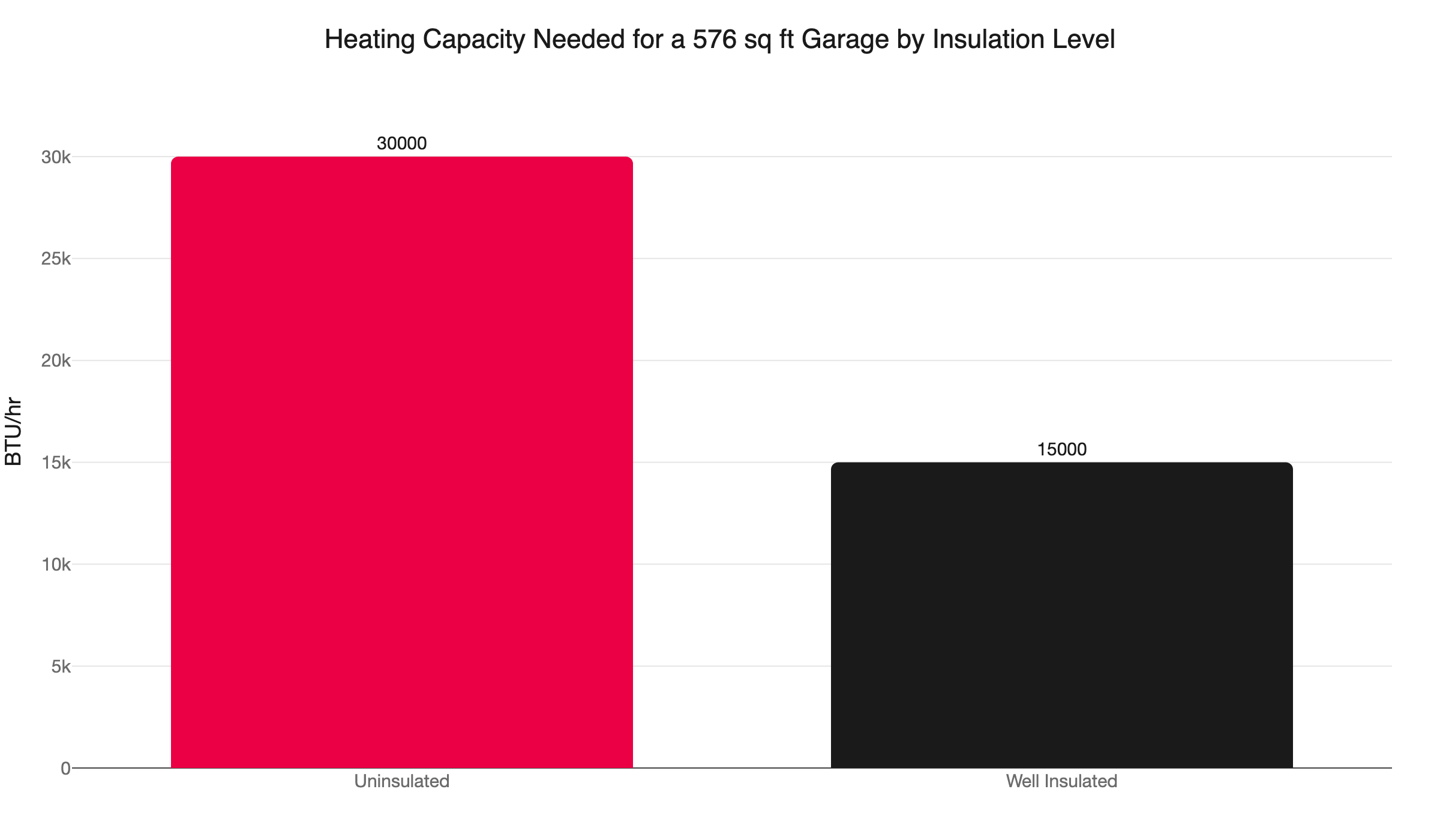
In Minneapolis winters, an uninsulated garage needs 40-80 BTU per square foot. For a standard 24 by 24 foot garage (576 square feet), here is what that means:
- Uninsulated: 24,000-36,000 BTU of heating capacity needed
- Well-insulated (walls, ceiling, and insulated door): 12,000-18,000 BTU
That gap is significant. A 36,000 BTU system costs substantially more to buy and run than an 18,000 BTU system. Insulating before you size can mean buying one to two sizes smaller - and lower monthly operating costs for the life of the equipment.
Spending $1,500-$3,000 on insulation often pays back in a lower system cost alone. Then it keeps paying through lower utility bills every month.
The accurate sizing method is a Manual J load calculation, not a rule-of-thumb table. Ask your contractor to run one before specifying equipment. A rule of thumb is an estimate. It is not a design document.
Do You Need a Cold-Climate Rated Unit?
Yes, if this mini split is your primary heat source. Standard units are not built for Twin Cities winters at full capacity.
Standard mini splits are not a reliable choice as the only heat source in climates where temperatures are regularly below freezing. That warning appears in most articles. What it rarely includes is the explanation Minnesota homeowners need.
Minneapolis’s 99% design heating temperature is approximately -13°F to -16°F. A standard mini split rated to hold capacity at 5°F or 17°F loses 40-60% of rated output before it reaches those extremes. Some units shut off entirely near -10°F. In a detached garage with no backup heat, that means a system that cannot do its job during the coldest weeks of the year.
What to confirm on any mini split spec sheet:
Rated heating output at -13°F or lower. The minimum operating temperature and the rated output temperature are different numbers. Ask for the BTU figure at low ambient, not just the cutoff point. A unit may technically “operate” at -22°F at a fraction of its nameplate capacity.
ENERGY STAR Cold Climate certification. Since January 1, 2025, ENERGY STAR introduced a dedicated Cold Climate pathway for heat pumps in heating-dominated applications. Minnesota is a heating-dominated application. Look for this designation specifically, not just standard ENERGY STAR certification.
HSPF2 rating in cold-climate conditions. Higher HSPF2 in cold conditions means lower operating costs through the heating season.
Cold-climate rated units cost more upfront. In the Twin Cities, that investment pays back in reliability. For a comparison of how cold-climate brands perform in Minnesota conditions, see our post on cold-climate heat pump brands and performance in Minnesota.
If the mini split cannot hold capacity at your design temperature, plan for a backup heat source: a dedicated garage heater or electric radiant panels. Factor that cost into the project budget before you commit to a system. For options, see our guide to garage heater options and installation costs in Minnesota.
What Are the Electrical Requirements for a Mini Split?
A mini split requires a dedicated 240V circuit sized to the manufacturer’s spec sheet. A detached garage may need a new circuit, a subpanel upgrade, or both - and that work adds real cost.
This is the item most national pricing guides skip entirely.
Your detached garage likely has one of three electrical situations:
No 240V service. Many older Twin Cities detached garages were wired for 120V lighting and a few outlets only. Adding 240V means running a new circuit from the main panel - or installing a subpanel in the garage. That is licensed electrician work with its own permit. It adds a separate cost line to the project.
A subpanel already carrying large loads. If the garage has a 60A subpanel running an air compressor, a welder, or a car lift, the available capacity for a mini split may be limited. A cold-climate mini split draws 20-30A. That load on a full panel may require an upgrade before the mini split can be added.
A subpanel with room. This is the simplest scenario. The electrician confirms available capacity, pulls the wire, and installs a dedicated breaker.
Two values on the manufacturer’s spec sheet drive the electrical scope: MCA (Minimum Circuit Ampacity) and MOCP (Maximum Overcurrent Protection). Your electrician needs both numbers before quoting the work. The MOCP determines breaker size. The MCA determines minimum wire gauge. Getting either wrong is a code violation that fails inspection. Ask your HVAC contractor for the spec sheet before calling the electrician.
Budget for both contractors from the start. The HVAC scope and the electrical scope are separate. Each carries its own permit.
What Permits Does a Mini Split Require in Minnesota?
Two permits: a mechanical permit for the mini split installation, and a separate electrical permit for the circuit work. Both require DLI-licensed contractors.
This is where most online estimates diverge from actual Twin Cities project costs.
HVAC installations in Minnesota require licensed mechanical contractors regulated by the Department of Labor and Industry. Mechanical contractors must hold a license and surety bond. Your HVAC contractor pulls the mechanical permit.
Electrical work - the 240V circuit and any panel work - requires a separately licensed electrical contractor. They pull the electrical permit. The two licenses come from the same DLI system but are not interchangeable. An HVAC contractor cannot pull an electrical permit.
Both permits require inspection sign-off before the job is considered complete.
National cost guides sometimes list permit costs as “$0-$125.” That figure may cover only one of the two required permits - or it may reflect fees in other states. Build both permit costs into your Minnesota budget.
Never skip permits to save a few hundred dollars. An unpermitted installation can affect homeowner’s insurance coverage. It can also create problems during a home sale when a buyer’s inspector flags work without a permit sign-off.
How Much Does a Mini Split for a Detached Garage Cost in Minnesota?
For a single-zone system in a Twin Cities detached garage, the typical installed range is $4,500-$9,500. That covers equipment, installation labor, permits, and startup for a 12,000-24,000 BTU system with straightforward electrical access. Cold-climate equipment, electrical work, or a longer line set push the number higher.
Most national cost guides apply national average labor rates. Twin Cities installation labor runs higher.
For a detailed breakdown of what drives costs up or down in this market, see our mini split installation cost guide for the Twin Cities.
What moves the number higher:
Cold-climate premium equipment. Premium brand single-zone heat pump equipment ranges from $1,550 to $5,700 nationally. Twin Cities pricing typically runs above those benchmarks given higher labor rates and permit costs.
Electrical work. A new 240V circuit or subpanel upgrade is a separate cost line. Get a dedicated electrical quote before finalizing the project budget. This item is easy to undercount.
Line-set length. A garage at the back of a deep lot requires a longer refrigerant line set. That adds material and labor.
Difficult wall penetrations. Brick, stucco, or thick concrete block takes more time to drill cleanly than framed siding.
If the project also includes insulation work, budget that separately before comparing system sizes. A smaller system installed on a well-insulated garage costs less to buy and less to run every month. Financing is available if the total project clears $7,000-$10,000. Ask about options when you call.
Are There Rebates or Tax Credits Still Available?
The federal 25C credit is gone. Utility rebates through Xcel Energy and CenterPoint remain active for qualifying heat pump installations.
The Section 25C Energy Efficient Home Improvement Credit covered products purchased and installed between January 1, 2023, and December 31, 2025. As of September 2026, it has expired. No extension is in effect. Any article still citing a $2,000 federal credit is out of date.
One additional detail is worth knowing. The 25C required the home to be “used as a residence.” A detached garage used as a workshop is not the residence itself. Its eligibility under the 25C was uncertain even when the credit was active. Homeowners who claimed it for a detached accessory structure were working in ambiguous territory.
What remains available:
Utility Conservation Improvement Program rebates. Xcel Energy and CenterPoint are the main investor-owned utilities in the Twin Cities. Both operate active rebate programs for heat pumps under their Conservation Improvement Programs. Amounts and eligibility change regularly. The current listings are at programs.dsireusa.org/system/program/mn. Check there before relying on any dollar figure in an article - program details update faster than most content does.
Financing. For a project totaling $8,000-$12,000 when electrical work is included, financing spreads the cost. Ask about options when you call.
For a broader look at rebates and credits still available in Minnesota for HVAC work, see our guide on Minnesota heat pump rebates and tax credits.
What About Maintenance in a Garage?
A garage mini split needs more frequent filter cleaning than a bedroom unit. Plan for every four to six weeks during active use, not the standard 90-day residential schedule.
Sawdust, metal shavings, car exhaust, and general workshop dust clog the indoor air handler filter faster than typical residential use. A clogged filter reduces airflow and forces the system to work harder. In a workshop environment, check the filter monthly.
The outdoor unit needs clear airflow on all sides in winter. Garages often accumulate snow against exterior walls. Keep the condensing unit clear of snowdrift and packed ice. Restricted airflow shortens system life.
For a full maintenance checklist, see our guide on keeping a ductless mini split running well year-round.
What to Have Ready Before You Call a Contractor
Walk the space before you pick up the phone. Having clear answers to a few questions makes the first call faster and the quote more accurate.
Know these before you call:
- Approximate square footage of the garage
- Current insulation level: walls, ceiling, garage door. The R-value if you have it.
- Electrical panel situation: is there a 240V circuit already? What is the subpanel size, and what does it currently carry?
- What you plan to use the space for: woodworking, car restoration, general storage
- Whether you want summer cooling in addition to winter heat
A contractor who asks these questions before quoting is giving you a more accurate number. One who quotes without asking them is giving you a guess.
Ready to Get a Quote?
Northern One Hour Heating & Air Conditioning is locally owned and operated in Ramsey. We serve Minneapolis, St. Paul, Blaine, Maple Grove, Plymouth, Brooklyn Park, Woodbury, Bloomington, and the broader Twin Cities metro.
We show up when we say we will. That commitment is backed by our on-time promise: “Always On Time… Or You Don’t Pay a Dime!(R)”
When you call, we walk the garage with you. We look at insulation, electrical panel capacity, and the full scope of what this project requires in your specific space. You get a straight quote on what it actually costs to do this right - not a national average applied to a Twin Cities job.
Call (763) 260-6662 or schedule a ductless mini split estimate online.
Frequently Asked Questions
What size mini split do I need for a 24x24 detached garage in Minnesota? +
Do I need a cold-climate mini split for a Minnesota garage? +
What permits are required for a mini split in a Minnesota detached garage? +
Is the federal 25C tax credit available for a mini split in 2026? +
Need a technician now?