
HVAC Split-Level Home Twin Cities: Solve Uneven Heat and Cooling
Key Takeaways
- HVAC in a Twin Cities split-level home presents a structural comfort problem. These 1950s-70s floor plans were designed for square footage, not airflow. Every furnace or AC installed in one inherits the same duct layout.
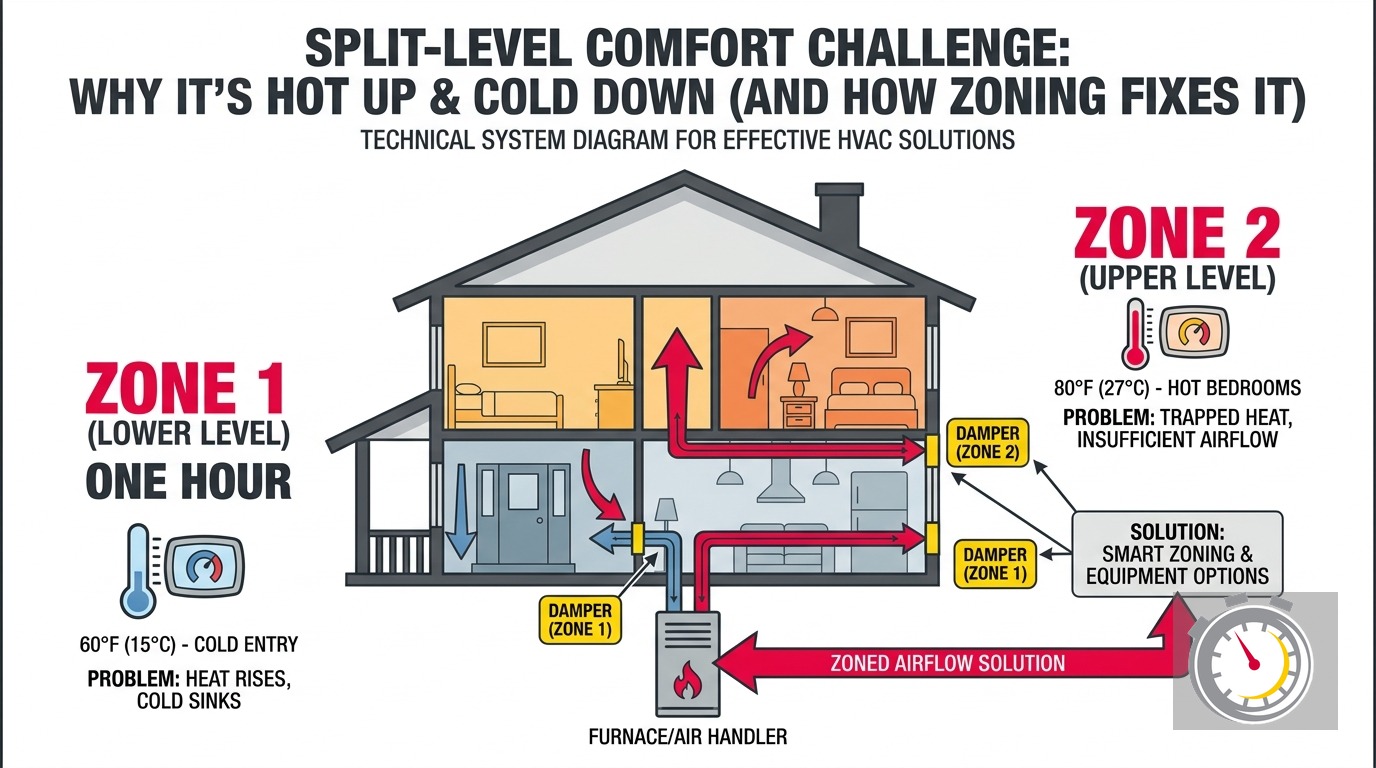
- The stairwells act like chimneys. Warm air rises through the home, leaving the entry level freezing in winter and the upper bedrooms overheated in summer.
- Minnesota’s outdoor design temperature of -16°F to -20°F makes the stack effect far more punishing than in most states. The pressure delta between levels here approaches 90°F. In Atlanta it is roughly 40°F.
- One thermostat on the main level cannot fix what is happening one floor up or one floor down.
- Three proven fixes exist: zoned dampers on existing ductwork, ductless mini-splits on the problem level, or a dual-fuel hybrid heat pump system.
- In 2026, Twin Cities homeowners can stack up to $3,700 in Xcel and CenterPoint rebates on a qualifying dual-fuel install.
- The federal 25C heat pump tax credit expired December 31, 2025. Verify any Congressional extension before counting on it.
Why Does an HVAC Split-Level Home in the Twin Cities Have Uneven Temps?
Short answer: The 1950s-70s split-level was optimized for square footage per dollar, not for airflow. Short stair runs, odd ceiling heights, and open half-floors create pressure imbalances that push conditioned air to the wrong places.
The postwar housing boom shaped how suburban Minneapolis and St. Paul grew outward. Builders in Bloomington, Fridley, Edina, Brooklyn Park, and Burnsville staggered floor levels to fit more livable space onto a narrow lot without a full two-story foundation. A half-flight up to the main level. Another half-flight to the bedrooms. A walk-out or look-out lower level for family space.
It was an efficient layout. HVAC was an afterthought.
The original furnace in most of these homes was a single-zone forced-air system fed from a basement unit. Modern high-efficiency furnaces replaced that equipment, but they inherited the same duct topology. The supply registers and return air paths were designed for a gravity or early forced-air system. They were never laid out for the precise pressure management that comfort on three separate levels demands.
That mismatch is still fighting you today. The floor plan did not cause the problem - the combination of that floor plan with a single-zone system did.
Minnesota’s Stack Effect Is More Severe Than Almost Anywhere
Stairwells and open half-floors act like chimneys for air, creating pressure imbalances that lift warm air to upper levels and leave cold air pooled below. In a moderate climate, that is a nuisance. In Minnesota, it is a months-long chronic complaint.
The Twin Cities uses an outdoor design temperature of -16°F to -20°F for heating load calculations. When outdoor temps are -18°F and your home is set to 70°F, the pressure differential between your cold entry and your warm upper floor approaches 90 degrees. Denver homeowners see roughly 55 degrees of delta. Atlanta homeowners see about 40. Every degree of heat stratification costs more here because the gap is so much larger to start.
Minneapolis logs roughly 8,000 heating degree days per year, placing it among the highest in the continental US. The cold-entry problem does not run for a few weeks in January. It runs from November through March, month after month, heating bill after heating bill.
Summer adds its own version of the same problem. Upper bedrooms collect heat rising from below and radiating from the roof. The entry level stays cooler. The thermostat on the main level satisfies itself and shuts off, leaving the bedrooms sticky and overheated. It is the same structural problem in a different season.
Why Can’t One Thermostat Fix the Problem?
Short answer: A thermostat reads only the air immediately around it. When the main-level thermostat reaches setpoint and shuts off, the upper bedrooms may still be 8-12°F warmer than you set, and the entry 10°F or more colder.
A single thermostat placed on the main floor cannot sense what is happening one level up or one level down. When it satisfies the main level, the system shuts off. Everyone else in the house is still uncomfortable, just in opposite directions.
In winter: the furnace runs until the main level hits 70°F. The entry might read 58°F. The upper bedrooms might read 74°F.
In summer: the AC runs until the main level hits 74°F. The upper bedrooms are 82°F. Someone cranks the thermostat down to fix a problem the thermostat cannot actually reach.
Relocating the thermostat helps one end while making the other worse. Adding a remote sensor to a smart thermostat gives the system more information. But it does not change where the conditioned air goes. The duct layout decides that. Changing the comfort result means changing the duct layout, the equipment, or both.
What Are the Three Fixes for a Split-Level HVAC Problem?
Short answer: Zoned dampers rebalance your existing ducts using per-floor thermostats. Ductless mini-splits add independent conditioning to one problem level. A dual-fuel hybrid heat pump replaces the whole system with better capacity and efficiency across every level.
Each approach suits a different situation. The right answer depends on your current equipment, your ductwork condition, and how many levels need help.
Fix 1: Zoned Dampers on Existing Ductwork
Motorized dampers install at the branch points in your duct system. A zone control panel wires to per-floor thermostats. When the upper bedroom zone calls for cooling, the panel closes dampers to the other zones and routes airflow upstairs. When the entry calls for heat, the same process runs in reverse.
Most split-levels need three to four zones, and a skilled technician can typically complete the installation in a few hours to one full day.
The critical step before adding zones is a capacity check. The existing furnace or AC must handle a reduced airflow path without short-cycling. Short-cycling means the system runs in brief bursts, satisfies the thermostat before the air is fully conditioned, and shuts off too quickly. Our team checks system capacity before we touch a duct.
Zoning works best when:
- Your ductwork is in reasonable condition with accessible branch points
- Your furnace or AC was installed within the last eight to ten years
- The complaint is about control, not about total system capacity
For more on how zoning works across a multi-level floor plan, see our guide to HVAC zoning systems for two-story homes.
Fix 2: Ductless Mini-Splits for Problem Levels
A ductless mini-split adds a wall-mounted or ceiling-cassette air handler directly to the level that needs help. It runs on its own refrigerant line from an outdoor unit and carries its own thermostat. The existing duct system keeps handling the levels it already serves. The mini-split takes over the one it could not reach.
This is the right approach when:
- One level is the chronic problem and the rest of the house is tolerable
- The ductwork is too old or poorly routed to support added zones
- You want independent control on that level without touching the rest of the system
Cold-climate mini-splits built for Minnesota winters maintain rated capacity down to -13°F to -22°F depending on the model. That covers the vast majority of what a Twin Cities winter delivers, though a gas furnace remains the right backup for the coldest stretches.
Xcel Energy’s 2026 rebate for a cold-climate ductless mini-split is $2,000. A standard (non-cold-climate) model qualifies for $1,600. Rebates do not require a participating contractor.
For details on how ductless systems fit into older Twin Cities homes, read ductless mini-splits for older Twin Cities homes.
Fix 3: A Dual-Fuel Hybrid Heat Pump System
A dual-fuel hybrid pairs a cold-climate air-source heat pump with a high-efficiency gas furnace. The heat pump handles heating and cooling during shoulder seasons and mild winter days, when it runs at peak efficiency. When the temperature drops below 40°F, the system automatically hands off to the gas furnace. The furnace handles Minnesota’s coldest nights.
This is the most complete fix on the list. A properly sized dual-fuel system addresses every level, pairs well with a zoning upgrade, and qualifies for the largest rebate stack available to Twin Cities homeowners.
Dual-fuel is particularly well matched to Minnesota’s weather. The heat pump carries the fall, spring, and mild-winter load efficiently, cutting gas consumption without sacrificing the backup capacity that -20°F nights demand. Gas still has the cost advantage on the coldest days, and the system switches automatically.
For a full explanation of how dual-fuel systems work in Minnesota, read dual-fuel heat pump and gas furnace hybrid for Minnesota.
What Will This Cost in the Twin Cities?
Short answer: Zoned damper costs vary by zone count and duct condition. A cold-climate mini-split for one zone starts at $3,900 and up installed. A dual-fuel heat pump system starts at $7,500 and scales with equipment tier and project scope.
Here is how to think about each option:
Zoned damper system (added to existing HVAC): Pricing depends on zone count, duct access, and the control panel selected. A three-to-four zone split-level job runs a half-day to a full day. A scoped estimate from a technician who has seen your duct layout is the only reliable number.
Ductless mini-split, one zone, cold-climate, installed: $3,900 and up for a single cold-climate zone installed in the Twin Cities. Higher-capacity models rated for lower temperatures run more. A multi-zone system covering several levels increases accordingly.
Dual-fuel hybrid system, full replacement, installed:
- Mid-tier equipment: $7,500-$10,400 installed
- High-efficiency 18-20+ SEER2 equipment: $11,000-$15,600
- A full project including ductwork re-zoning, new furnace, and heat pump will vary based on scope. Financing options are available for larger installs.
All ranges are installed prices covering parts and labor. A split-level installation takes more time than a single-story job. The technician works across multiple levels and duct branches. Never compare a bare equipment price to an installed estimate.
Can Xcel and CenterPoint Rebates Lower Your Cost?
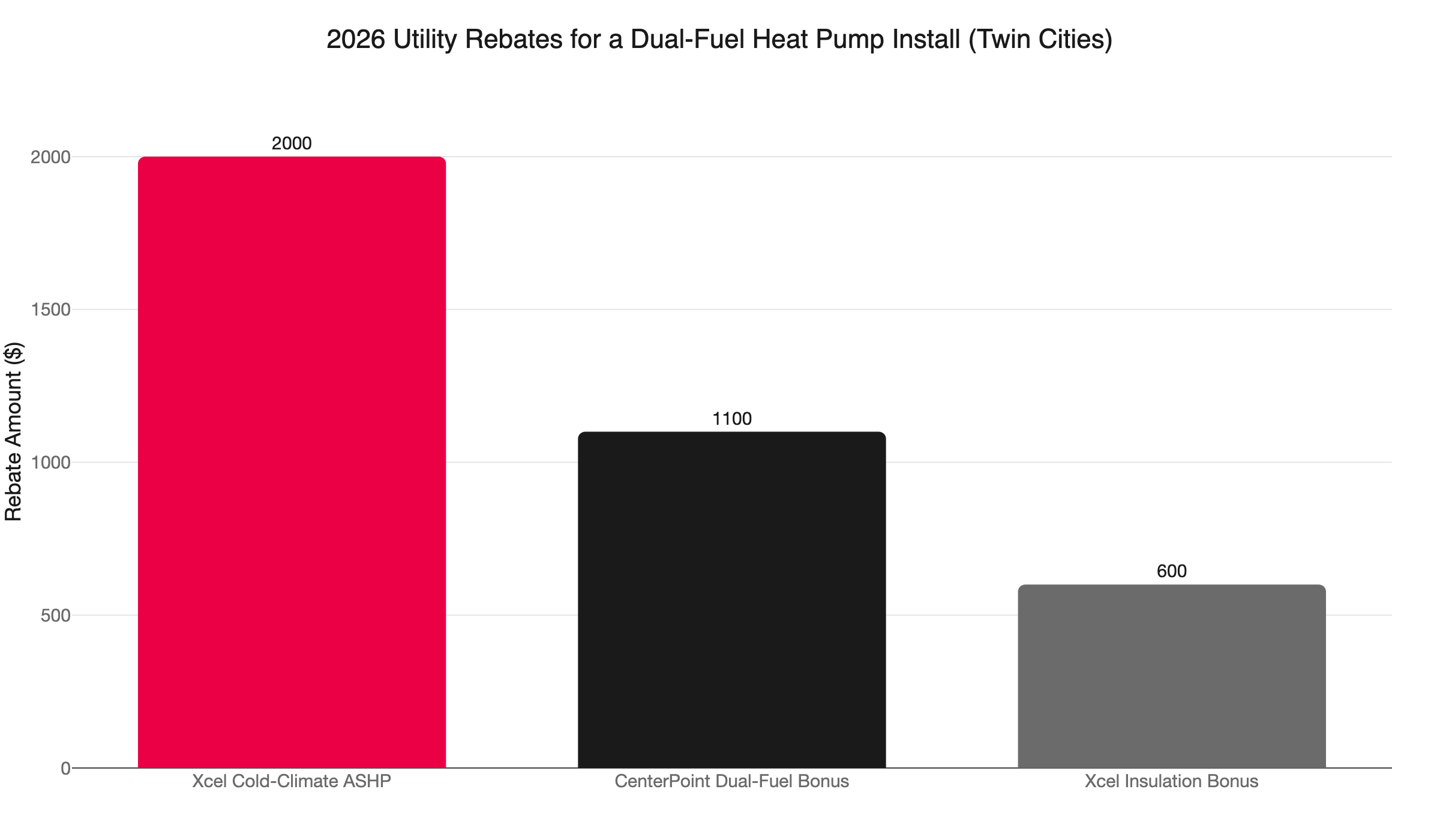
Short answer: Yes, significantly. A dual-fuel heat pump install in the Twin Cities can qualify for $3,700 in stacked utility rebates in 2026: $2,000 from Xcel (cold-climate ASHP) plus $1,100 from CenterPoint (dual-fuel bonus) plus $600 from Xcel (insulation and air-sealing bonus).
Here is the full 2026 picture:
Xcel Energy (customers with Xcel electric service):
- Cold-climate ductless mini-split: $2,000
- Standard ductless mini-split: $1,600
- Cold-climate ducted air-source heat pump, combo customer (gas and electric): $2,000
- Insulation and air-sealing bonus stacked with a heat pump install: $600 additional
Xcel mini-split rebates do not require a participating contractor.
CenterPoint Energy (customers with CenterPoint gas service):
- Dual-fuel heat pump paired with a 92%+ AFUE gas furnace, switching to gas at 40°F: $1,100
- CenterPoint does not rebate standalone mini-splits or full-electric heat pump replacements
How the stack works on a dual-fuel install:
Combo Xcel-CenterPoint customers who install a qualifying cold-climate dual-fuel system can claim the Xcel ASHP rebate and the CenterPoint dual-fuel bonus together. Add qualifying insulation or air sealing within two years of the heat pump install and the Xcel insulation bonus applies as well:
- Xcel cold-climate ASHP rebate: $2,000
- CenterPoint dual-fuel rebate: $1,100
- Xcel insulation and air-sealing bonus: $600
- Total: $3,700 in utility rebates
That offset is specific to Minnesota. A homeowner in Michigan or Pennsylvania doing the same project would see little to none of it. It is a genuine advantage for Twin Cities split-level owners weighing a full system upgrade.
For the complete 2026 rebate breakdown, see Xcel and CenterPoint HVAC rebates in Minnesota.
Is the Federal Tax Credit Still Available?
Short answer: Not as of September 2026. The 25C ENERGY STAR heat pump tax credit covered products purchased and installed through December 31, 2025. That credit has expired. Verify with a tax professional or check energystar.gov directly for any Congressional extension before building it into your budget.
Do not let an expired credit be the reason you delay a project. The utility rebates above are active and verified as of 2026. They do not require Congressional action to claim. The $3,700 rebate stack is available now.
Do You Need a Mechanical Permit for a Mini-Split in Minnesota?
Short answer: Yes. Most Minnesota municipalities require a mechanical permit for ductless mini-split installation. A licensed contractor pulls it as part of the job. It confirms the install meets code and protects you at resale time.
If a contractor proposes skipping the permit to save time or cost, treat that as a flag. The permit process confirms the work is safe and code-compliant. A homeowner who skips it can face inspection complications and questions from buyers. Our team pulls every required permit on every install.
Which Fix Is Right for Your Twin Cities Split-Level Home?
Short answer: If your existing system is newer and your ducts are in good shape, start with zoned dampers. If one level is the chronic problem, a mini-split on that level is the most targeted fix. If your furnace or AC is aging, a dual-fuel hybrid gives the most complete solution and qualifies for the largest rebate stack.
Use these four questions to narrow it down:
1. How old is your current equipment? Furnaces and central AC systems typically run 15-20 years with regular maintenance. If yours is under ten years old, adding zoning extends its useful life without a major capital outlay. If it is 15 years or older, a full replacement often costs less over five years than repairing aging equipment and adding zoning on top of it.
2. Which level is the worst? If the entry level or a finished lower level is always the problem and the rest of the house is tolerable, a single-zone mini-split is the most targeted fix. If every level has a complaint, zoning or a full system replacement makes more sense than adding a point solution to a systemic problem.
3. What is your utility setup? Xcel and CenterPoint combo customers have access to the full rebate stack. Homeowners with electric-only service lose the CenterPoint dual-fuel rebate. Know your utility accounts before you talk to a technician. The rebate eligibility changes the math significantly.
4. Is financing a factor? Larger projects, including a dual-fuel hybrid system or a full ductwork re-zoning, qualify for financing that spreads the cost across monthly payments. Ask our team about current financing options when you call. A project that fits your budget now prevents a more expensive emergency repair later.
Get the Right Diagnosis First
Northern One Hour Heating and Air Conditioning is locally owned and operated in Ramsey, MN. Our team serves homeowners across the Twin Cities, including Bloomington, Brooklyn Park, Burnsville, Edina, Fridley, Maple Grove, and Plymouth. These are the neighborhoods full of the 1950s-70s split-levels described above. We have seen every version of this problem.
We diagnose the actual cause before recommending a fix. Zoned dampers are not the right call for every home. A mini-split is not always the cheapest path forward. A full system replacement is not always the most expensive one. Honest, transparent pricing means you hear what makes sense for your specific home, not what produces the largest ticket.
“Always On Time… Or You Don’t Pay a Dime!(R)”
Call (763) 260-6662 or book online to schedule a diagnostic visit. If your split-level has been fighting itself for years, we can tell you exactly which fix makes sense for your equipment, your ductwork, and your utility setup.
Frequently Asked Questions
Why is my split-level home always colder downstairs and hotter upstairs? +
What is the best HVAC solution for a Twin Cities split-level home? +
Do I need a permit to install a mini-split in Minnesota? +
Need a technician now?