
HOA Approval for HVAC and Heat Pump Replacement in Minnesota
Key Takeaways
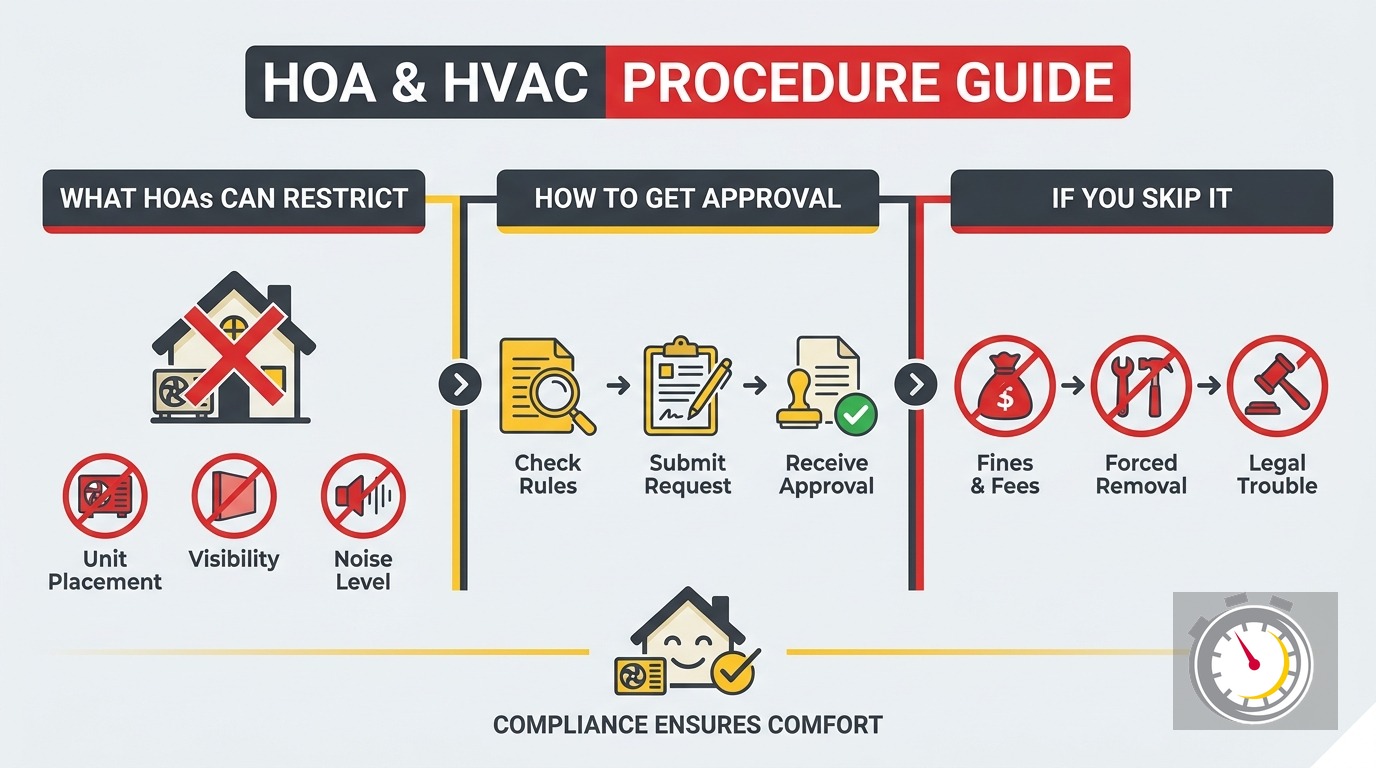
- Most Minnesota HOAs formed on or after June 1, 1994, have legal authority to require approval before you replace HVAC equipment or install a heat pump outdoors. Check your Declaration and Bylaws first.
- Minnesota law gives associations broad authority over exterior changes under Minn. Stat. § 515B.3-102, but sets no mandatory approval deadline. Your board can take as long as it wants.
- HOA approval and a city mechanical permit are two separate requirements. Getting one does not satisfy the other. You need both before work begins.
- Skipping HOA approval can result in fines and forced removal of the installed equipment under Minnesota statute.
- An HOA delay that pushes your install past December 2026 could cost you up to $2,600 in Xcel Energy heat pump rebates. That is real money, and you cannot recover it after the window closes.
- Cold-climate heat pumps work in Minnesota winters. Qualifying models must achieve a COP of at least 1.75 at 5°F to meet Xcel’s rebate standard.
Does Your HOA Have the Right to Approve or Deny HVAC Work?
Almost certainly yes, if your community was formed on or after June 1, 1994. Minnesota law gives associations broad authority to regulate exterior modifications. Replacing an outdoor HVAC unit or installing a heat pump falls squarely in that category.
Minnesota’s Common Interest Community Ownership Act grants associations power to regulate the exterior appearance of the community and the modification of common elements and units under Minn. Stat. § 515B.3-102(a)(1) and (a)(16). The Minnesota Commerce Department groups exterior changes - sheds, fences, playground equipment, and paint colors - in the category that requires prior approval under those same statutes. A new outdoor condenser or heat pump unit is exterior equipment. It sits in the same bucket.
What the approval process looks like depends entirely on your specific community’s Declaration, Bylaws, and Rules and Regulations. Some communities have a streamlined path for mechanical replacements. Others treat any exterior change the same way they treat a deck or fence application. Pull those governing documents and read them before you talk to a contractor, schedule an estimate, or spend time pricing equipment.
If your community was formed before June 1, 1994, or operates outside the MCIOA framework, different rules may apply. Your association manager can tell you which framework governs your community and what the review process involves.
What Does “No Approval Deadline” Mean for Your Project?
It means your board can take as long as it wants, and that is entirely legal under Minnesota law. Unlike California, which requires HOA architectural review committees to respond within a statutory window, Minnesota’s MCIOA sets no mandatory response deadline. Your timeline comes entirely from your own community’s governing documents.
If your Declaration does not specify a review period, your board can sit on an application for 30, 60, or even 90 days without violating state law. That has real consequences when your project has a timing constraint - a rebate deadline, a heating system approaching failure, or a fall installation window before the season locks in.
The practical move is to start the HOA approval process well before you feel ready. Submit your application the moment you decide to move forward. Start it before you have a contractor scheduled and before you have finalized equipment. Waiting until the job is booked means HOA review can hold up work that is already paid for and on the calendar - and your contractor cannot reschedule at no cost.
Some community documents do include a deemed-approval provision: if the board fails to act within the stated review period, approval is automatically granted. Most Minnesota HOAs do not have this language. Check yours. If you find it, note the exact start date of the clock.
Do You Need a Permit for HVAC Replacement?
Yes. In virtually every Minnesota jurisdiction, a mechanical permit is required for HVAC replacement. There is no “straight swap” exemption under the Minnesota Mechanical Code. A permit is required for HVAC replacement across Minnesota, regardless of whether the new system is the same size and type as what it is replacing.
Permit timelines and fees vary by city. Blaine charges 3% of job valuation with a $60 minimum and allows up to 15 business days for permit review. Other Twin Cities suburbs process permits faster or slower. Your contractor should pull the permit as part of the installation quote and timeline. If a contractor proposes to skip it, that is a serious red flag.
Homeowners may pull their own mechanical permit for non-gas work on a primary residence. Gas work requires a mechanical license. Your HVAC contractor must also carry a mechanical contractor bond filed with the Minnesota Department of Labor and Industry before they can legally pull a permit on your behalf. Ask to see proof before work begins. Any technician handling refrigerants must hold EPA Section 608 certification - a federal requirement with no exceptions.
Is the HOA Approval the Same as the City Permit?
No. They are two completely separate approvals, and you need both. HOA approval is a private contractual requirement between you and your community. A mechanical permit is a legal requirement from your city or county. Getting one does not satisfy the other.
The city cares only that the work meets code. The HOA cares only that the community approved the exterior change. Neither authority checks the other’s box.
This catches homeowners off guard more often than it should. A contractor can pull a permit and pass inspection. Your HOA can still fine you and require removal if the board never approved the project. Both gates must be cleared before a single piece of equipment goes in the ground.
Build time for both into your project timeline. HOA review typically takes longer. Start that process first. Begin the permit process as soon as you have a contractor and equipment selected. Our post on what to expect for HVAC permit costs in Minnesota covers fees and timelines across the Twin Cities metro.
What Happens If You Skip HOA Approval?
Fines, forced removal of the equipment, or both. Minnesota law gives associations authority to levy fines and require that unauthorized modifications be reversed. “Reversed” means physically removing the equipment - at your expense, not the HOA’s.
This is not a theoretical risk. Contractors have installed outdoor HVAC equipment that homeowners were subsequently required to remove. A new condenser, refrigerant lines, and a concrete equipment pad are visible from the street. Neighbors notice. Board members get calls.
The financial picture is bad. You pay for installation. You pay for removal. You pay fines that continue to accumulate until the violation is resolved. Then you still need to submit an application and wait for approval before you can do the project correctly. The total cost can easily exceed what the project would have cost if you had gone through the process first.
The Minnesota Winter Emergency Problem
Most guides on this topic skip the scenario that matters most in this state: your heat pump or furnace fails on January 15. It is -10°F outside. Your HOA’s next scheduled board meeting is February 10.
Here is what your options actually look like in that moment.
Check your governing documents for an emergency provision. Many HOA declarations include language permitting expedited or verbal approval for genuine emergencies, with written follow-up documentation. If yours has this provision, get verbal approval and confirm it in writing the same day - by email, text, or any format the board member will acknowledge. A verbal approval that lives only in your memory is not protection.
Contact your association manager or a board member directly. Most boards, when presented with a documented heating emergency in January, act quickly. The word “documented” matters. Have your contractor’s written emergency diagnosis in hand before you make that call. A paper diagnosis of a failed system carries more weight than a homeowner’s verbal report.
Use a portable electric heater as a bridge. It will not heat your whole home to 70 degrees. But it can keep pipes from freezing and keep one or two rooms livable while you work through the process correctly rather than forcing your hand and risking a forced removal later.
The real answer is to start this conversation before January. Systems more than 15 years old are approaching the end of their statistical service life. A January failure in Minnesota is not a slow emergency - it is a same-day emergency. Starting the HOA process now, while your equipment is still running, means you can replace on your terms: the equipment you want, the rebate window you need, and a schedule that does not cost you thousands in avoidable penalties.
Northern One Hour is locally owned and based in Ramsey. We serve the Twin Cities year-round, including the coldest nights of the year. Every visit is backed by a commitment to arrive when we say we will: “Always On Time… Or You Don’t Pay a Dime!(R)“
The Rebate Timing Risk You Cannot Ignore
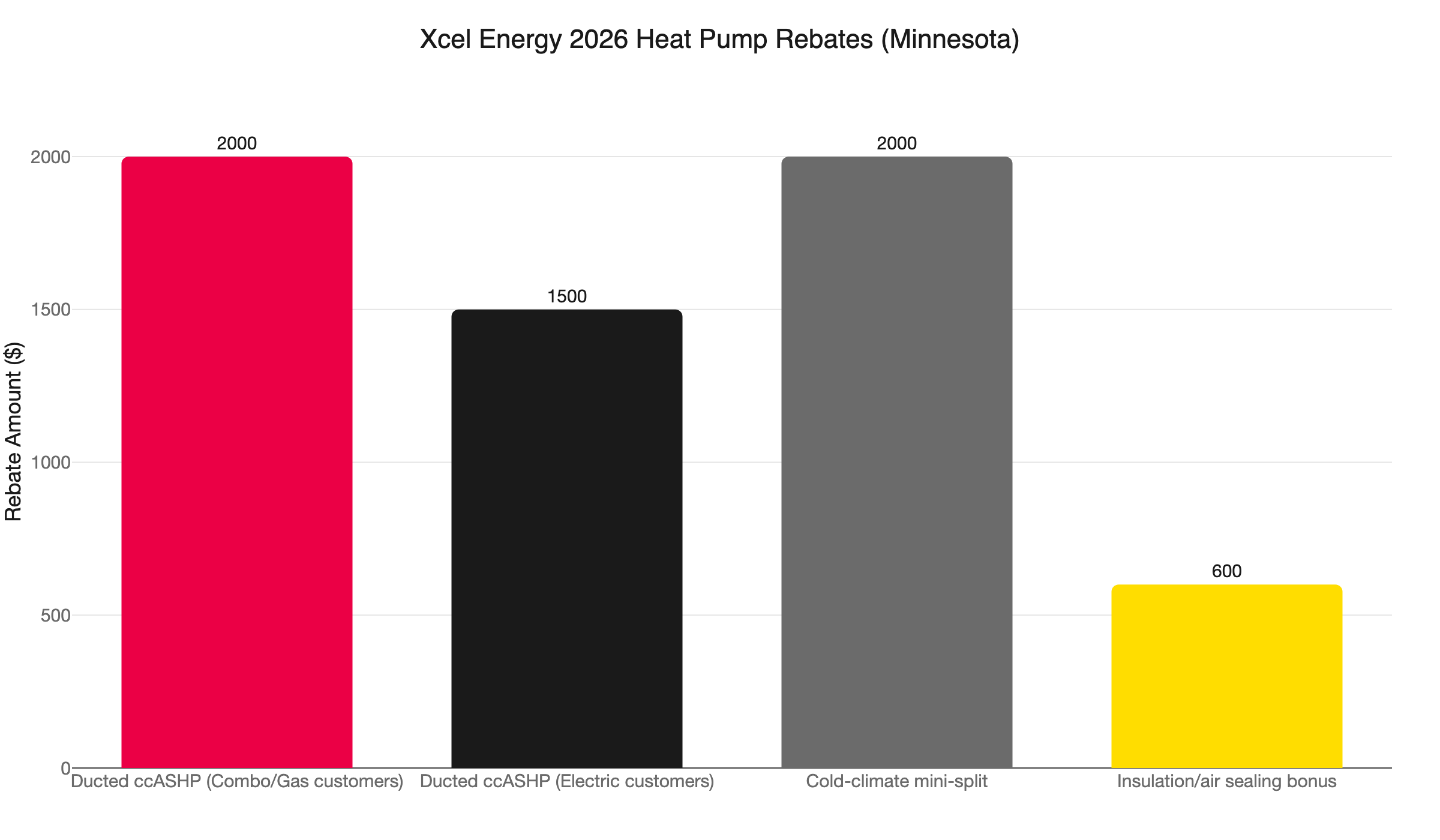
Here is the number that makes HOA delays genuinely expensive: Xcel Energy is offering a $2,000 rebate for a qualifying cold-climate ducted air-source heat pump for Combo or Natural Gas customers in 2026. Electric-only customers qualify for $1,500. Add qualifying insulation or air sealing to the same project, and a $600 bonus brings the maximum Xcel rebate to $2,600. The program runs through December 2026, with applications accepted through September 30, 2027.
To qualify, a ducted system must meet 15.2 SEER2, 10.0 EER2, and 8.1 HSPF2, plus a Quality Installation standard. Cold-climate mini-splits require 16.0 SEER2, 9.0 EER2, and 9.5 HSPF2. Not every heat pump model qualifies. Confirm the equipment you are considering is listed on the Northeast Energy Efficiency Partnerships database at ashp.neep.org before you count the rebate as money in hand.
Two other rebate sources are worth noting. The federal Section 25C heat pump tax credit expired on December 31, 2025, and is not available for equipment placed in service in 2026. The Minnesota state HEAR program offers up to $4,000 for qualifying cold-climate heat pumps, but as of June 12, 2026, the program had not yet launched, pending U.S. DOE approval with no confirmed launch date.
The timing math is straightforward. Submit your HOA application in late October. The board takes 60 days, as it is legally permitted to do. Your install falls in January 2027, after the Xcel program window has closed. That is $2,000 to $2,600 gone.
Submit your HOA application the moment you decide to move forward. Include manufacturer spec sheets with your first submission so the board has everything it needs. Do not make them ask twice. For the full picture on current rebate programs and how to combine them, our post on Minnesota heat pump rebates and available utility incentives covers where things stand today.
Can Heat Pumps Use Existing Ductwork?
Often yes, but the ductwork needs to be assessed before you commit. Heat pumps move larger volumes of air at lower supply temperatures than a gas furnace. Duct systems that are leaky, undersized, or poorly insulated reduce efficiency and cause comfort problems in the rooms farthest from the air handler.
Whether your existing ductwork is a good fit depends on duct sizing, sealing condition, insulation, and the static pressure your system is designed to handle. Our detailed post on evaluating your existing ductwork for heat pump compatibility walks through the key factors and the most common duct problems we see in Twin Cities homes.
Do Heat Pumps Work in Northern Minnesota Winters?
Yes. Cold-climate heat pumps are engineered for Minnesota conditions. To qualify for Xcel Energy rebates, a ducted system must achieve a COP of at least 1.75 at 5°F and maintain at least 70% of its rated heating capacity at that temperature. Equipment that meets this standard appears on the NEEP database at ashp.neep.org.
Qualifying systems use variable-capacity or multi-stage compressors to match output to demand instead of cycling on and off the way single-stage equipment does. That steady, lower-intensity operation is more efficient and more consistent in cold weather. Our post on how heat pump staging operates during a Minnesota heating season explains the mechanics in plain terms.
If you are heading into your first winter with a heat pump after the upgrade, our first-winter guide for Minnesota heat pump owners covers normal operating behavior, what to expect on your utility bill, and when to call for service.
To learn more about what we install and service, see our heat pump services page.
How to Submit an HOA Application That Gets Approved Quickly
The homeowners who clear HOA review without delays tend to do three things well.
Read the governing documents before you contact anyone. Pull your Declaration, Bylaws, and Rules and Regulations. Find the section on architectural changes or exterior modifications. Note the required forms, the list of submittal items (photos, spec sheets, site plans), and any stated review timeline. An incomplete first submission is the most common reason for delays - boards table incomplete applications and restart the clock.
Submit a complete package on the first pass. A strong application typically includes: a clear description of the scope of work, manufacturer specification sheets for the new equipment, a site plan or diagram showing unit placement, photographs of the existing equipment and location, and a statement from your HVAC contractor confirming that the work will meet local permit requirements and applicable code. Northern One Hour provides all of this contractor documentation as part of the estimate process. You will not need to track down paperwork separately.
Follow up in writing after every conversation. After any discussion with a board member or association manager, send a brief confirming email. “Per our conversation today, I have attached the application for your review. Please confirm receipt.” A written record protects you and keeps the process moving. If a board member gave verbal approval for anything, that email is what makes it real.
One more thing to confirm in your documents: whether your HOA requires a specific form or a licensed contractor’s signature on the application. Some communities do. Submitting without the required form means starting over.
Ready to Move Forward?
If you’re planning a heat pump replacement or HVAC upgrade in a Twin Cities home with an HOA, Northern One Hour is the locally owned, Ramsey-based HVAC company to call. We handle the mechanical permit, provide the contractor documentation your HOA application needs, and price every job honestly with no surprises.
Call (763) 260-6662 or book online to schedule an estimate. For larger heat pump and HVAC installations, financing is available - so upfront cost does not hold up a project that makes good financial sense after rebates.
Frequently Asked Questions
Can any electrician install a heat pump? +
Need a technician now?