
How to Heat and Cool a Sunroom in Minnesota (2026 Guide)
Key Takeaways
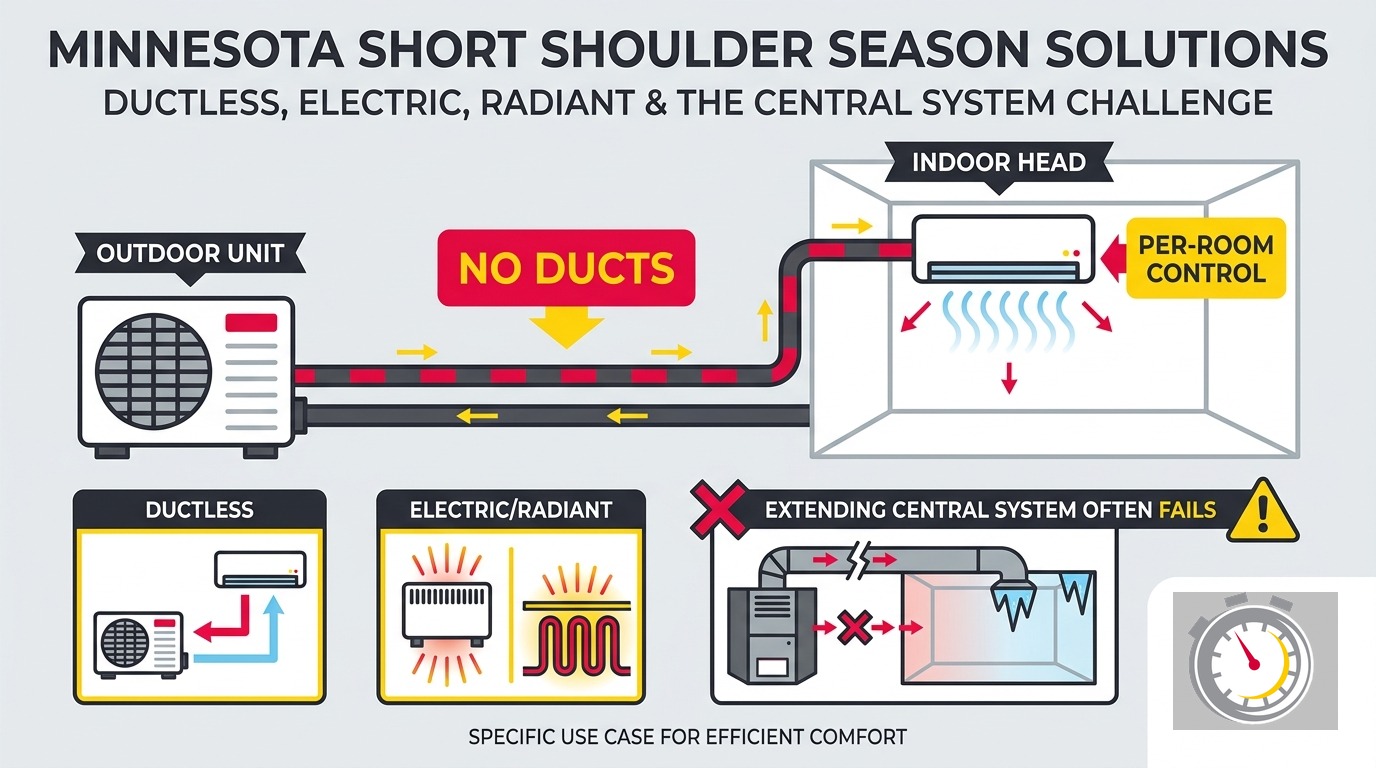
- A duct extension from your central system almost never works in a Minnesota sunroom. The glazing load is too high, and adding a supply register without a dedicated return creates a pressure imbalance that pulls conditioned air out of the main house.
- A cold-climate mini-split is the standard solution for an insulated 4-season sunroom. It heats and cools from one outdoor unit and qualifies for up to $2,600 in Xcel Energy rebates in 2026.
- The federal 25C tax credit expired December 31, 2025. Savings in 2026 come from utility rebates only.
- Minneapolis logs roughly 8,300 heating degree days per year, about twice the national average. A sunroom that only works in the shoulder season gives you roughly 8 to 10 usable weeks per year.
- Electric radiant floor heat works well as a supplement under tile or stone. It rarely works as the sole heat source in a heavily glazed room at -15°F.
- Mechanical permits for HVAC work in a conditioned Minnesota sunroom must be pulled by a licensed contractor bonded by MN DOLI. DIY HVAC connections are not allowed.
Why Does Extending Central HVAC Usually Fail in a Minnesota Sunroom?
Answer: Adding a supply register to an existing duct system without a dedicated return creates a pressure imbalance. Conditioned air gets pushed out through gaps in the sunroom. Cold or hot outside air gets pulled into the main house through every other leak. The thermostat in the main house is blind to the sunroom’s temperature.
Minnesota residential duct systems are sized for the house they serve. There is no spare capacity waiting in a trunk line for a sunroom addition. Even if you tapped enough airflow, the pressure problem remains.
Here is how it plays out. You add a supply register to the sunroom. Conditioned air flows in. Without a return path, the sunroom pressurizes. That pressure pushes air out through every gap: around window frames, through framing cavities, under the door. The main house goes slightly negative. It pulls unconditioned air in from outside. Homeowners notice the rest of the house becomes harder to heat or cool. The cause is pressure imbalance, not a failing furnace.
There is also a solar gain problem. South-facing glass can push the sunroom 20 to 30 degrees warmer than the rest of the house on a clear January afternoon. The thermostat in the hallway calls for heat. The furnace runs. The sunroom overheats. A standalone system with its own thermostat solves this entirely.
Your Building Envelope Has to Come First
Before choosing equipment, evaluate the building envelope. A 3-season porch with single-pane glass and uninsulated knee walls cannot become a 4-season room by adding heat alone. No HVAC system overcomes a poorly insulated building at -15°F without running constantly.
Minnesota’s residential energy code places the Twin Cities in Climate Zone 6A. Any sunroom designed to hold 50°F in winter must meet Zone 6A minimums: R-49 ceiling insulation and R-20 walls. If your sunroom does not meet those specs, address the envelope before you size any equipment.
There is a practical reason beyond code compliance. If you size a mini-split to overcome poor insulation, then later insulate properly, the unit will be oversized. An oversized unit short-cycles in shoulder season and does not dehumidify effectively in summer. Seal and insulate first. Then size the equipment to the real load.
Does a Mini-Split Heat and Cool?
Answer: Yes. A mini-split is a heat pump: one outdoor unit connected to one indoor air handler. It moves heat out of the sunroom in summer and into it in winter. One system handles both seasons without ductwork, and it responds to the sunroom’s thermostat, not the main house.
A ductless mini-split is the most common HVAC solution for a Minnesota sunroom. The outdoor unit mounts on an exterior wall or a ground pad. A refrigerant line set runs through a small hole in the wall. The indoor air handler mounts high on the interior wall. Installation typically takes a day.
Single-zone means the unit responds only to that room’s thermostat. When July sun hammers a south-facing sunroom, the mini-split responds to that sensor alone. That independent control is what makes it the right tool for a sunroom.
Our team handles ductless mini-split installation as a dedicated zone with its own controls. We pull the mechanical permit as part of the job.
One summer note: solar gain in a south- or west-facing sunroom can outpace a mini-split’s response on peak afternoons. Manual or motorized shading reduces the peak load. It helps the unit stay within its rated capacity rather than chasing a load it cannot fully handle. This is a building and HVAC detail together, not something equipment alone fully solves.
Do Heat Pumps Work in Minnesota Winters?
Answer: Cold-climate models work well in Minnesota. They maintain useful heating output down to -13°F to -22°F, depending on the model. Standard mini-splits lose substantial heating capacity below 20°F. That is exactly when the sunroom’s glazing load is at its worst. Spec the cold-climate equipment and you are covered.
Energy Star’s cold-climate heat pump criteria require a COP of at least 1.75 at 5°F and heating capacity at 5°F of at least 70% of capacity at 47°F. A standard mini-split does not meet those thresholds.
A DOE/PNNL field study on cold-climate heat pumps measured median COP of 1.6 to 2.7 below 30°F. An electric resistance baseboard heater delivers exactly COP 1.0 at any temperature. The efficiency gap is real, and it matters most on the nights when your sunroom is losing the most heat through glass.
For a deeper look at how a multi-zone or staged system manages different loads across the house, see our guide on how heat pump staging works in Minnesota.
Cold-Climate vs. Standard Mini-Splits: Why the Spec Matters More for a Sunroom
A sunroom sees greater load swings than any other room in the house. On a -15°F January night, the glazing is losing heat at its maximum rate. On a 90°F July afternoon with direct sun, it is gaining heat at the same extreme. The equipment needs to perform at both ends.
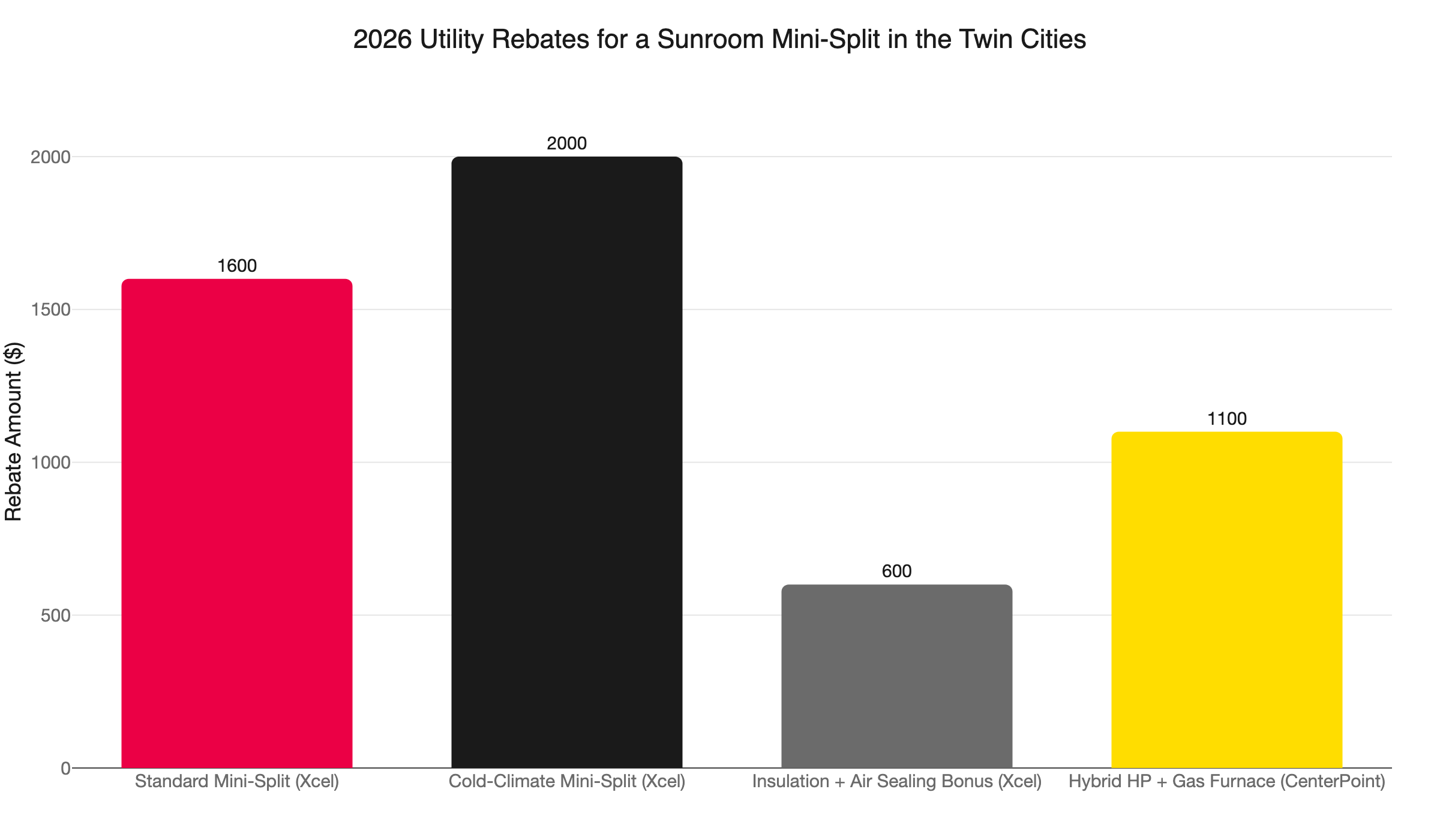
Xcel Energy separates its rebates by efficiency spec for exactly this reason. A standard qualifying mini-split earns $1,600 (SEER2 at or above 15.2, HSPF2 at or above 8.5). A cold-climate unit earns $2,000 (SEER2 at or above 16.0, HSPF2 at or above 9.5, COP at or above 1.75 at 5°F, capacity at or above 70% at 5°F vs. 47°F). For a sunroom in Minnesota, the cold-climate spec is the right choice. The additional $400 in rebates also helps offset the modest price premium.
The unit must appear on the NEEP ASHP product list and the AHRI directory to qualify. Cooling-only mini-splits do not qualify. We specify qualifying equipment on every installation so your rebate paperwork clears without surprises.
What Rebates Are Available for a Sunroom Mini-Split in the Twin Cities?
Answer: Xcel Energy customers get up to $2,000 for a cold-climate mini-split. An additional $600 is available if qualifying insulation and air sealing are done at the same time. That is $2,600 total from one utility. CenterPoint gas customers who configure a hybrid dual-fuel system can also stack a separate $1,100 rebate.
Here is the breakdown for an Xcel customer installing a cold-climate mini-split alongside insulation improvements:
- Cold-climate mini-split rebate: $2,000
- Qualifying insulation and air sealing bonus: $600
- Xcel total: $2,600
Rebates are paid as a check. Allow 6 to 8 weeks for processing after submission.
If your home uses CenterPoint natural gas and you are considering a dual-fuel hybrid setup, where a mini-split carries most of the load and a gas furnace handles the coldest nights, CenterPoint offers a rebate for a qualifying ducted air source heat pump paired with a gas furnace at or above 92% AFUE. The switchover must be set at 40°F or lower. That is a different configuration than a standalone sunroom mini-split, but worth knowing if you are planning a broader project.
One critical note for 2026: the federal 25C tax credit for heat pumps expired December 31, 2025. No federal credit is available for equipment installed this year. Utility rebates are now the primary incentive. For a rundown of how to layer Xcel and CenterPoint rebates on the same project, see our guide to stacking HVAC rebates in Minnesota.
For current installed cost ranges, see our heat pump installation cost guide for the Twin Cities.
When Does Electric Radiant Floor Heat Make Sense?
Answer: Electric radiant makes sense as a comfort supplement under tile or stone floors when you want warmth underfoot without a wall-mounted air handler. Paired with a mini-split, it works well. As the sole heat source in a glass-heavy Minnesota sunroom, it almost never works.
HomeGuide puts electric radiant floor heat at $8 to $15 per square foot installed, using cables or heating mats. For a 200-square-foot sunroom, that is roughly $1,600 to $3,000 for the radiant system alone. Pair it with a cold-climate mini-split handling air temperature and solar gain, and you have a genuinely comfortable layered system.
Hydronic radiant ($6 to $20 per square foot installed, per HomeGuide) only makes economic sense when a boiler is already in the home. Adding a new condensing boiler to serve one sunroom zone costs $9,100 to $15,600 for the boiler alone. That math rarely works for a single-room addition. If you have a boiler and want to extend a zone to the sunroom, that is a different conversation and one our team can walk through with you.
What Permits Does Minnesota Require for a Conditioned Sunroom?
Answer: Minnesota requires separate building, electrical, and mechanical permits for a conditioned sunroom addition. The mechanical permit must be pulled by a licensed Mechanical Contractor bonded by MN DOLI. No DIY HVAC connections are allowed under state law.
Brooklyn Park’s permit guidance for porches and sunrooms reflects what most Twin Cities municipalities require. You will need a building permit for the structure, an electrical permit for any new circuits, and a mechanical permit for the HVAC work. Some municipalities require a separate plumbing permit if hydronic systems are involved.
Permit review adds time to your project timeline. Many jurisdictions require an inspection before insulation is closed over wall cavities. Ask your contractor to confirm the permit scope and review timeline for your specific city before work begins.
We pull the mechanical permit on every installation. It is part of the job. As a locally owned and operated company serving Ramsey, Blaine, Brooklyn Park, Maple Grove, Plymouth, and the surrounding Twin Cities, we know what local inspectors expect and how to move projects through review cleanly.
Minnesota’s Short Shoulder Season Changes the Math
Minneapolis logs approximately 8,300 heating degree days per year. The national average is around 4,500. That 8:1 ratio of heating to cooling degree days means heating efficiency drives the majority of your annual energy cost, not cooling efficiency.
The true shoulder season, when outdoor temperatures stay between 45°F and 70°F and you need neither heat nor AC, amounts to roughly 4 to 6 weeks in April and May, and another 4 to 6 weeks in October. A sunroom that is only comfortable in that window gives you about 8 to 10 usable weeks per year. A well-insulated 4-season sunroom with a cold-climate mini-split is usable every month. The difference in livable time is significant.
This is also why the cold-climate spec matters more for a sunroom than for a bonus room addition. The sunroom takes the full brunt of the coldest design days. The glazing is not forgiving. You want a unit built for exactly that condition, not one sized for a more sheltered load.
For a comparison of air-source and ground-source options, and the scenarios where geothermal makes more sense than a mini-split, see our geothermal heat pump cost breakdown for Minnesota.
Choosing the Right System for Your Sunroom
Here is how the main options compare for a typical Minnesota 4-season sunroom:
Cold-climate ductless mini-split: Best overall. Handles heating and cooling, installs without ductwork, is sized to the sunroom load, and qualifies for up to $2,600 in Xcel rebates. This is what we recommend for most sunroom projects in the Twin Cities.
Extending central HVAC: Usually fails due to pressure imbalance and a misplaced thermostat. Viable only with a full duct redesign that includes a dedicated return, a larger and more expensive job than it first appears. The thermostat problem is still unsolved after the ductwork is done.
Electric radiant floor heat: A good supplement under tile or stone. Not a standalone solution at -15°F in a glass-heavy room.
Hydronic radiant: Sensible only when a boiler is already in the home and a zone extension is practical. Adding a new boiler for one room rarely pencils out.
Standard (non-cold-climate) mini-split: Underpowered at the worst moments. Spend the extra on the cold-climate spec. The rebate difference partially offsets the cost, and the performance gap on a -15°F night is meaningful.
Ready to Make Your Sunroom Usable Year-Round?
We are locally owned and operated, and our team installs cold-climate mini-splits in sunrooms across Ramsey, Blaine, Brooklyn Park, Maple Grove, and the wider Twin Cities metro. We size the unit to the actual room load: glass area, orientation, insulation values. We handle the mechanical permit. And we show up when we say we will.
“Always On Time… Or You Don’t Pay a Dime!(R)” is our promise. If our technician does not arrive within the window you select, you do not pay for the service.
Call (763) 260-6662 or book online to schedule your sunroom assessment.
Frequently Asked Questions
Are heat pumps worth it in Minnesota? +
How much would a 20x20 sunroom cost to heat and cool? +
Need a technician now?