
Geothermal Heat Pump Minnesota Cost: Honest 2026 Breakdown
Key Takeaways
- A geothermal heat pump system in Minnesota runs $20,000-$30,000+ installed for a typical 1,500-2,500 sq ft Twin Cities home.
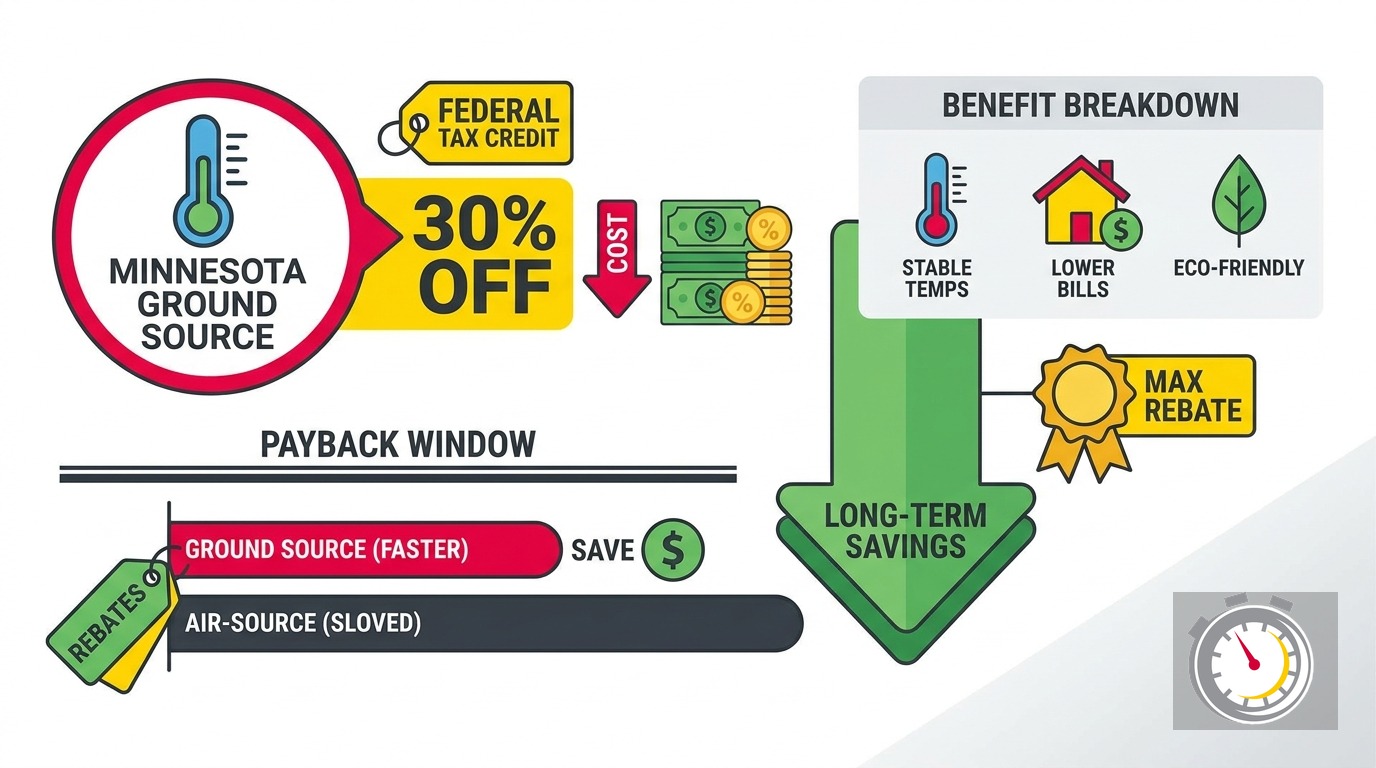
- The 30% federal tax credit (§25D) is gone for 2026 installations. Budget the full price.
- Twin Cities Xcel Energy and CenterPoint customers have no utility rebate specific to geothermal. The Minnesota Power GSHP program covers northeastern Minnesota only.
- The strongest financial case is replacing oil, propane, or electric resistance heating. A modern 96% AFUE gas furnace rarely pays back within 15 years.
- Twin Cities soil (glacial clay and loam) keeps drilling costs moderate. But our heating-heavy climate requires loop fields 15-25% larger than comparable homes in warmer states.
- A $250-$650 pre-installation energy audit can trim equipment and loop sizing costs by $3,000-$8,000.
Geothermal heat pump Minnesota cost is one of the most-searched HVAC questions in the Twin Cities right now. Most of what’s online is out of date. The 30% federal tax credit ended December 31, 2025. Here’s what a 2026 install actually costs, and how to know if it makes financial sense for your home.
What Does a Geothermal Heat Pump Cost in Minnesota?
The short answer: Expect $20,000-$30,000 or more for a fully installed system in the Twin Cities. The national midpoint for a 3-4 ton system is around $25,500 per RSMeans 2026 data. Minnesota homes, because of our heating-dominated climate, typically land at the higher end of that range.
Here’s how the installed cost breaks down by component:
- Ground loop (vertical bore field): $10,400-$23,400. Most suburban Twin Cities lots don’t have the 1-2 acres a horizontal loop requires. Vertical boreholes at 150-400 feet deep are the standard solution.
- Heat pump unit: $5,000-$9,000 depending on capacity and brand.
- Distribution system modifications: $1,300-$7,800 if your existing ductwork needs upgrades. Geothermal systems produce lower supply temperatures than furnaces and may require additional airflow capacity.
- Electrical work and permits: $1,300-$3,900.
Total installed cost for a mid-size Twin Cities home typically lands between $28,600 and $39,000. Larger homes or sites with more complex conditions push that higher.
One thing that surprises homeowners: the heat pump unit is rarely the biggest line item. The ground loop usually is. That’s why sizing and energy assessment before installation matters so much. We’ll cover that later.
Why Minnesota Ground Temps Work in Your Favor
Here is the physics behind why geothermal is especially compelling in a Minnesota winter.
Below-grade earth holds steady between 45 and 75°F year-round. That holds true even when surface air drops to -10°F or -20°F. A geothermal heat pump pulls heat from that stable ground temperature rather than frigid outdoor air. That keeps the system’s coefficient of performance (COP) at 3.0-4.5 through our coldest weeks.
Think of the ground loop as a thermal battery. In summer, heat from your home is deposited into the ground. In winter, that stored warmth is extracted back out. The earth never swings to -20°F, so the heat pump is never working as hard as an air-source unit on the same night. That stable operating condition contributes to longer service lives: typically 20+ years for the heat pump unit and 50+ years for the loop itself with normal maintenance.
Air-source heat pumps work differently. They extract heat from outdoor air. Efficiency drops noticeably below 20°F, and on the coldest Minnesota nights many units fall back on electric resistance backup, which cuts into their efficiency advantage.
A 2025 field study covering more than 1,000 installed units found that geothermal systems missed their expected efficiency targets in only 2% of installs, compared to 17% for air-source heat pumps. That reliability gap is meaningful when your heating season runs from October through April.
If you’re weighing geothermal against a cold-climate air-source option, our breakdown of cold-climate heat pump performance in Minnesota covers what to expect from those systems at extreme temperatures.
What Pushes Geothermal Heat Pump Cost Higher in Minnesota?
The short answer: Loop field size is the primary driver. Heating-dominated climates like ours require loop fields 15-25% larger than a comparable home would need in a warmer state. That adds cost before anything else is factored in.
Two things do work in our favor.
Twin Cities soil is primarily glacial clay and loam, not granite bedrock. Hard-rock drilling, common in states like Maine and New Hampshire, takes two to three times longer per borehole. Our moderate soil keeps drilling costs in the middle of the national range.
Lot size is the binding constraint for most Twin Cities homeowners. Suburban properties typically don’t have the open land for a horizontal loop field. Vertical boreholes are the standard, and they’re priced per foot of depth. The combination of heating climate plus lot constraint is what pushes geothermal heat pump Minnesota cost toward the upper end of national ranges rather than the midpoint.
The practical implication: request quotes only from contractors who pull the required well permits and provide a full Manual J load calculation before specifying loop size. A contractor who quotes without calculating your load is working from a number they guessed.
The Federal Tax Credit Is Gone for 2026 Installations
This is the most consequential planning mistake we’re seeing right now. Most articles online still imply the credit is available, and some were written as recently as late 2025.
The 30% residential geothermal tax credit under IRS §25D, also known as the Residential Clean Energy Credit, ended for systems placed in service after December 31, 2025. The One Big Beautiful Bill Act (P.L. 119-21), signed July 4, 2025, repealed it. If your system is installed in 2026, you cannot claim it.
On a $26,000 install, that credit was worth $7,800. Going into a 2026 project without accounting for this puts your budget off by a significant amount. It also shifts the payback math materially.
A few clarifications worth knowing:
- Systems installed and placed in service by December 31, 2025 can still claim the credit on IRS Form 5695. Unused credit from prior years can be carried forward.
- The commercial §48 investment tax credit remains active through 2034. It’s driving some third-party residential leasing arrangements for homeowners. That’s a separate conversation for a tax professional, not an HVAC contractor.
- Systems claiming any remaining rebate programs must meet ENERGY STAR certification standards. That’s the minimum qualification for any incentive.
If a contractor quotes you a price “after the 30% credit” for a 2026 installation, ask them to show you the current IRS guidance. The credit is not available this year.
What Rebates Are Actually Available for Twin Cities Homeowners?
The short answer: Very few, if Xcel Energy or CenterPoint serves your address. The best geothermal utility rebate in Minnesota is a northeastern Minnesota program that does not apply to the metro.
Here’s the honest incentive picture for a 2026 Twin Cities installation.
Minnesota Power (northeastern MN only):
- $800/ton for ENERGY STAR certified geothermal, installed through a participating contractor by December 31, 2026.
- $1,000/ton if the contractor holds MNGHPA Master Installer certification.
- This is a northeastern Minnesota program covering Duluth, the Iron Range, and Grand Rapids. It does not serve Minneapolis, St. Paul, or the surrounding metro.
Xcel Energy (Twin Cities metro):
- Up to $2,000 for a cold-climate air-source heat pump, plus a $600 insulation bonus.
- No confirmed geothermal-specific rebate on Xcel’s current program list as of July 2026.
CenterPoint Energy (Twin Cities metro):
- $1,500 for a ducted air-source heat pump in a hybrid configuration alongside a 92%+ AFUE gas furnace.
- CenterPoint does not rebate standalone geothermal or heat pumps that fully replace gas service.
Federal HEAR and HOMES rebates:
- Minnesota has not launched either program as of June 2026. The MN Department of Commerce is still awaiting DOE approval, with no estimated launch date. These rebates are not issued retroactively.
Minnesota sales tax exemption:
- Geothermal equipment qualifies for a Minnesota sales tax exemption. On the equipment portion of a large install, that saves a few hundred dollars. It’s a real benefit, not a large one.
The bottom line for a Twin Cities homeowner in 2026: your incentive stack is the sales tax exemption and whatever a small cooperative or municipal utility might offer at your specific address. If Xcel or CenterPoint serves you, there is no geothermal-specific utility rebate to stack.
For a full picture of what rebates are available on heat pump alternatives, see our guide to Minnesota heat pump rebates and tax credits.
Who Actually Benefits from Geothermal in Minnesota?
The short answer: Homeowners replacing oil, propane, or electric resistance heating see the strongest financial case. If you have a modern natural gas furnace, the numbers are tighter than most articles suggest.
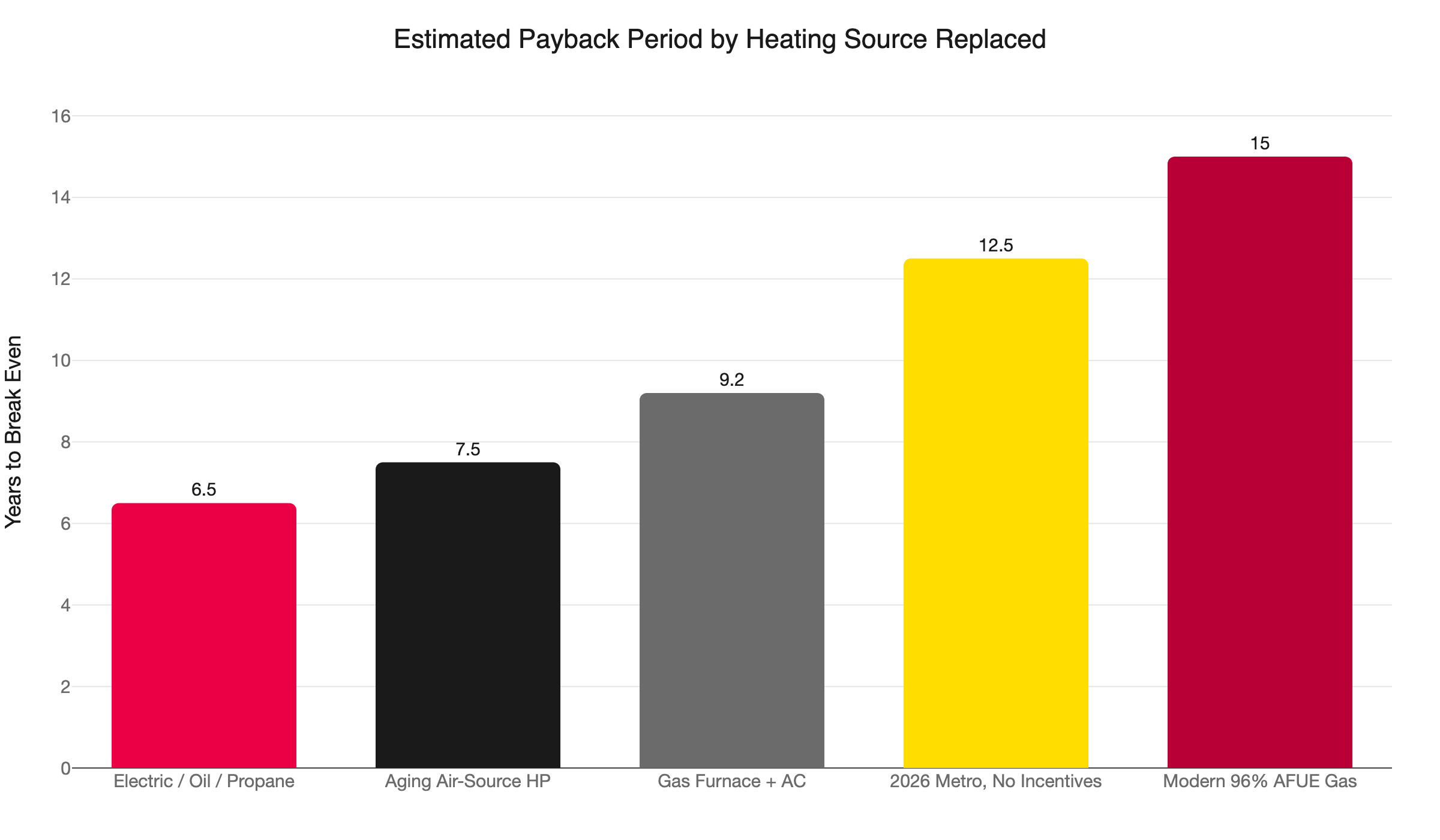
Here’s the payback picture by scenario, based on DOE Monte Carlo modeling:
- Replacing electric resistance, oil, or propane: 5-8 years. This is the strongest case. You’re moving away from expensive fuels to electricity at geothermal efficiency levels.
- Replacing an aging air-source heat pump: 7.5-year median payback.
- Replacing a gas furnace plus central AC: 9.2-year median.
- 2026 metro install with no federal credit and no utility rebate: 10-15 years.
- Replacing a modern 96% AFUE natural gas furnace: Does not reach payback within 15 years at current natural gas rates.
That last point is the one most geothermal articles skip. A 96% AFUE furnace already converts nearly all the gas it burns into usable heat. The efficiency gap between that furnace and geothermal is smaller than the gap between geothermal and oil or propane. Remove the federal tax credit from the 2026 equation, and the case grows even harder to make on a natural gas baseline.
If your home heats with natural gas and your furnace is less than 10 years old, the honest recommendation is to look carefully at the numbers before committing to a full geothermal project. A hybrid heat pump arrangement may offer better economics at a lower upfront cost.
If you heat with oil, propane, or electric baseboard, request a geothermal quote. Fuel savings alone can shorten payback significantly, even without the federal credit.
Time horizon matters too. If you plan to sell within five years, you will not recoup the upfront cost in most scenarios. In your long-term home, a 10-12 year payback is a reasonable threshold for a system that will last 20-25 years with minimal maintenance.
Financing is also worth considering on a project this size. If geothermal eliminates a $250-$350/month propane bill and your loan payment is $180/month, you’re cash-flow positive from day one. Our overview of HVAC financing options in the Twin Cities covers what to expect from that process.
Should You Get an Energy Audit Before Installing Geothermal?
The short answer: Yes. A $250-$650 pre-installation energy audit can trim total project cost by $3,000-$8,000 by right-sizing the system to your actual load rather than your current equipment size.
Geothermal systems are sized to the real heating and cooling demand of your home. If your attic insulation is thin, your windows leak air, or your ductwork is undersized, the system will be oversized for where your home should be after those improvements are made. You end up paying for loop footage and equipment capacity that does nothing for you.
An energy auditor measures your actual load and identifies which improvements yield the most impact per dollar. The geothermal contractor then sizes the loop field to the improved home, not the current one. Trimming several hundred feet of borehole from the job is where the savings show up.
Correct sizing also matters for long-term comfort. An oversized geothermal system short-cycles, meaning it turns on and off too frequently. Short-cycling reduces humidity control, wears components faster, and leaves the home less comfortable than a well-matched system running in long, even cycles. In a Minnesota summer, humidity management is not a minor detail.
Is Geothermal Right for Your Home?
The short answer: For the right fuel situation, lot, and time horizon, geothermal is one of the most reliable and efficient systems available. For Twin Cities gas customers with a newer furnace, it is a harder sell in 2026 without the federal credit.
A few filters to run before requesting quotes:
Strong candidates:
- You heat with oil, propane, or electric resistance.
- Your lot has normal clay or loam soil. Shallow granite bedrock is uncommon in the Twin Cities, but a site assessment is worth requesting.
- You plan to stay in the home 10 years or more.
- You can absorb the upfront cost or qualify for financing on a project this size.
Tougher cases:
- You heat with natural gas and your furnace is less than 10 years old.
- You plan to sell within five to seven years.
- Your lot is unusually small, or site conditions complicate boring access.
Northern One Hour is locally owned and operated in Ramsey, MN. We serve Minneapolis, St. Paul, Blaine, Maple Grove, Plymouth, Brooklyn Park, Woodbury, Bloomington, and the surrounding metro. We can assess whether geothermal is the right fit for your home, or whether another heat pump option makes more sense given your situation and budget.
We stand behind the on-time promise: “Always On Time… Or You Don’t Pay a Dime!(R)” That applies to consultations on big decisions like this, not just service calls. If geothermal makes sense, we’ll tell you exactly why. If it doesn’t, we’ll tell you that too.
Call us at (763) 260-6662 or book online to schedule a consultation. Straight answers, on time.
Frequently Asked Questions
How much does a geothermal heat pump cost in Minnesota? +
Is the federal geothermal tax credit still available in 2026? +
Does Xcel Energy offer a rebate for geothermal heat pumps? +
What is the realistic payback period for geothermal in Minnesota? +
Need a technician now?