
Does Attic Insulation Lower Heating Bills in Minnesota?
Key Takeaways
- EPA data shows air sealing and attic insulation together save homeowners an average of 15% on heating and cooling costs. That number requires both steps, not just one.
- Air leakage accounts for 30 to 40% of a home’s heat loss and bypasses insulation completely. Sealing must come before insulating, not after.
- The Twin Cities metro falls in IECC Climate Zone 6. Minnesota’s energy code requires R-49 minimum for attic ceilings. Most pre-1990 homes fall far short of that.
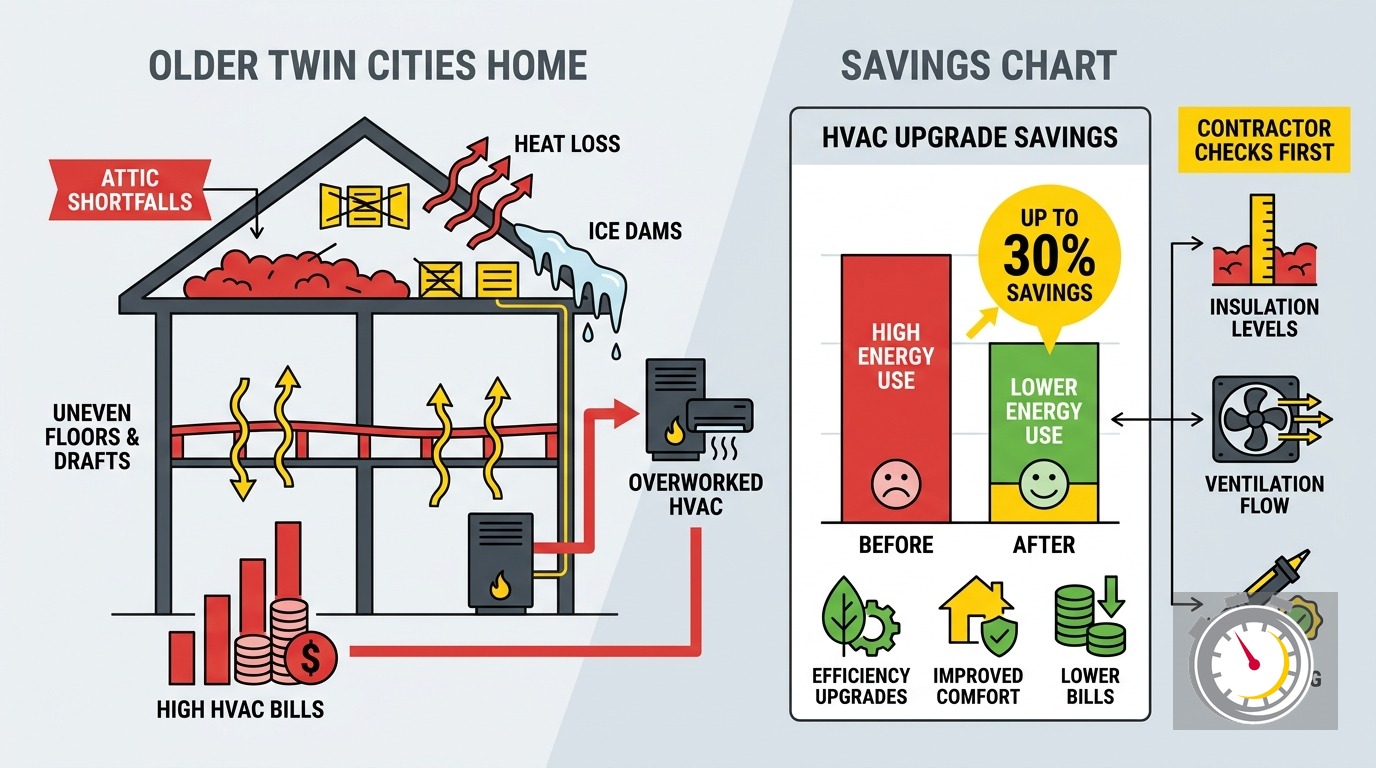
- Ice dams are a building-science problem, not a roofing problem. Warm air escaping through partition wall top plates and light penetrations drives uneven snow melt.
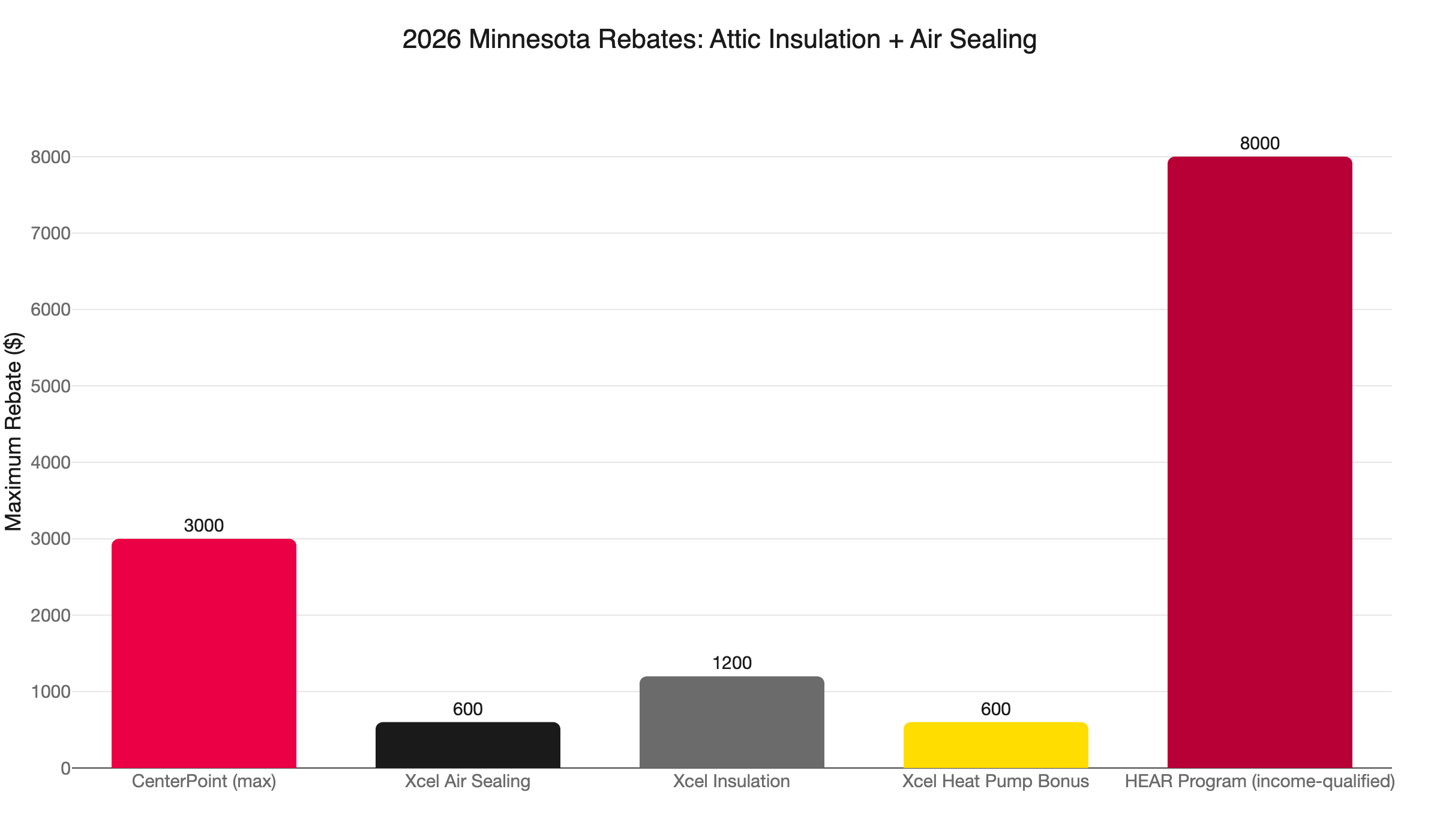
- In 2026, CenterPoint Energy offers up to $3,000 for qualifying air sealing and insulation projects. Xcel Energy offers up to $1,800 combined. The federal 25C tax credit expired January 1, 2026.
- A good contractor starts with a blower door test and thermal imaging. The tape measure comes later.
Does Attic Insulation Lower Heating Bills?
Yes, but the answer comes with a condition most insulation articles skip. The EPA estimates homeowners save an average of 15% on heating and cooling costs by air sealing and adding insulation in attics, floors over crawl spaces, and basements. That number is for both steps together. Drop insulation into an attic full of unsealed air bypasses, and you will see a fraction of those savings.
Here is why. Air leakage accounts for 30 to 40% of total heat loss in a typical home, and it does not travel through insulation. It travels around it. Add twelve inches of blown-in insulation on top of unsealed gaps, and the warm air still finds its way through. Insulation slows conductive heat transfer. It does not stop convective air movement.
The symptom most Twin Cities homeowners describe goes something like this: the utility bill keeps climbing year over year, certain rooms never feel right in January, and every winter brings another ice dam on the north eave. Those three symptoms often share a single root cause. We will work through all three.
Why Air Leakage Matters More Than Insulation Thickness
Most homeowners think of insulation as the fix. Contractors who have done blower door tests know the real problem is usually air movement.
Heat escapes living space through a predictable set of pathways. Partition wall top plates, the horizontal framing where interior walls meet the ceiling, are among the worst offenders. Recessed light penetrations, plumbing chases, electrical runs, and chimney chases all contribute. In an older Twin Cities home, the combined open area of unsealed top plates and penetrations can be substantial. Together they can equal leaving a window open all winter.
The rim joist deserves its own mention. That is the band of wood between your foundation wall and the first-floor framing. Heat rises through uninsulated wall cavities and exits into the attic via this path. It is a stack-effect problem: warm air at the bottom of the house creates pressure that drives cold air in at the bottom and pushes warm air out at the top. Sealing the rim joist and the top plates together breaks that loop.
Up to 40% of a home’s heat can be lost through an under-insulated attic in winter. When leaky penetrations combine with inadequate insulation, you are fighting both problems at once. Roughly 80% of homes built before 1980 can benefit from additional attic insulation, according to DOE figures. If your home was built before 1990 and has never had a professional energy assessment, assume both problems exist.
The practical takeaway: a well-sealed attic with modest R-value outperforms a thick insulation layer over unsealed bypasses. Sequence is not optional. It is the whole point.
Does a Leaky Attic Cause Ice Dams?
Yes, and it does so through a predictable sequence. Warm air leaks into the attic and heats the roof deck from below. That heat melts snow at the upper portion of the roof. The meltwater runs toward the cold eave, hits the unheated overhang, and refreezes. The dam grows until backed-up meltwater forces its way into wall cavities and ceiling assemblies.
Most homeowners treat ice dams as a roof problem. They are a building-science problem. Adding a better roof membrane slows the water damage. It does not stop the ice from forming. The only reliable fix is stopping the heat that creates uneven roof deck temperatures in the first place.
Heat convects into the attic through partition wall top plates, recessed light penetrations, plumbing and electrical bypasses, and chimney chases - not primarily through the insulation itself. Add insulation over unsealed penetrations, and the ice dams keep coming. Seal those penetrations first, then insulate, and the roof deck stays close to the outside air temperature. No differential. No melt-freeze cycle. No dam.
This is the piece generic insulation articles miss. Ice dam prevention is not about buying the thickest insulation product on the shelf. It is about stopping the air movement that creates uneven temperatures across the roof deck in the first place.
What Does Attic Venting Have to Do With HVAC Bills?
A lot, and the effect runs in both directions. In summer, a poorly ventilated attic traps heat that radiates into the living space and forces the AC to run longer. In winter, imbalanced airflow can pull conditioned air out of the house and into the unconditioned attic.
The standard ratio is one square foot of net free ventilation area for every 150 square feet of attic floor, delivered as balanced intake from soffit vents and exhaust from ridge vents. When that balance breaks down, three things go wrong:
- Soffit vents blocked by insulation. Blown-in insulation installed without baffles slides toward the eave and plugs the intake. Minnesota’s energy code requires baffles at all soffit and eave vents to prevent exactly this. Without them, any exhaust fans in the attic create negative pressure and pull conditioned air from the living space upward.
- Attic temperatures spike in summer. Without adequate ventilation, attic temperatures can exceed 150 degrees Fahrenheit on a hot Minnesota afternoon. That radiated heat forces your air conditioner to run longer and harder, raising cooling bills and shortening equipment life.
- Leaky attic ducts compound the problem. Every loose duct connection in an unconditioned attic dumps conditioned air directly into that overheated space. Attic ducts must be insulated to R-8 minimum and sealed with mastic, not standard duct tape. Duct tape fails in extreme heat.
If your cooling bills have been trending up and your equipment is less than ten years old, check the attic before assuming the system is failing. Leaky ductwork is its own issue - see our breakdown of duct sealing and energy loss for details on how duct performance affects your bills.
What Does a Contractor Check First?
Not the insulation. The first move for any reputable contractor is a blower door test to quantify total air leakage, combined with thermal imaging to pinpoint exactly where it is happening.
A blower door depressurizes the house to a standard reference pressure. The test measures how many times per hour the house exchanges its air volume with the outside. Energy-efficient homes target two air changes per hour or fewer. Older Twin Cities homes with no air sealing history can measure eight or ten. That number tells the contractor how much sealing work the house needs before a single bag of blown-in insulation goes down.
Thermal imaging finds the specific bypasses the blower door quantifies. In winter, a thermal image of an attic floor lit up with warm patches tells you exactly where the top plates, penetrations, and chases are leaking. No guesswork required.
The correct sequence looks like this:
- Blower door test and thermal scan.
- Seal all bypasses: top plates, recessed lights, plumbing and electrical penetrations, chimney chases, rim joist.
- Verify the seal with a follow-up thermal scan.
- Blow in insulation to meet code minimum (R-49 for Zone 6).
- Confirm baffles are in place at all soffit vents before insulating near the eaves.
Skipping step one saves an hour upfront and costs homeowners years of high bills. The attic work that follows is only as effective as the sealing beneath it.
Our team runs into this connection often. Homeowners call about rooms that never feel right or temperature swings between floors, and the attic turns out to be a major driver. Addressing the envelope is the fix the equipment upgrade alone cannot deliver.
Minnesota Code Minimums and Climate Zones
The Twin Cities metro - Hennepin, Ramsey, Dakota, Anoka, Carver, Washington, and Scott counties - sits in IECC Climate Zone 6. Northern Minnesota is Zone 7. Those zones drive the R-value floors your attic must meet under the Minnesota Energy Code, Chapter 1322.
Zone 6 requires R-49 minimum for attic ceilings. Zone 7 requires R-60. Many pre-1990 Twin Cities homes were built with R-11 or R-19. Some have even less after decades of settling and moisture damage. They are operating at a fraction of what the code now requires and far below what a Minnesota winter demands.
R-value measures resistance to conductive heat flow through a material. More is better, up to the point where air leakage becomes the dominant factor. That is exactly why the sequence matters. A home at R-49 with major air bypasses may perform worse than a home at R-30 that is tightly sealed.
You can get a rough read on your current R-value without a contractor. If your attic has fiberglass batts, count the layers and check the facing label. If it has blown-in cellulose or fiberglass, a depth of three and a half inches is roughly R-13. Twelve inches of blown-in cellulose is closer to R-38. Anything below twelve inches in a Zone 6 attic falls short of current code.
Minnesota code also requires baffles at all soffit and eave vents. A contractor who skips baffles to move faster creates new moisture and ventilation problems while solving the old insulation shortfall.
What Rebates Are Available in 2026?
Good news on the utility side, with one important federal update. CenterPoint and Xcel both offer rebates for qualifying air sealing and insulation work. The federal 25C tax credit is gone - it expired December 31, 2025, eliminated by the One Big Beautiful Bill Act signed July 4, 2025. Projects completed in 2026 or later cannot claim it. Homeowners who completed work before January 1, 2026 can still claim it on their 2025 return via Form 5695.
CenterPoint Energy (natural gas customers in the Twin Cities metro): up to $3,000 for qualifying attic insulation combined with air sealing. Air sealing is required - there is no rebate for insulation alone. Your pre-project R-value must be R-30 or lower, and the completed project must reach R-49 or higher. The contractor must be a Rebate Eligible Installer, and the rebate is issued as a check after project completion.
Xcel Energy: up to $600 for attic air sealing and up to $1,200 for attic insulation, for a combined maximum of $1,800. Air sealing is required alongside insulation. An additional $600 bonus rebate applies if you install a qualifying heat pump within two years of the insulation project. If you are already thinking about a heat pump upgrade, that bonus is worth factoring into the timing.
Minnesota HEAR program (income-qualified households): federally backed Home Energy Rebate administered through mn.gov Commerce. Up to $8,000 for qualifying households. Expected to continue in 2026.
Confirm rebate eligibility with your contractor before work begins, not after. Some programs require pre-project enrollment or inspections.
How Does Attic Insulation Affect HVAC Equipment?
Your furnace and air conditioner are sized for the heat loss and heat gain of your home as it was calculated at installation. When the attic is leaky and under-insulated, the actual heat loss exceeds what the equipment was designed to handle. The system runs longer cycles, or short-cycles trying to catch up. Either way, it works harder than it should.
In winter, that means more run hours per day: more gas or electricity consumed, more thermal stress on the heat exchanger, more wear on the blower motor and controls. In summer, the AC works against heat radiating from a 150-degree attic space down through the ceiling into the living area. No amount of thermostat adjustment compensates for radiant gain from an overheated attic.
Equipment that runs too long or too often wears faster. It needs repairs sooner. It gets replaced before its rated service life. The attic shortfall is not just a comfort problem or a utility bill problem. It is a maintenance cost problem that compounds over time.
Fixing the attic envelope is often the highest-return action a homeowner can take to reduce HVAC run time and extend equipment life. When a technician can see the attic is driving the system to overwork, that is the conversation to have before investing in equipment repairs or a replacement.
Is Attic Work Worth It Before a Furnace Replacement?
Almost always yes. Here is the reason: furnace sizing is based on the home’s calculated heat load. A leaky, under-insulated house carries a high heat load. If you replace the furnace without correcting the envelope, your contractor sizes the new unit for the house as it stands. Fix the envelope first, and your heat load drops. You may qualify for a smaller, more efficient system at a lower equipment cost.
The sequencing also matters for rebates. Xcel’s $600 heat pump bonus only applies within two years of a qualifying insulation project. If you are planning both, do the attic work first and time the equipment upgrade within that window.
Our heating services include assessments that look at both the equipment and the building shell together. If the furnace is the bottleneck, we will say so. If the attic is the bottleneck, we will say that instead. Honest assessment, transparent pricing - that is how we work.
Getting an Assessment in the Twin Cities
Northern One Hour Heating & Air Conditioning is locally owned and operated in Ramsey, MN. We serve Minneapolis, St. Paul, Blaine, Maple Grove, Plymouth, Brooklyn Park, Woodbury, Bloomington, and communities throughout the Twin Cities metro.
When our technicians come out for a heating or cooling concern, they look at the full system - not just the equipment in the mechanical room. If attic conditions are driving your bills or contributing to uneven comfort, we will tell you. If the problem is the furnace or the ductwork, we will tell you that instead.
We back every appointment with our on-time promise: “Always On Time… Or You Don’t Pay a Dime!(R)” That means we show up when we say we will, every time.
To schedule a heating or cooling assessment, call (763) 260-6662 or book online. If you are considering a larger project - air sealing, insulation, equipment replacement, or some combination - ask about financing options when you call. We can walk through what the rebate timeline looks like for your utility and what that means for your project cost.
Frequently Asked Questions
Does adding attic insulation actually lower my heating bill? +
What causes ice dams on a Minnesota roof? +
What R-value does my attic need in the Twin Cities? +
Are there rebates for attic insulation in Minnesota in 2026? +
Need a technician now?