
AC Compressor Failing Signs: Twin Cities Repair Guide
Key Takeaways
- Hard faults (unit hums but will not start, breaker trips on every cycle, loud mechanical clank) require a professional diagnostic before any repair is approved.
- Soft warnings (hard starting, short cycling, warm air with a running system, rising energy bills) appear weeks or months before a hard fault. Catching them early is the difference between a small repair and a large one.
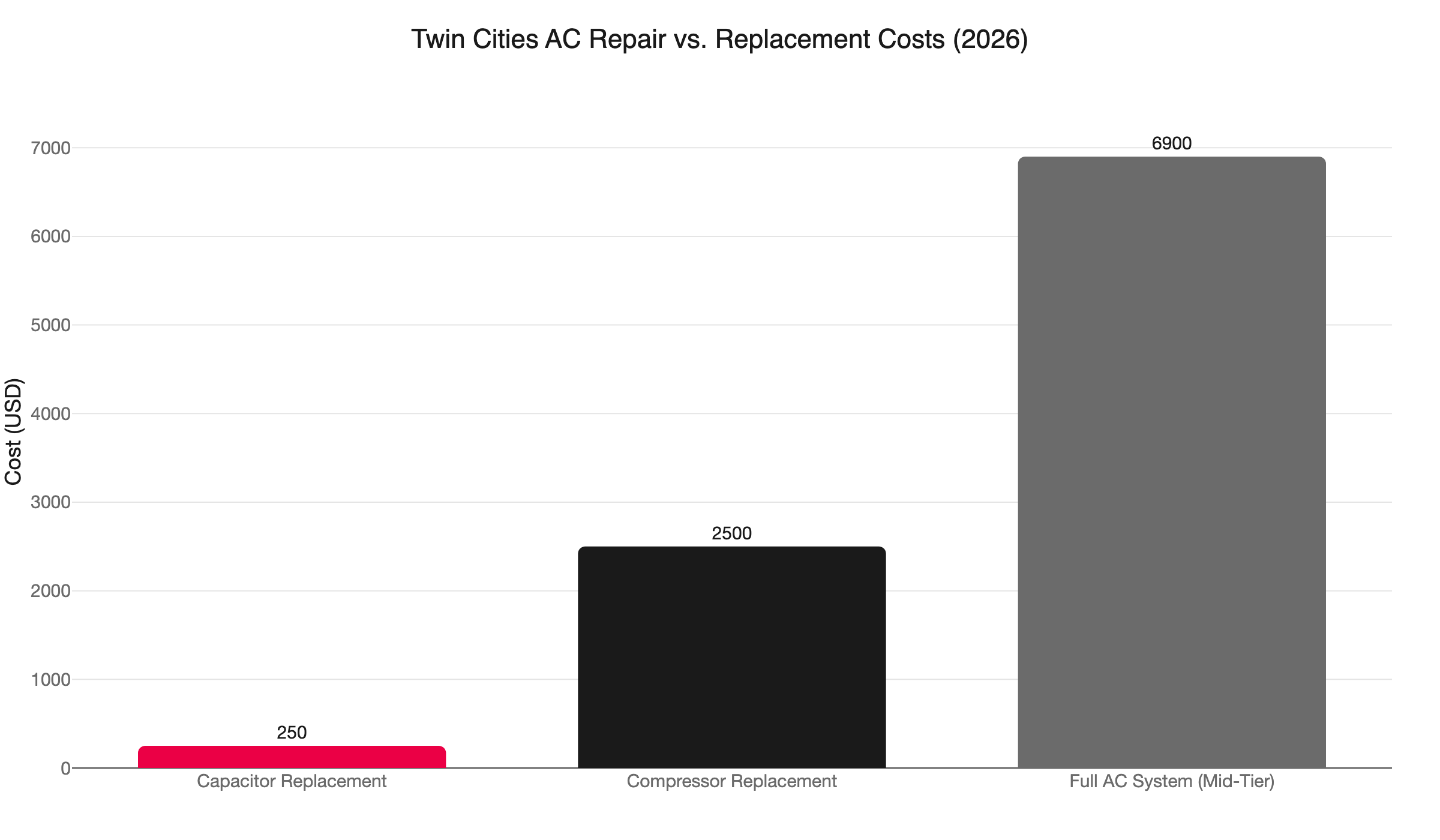
- A failed run capacitor and a failed compressor produce nearly identical homeowner symptoms. Capacitor repair: $150-$350. Compressor replacement: $1,500-$3,500.
- Never approve compressor replacement without seeing capacitor test results first.
- The 50% rule at Minnesota prices: system 10 or more years old plus a repair quote at or near half the replacement cost is a replace signal.
- At Twin Cities mid-tier installed costs of $5,800-$8,000, a $2,500-plus compressor repair on a 12-year-old system is a replace signal.
- R-22 systems are auto-replace. R-410A systems need individual analysis given the EPA phase-down.
- Xcel Energy offers up to $500 for qualifying central AC and up to $1,500 for a cold-climate heat pump.
Your outdoor unit hums. The fan does not spin. The house is getting warmer by the hour. You search “AC compressor failing signs Twin Cities” and brace for a four-figure repair bill. Before you approve anything, know this: that exact symptom - outdoor unit hums, fan sits still - is the classic presentation of a failed run capacitor, not a dead compressor. The cost difference is $1,200 to $3,000.
What Are the Hard-Fault AC Compressor Failing Signs?
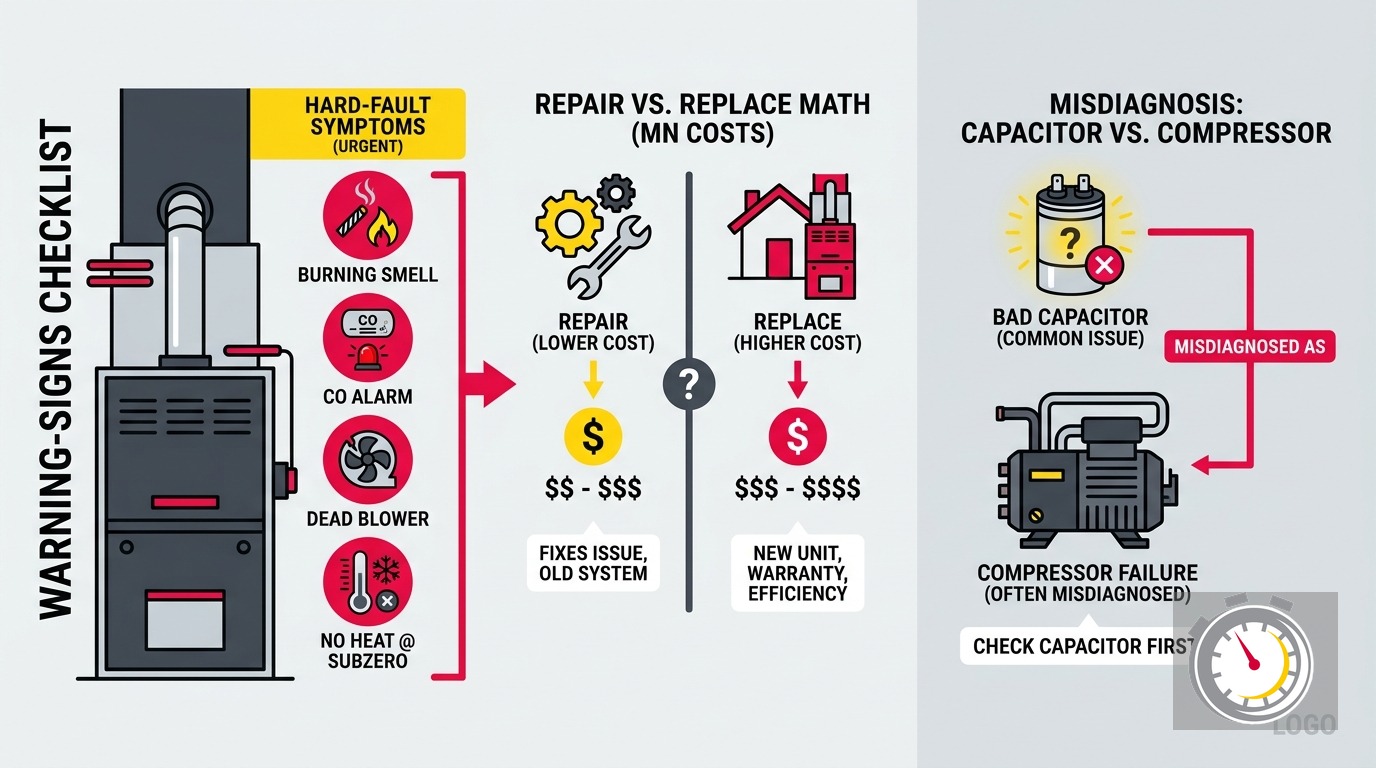
The short answer: Hard faults mean the system cannot run at all. Signs include the outdoor unit humming but not starting, the breaker tripping on every startup cycle, or a loud metal-on-metal clank from the compressor housing. Each requires a professional diagnostic - not an automatic compressor replacement quote.
When your AC stops on a July afternoon in Ramsey, Blaine, or Brooklyn Park, the impulse is to assume the worst. But “system will not run” has several possible causes. Knowing which type you are dealing with prevents a costly rushed decision.
Hard faults leave the system unable to operate at all:
- The outdoor unit hums but the fan blade does not spin. This is the most common hard-fault presentation - and the most misread one. The run capacitor gives the fan motor and the compressor the electrical jolt they need to start. When the capacitor fails, neither the fan nor the compressor can operate. The result looks identical to a dead compressor from the outside.
- The breaker trips on every startup. A compressor drawing more current than the circuit can handle will trip the breaker repeatedly. This is a hard fault. The cause could be the compressor - or it could be a seized contactor or a shorted capacitor pulling excess amperage.
- A loud metal-on-metal clank or knock from the outdoor unit. Mechanical failure inside the compressor produces a distinct clank or rattle - broken pistons, loose connecting rods, seized bearings. This is different from the electrical humming of a capacitor failure. A mechanical clank points more directly at the compressor itself.
- The unit does not attempt to start at all - completely silent. “Silent” does not mean “dead compressor.” It can mean a blown fuse, a failed contactor delivering no voltage, or a thermostat not sending a call for cooling.
Every hard fault requires a diagnostic visit. None of them automatically means you need a compressor.
What Are the Early Warning Signs Before a Compressor Fails?
The short answer: Soft warnings - hard starting, short cycling, warm air with a running system, and rising energy bills - typically surface weeks or months before a hard fault. Catching them early is the difference between a $180 fix and a $3,500 one.
Minnesota summers are short. The Twin Cities cooling season runs roughly 4-5 months. Every week your AC runs unreliably is a week you cannot get back. Watch for these early signals.
Hard starting. The system hesitates before it kicks on. You hear a grunt or a struggle, then the compressor engages. Repeated hard starts put significant mechanical stress on the compressor. A weakening capacitor is usually the cause. A timely capacitor swap prevents a much larger failure later.
Short cycling. The system starts, runs 5-10 minutes, shuts off before reaching your set temperature, then restarts a few minutes later. Short cycling can be caused by capacitor-failure-induced overheating - the compressor works harder than it should, gets hot, and the thermal protection shuts it down. This pattern often precedes a hard fault by weeks.
Warm air with a running system. The fan blows, the system runs, but the air is not cold. This can be refrigerant-related (a leak or low charge) or compressor-related (worn internal components unable to build adequate pressure). It is not self-diagnosable. Our post on why your AC keeps running but won’t cool your home covers this pattern in more depth.
Higher-than-usual energy bills without a change in usage. A compressor losing efficiency draws more power to produce the same cooling. If your Xcel Energy bill climbs noticeably through the cooling season when habits have not changed, schedule an inspection.
Oil stains near the outdoor unit or on the refrigerant line set. Refrigerant leaks carry compressor oil with them. Oil stains indicate a leak. Leaks accelerate compressor wear because the compressor depends on refrigerant-entrained oil for lubrication.
None of these soft warnings means the compressor is dead. All of them mean schedule a diagnostic before the problem becomes a hard fault on a hot weekend in August.
Why Does a Bad Capacitor Look Like Compressor Failure?
The short answer: The run capacitor is what allows the fan motor and compressor to start and run. When it fails, neither can operate - which looks identical to a dead compressor from outside the unit. A failed run capacitor and a failed compressor produce nearly identical symptoms for the homeowner. The cost difference: $150-$350 for a capacitor versus $1,500-$3,500 for a compressor.
This is the diagnostic trap that costs Twin Cities homeowners thousands of dollars every cooling season. The outdoor unit hums. The fan does not spin. The house does not cool. A tech working from symptoms alone - without running a proper electrical test - can easily misquote a capacitor failure as compressor failure.
Here is why the confusion happens.
The run capacitor is a small cylindrical component inside the outdoor unit’s electrical panel. It stores an electrical charge that gives the fan motor and compressor their startup kick. It also sustains the current they need to run efficiently. When the capacitor fails, both the fan and the compressor lose the electrical assistance they depend on - even if the compressor motor itself is mechanically healthy.
A partially failed or weak capacitor is trickier still. It does not produce a clean hard fault. Instead, it causes hard starts and short cycling - symptoms that look like early compressor failure to the untrained eye.
Here is the longer-term risk: a weak capacitor that repeatedly forces the compressor to hard-start will eventually cause real compressor failure. A timely capacitor repair prevents a compressor replacement. The sequence matters.
If a technician quotes you compressor replacement without first showing you the results of a capacitor test, ask for those results before approving any work. A transparent diagnostic process is the mark of a trustworthy contractor.
How Do Technicians Tell a Bad Capacitor from a Failed Compressor?
The short answer: A compressor should never be condemned from sound or visual observation alone. A capacitance test measures whether the capacitor is holding its rated charge. An amperage test at the compressor terminals shows whether the compressor itself is straining. Both tests take minutes. Neither should be skipped.
A qualified technician works through these steps before recommending any major repair:
- Visual inspection. A failed capacitor sometimes bulges at the top or leaks oil. This can confirm the diagnosis, but a capacitor can fail without any visible damage.
- Capacitance test. Using a multimeter, the tech checks whether the capacitor holds its rated charge in microfarads (uF). A reading significantly below the value on the capacitor label means it is failing.
- Amperage draw at the compressor. Clipping an amp meter to the compressor leads reveals startup and run current. High locked-rotor amperage - the system straining to start and failing - with a good capacitor reading points toward the compressor.
- Voltage at the contactor. If the contactor is not delivering voltage, the compressor cannot start regardless of its own condition. A contactor test rules out a cheaper repair before the compressor is targeted.
These are not optional steps. They take 10-15 minutes and protect you from a four-figure mistake.
Northern One Hour is locally owned and operated out of Ramsey. Our technicians run a full electrical diagnostic before they recommend any repair. If your outdoor unit is humming but not starting, we test the capacitor before we discuss the compressor.
Should You Repair or Replace a Failing AC Compressor in Minnesota?
The short answer: If the system is 10 or more years old and the repair quote is at or near 50% of the replacement cost, replace. At Twin Cities prices, a $2,500-plus compressor repair on a 12-year-old system is a replace signal. On a newer system with a minor component failure, repair first.
Here is how to apply the math in Minnesota.
Twin Cities AC replacement costs (2026):
- Mid-tier central AC, installed: $5,800-$8,000
- Full market range: $4,200-$11,500
- Minnesota labor runs 10-20% above the national average due to cold-climate equipment requirements and state licensing standards
Applying the 50% rule at local prices:
- A $2,500 compressor repair on a 12-year-old system is roughly 40% of a $6,500 mid-tier replacement. Combined with the system age, this is a replace signal.
- A $3,000 compressor repair on a 15-year-old system exceeds 50% of the replacement floor. Replace.
- Repair makes financial sense when the unit is under 8 years old, the failure does not involve refrigerant, and the repair covers a minor component - capacitor, contactor, or blower motor.
Minnesota cooling season length changes the payback math. The Twin Cities cooling season runs roughly 4-5 months - much shorter than southern states. The efficiency gain from upgrading a 16 SEER2 system to a 20 SEER2 system pays back in a few years in Houston. In Minneapolis, the payback period is significantly longer. Do not let anyone use southern-climate efficiency projections to justify a premium system for a Minnesota home.
Minnesota central AC lifespan: 12-15 years with regular maintenance. A 14-year-old system with a $2,800 compressor repair quote is not a long-term investment. A 5-year-old system with a $250 capacitor repair is a clear fix. Most decisions fall between those poles.
Our AC replacement cost guide for Minnesota walks through the full breakdown of installed costs, labor rates, and how system age factors into the decision. Call us at (763) 260-6662 and we will walk through the math with your specific system, age, and repair quote in hand.
Does Your Refrigerant Type Change the Repair-vs-Replace Math?
The short answer: Yes, significantly. R-22 systems are auto-replace - recharging costs far exceed the value of any repair. R-410A systems need individual analysis given the EPA phase-down. New systems installed since January 1, 2025 use R-454B.
Your system’s refrigerant type can override the 50% rule entirely. Check the data plate on your outdoor unit.
R-22 systems (generally installed before 2010): R-22 production and import has been banned in the United States since January 1, 2020. Supply is severely constrained and prices are high. Recharging an R-22 system costs far more than the repair is worth in most cases, and costs will only rise from here. If your system runs on R-22 and has a compressor failure, replace the whole system. There is no cost case for a compressor repair on an R-22 unit.
R-410A systems (approximately 2010-2024): R-410A is under the EPA AIM Act phase-down. Parts and refrigerant costs are rising. A newer R-410A unit under 8 years old is not an auto-replace situation yet, but factor those rising service costs into any repair-versus-replace decision.
New systems (installed January 1, 2025 and later): New AC installations now use R-454B, the EPA-approved transition refrigerant. If you replace an older system today, your new unit will use R-454B. Our post on the R-454B refrigerant transition for Minnesota homeowners explains what that means for parts availability and future service costs.
Knowing your refrigerant type is step one in any honest repair-versus-replace conversation. We can tell you which refrigerant your system uses and what that means for your options.
What About Utility Rebates When You Replace?
The short answer: Xcel Energy and CenterPoint Energy both offer rebates on qualifying replacements. A mid-tier AC replacement qualifies for up to $500 from Xcel. A cold-climate heat pump can bring in up to $2,600 in stacked rebates from multiple programs.
If the repair-versus-replace math points toward replacement, rebates change your net cost in a meaningful way.
Xcel Energy (active as of 2026):
- Up to $500 for a qualifying central AC at SEER2 16 or higher
- Up to $1,500 for a cold-climate heat pump (NEEP-listed)
- Up to $100 for an ENERGY STAR smart thermostat
- Up to $600 insulation and air-sealing bonus paired with a heat pump installation
CenterPoint Energy:
- Up to $1,500 for a ducted air-source heat pump
- $1,100 for a dual-fuel heat pump system
The maximum stacked rebate on a heat pump installation reaches approximately $2,600. On a $7,000 mid-tier heat pump install, that brings your net cost to roughly $4,400 before financing.
One important note on federal incentives: the Section 25C tax credit expired December 31, 2025. It does not apply to 2026 installations. Do not budget for it.
Our Minnesota heat pump rebates guide has the current figures for both Xcel and CenterPoint customers. We help qualify every purchase for available rebates as part of the installation process. For larger jobs, ask about financing options when you call.
Does Every AC Replacement in Minnesota Require a Permit?
The short answer: Yes. Every AC replacement in Minnesota requires a local mechanical permit. A contractor who does not mention pulling a permit is a red flag. Permitted work is inspected. Unpermitted work can void manufacturer warranties and create liability when you sell your home.
Northern One Hour pulls the required permits on every installation. You should not have to ask.
What to Do When You Spot AC Compressor Failing Signs in Twin Cities
Here is the short checklist for any Twin Cities homeowner dealing with an AC system that is struggling or will not start:
- Do not diagnose by sound alone. Hard starting, humming without running, and short cycling all have multiple causes. Let a technician test before drawing conclusions.
- Ask for capacitor test results before approving compressor replacement. A compressor diagnosis without a prior capacitor test is incomplete.
- Know your system’s age and refrigerant type. Both change the repair-versus-replace calculation. The data plate on the outdoor unit tells you both.
- Apply the 50% rule with Minnesota costs. System 10 or more years old plus a repair quote at or near half the replacement cost is a replace signal.
- Check rebate eligibility before committing to a replacement. Xcel and CenterPoint rebates can reduce your net cost by $500 to $2,600 depending on the equipment you choose.
- Choose a company that diagnoses before it quotes. A tech who recommends compressor replacement without testing the capacitor first is not working in your interest.
Northern One Hour is locally owned and operated, and we back every service visit with “Always On Time… Or You Don’t Pay a Dime!(R).” If your outdoor unit is humming, your home is warming up, or your system is short-cycling through a Minnesota summer, call us at (763) 260-6662 or book a diagnostic visit online.
Frequently Asked Questions
What are the signs my AC compressor is failing? +
How do I know if it's the capacitor or the compressor? +
Should I repair or replace my AC if the compressor is failing in Minnesota? +
Need a technician now?