
UV Light for HVAC System: What Works in Twin Cities Homes
Key Takeaways
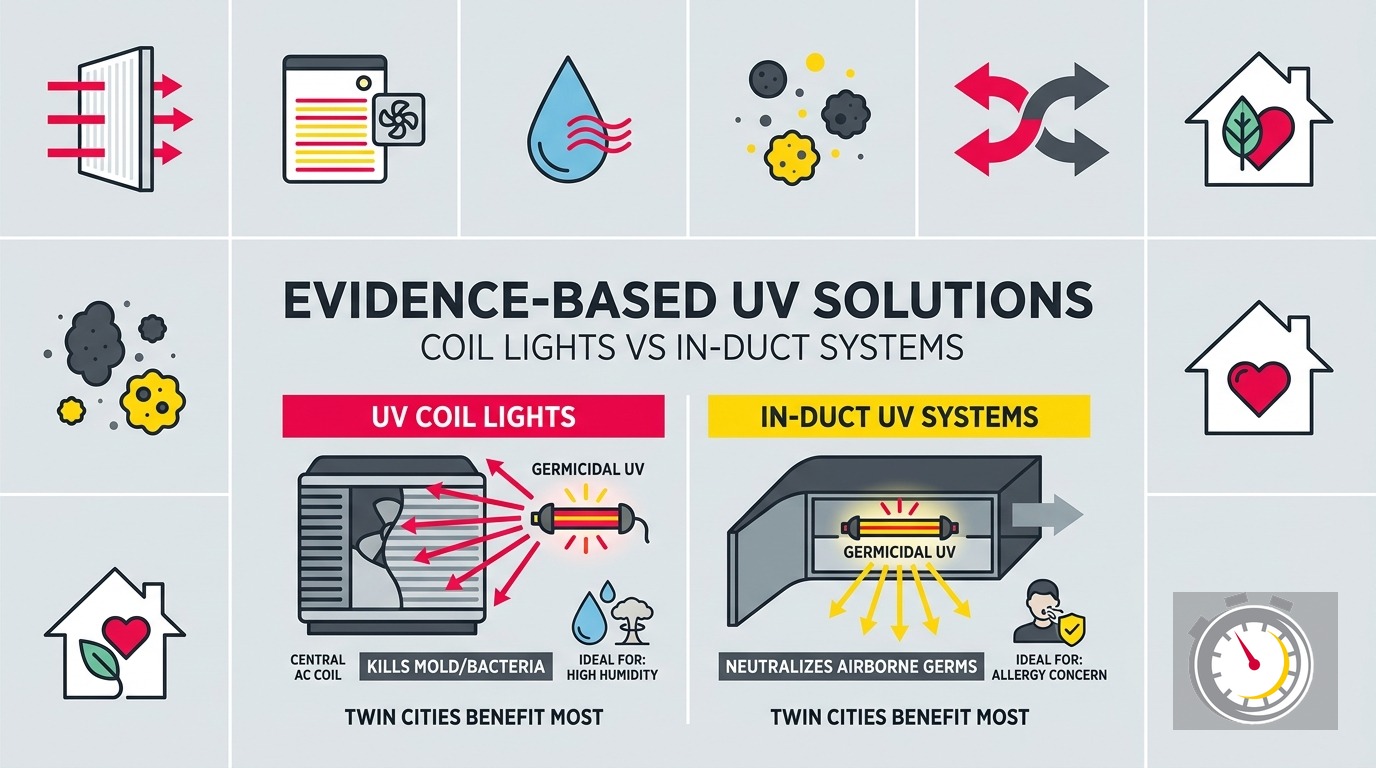
- UV light for HVAC comes in two types: coil UV (at the evaporator) and in-duct UV (in the airstream). They work by different physics and solve different problems.
- Coil UV shines on a stationary surface 24 hours a day. Exposure time is essentially unlimited. This is the type with the strongest evidence base for residential use.
- In-duct UV has roughly half a second to act on air moving at 400-500 FPM. Dose is often insufficient in standard residential units.
- UV does not remove particles. Pollen, dust, and pet dander stay in the air after UV exposure. For allergy relief, start with better mechanical filtration (MERV 13+), not UV.
- Twin Cities evaporator coils run through a genuinely humid Minnesota summer. Coil biofilm is a documented local concern. Coil UV addresses the source.
- UV installation in Minnesota requires a mechanical permit and possibly an electrical permit. A licensed contractor pulls these.
- No Xcel Energy or CenterPoint rebates apply to UV IAQ add-ons. Budget for the full cost.
A UV light for your HVAC system is not one product. It is two different products that work on completely different physics and solve different problems. Most homeowners research “HVAC UV lights” and land on articles that treat them as interchangeable options with minor cost differences. They are not. Choosing the wrong type wastes money. Understanding the difference takes about ten minutes - and those ten minutes will shape a decision you will not regret. Here is the honest version, tailored to what Twin Cities homes actually face.
What Does a UV Light for an HVAC System Actually Do?
In short: A UV-C lamp (typically 253.7 nm) disrupts the DNA and RNA of microorganisms, preventing reproduction. It inactivates mold, bacteria, and some viruses. It does not trap or remove particles. It is a disinfection tool, not a filter - and it works best when the physics are in its favor.
Germicidal UV has been in clinical use since the 1930s, with a proven track record of limiting airborne transmission of measles and tuberculosis. UV-C light at 253.7 nm from low-pressure mercury vapor lamps is the established residential standard.
The key word in that track record is dose. UV-C kills microorganisms when they receive enough light energy. Dose is a product of intensity and time. Change one of those variables - as happens dramatically when air is moving rather than standing still - and effectiveness changes with it. This is why coil UV and in-duct UV are genuinely different products, not just different placements of the same product.
The EPA is honest about the residential ceiling: “The effective destruction of some viruses and most mold and bacteria spores usually requires much higher UV exposures than a typical home unit provides.” That caveat does not apply equally to both UV types. It matters far more for in-duct UV than for coil UV.
Coil UV vs. In-Duct UV: Two Products, Two Jobs
This is the section most articles skip. It is worth understanding.
Coil UV installs inside the air handler, positioned to shine directly on the evaporator coil and drain pan. The lamp runs continuously. The target never moves. In surface-disinfection applications, UV-C intensity can be relatively low because exposure time is effectively unlimited. ASHRAE recommends 50-100 µW/cm² for coil irradiance - a standard a single, properly positioned lamp can meet. The result: biofilm does not build up. The coil surface stays cleaner. Mold does not colonize the drain pan.
In-duct UV installs in the supply or return plenum, downstream from the air handler. Air moves through residential ductwork at roughly 400-500 feet per minute. At those velocities, a microorganism passing a UV lamp gets a mere fraction of a second of exposure. Delivering a killing dose in that time window requires far higher lamp intensity than most residential units produce.
The gap matters. A standard residential in-duct lamp is probably not delivering meaningful germicidal dose to the moving airstream in your home. A commercial-grade, purpose-built in-duct UV system - sized specifically for your system’s airflow rate - is a different product. Most residential installations do not meet that engineering standard.
This is not a reason to dismiss UV entirely. It is a reason to recognize coil UV as the stronger evidence-based choice for the average Twin Cities home.
Why Do Twin Cities Summers Make Coil Biofilm a Real Problem?
In short: The Twin Cities has a legitimately humid summer. When outdoor dew points climb above 60°F - a regular occurrence from June through August - indoor relative humidity near the evaporator coil can exceed 70%. That is prime mold-growth territory. Coil biofilm is not a theoretical concern for Minnesota homeowners; it is a predictable seasonal event.
The Twin Cities averages a January temperature of 15.6°F (-9.1°C), making it the coldest major metro in the continental United States. That cold-climate identity creates a blind spot: we think of our air quality problems as dry-air winter problems. The humid summer is its own challenge.
When outdoor dew points hit 60°F or higher, warm humid air enters the home and the AC runs hard to cool it. The evaporator coil gets cold. Moisture from the air condenses on the coil surface. The drain pan fills. Organic debris - dust, skin cells, biological material pulled through the return air - settles on those wet surfaces. Biofilm forms. Mold follows.
The Minnesota Department of Health recommends keeping indoor relative humidity below 60% year-round (and 20-40% in winter). A well-functioning AC should hold that range for the living space. But the coil itself sits in a micro-environment that regularly exceeds it during July and August. That is the design reality of running an AC through a Minnesota summer - and coil UV addresses it directly.
If your system produces a musty smell during the first few minutes of operation after a warm, humid night, that odor is coming from biofilm on the coil. The smell fades once airflow dilutes it, which makes it easy to dismiss. It should not be dismissed. Persistent biofilm degrades indoor air quality, restricts airflow, and drives up energy costs over time.
For context on related coil and drainage issues, see our post on what causes water leaks inside your AC in a Twin Cities summer.
Does UV Light Actually Kill Mold and Bacteria?
In short: Yes, for coil applications. A California Energy Commission study in K-12 schools found coil UV-C treatment reduced total fungal and gram-positive bacteria on cooling coil surfaces by 65-100%. Those are stationary-target conditions - exactly what coil UV is designed for.
ASHRAE Research Study 1738 tested coil UV in commercial HVAC applications and found a 21% decrease in mean coil airside pressure drop and a 14% increase in mean overall heat transfer coefficient. Those are efficiency numbers. They reflect what happens when you remove the biofilm layer that was insulating the coil and restricting airflow: the system runs more effectively.
For airstream organisms, the picture is more nuanced. The EPA notes that UVGI should be used in addition to - not as a replacement for - conventional particle filtration. And adding UV to a system that already uses HEPA filtration provides “only minimal infection control benefits over those provided by the HEPA filters alone.” UV is a complement to filtration, not a substitute for it.
The clear takeaway for Twin Cities homeowners: if your goal is to reduce mold and bacteria on your evaporator coil, coil UV delivers documented results in the exact conditions your system faces each summer.
Will a UV Light Help With My Allergies?
In short: Not directly, and possibly not at all. UV inactivates living organisms. Pollen, dust, and pet dander are not organisms. They remain airborne after UV exposure. If allergies are your primary motivation, a MERV 13 or better filter upgrade is the right first step - not UV.
This is the most common misunderstanding in residential UV marketing. UV inactivates bioaerosols - mold spores, bacteria, some viruses. It does not neutralize inert particulate allergens like pollen or pet dander. A UV lamp cannot make a pollen grain inert because pollen is already inert. The particle stays in the air. You breathe it.
For allergy relief, start with better filtration. Our guide to air purifiers vs. filters and MERV ratings explained walks through the difference between filter types and which MERV rating makes sense for common allergy profiles.
If you have both allergy concerns and a history of mold or musty odors in your HVAC system, the right answer is layered: a MERV 13+ filter to capture particulates and a coil UV lamp to prevent biofilm growth. That combination addresses both problems. UV alone addresses only one.
How Much Energy Can Coil UV Save?
In short: Meaningful savings are documented. Removing biofilm restores coil heat transfer efficiency, which means your system reaches setpoint faster and runs fewer hours. Energy savings are a secondary benefit here - air quality improvement is the primary goal - but the efficiency case is real and supported by peer-reviewed research.
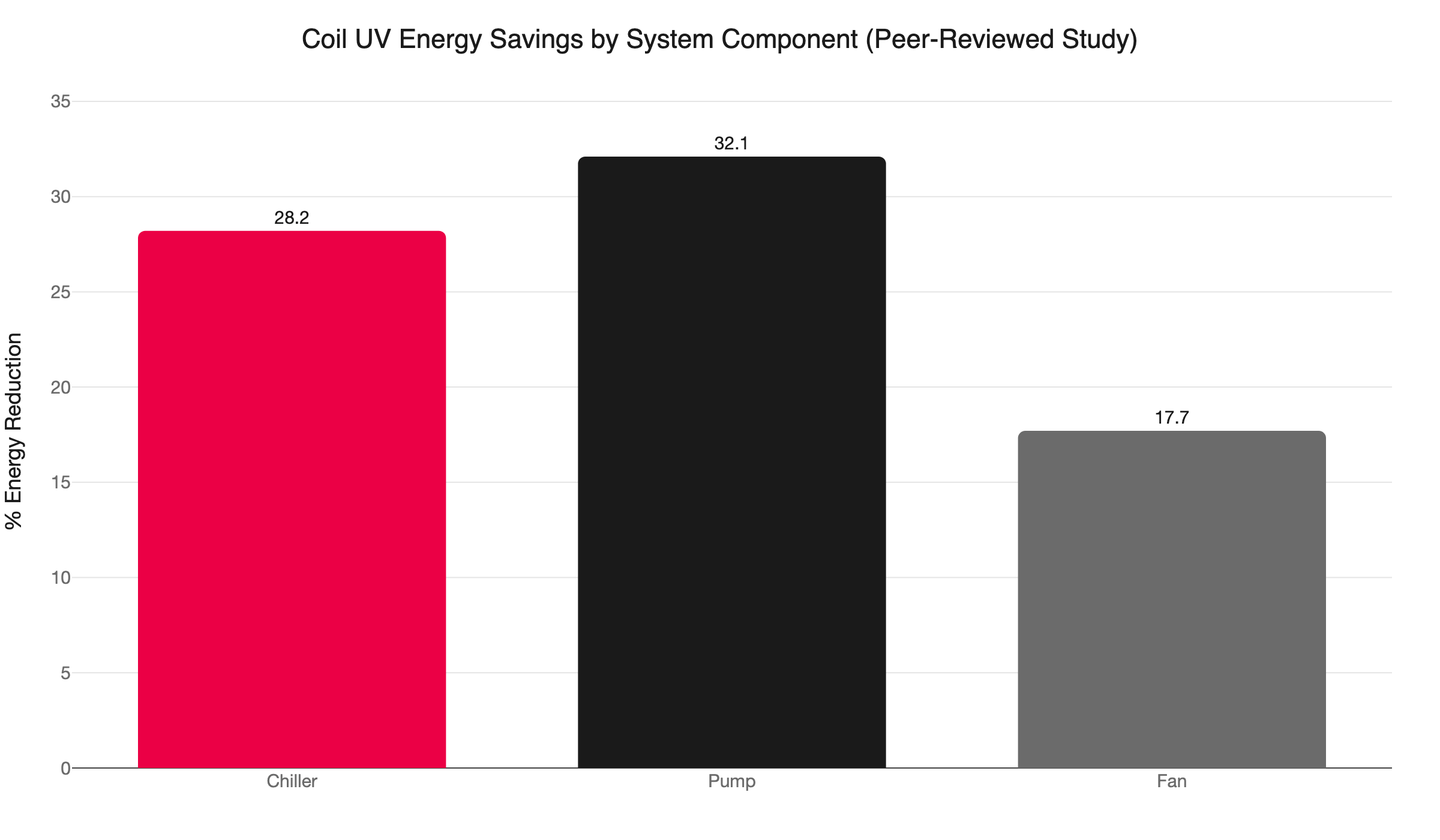
A study published in ScienceDirect tracked UV-C coil treatment in a cool-humid climate over seven weeks. Chiller-side energy savings reached 28.2%, pump energy dropped 32.1%, and fan energy fell 17.7%. Those gains came from a 15.62% increase in coil thermal conductance - the direct result of cleaner coil surfaces.
These are commercial-scale numbers. A residential system will show smaller absolute savings. But the underlying mechanism is the same in your home as in a commercial building. Biofilm insulates the coil. Biofilm restricts airflow. Clean coils transfer heat more efficiently. Efficient heat transfer means shorter run cycles and lower monthly bills.
For older Twin Cities homes with coils that have never been professionally cleaned, the efficiency payback can be significant. If your energy bills have been climbing without an obvious explanation and your system is 7-10 years old, a coil inspection is worth scheduling before you dismiss UV costs as too high.
Which Twin Cities Households Get the Most from UV?
In short: Households with recurring mold or musty HVAC odors benefit most from coil UV. Allergy sufferers need better filtration first. Immunocompromised households benefit from a layered approach: coil UV combined with MERV 13 filtration. In-duct UV fits a narrow use case and only when properly sized for the specific system.
Here is an honest breakdown of who benefits most, based on the research:
Strongest case for coil UV:
- Your HVAC produces a musty smell during the first few minutes of operation, especially after humid weather. This is a coil biofilm signature.
- Visible mold near HVAC registers, in the air handler cabinet, or around the drain pan.
- Your system is 7 or more years old and has never had a professional coil cleaning.
- A household member is immunocompromised. In this case, pair coil UV with a MERV 13 filter for a layered approach that addresses both surface organisms and airborne particulates.
Better served by filtration first:
- Seasonal allergies driven by pollen, pet dander, or dust. A MERV 13+ filter upgrade delivers more direct benefit. UV will not reduce particle counts.
- Already running HEPA filtration. Adding UV in this case provides, per the EPA, minimal additional infection control benefit.
- Budget is limited. A quality filter upgrade is more broadly effective for most allergy-driven IAQ concerns.
Narrow case for in-duct UV:
- Genuine concern about airborne pathogen transmission - for example, a high-risk household member during respiratory illness season. In-duct UV can be part of a layered strategy, but only if the system is properly engineered for your home’s airflow and the installer verifies dose delivery. Understand the EPA’s clear caveat: most standard residential units do not reach sufficient germicidal dose.
What to Know Before You Schedule Installation
Several practical realities to set expectations before you commit:
Permits are required. UV light installation adds a new component to a regulated mechanical system. Under Minnesota Administrative Rules Part 1346 (Minnesota Mechanical Code), that almost certainly requires a mechanical permit. Wiring the lamp may require a separate electrical permit. Your licensed HVAC contractor pulls these permits. If a contractor offers to skip them, treat that as a warning sign and walk away. Verify the specific requirements with your city or county building department before work begins.
No utility rebates apply to UV. Xcel Energy and CenterPoint Energy’s current Minnesota residential rebate programs are built around efficiency equipment: heat pumps, qualifying furnaces, and qualifying air conditioners. Neither utility offers a rebate for UV IAQ add-ons. The federal IRA Section 25C credit (up to $600 for qualifying HVAC equipment) and Xcel’s up-to-$450 AC rebate do not apply to UV lamps. Plan your budget without a rebate offset.
Lamp replacement is an ongoing cost. UV-C lamp output drops before the bulb visibly fails. Most lamps need replacement every 9,000-12,000 hours - roughly one to two years of continuous operation. This is a known maintenance item, not a surprise, but it belongs in your total cost calculation from the start.
UV does not replace regular HVAC maintenance. A coil UV lamp significantly reduces biofilm accumulation. It does not eliminate the need for annual coil cleaning, filter changes, or system tune-ups. Our post on 5 maintenance tips to extend your AC’s lifespan covers what a solid annual maintenance schedule looks like.
Ozone-generating devices are not UV-C. Some IAQ products sold alongside - or instead of - UV systems generate ozone or hydrogen peroxide. The Minnesota Department of Health does not recommend ozone-generating air cleaners for mold control. Before purchasing anything, confirm you are buying a standard UV-C product at 253.7 nm from a low-pressure mercury vapor lamp. That is the technology with the established, peer-reviewed evidence base.
Ready to Talk UV for Your Twin Cities HVAC System?
If your HVAC is producing musty odors, your coils have not been inspected in years, or you are building a layered IAQ strategy for a household with health concerns - coil UV is a well-supported option for Twin Cities homes. The research backs it. The climate makes it relevant.
Northern One Hour Heating & Air Conditioning is locally owned and operated in Ramsey, MN. We serve Minneapolis, St. Paul, Blaine, Maple Grove, Plymouth, Brooklyn Park, Woodbury, Bloomington, and the surrounding metro. We assess your system, look at what is actually there, and give you a straight recommendation. If UV fits your home, we install it correctly and pull the required permits. If something else is the better call, we will tell you that instead.
“Always On Time… Or You Don’t Pay a Dime!(R)” - that is our guarantee on every appointment, not a line we dust off for marketing. Call us at (763) 260-6662 or book an indoor air quality assessment online to get started.
Frequently Asked Questions
How long do HVAC UV lights last before needing replacement? +
Do I need a permit to install a UV light in my Minnesota home? +
Can a UV light replace my HVAC air filter? +
Need a technician now?