
Best HVAC Brands Minnesota: What Actually Matters in 2026
Key Takeaways
- The major HVAC brands belong to a handful of corporate families. Carrier, Bryant, and Payne are all Carrier Global. Trane and American Standard are Trane Technologies. Goodman, Amana, and the Daikin brand are all Daikin Industries. Lennox, Armstrong Air, and Ducane are Lennox International. Rheem and Ruud are the same equipment through different distribution channels.
- Minnesota’s minimum furnace efficiency is 92% AFUE, not 95%. Every furnace that meets this threshold is a condensing unit. That changes the flue, drainage, and permit requirements for the install.
- Warranty registration windows are short. Carrier and Trane both require registration within 60 days of installation. Miss that window and 10-year parts coverage drops to 5 years.
- The federal 25C tax credit for heat pumps and high-efficiency furnaces expired December 31, 2025. It is not available in 2026.
- CenterPoint’s heat pump rebate covers only dual-fuel systems paired with a gas furnace. It does not apply to full heat pump replacements or mini-splits.
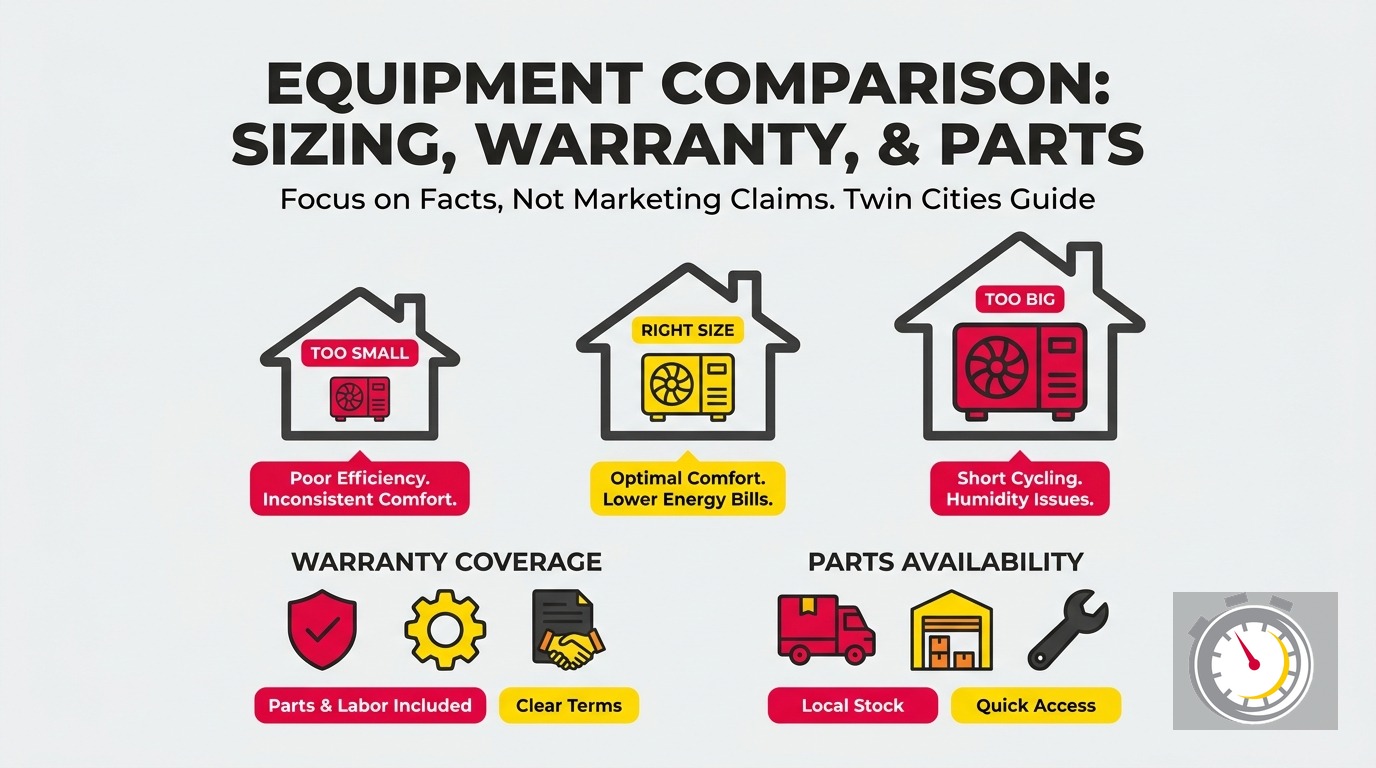
- Proper sizing with a Manual J load calculation matters more than brand. An oversized premium system will underperform a correctly sized mid-range one.
When a furnace dies in January, Twin Cities homeowners start researching the best HVAC brands in Minnesota. Most of what they find is a brand-versus-brand beauty contest: Carrier or Trane, Lennox or Goodman, premium or value. Those comparisons are not useless, but they leave out the information that actually shapes your decision: corporate family structure, parts networks, warranty registration deadlines, the real Minnesota efficiency code floor, and which 2026 rebates are still active.
We are locally owned and operated in Ramsey, MN. Here is what we tell customers before they commit to any system.
The Best HVAC Brands in Minnesota Belong to Four Corporate Families
What most brand-comparison articles skip is that the major HVAC brands are not independent manufacturers competing on separate engineering platforms. They belong to a small number of corporate families, and the corporate parent determines engineering lineage, parts distribution, and dealer network:
- Carrier Global: Carrier, Bryant, Payne
- Trane Technologies: Trane, American Standard
- Daikin Industries: Goodman, Amana, Daikin brand (Daikin acquired Goodman in 2012)
- Lennox International: Lennox, Armstrong Air, Ducane
- Rheem/Ruud: Same equipment, separate distribution channels
A Bryant and a Carrier often come off the same production line. A Goodman and an Amana are the same unit badged differently for different contractor channels. If a contractor quotes Bryant at 15% less than Carrier for the same efficiency class, that price gap reflects the channel, not the engineering.
This matters because it reframes the question. The decision is not “which brand is best?” It is: which corporate family does your local contractor primarily stock, and what does their parts network look like when something fails at 11 PM in February?
Does the Brand Name Actually Matter?
Somewhat - but not the way most homeowners expect. Brand quality within each price tier is comparable across corporate families. What differs is parts distribution, and for Lennox in particular, that difference is real.
Carrier and Trane maintain broad dealer and distributor networks across the upper Midwest. Multiple local suppliers can pull parts for either brand. Lennox operates a more proprietary parts distribution network than either of them. A non-Lennox dealer in the Twin Cities cannot walk into a general HVAC supply house and pull Lennox parts off the rack.
In a January emergency, that access gap can translate to a longer wait for the part you need. If your installing contractor does not primarily stock Lennox, that is worth factoring into the decision - especially for a 20-year system.
At the value tier, Goodman and Amana are legitimate systems with competitive warranties, not discounted throwaways. The Amana 2026 lineup includes a lifetime heat exchanger replacement warranty on select models. For a homeowner comparing a mid-range Amana against a premium-tier upgrade, that warranty term is worth pricing against the cost difference.
The practical bottom line: the person who installs the equipment, sizes it correctly, and pulls the permit matters more than the name on the box. A premium system installed wrong will fail sooner than a mid-range system installed right.
What Is the Minnesota Efficiency Code Minimum?
Minnesota requires a minimum of 92% AFUE for gas furnaces statewide - not 95%. Minnesota Energy Code (MN Rules 1322.0120, based on IECC 2018) sets the floor at 92% AFUE for Climate Zones 6 and 7, which cover the entire state. Some contractors cite 95% as the legal minimum. That figure is not in the code. Ask for the citation if you hear it.
The 92% threshold matters because every furnace that meets it is a condensing furnace. Condensing units extract more heat from combustion gases, and that changes the install scope significantly:
The flue pipe changes. Your old 80% furnace used metal B-vent. A condensing unit requires PVC plastic pipe. The metal flue opening must be sealed, and a new PVC route must be cut and run to exterior.
Condensate must drain. Condensing combustion produces several gallons of acidic liquid water per day during operation. That condensate must route to a floor drain or condensate pump. If your utility room does not have one, it needs to be added as part of the install.
A mechanical permit is required. Every furnace replacement in Minnesota requires a mechanical permit. Your contractor must hold a state mechanical license. Minneapolis adds a city-level license on top of the state requirement.
None of these are optional add-ons. They are code requirements. A quote that lists only the equipment price is not a complete quote. Our post on furnace replacement costs in the Twin Cities walks through what a permitted, code-compliant install actually includes from start to finish.
Why Do Warranty Registration Deadlines Matter?
Because missing the window cuts your parts coverage from 10 years to 5 years - on a system you just paid $8,000-$15,000 to install. Carrier, Trane, and Lennox all offer 10-year parts and 1-year labor as the standard term, extended to 12 years on registered premium equipment. Without registration, most drop to 5 years for parts. Labor coverage ends after year 1 regardless of brand.
A few specifics worth knowing:
- Trane’s XV20i carries a lifetime compressor warranty when registered within 60 days of installation. On a variable-capacity premium unit in the $12,000-plus range, that coverage is meaningful over a 20-year ownership window.
- Carrier’s registration window is also 60 days. Same consequence: 10-year parts coverage drops to 5 without it.
- Labor is excluded from all standard warranties after year 1, across every major brand. If a covered component fails in year 4, you pay the labor cost of the repair even though the part ships free.
- Amana (Daikin family) offers a lifetime heat exchanger replacement warranty on select 2026 models. For value-tier buyers, that is a distinct competitive advantage worth asking about when comparing quotes.
Do not assume the installing contractor handles registration automatically. Some do. Some do not. Register the equipment yourself within the first week after install. Set a calendar reminder the day the system goes in. Check the confirmation email before the 60-day window closes.
Will a Cold-Climate Heat Pump Work Through a Minnesota Winter?
A standard heat pump will not. A NEEP-certified cold-climate system, correctly installed as part of a dual-fuel setup, works well through most Twin Cities winters. Minneapolis averages -14F lows in January. Standard heat pumps lose meaningful heating capacity below 17F, and at or near 0F, a standard heat pump running as the sole heat source is a safety risk in homes with elderly residents or young children.
Minnesota requires NEEP-certified cold-climate heat pump equipment rated to at least -13F for residential installations intended to function in heating mode. Systems rated to -22F are preferred statewide given our temperature extremes.
The dual-fuel setup is the standard approach for most Twin Cities homes:
- A cold-climate heat pump handles heating efficiently from about 65F down to 30-40F. In that range, a heat pump is significantly more efficient than a gas furnace.
- When temperatures drop below the heat pump’s reliable range, the gas furnace takes over automatically.
- The result is lower energy costs during the fall and spring shoulder seasons, with full gas furnace reliability during the coldest weeks.
Brands producing NEEP-certified cold-climate equipment include Mitsubishi, Bosch, Daikin, Carrier, and Trane, among others. The certification rating matters more than the brand name when choosing. Our post on heat pump performance below zero in Minnesota walks through how these systems behave at the temperatures that actually matter here.
What HVAC Rebates Are Available in Minnesota in 2026?
Utility rebates from Xcel and CenterPoint are active. Federal 25C tax credits are not. The federal 25C credit for heat pumps and high-efficiency furnaces expired December 31, 2025 and is not available for installations in 2026. Any contractor or website still referencing it is working from outdated information.
Here is what is current as of August 2026:
Xcel Energy customers:
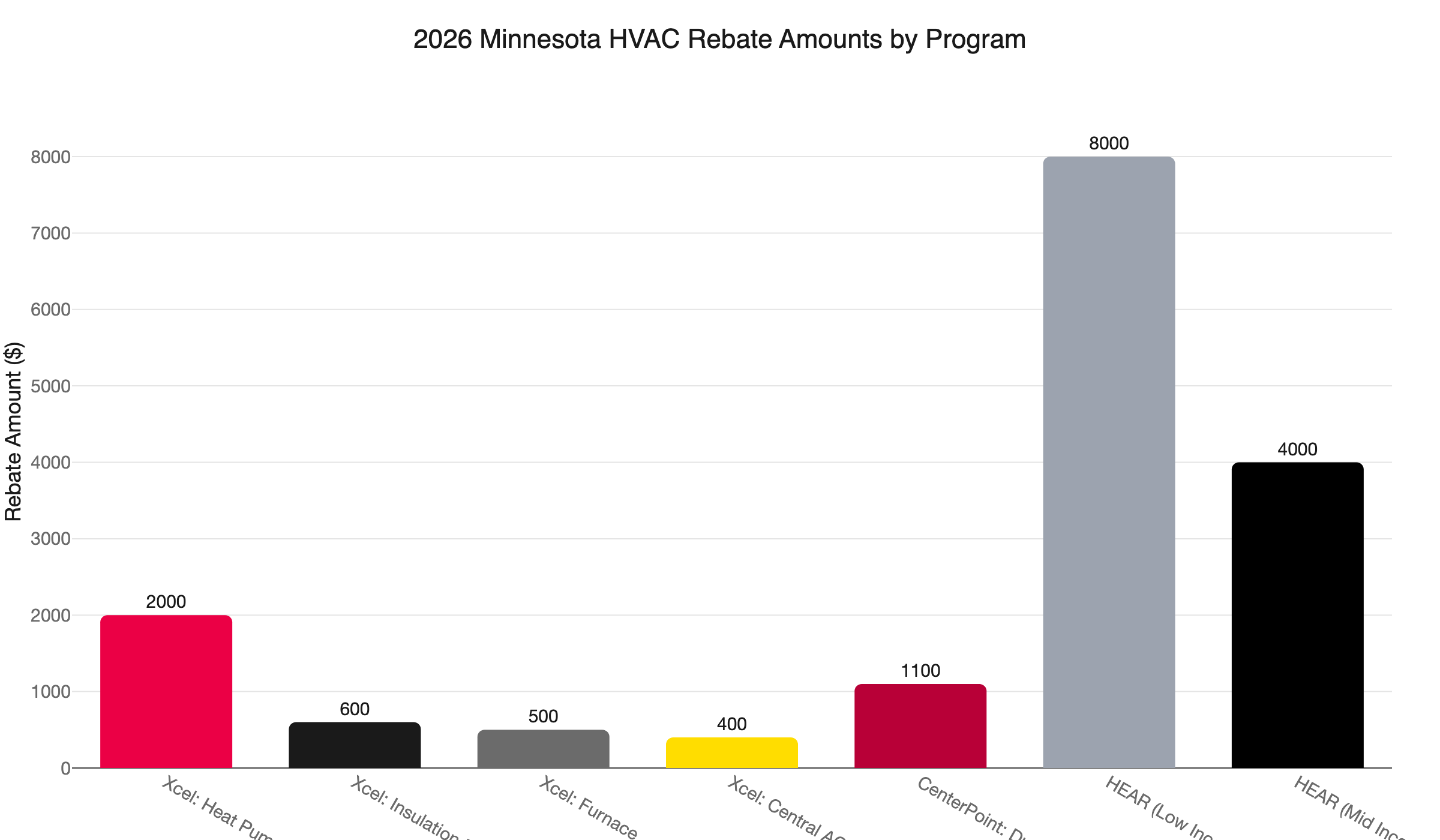
- Up to $2,000 for a cold-climate ducted heat pump
- Up to $600 additional insulation bonus when paired with air sealing ($2,600 combined maximum)
- $500 for a qualifying high-efficiency gas furnace
- $400 for central AC replacement
CenterPoint Energy customers:
- $1,100 for a ducted air-source heat pump - but only as a dual-fuel system paired with a 92%+ AFUE gas furnace, and the heat pump must switch to gas at 40F or below. This rebate does not apply to mini-splits or full heat pump replacements. This is a common source of confusion for homeowners who hear “heat pump rebate” and assume it covers all heat pump types.
Income-qualified households - HEAR program (federal, still active):
- Up to $8,000 for households at or below 80% AMI
- Up to $4,000 for households between 80-150% AMI
- No retroactive credits; the install must happen after the program launches in your jurisdiction
Save Energy MN (state program):
- Up to $4,000, designed to stack with HEAR. As of August 2026, this program has not launched. No retroactive credit once it opens.
An income-qualified Twin Cities homeowner on Xcel (at or below 80% AMI) installing a $19,000 cold-climate system could stack Xcel and HEAR rebates to net approximately $9,000 out of pocket. Stacking requires coordinating eligibility and timing before the install date, not after.
Our post on Minnesota heat pump rebates and tax credits covers current program details and how to apply for each.
Why Does Contractor Sizing Matter More Than Brand?
An incorrectly sized system - even a premium one - will underperform a correctly sized mid-range system, wear out faster, and may void warranty coverage ahead of schedule. Proper sizing requires a Manual J load calculation: a room-by-room analysis of your home’s square footage, insulation levels, window orientation, ductwork condition, and air infiltration rate.
Oversized equipment short-cycles. It heats or cools the space quickly, shuts off before completing a full cycle, and restarts. Short-cycling causes several problems:
Condensation buildup inside the air handler. Short cycles do not allow the system to drain properly. Accumulated moisture accelerates mold risk and speeds up internal component wear.
Poor dehumidification. In a Minnesota summer, an air conditioner that short-cycles leaves the house cool and clammy. The system never runs long enough to pull humidity out of the air. Comfort suffers even when the temperature reads correctly on the thermostat.
Compressor stress. Start-stop cycles put more mechanical strain on the compressor than longer, consistent operating cycles. More stress means shorter service life.
Warranty risk. Manufacturers inspect warranty claims. A system operating outside its design parameters due to improper sizing can complicate coverage disputes.
If a contractor quotes a system size based only on square footage or “what you had before,” that is not a Manual J. Ask for the full load calculation in writing before signing any proposal. Our post on HVAC sizing and Manual J explains what the process involves and what to ask for.
How Do You Choose the Right System for Your Twin Cities Home?
Match equipment to a certified contractor in your brand’s parts network, size it with Manual J, and register the warranty within 60 days. Brand choice within that framework is a secondary decision, not the primary one.
A practical checklist for any replacement conversation:
- Ask which corporate family the contractor primarily stocks. Carrier/Bryant, Trane/American Standard, Daikin/Goodman/Amana, or Lennox. Parts access follows from the answer.
- Confirm the quote includes full code compliance: PVC flue routing, condensate drainage, mechanical permit, and a state-licensed contractor.
- Request a Manual J load calculation in writing before signing the proposal. A tonnage based on square footage alone is not a load calculation.
- Ask who handles warranty registration and when. Get it in writing, then register yourself as a backup before the 60-day window closes.
- For heat pumps, ask for the NEEP certification rating and the temperature at which the backup gas heat activates.
- Confirm the contractor is enrolled in relevant rebate programs before install. Xcel and CenterPoint require contractor participation for clean rebate processing.
Financing is worth asking about on any major HVAC replacement. A new furnace, AC, or heat pump in the $8,000-$20,000 range is a significant investment. Spreading that cost over 24-60 months often makes the right equipment more accessible than waiting on a failing system that runs inefficiently through the next heating season.
The Bottom Line on the Best HVAC Brands in Minnesota
The best HVAC brands in Minnesota are the ones installed by a contractor who sizes correctly, pulls the permit, explains the full install scope, and tracks the warranty registration deadline.
Carrier, Trane, and Lennox are all quality equipment at the premium tier. Goodman and Amana deliver real performance at the value tier, and the Amana lifetime heat exchanger warranty on select 2026 models is a genuine competitive differentiator. The gap between corporate families is smaller than the gap between a well-installed mid-range system and a poorly installed premium one.
What matters most:
- Parts network access. Carrier and Trane have broader distributor coverage across the upper Midwest. Lennox’s proprietary network means a non-Lennox dealer may not have same-day access to parts.
- Warranty registration. Do it yourself within 60 days. A 10-to-5-year drop in parts coverage on a $10,000-plus system is not an abstract risk.
- 92% AFUE and full install scope. PVC flue, condensate drain, permit. These are code requirements, not upsells.
- Manual J sizing. A quote without a load calculation is not a complete proposal.
- Rebate eligibility confirmed before the install date. Not after.
We are locally owned and operated in Ramsey, MN, and we serve the Twin Cities every day with the promise we back: “Always On Time… Or You Don’t Pay a Dime!(R)” Whether you are replacing a 20-year-old furnace or upgrading to a cold-climate heat pump, our team gives you the straight answer on what your home actually needs.
Ready to talk through the right system? Call us at (763) 260-6662 or book online to schedule a no-surprise estimate.
Frequently Asked Questions
Which HVAC brand is best for Minnesota winters? +
What is the minimum furnace efficiency required in Minnesota? +
Are there HVAC rebates available in Minnesota in 2026? +
Need a technician now?