
Switching from Gas Furnace to Heat Pump in Minnesota
Key Takeaways
- Switching from gas furnace to heat pump in Minnesota requires work in four areas: electrical panel assessment, a new dedicated circuit and refrigerant line set, ductwork review, and a mechanical permit.
- The Minneapolis-St. Paul design temperature is -12°F. Cold-climate heat pump models are required in this market. Standard units fail at 0°F.
- At Xcel Energy’s current rate of 15.82 cents per kWh and CenterPoint’s all-in rate of roughly $1.08 per therm, full electric operation costs about $500 per year more than a 96% AFUE gas furnace.
- Dual-fuel systems (heat pump plus gas furnace backup) are cost-competitive for Xcel customers who qualify for the electric space heating rate.
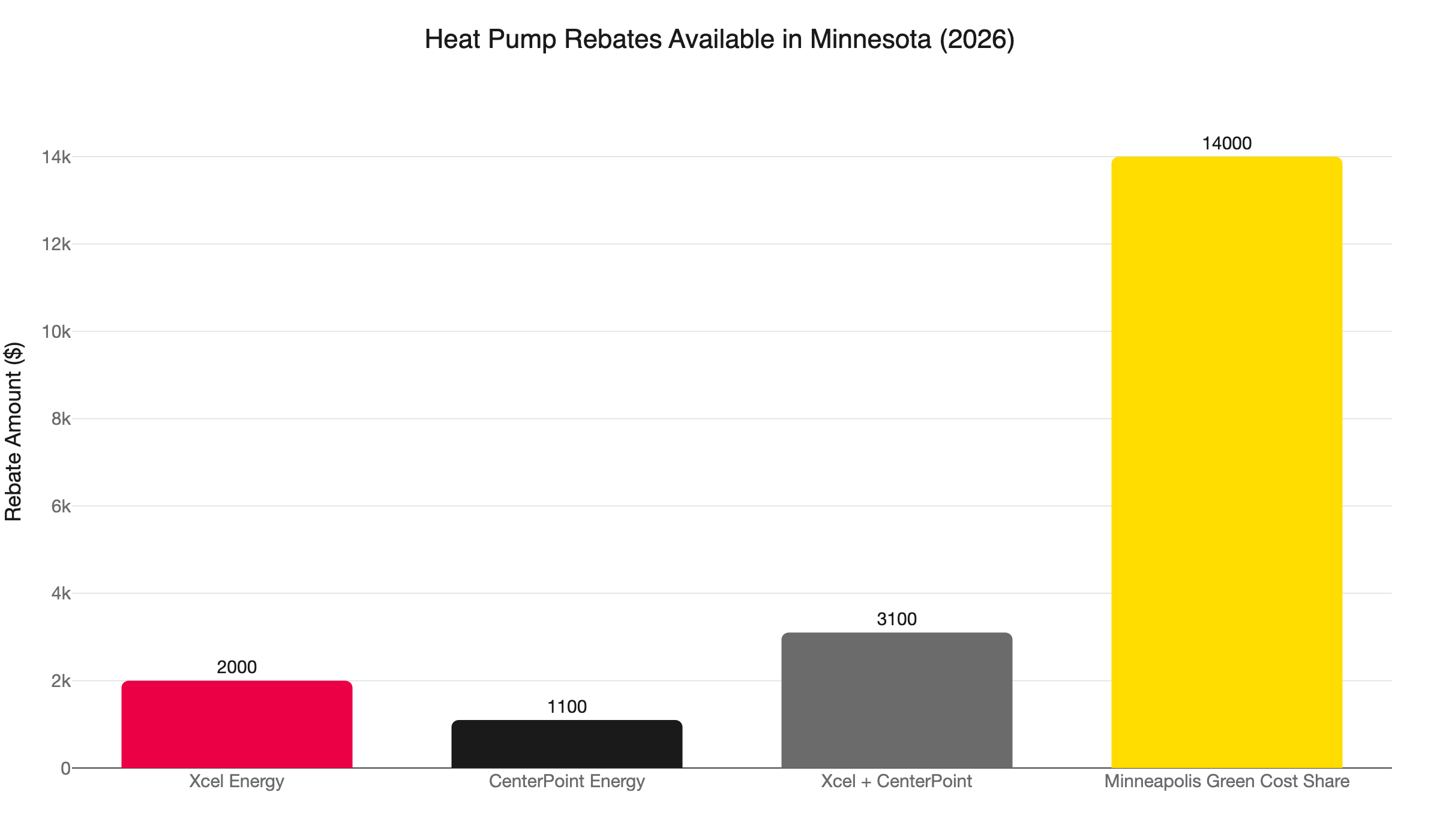
- Rebates stack to $3,100 if you have Xcel electric and CenterPoint gas service. The federal 25C tax credit expired December 31, 2025.
- The income-qualified HEAR program has not launched. No launch date has been set.
What Does Switching from a Gas Furnace to a Heat Pump in Minnesota Actually Involve?
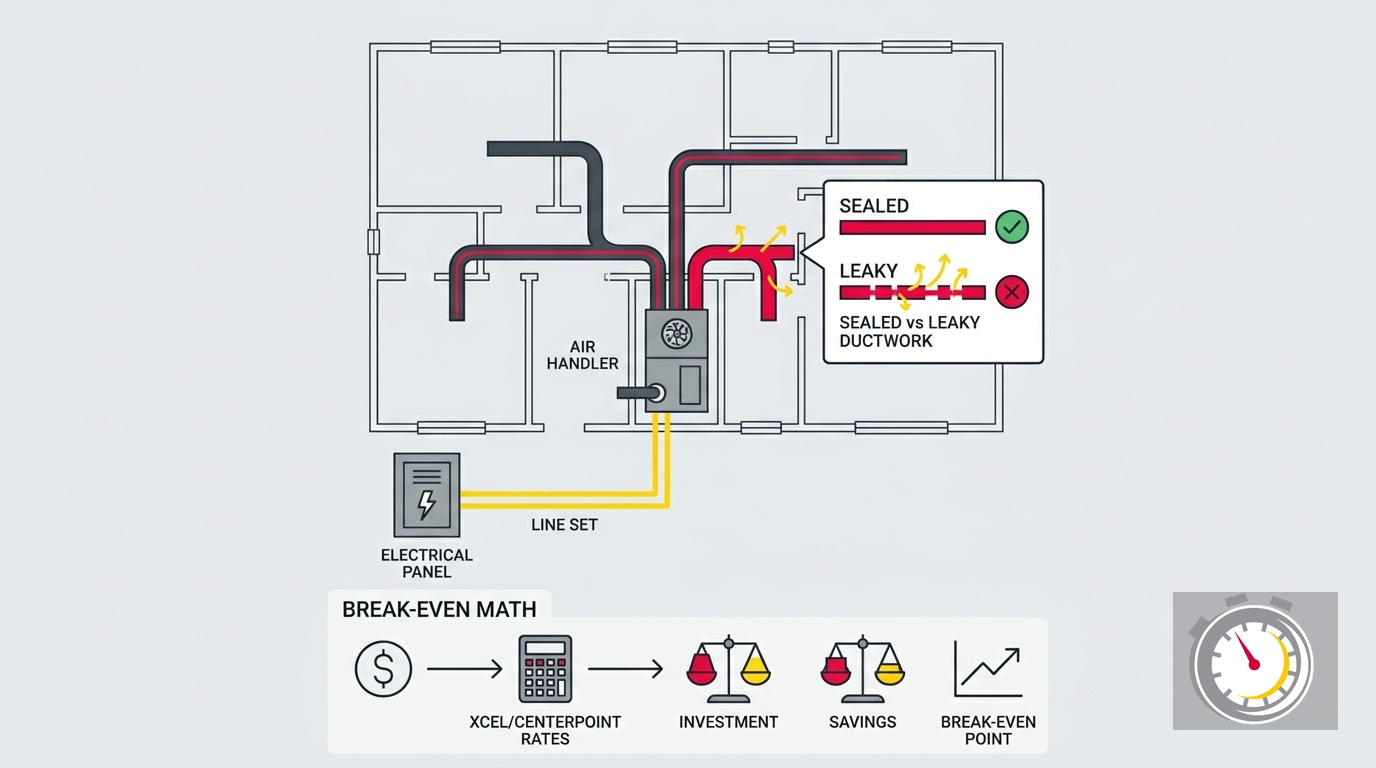
The short answer: Four systems get touched on every conversion: your electrical panel, a new dedicated circuit and refrigerant line set, your existing ductwork, and a mechanical permit. How much work each requires depends on your home’s starting point. Most quotes bundle these areas without separating them.
When a heat pump quote arrives and the number is larger than expected, two questions follow. What exactly am I paying for? And does this math work for my situation? Most articles gesture at a cost range and skip both. This post walks through each part of the scope, then runs the numbers at today’s Xcel and CenterPoint rates.
Minnesota’s climate sets the baseline. The Minneapolis-St. Paul design temperature is -12°F, placing the metro in Climate Zone 6A. Duluth reaches -21°F. International Falls sits at -31°F. Cold-climate heat pump models are not optional here. Standard residential units struggle at 0°F and can fail below that.
About 66% of Minnesota homes heat with natural gas. If your home is in that majority, the four sections below describe what a competent conversion actually involves.
Will Your Electrical Panel Handle a Heat Pump?
The short answer: Possibly. Heat pumps require a dedicated 240V circuit drawing 20 to 60 amps depending on unit size. Homes that use gas for cooking, water heating, and the dryer often have enough headroom in a 100A panel. Tight panels, or any system with electric backup strips, need a subpanel or a full service upgrade.
Panel assessment is the first step any thorough contractor should walk through with you. This is not just about whether one circuit fits. It is about whether your home’s full load profile, plus the new heat pump circuit, stays within the safe operating margin of the existing equipment.
A full 100A to 200A service upgrade runs $1,500 to $4,000 for panel and breaker work. When the utility must replace service entrance conductors or meter equipment, costs climb to $3,000 to $6,000. Panel work is a permitted job in Minnesota. Build the inspection timeline into your project schedule.
One code detail many homeowners miss: Minnesota’s 2020 electrical code requires a whole-home surge protector any time a service panel is installed or replaced. If a panel upgrade is part of your heat pump project, budget for the surge protector as a separate line item.
The dedicated heat pump circuit runs from the panel to the outdoor condenser and to the indoor air handler. Conductor size, breaker rating, and run length all affect the electrical cost. A proper load calculation should drive the design.
What Goes In: Line Set, Refrigerant Lines, and the Outdoor Unit
This is the most visible part of the installation and often the least explained to homeowners.
Each indoor air handler connects to the outdoor condenser via two copper refrigerant lines plus electrical wiring. That bundle passes through a hole roughly 3 inches in diameter in the exterior wall. On the outside, the lines run along the house inside a line hide: a plastic channel available in white, ivory, or brown. Depending on run length, line hide adds $100 to $300 and protects the refrigerant lines from UV and weather damage.
The outdoor unit mounts on a concrete pad or wall brackets. In Minnesota, placement matters beyond summer footprint. The unit must sit above average snowpack accumulation with clear access for winter service calls. Units set too low in heavy-snowfall areas need risers or elevated pads.
A communication wire and condensate drain line travel with the refrigerant bundle. The drain exits the building. In cold climates, that exit point must drain freely in winter. A drain exit placed low on a north-facing wall can freeze and back up into the indoor unit, causing water damage.
Do You Need a Ductwork Assessment Before Installing a Heat Pump?
The short answer: Yes, on every installation. Heat pumps move more air than gas furnaces at equivalent comfort levels. Undersized, leaky, or poorly insulated ducts restrict airflow and reduce measured efficiency. Skipping the duct review is how homeowners end up with comfort problems in the first winter that are hard to trace back to the duct system.
Two code requirements apply. First, ducts located outside conditioned space must be insulated to a minimum of R-8 under the Minnesota mechanical code. If your ductwork runs through an uninsulated attic or crawl space, that must be addressed before or as part of the installation. Second, duct leakage reduces the efficiency the equipment was rated to deliver. A sealing pass before installation captures what you are paying for.
Homes with no existing ductwork present a different question. If your home heats with a boiler, electric baseboard, or in-floor radiant, adding full ductwork to support a central ducted heat pump is expensive and rarely pencils out. Ductless mini-splits are typically the practical choice for non-ducted homes, and we install them in the Twin Cities.
What Permits Are Required in Minnesota?
The short answer: A mechanical permit is required for any HVAC installation in Minnesota. Inspectors verify compliance with the Minnesota State Building Code, including current SEER2 minimums. Unpermitted HVAC work creates problems at sale and refinancing and may void manufacturer warranties.
Most licensed HVAC contractors include permit filing as part of the job scope. If a contractor offers to skip the permit to save time or reduce your cost, decline and move on.
Permit timing affects rebate eligibility. CenterPoint Energy’s rebate submission deadline is December 31 of the installation year. Xcel Energy’s deadline is September 30 of the year following installation. Both programs require proof of permitted installation. Schedule the job with enough runway to complete the inspection before your utility deadline.
Work requiring a permit includes the heat pump installation itself, any ductwork modifications, and any electrical panel work connected to the project.
Does Switching from Gas Furnace to Heat Pump in Minnesota Save Money?
The short answer: For full electric replacement of a gas furnace, the math does not favor a switch at today’s rates. Operating costs run about $500 per year higher. For a dual-fuel system on Xcel’s electric space heating rate, operating costs become competitive. The upfront premium over a straight furnace replacement is large either way, and break-even depends on rebate stacking.
Here is the arithmetic. A typical Twin Cities home uses about 700 therms per year for space heating. At 96% AFUE and CenterPoint’s all-in rate of about $1.08 per therm, that comes to roughly $788 per year in gas costs.
Delivering the same heat via a cold-climate heat pump at a seasonal COP of 2.5 requires about 8,200 kWh. At Xcel Energy’s current residential rate of 15.82 cents per kWh, that is about $1,297 per year. Roughly $509 more than gas.
Dual-fuel narrows the gap. Analysis from the Minnesota Center for Energy and Environment shows that Xcel’s electric space heating rate makes dual-fuel systems cost-competitive against a gas furnace plus central AC combination at the operating-cost level. That rate applies to Xcel customers only. If you are on a municipal utility or electric cooperative, ask your utility directly whether a comparable rate exists.
MNASHP recommends a switchover temperature between 25°F and 45°F. At that range, the heat pump handles most annual heating hours. The gas furnace covers the deep cold. Dropping the switchover below 25°F displaces more gas but does not improve the operating-cost math at current rates.
The upfront cost gap is also significant. A new 96% AFUE gas furnace installed runs $2,500 to $4,500. A whole-home cold-climate ducted heat pump system runs $18,500 to $36,500 before rebates. Recovering that premium depends on rebate stacking and whether Xcel’s space heating rate applies to your situation.
For more detail on how cold-climate systems perform when temperatures fall below zero, see our post on heat pump operation in extreme Minnesota cold.
What Rebates Are Available Right Now?
The short answer: Xcel Energy offers up to $2,000. CenterPoint offers $1,100 for dual-fuel installs only. Minneapolis homeowners may qualify for up to $14,000 through the Green Cost Share program. Stack the right combination and the upfront cost drops meaningfully. The federal 25C credit is gone.
Here is the current lineup:
Xcel Energy: Up to $2,000 for a qualifying cold-climate heat pump. Requires a minimum COP of 1.75 at 5°F. Available to Xcel electric customers only. Submission deadline is September 30 of the year after installation.
CenterPoint Energy: $1,100 for dual-fuel systems only. The heat pump must be programmed to switch to the gas furnace at 40°F or below. The gas furnace must be at least 92% AFUE. CenterPoint does not rebate mini-splits, ground-source systems, or full gas furnace replacements. Submission deadline is December 31 of the installation year.
Xcel plus CenterPoint stacked: Up to $3,100 combined if you have both utility services and meet both programs’ equipment requirements.
Minneapolis Green Cost Share: Up to $14,000. Contact the City of Minneapolis directly for current eligibility criteria and available funding.
HEAR (Save Energy Minnesota): Income-qualified program. Up to $8,000 for households below 80% of area median income; $4,000 for those between 80% and 150% AMI. This program has not launched. No launch date has been set as of August 2026.
Federal 25C tax credit: Expired December 31, 2025.
For a full breakdown of each incentive program and how to apply, see our guide to Minnesota heat pump rebates and tax credits.
Is Switching from Gas Furnace to Heat Pump in Minnesota Worth It?
The short answer: For most Twin Cities homeowners replacing an aging gas furnace, a dual-fuel system is the more financially defensible choice at today’s rates. It qualifies for rebates from both utilities, covers the coldest design temperatures with reliable gas backup, and delivers efficiency gains on the majority of heating hours that fall above the switchover temperature.
Full electric replacement makes sense in a specific set of circumstances: access to low electric rates, a home that is already largely electrified, or a situation where the gas infrastructure is being phased out anyway.
For most Twin Cities homes, the dual-fuel case is practical:
- The cold-climate heat pump handles most annual heating hours at efficiency well above a gas furnace.
- The gas furnace covers design-temperature conditions reliably.
- Both Xcel and CenterPoint rebates are available for qualifying installs.
- Full panel upgrades are less commonly required than with all-electric configurations.
If your furnace is already at end of life and you are deciding what to install next, this is the right moment to run both scenarios against your actual utility rates and rebate eligibility. The numbers are specific to your situation, not a general rule.
How to Choose a Contractor for a Minnesota Heat Pump Install
Cold-climate heat pump installation requires specialized experience. Not every HVAC company has done a significant number of these in Minnesota’s climate. Ask directly: how many cold-climate heat pump systems have you installed in the Twin Cities? What brand and model do you recommend, and why?
The MNASHP Preferred Contractor Network lists contractors who have attended technical training specific to cold-climate heat pump systems, provided license documentation, and demonstrated quality installations. It is a reasonable starting point for vetting unfamiliar companies.
Before signing any quote, verify these items:
- The contractor files the mechanical permit.
- The scope includes a Manual J load calculation, not a rule-of-thumb equipment size.
- The panel is assessed before equipment is specified.
- The quote itemizes the heat pump, furnace (if dual-fuel), electrical work, and any duct repairs as separate line items.
Transparent itemization is what honest pricing looks like. A single bundled number with no breakdown is hard to compare and hard to verify after the work is done.
Ready to Get a Heat Pump Estimate?
Switching from gas furnace to heat pump in Minnesota is a larger commitment than most equipment swaps. The scope is real. The math is specific to your home, your utility situation, and your rebate eligibility.
We are locally owned and operated. We will assess your panel, review your duct system, and give you a quote that clearly shows what you are paying for and why. We back every appointment with our on-time promise: “Always On Time… Or You Don’t Pay a Dime!(R)”
Call (763) 260-6662 or book your estimate online. We serve Minneapolis, St. Paul, Ramsey, Blaine, Maple Grove, Plymouth, Brooklyn Park, Woodbury, Bloomington, and the surrounding Twin Cities area.
Frequently Asked Questions
Does a heat pump work in a Minnesota winter? +
Will my electrical panel need upgrading for a heat pump? +
What heat pump rebates are available in Minnesota right now? +
Does switching to a heat pump save money on heating bills in Minnesota? +
Need a technician now?