
Radiant Floor Heating Cost Minnesota: Hydronic vs. Electric
Key Takeaways
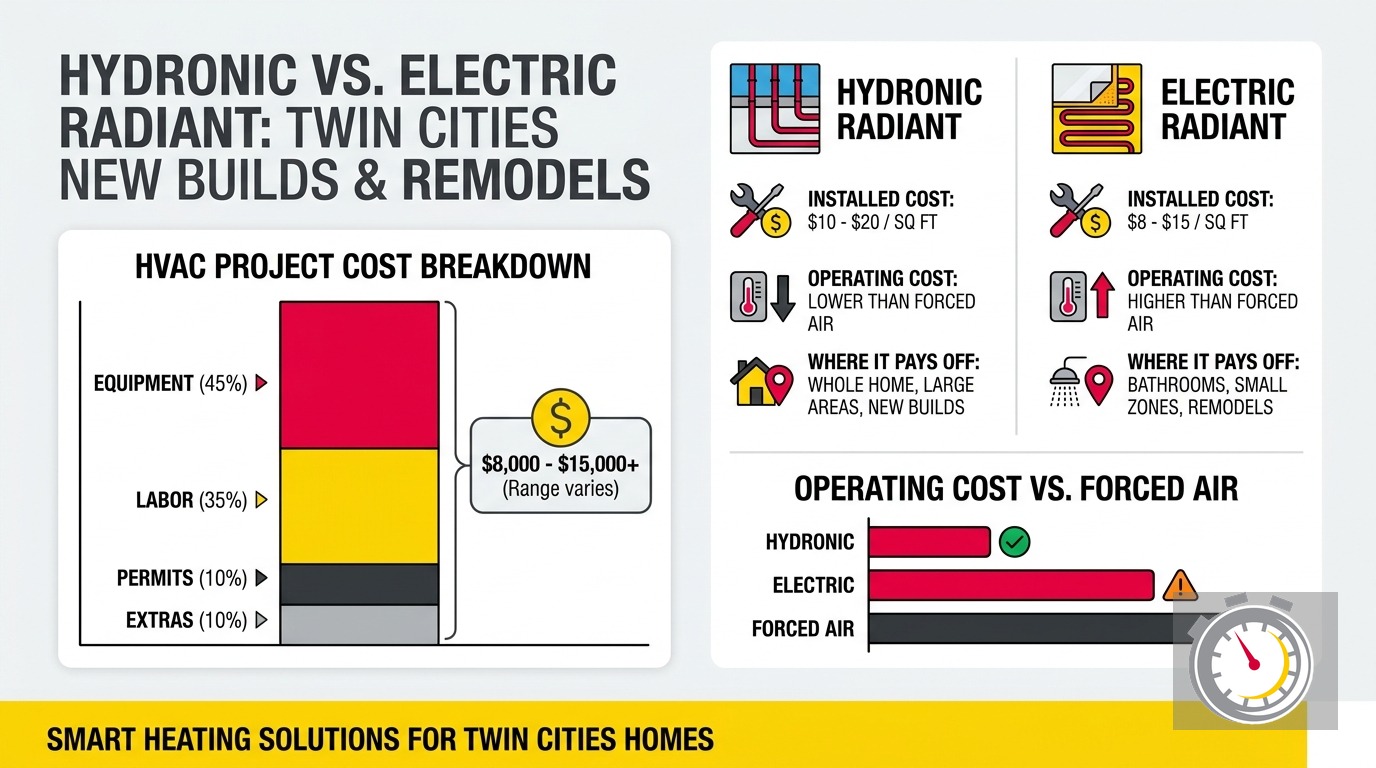
- Hydronic radiant floor heating costs $6-$22 per square foot installed in new construction. Retrofits add $3-$10 per square foot in demolition costs before the first inch of tubing goes in.
- Electric radiant mats run $8-$15 per square foot. They are best for single rooms, not whole-home heating.
- A complete hydronic system with a new boiler typically costs $13,700-$43,000 for a 1,500-2,000 square foot Twin Cities home.
- Radiant provides no cooling. Every Minnesota home with radiant heat still needs a separate air conditioning system.
- Minnesota Statutes §326B requires a mechanical permit for every hydronic radiant install.
- Xcel Energy and CenterPoint Energy offer 2026 rebates on qualifying heat sources paired with radiant systems.
- New-build hydronic can pay back in 5-10 years in Minnesota’s cold climate. Retrofits rarely pencil out unless the floor is already coming up.
What Does Radiant Floor Heating Cost in Minnesota?
Hydronic radiant runs $6-$22 per square foot installed for new construction. Electric mats cost $8-$15 per square foot. A whole-home hydronic system with a boiler typically runs $13,700-$43,000 for a 1,500-2,000 square foot home. Retrofit projects cost substantially more once you add floor demolition.
Minnesota is a heating-dominated climate. The Twin Cities design heating day hovers around -16°F to -20°F. That reality shapes how every heating investment performs here, and radiant floor heating is no exception.
The cost range looks wide because it is wide. What you pay depends on three things. First, which type of radiant system you choose. Second, whether you are building new or retrofitting. Third, the total square footage you are heating.
According to Today’s Homeowner, hydronic radiant floor heating runs $6-$22 per square foot installed. The low end is new construction with a concrete slab, where tubing goes in before the pour. The high end is retrofit work where the existing floor must come up first.
Electric radiant mats and cables fall in a narrower range: $8-$15 per square foot installed. The upfront cost is lower, and they work well in smaller zones. Most homeowners use them to add comfort in a bathroom or kitchen, not as the primary heat source for an entire home.
For a whole-home hydronic system, HomeGuide puts the total at $13,700-$43,000 for a 1,500-2,000 square foot home. The boiler alone accounts for $3,200-$9,000 of that figure. The remainder covers tubing, manifolds, labor, and the required insulation beneath the slab or in joist bays.
Forced-air installation runs 10-25% cheaper than radiant overall. Duct runs are less labor-intensive than laying tubing 12 inches on center throughout every room. That gap matters most on new construction when you are comparing two complete system budgets.
Hydronic vs. Electric: Which System Fits Your Home?
Hydronic uses hot water circulated through tubing beneath the floor. It costs more upfront but performs efficiently as a whole-home heat source in Minnesota. Electric uses resistance mats or cables beneath tile or flooring. It installs for less but gets expensive at scale. Choose electric for single rooms, hydronic for whole-home heating.
Hydronic radiant
A hydronic system circulates heated water through cross-linked polyethylene (PEX) tubing embedded under the floor. The heat source is a high-efficiency gas boiler or, increasingly, a cold-climate heat pump.
The U.S. Department of Energy names hydronic radiant “the most popular and cost-effective radiant heating systems for heating-dominated climates.” Minnesota fits that description precisely. The DOE also states that hydronic systems eliminate duct losses. That makes them more efficient than both baseboard heating and most forced-air systems.
Duct leakage in a typical forced-air home accounts for up to 30% of energy consumption. A hydronic radiant system has no ducts, so that loss disappears entirely.
Radiant heats from the floor up. That is a comfort advantage that compounds over a long Minnesota heating season. It warms bodies and objects directly instead of blowing warm air past cold exterior walls. Because the heat surrounds you, you can set the thermostat 2-4 degrees lower and stay just as comfortable. Over six months of heating season, that setback adds up on your energy bill.
Our boiler installation and replacement service covers what a hydronic project involves, from system sizing through final inspection.
Electric radiant
Electric mats and cables are the simpler option. An electrician installs the mat beneath tile or thin flooring. A thermostat controls the zone independently.
A 100 square foot bathroom runs $800-$1,700 total installed. Operating at four hours per day, that zone costs roughly $14-$18 per month. The investment is modest and the comfort payoff in a Minnesota bathroom in January is real.
The limitation is scale. Electric resistance heat becomes expensive when you push it to an entire house. For whole-home radiant heat, hydronic is the right tool.
New Build vs. Retrofit: Where the Cost Cliff Happens
This is the single most important cost factor for Twin Cities homeowners evaluating radiant. National cost guides rarely address it clearly.
New construction: Tubing goes in before the concrete slab pours. The incremental cost over standard slab work is modest: materials plus additional labor, not a demolition project. In a heating-dominated climate like Minnesota’s, payback vs. forced air narrows to 5-10 years.
Retrofit or remodel: The floor has to come up first. Demo costs alone add $3-$10 per square foot before a single inch of tubing is installed. Add that to the system cost and the whole-project total pushes toward $25-$35 per square foot. Payback stretches to 12-20 years.
That math almost never works unless the floor is already coming up for another reason. A kitchen gut, a bathroom remodel, or a slab repair already has demolition baked in. Adding radiant tubing while the floor is open is a smart call in that situation. Tearing up a perfectly good floor just to add radiant rarely pencils out.
The bottom line: radiant is more of a new-build decision than a renovation decision. If you are designing a new home in the Twin Cities metro, discuss radiant with your HVAC contractor before the foundation goes in. If you are retrofitting an existing home, run the full numbers, including demo costs and the separate cooling system, before committing.
What Does Radiant Floor Heating Cost to Run Each Month?
Radiant floor heating costs $1-$7 per day to operate, depending on zone size and usage. Average monthly operating cost for high-traffic zones like bathrooms and kitchens runs around $50. Hydronic systems have no duct losses, which puts them ahead of forced air on operating efficiency over a long Minnesota heating season.
Operating costs run $1-$7 per day, with most homeowners averaging about $50 per month for heated zones. That range reflects the difference between a small bathroom mat running a few hours daily and a whole-home hydronic system carrying the full heating load through January and February.
Hydronic’s efficiency advantage compounds over Minnesota’s long heating season. Eliminating duct losses, running at a slightly lower thermostat setting, and delivering even heat without temperature swings all contribute to a lower annual energy bill compared to a similarly sized forced-air system.
One important caveat: operating cost comparisons only hold when you account for the full system. Radiant provides no cooling. The cost of your separate AC system belongs in the total picture.
The Cooling Gap: What Radiant Cannot Do
This is the detail most cost guides leave out entirely. Neither hydronic nor electric radiant delivers air conditioning.
Every Twin Cities home with radiant heating still needs a separate cooling system. That means either a ductless mini-split or a central air system installed independently. These are not minor additions. They represent a real capital cost that changes the whole-home comparison with forced air.
Forced air delivers both heating and cooling through the same ductwork. When you choose radiant heat, you are choosing to run two separate systems. A ductless mini-split setup for a 2,000 square foot home adds meaningful installed cost on top of the radiant system budget.
For homes that plan around radiant heat and skip ductwork, ductless mini-splits are the practical cooling choice. They handle air conditioning without a duct system. Our ductless mini-split installation service covers what that project involves for Twin Cities homes.
For homes with existing ductwork, central air can handle cooling while radiant carries the heat. That works, but it is still two systems to budget for and maintain.
Keep the full cooling cost in your budget when comparing radiant to forced air. The heat-only figure understates the real investment.
What Minnesota Code Requirements Apply to Radiant Floor Heating?
A mechanical permit is required under Minnesota Statutes §326B for every hydronic radiant install. The state mandates R-5 minimum insulation beneath slab-on-grade systems and R-11 for suspended-floor applications. Pressure testing at 1.5 times design pressure is required before the floor closes. These are real cost line items that national cost calculators never include.
The Minnesota Mechanical Code specifies two insulation minimums that directly affect installed cost:
- Slab-on-grade systems: Minimum R-5 insulation beneath the tubing. Without it, heat escapes downward into the ground instead of upward into the living space.
- Suspended-floor (joist bay) systems: Minimum R-11 insulation beneath the tubing.
Both are real line items. Budget for them. A bid that excludes these materials is not comparing equally to one that includes them.
The code also requires pressure testing at 1.5 times maximum design pressure, minimum 100 psi, before the floor closes. A failed pressure test discovered after a finished floor is in place is a serious problem. That requirement makes hydronic radiant engineering-grade work, not a DIY project.
All of this points to one practical conclusion: hire a licensed HVAC contractor who pulls permits, passes inspections, and stands behind the work. Our team is locally owned and operated in Ramsey. We work under Minnesota code on every hydronic job and know what these requirements cost in practice.
What Rebates Are Available for Radiant Heating in Minnesota?
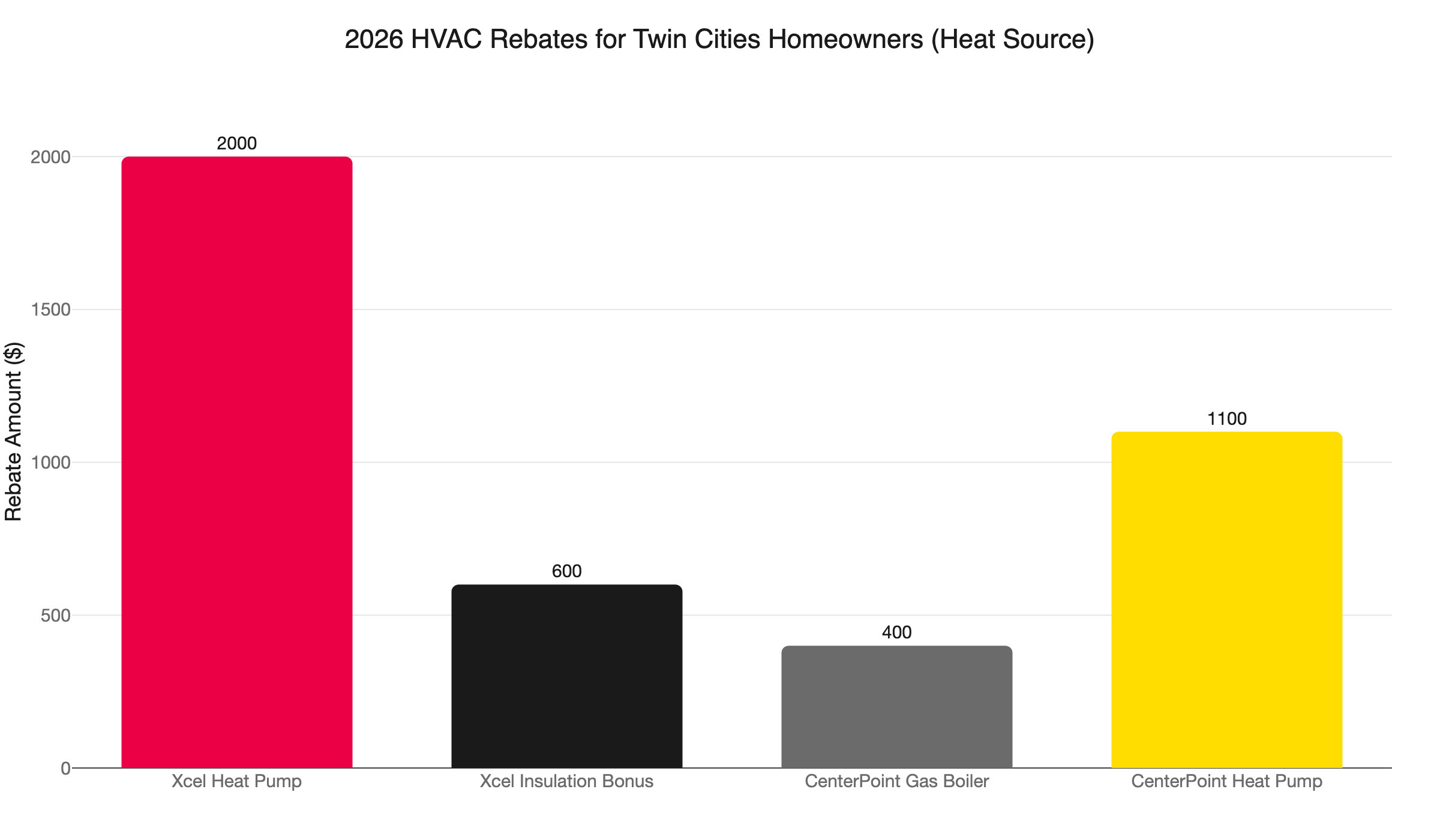
Rebates apply to the heat source, not the radiant tubing itself. Xcel Energy offers up to $2,000 for qualifying cold-climate heat pumps in 2026. CenterPoint Energy offers $400 for 95%+ AFUE gas boilers. Minneapolis residents can stack additional city incentives. The federal 25C tax credit expired December 31, 2025.
The incentive programs target the boiler or heat pump driving the hydronic system. Here is what is available in 2026:
- Xcel Energy: Up to $2,000 for a qualifying cold-climate heat pump used as the heat source for a hydronic system. An additional $600 insulation bonus applies when paired with qualifying insulation and air-sealing upgrades. Applications for 2025-installed equipment are accepted through September 30, 2026.
- CenterPoint Energy: $400 for a 95%+ AFUE gas boiler. $1,100 for a ducted heat pump paired with 92%+ AFUE gas backup in a dual-fuel setup. This program runs through December 31, 2026.
- Minneapolis Green Cost Share: Minneapolis residents can combine city, utility, and state incentives for up to $14,000 toward qualifying projects.
One note worth flagging: the federal 25C energy tax credit expired December 31, 2025. It is not available for 2026 installations. The federal HEAR program for income-qualified households has not launched in Minnesota as of August 2026.
For a full breakdown of heat pump incentives in the Twin Cities, see our post on Minnesota heat pump rebates and tax credits.
Is Radiant Floor Heating Worth the Investment in Minnesota?
In new construction with a concrete slab, yes: payback vs. forced air runs 5-10 years in Minnesota’s heating-dominated climate. For retrofits, payback stretches to 12-20 years because of demolition costs. It rarely pencils out unless the floor is already coming up. A single-room electric mat in a bathroom delivers real comfort at modest cost.
Minnesota’s climate tilts the math toward hydronic radiant faster than national averages suggest. Six months of heating weather means more operating hours where radiant’s efficiency advantage accumulates. A heating-dominated climate is exactly where the DOE says hydronic is most cost-effective.
The payoff breaks down clearly by scenario:
New construction with a concrete slab. Tubing sets before the pour at modest incremental cost. Payback vs. forced air runs 5-10 years. If you are building a new home in the Twin Cities area, radiant is a legitimate option worth pricing before the foundation goes in.
Retrofit of an existing home. Demo costs add $3-$10 per square foot before system costs begin. Total project cost approaches $25-$35 per square foot. Payback extends to 12-20 years. It only makes sense when the floor is already coming up for another reason.
Single-room electric mat. A 100 square foot bathroom at $800-$1,700 installed delivers high comfort payoff at a price that does not require a payback analysis. It simply makes a January morning more tolerable.
For a direct comparison of a boiler-driven system against a traditional furnace, our post on boilers vs. forced-air furnaces in Minnesota walks through how those two approaches stack up for Twin Cities homeowners.
Should You Add Radiant Floor Heating to Your Twin Cities Home?
Radiant is an excellent fit for new construction in Minnesota, where the long cold season makes hydronic’s efficiency advantage meaningful over time. For most existing homes, a high-efficiency furnace is the better financial choice unless the floor is already coming up. A bathroom electric mat is the right starting point for existing homeowners who want radiant comfort without the retrofit cost.
Here is a simple framework to work through before you decide:
Consider radiant if:
- You are building new and can set the tubing before the slab pours.
- You are doing a full kitchen or bathroom gut, and the floor is already coming up.
- Your home has no ductwork and you are planning ductless mini-splits for cooling regardless.
Think carefully before choosing radiant if:
- You are retrofitting intact floors. Add the full demo cost plus the separate cooling system cost, then compare that total against a new high-efficiency furnace and central air.
- Your existing forced-air system is functional and mid-life. A modulating or two-stage furnace paired with quality ductwork closes much of radiant’s comfort gap at a fraction of the cost.
Ask us before deciding if:
- You are building new and want a side-by-side total cost: radiant plus mini-splits versus forced air plus central AC.
- You are doing a large-scale remodel and want to know whether the floors you are pulling justify adding radiant tubing while they are open.
Our team gives you a straight answer on what makes sense for your home and your budget. That is what locally owned and operated means for Twin Cities homeowners.
Get a Straight Answer from a Local Team
Northern One Hour Heating & Air Conditioning is locally owned and operated in Ramsey, Minnesota. We serve Minneapolis, St. Paul, Blaine, Maple Grove, Plymouth, Brooklyn Park, Woodbury, Bloomington, and the surrounding Twin Cities metro.
Radiant floor heating involves decisions a national cost calculator cannot make for you: which system type, which heat source, what the permit and insulation requirements actually cost in Minnesota, whether the rebates apply to your project, and whether the payback math works for your specific home.
Our team pulls permits, follows Minnesota code, sizes systems accurately, and gives you an honest picture of total cost before any work starts. We want you to make the right call for your budget and your house.
“Always On Time… Or You Don’t Pay a Dime!(R)” is our promise on every appointment.
Call us at (763) 260-6662 or book online to schedule a consultation. We will walk through what radiant floor heating actually costs for your home and help you decide whether it is the right fit.
Frequently Asked Questions
How much does radiant floor heating cost to install in Minnesota? +
Is radiant floor heating worth it in Minnesota? +
Does radiant floor heating provide cooling in Minnesota? +
Do you need a permit for radiant floor heating in Minnesota? +
Need a technician now?