
Furnace Shuts Off in Cold Weather: Snow-Blocked Vent Fix
Key Takeaways
- A blocked PVC exhaust or intake vent triggers the pressure switch and shuts the furnace off before any ignition attempt.
- Three failure chains produce identical symptoms: exterior snow at the vent opening, an internal ice dam inside the pipe, and a frozen condensate drain line.
- Clearing the exterior opening solves only the first chain.
- Do not use hot water or metal tools on PVC vent pipes.
- After clearing the exterior, reset by setting the thermostat to off for 30 seconds, then back to heat. One restart attempt only.
- If the furnace trips a second time, or if you find no visible exterior blockage, call a technician.
- Minnesota code allows vent terminations as low as 12 inches above grade. That is not enough during a major blizzard.
- An annual furnace tune-up catches sagging condensate lines and internal ice risks before they fail at minus 20.
Why Does a Furnace Shut Off in Cold Weather When the Vent Is Blocked?
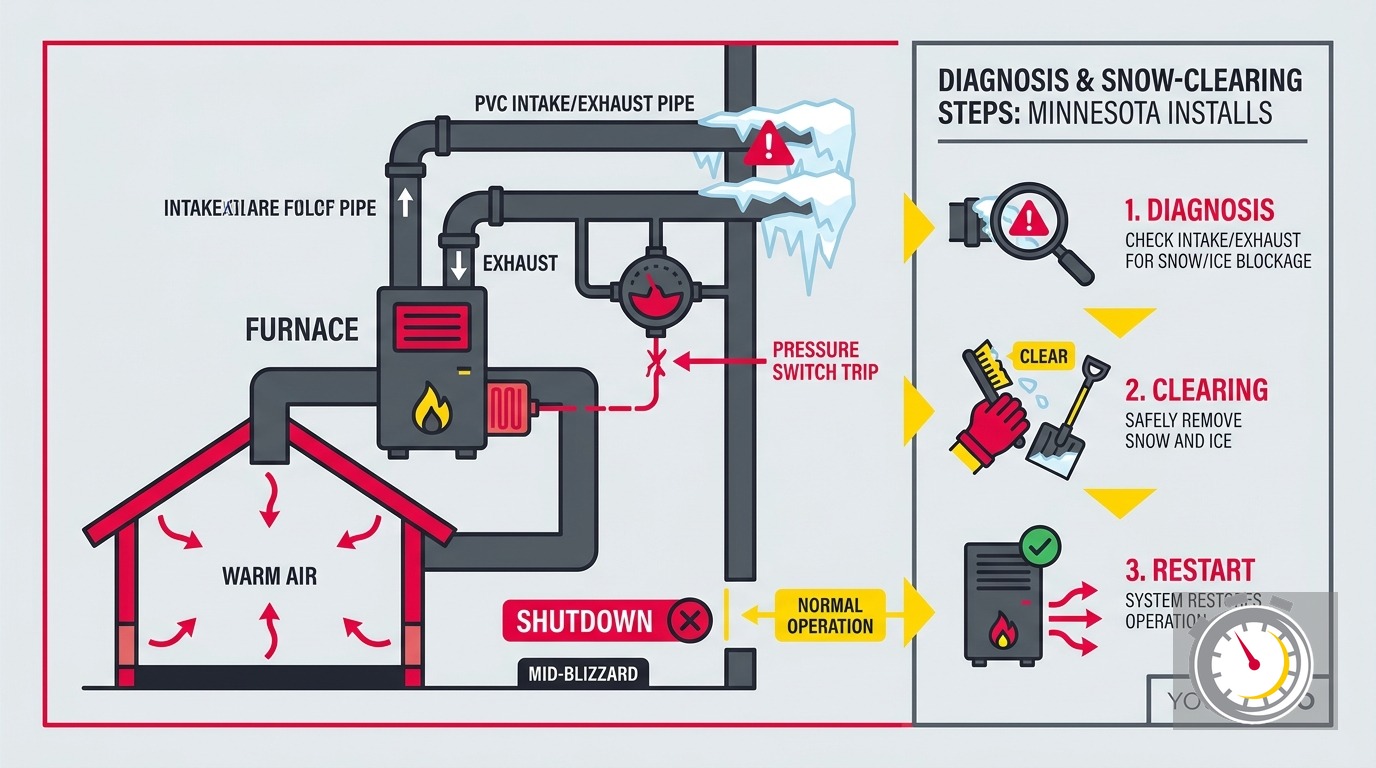
The short answer: When snow or ice blocks your PVC exhaust or intake pipe, the pressure switch inside the furnace detects the airflow drop and locks the furnace out before the gas valve ever opens. No flame lights. The furnace simply refuses to start until the blockage is cleared.
Most homeowners picture a flame going out in the cold. That is not what happens with a modern high-efficiency furnace.
Here is the actual sequence. When your thermostat calls for heat, the inducer motor starts first. This small blower pulls combustion gases through the heat exchanger and out through the PVC exhaust pipe. A pressure switch monitors the negative pressure the inducer creates. If snow or ice is blocking the exhaust, the inducer cannot pull enough air through. The pressure differential falls below the switch threshold. The switch opens, the gas valve stays closed, and the furnace locks out.
Nothing ignites. Nothing burns. The furnace sits there while your house gets colder.
This matters for diagnosis. You will not smell gas. You will not see a pilot fault. The furnace simply will not run, and the control board will log a pressure switch fault. That fault code is your starting point.
What Are the Three Failure Chains That Look the Same?
The short answer: All three chains produce the same symptom: no heat, furnace quiet, thermostat calling. Each has a different cause and a different fix. Only the first is safe to address yourself.
Chain 1: External snow or ice at the vent opening. A drift piles against the foundation wall and covers the pipe end. This is the most common scenario during a heavy Twin Cities snowfall. It is the only chain where a homeowner can safely intervene. Clear the snow and attempt a single restart.
Chain 2: Internal ice dam inside the exhaust pipe. The PVC exhaust pipe must slope back toward the furnace at 1/4 inch per foot minimum. That slope lets condensate drain into the unit rather than pool in the pipe. If the pipe sags even a fraction, condensate collects in the low spot and freezes during a cold snap. The exterior opening can look completely clear. The blockage is 10 or 20 feet inside the wall, and you cannot reach it without accessing the pipe directly.
Chain 3: Frozen condensate drain line. The condensate collected in the heat exchanger drains out through a separate plastic line, typically to a floor drain or utility sink. If that line freezes or kinks, water backs up into the furnace body and trips a safety float switch. A frozen condensate drain is the single most common cause of “frozen furnace” calls in central Minnesota. One documented case involved a condensate line that had sagged and created a 3-inch ice plug inside the wall. No exterior blockage was visible at all. The homeowner cleared both vent pipe ends and could not understand why the furnace kept locking out. Our post on high-efficiency furnace condensate drains in Minnesota covers how this failure develops and what a technician does to fix it.
How Do You Tell Which Failure Chain You Have?
The short answer: Start outside. If snow is packed over the pipe end, clear it and try one restart. If the exterior is clear, or if the furnace trips again after that restart, the problem is internal. Call a technician.
One fast diagnostic tool: the blink code on your furnace’s control board. Most 90-plus percent efficient furnaces signal fault conditions as a pattern of short and long LED blinks. A pressure switch fault blinks a specific sequence. On many Carrier and Bryant models, that is three short blinks followed by one long blink. Open the furnace door panel and look for a fault code chart. It is usually printed on a sticker inside the door. Our furnace error codes and blinking light guide explains how to read these across common brands sold in Minnesota.
A pressure switch fault code tells you the furnace sees low airflow. It does not tell you whether the blockage is at the exterior pipe end, inside the duct run, or in the condensate system. That distinction is what determines your next move.
If the code points to something other than the pressure switch, you are dealing with a different problem. A flame sensor fault, ignition failure, or rollout switch trip requires a technician regardless of what is happening outside.
What to Check Outside: Step by Step
Before going outside, note which way the PVC pipes face on your foundation. On a high-efficiency furnace, two white pipes exit through the rim joist or sidewall. They are typically 2 or 3 inches in diameter. One is exhaust. One is intake. Both can trigger a pressure switch lockout when blocked. In many installations, the intake and exhaust terminate within a foot or two of each other on the same side of the house.
What to look for at each pipe end:
- Snow packed against or covering the opening
- An ice cap forming across the rim
- A solid plug of ice just inside the pipe end (use a flashlight to check)
- Heavy frost forming inside the intake pipe, which often signals that warm exhaust is blowing toward the intake, melting nearby snow, then refreezing inside the cold intake
How to clear it safely:
- Use a soft brush or your gloved hand. Do not use a shovel blade against PVC.
- Clear snow from all around the pipe end, not just the area directly in front of it.
- For an ice cap, use warm water from a pitcher or thermos. Not boiling. Pour slowly and let it work.
- Do not put metal tools inside the pipe. A dented or cracked PVC pipe inside a wall is a separate, more expensive repair.
- If the termination has a screen or a downward-facing elbow, confirm ice is not bridging across the opening.
- After clearing both pipes, stand back and look at the surrounding wall. If a large drift runs along the foundation, clear enough of it to give both pipes 12 to 18 inches of open clearance above them.
While you are outside, check the gas meter. CenterPoint Energy recommends keeping the area around the meter clear of snow and ice during winter, as freeze-thaw cycles can affect the regulator vent and interrupt gas service. A two-foot clearance around the meter is a good standing habit for any Minnesota home.
What NOT to Do When Clearing a Blocked Vent
Several actions seem reasonable under stress but cause real damage.
Do not use a heat gun or torch near the pipe. PVC is flammable. You are working adjacent to a gas appliance. An open flame near a gas line is never the right tool.
Do not pour boiling or very hot water on a frozen opening. Hot water refreezes almost immediately on a cold surface and can thermally crack PVC fittings. Warm water works. Hot water does not.
Do not use a metal rod or screwdriver to chip ice out of the pipe interior. A small puncture in a PVC pipe inside the wall requires cutting into drywall or siding to access. That repair costs far more than a service call.
Do not run the furnace with only one pipe cleared. If the exhaust is open but the intake is still blocked, the pressure switch trips again. Worse, a restricted exhaust creates backpressure that pushes combustion gases into the space around the pipe penetration.
Do not ignore a CO detector alarm. When an exhaust vent is blocked, carbon monoxide can enter the home before the pressure switch trips the furnace off. If a CO detector sounds during a furnace lockout, leave the home immediately and call 911. Do not go back inside to check the vent. Our post on carbon monoxide safety during furnace season covers what to do in that situation and how to get the home safely cleared.
How Do You Reset Your Furnace After Clearing a Snow-Blocked Vent?
The short answer: Set the thermostat to off. Wait 30 seconds. Set it back to heat. The furnace should cycle through startup on its own. Do not reach for the red reset button until you have tried the thermostat cycle first.
When you return the thermostat to heat, the furnace goes through its startup sequence automatically. The inducer motor spins up. The pressure switch checks for adequate airflow. The igniter glows. The gas valve opens. The burner lights. The full sequence takes about 60 to 90 seconds from thermostat call to heat at the registers.
If the furnace lights and holds, stay nearby for five minutes. Listen for consistent operation: a steady flame sound, the blower ramping up a couple of minutes after ignition, warm air from the vents. A furnace that runs steadily for five minutes after a snow-clearing is almost certainly back to normal.
About the red reset button: Some furnaces have a red or yellow high-limit reset on the burner assembly. If the thermostat cycle above does not restart the furnace, press the red button once. Once only. If the furnace trips again after that single press, stop pressing it. Repeated resets can force ignition under an unsafe condition. At that point, the furnace needs a technician.
If the furnace returns to normal operation, plan to book a tune-up within the next 30 days. A technician can measure the vent height, check the pipe slope, and inspect the condensate system. That visit now prevents the same 2 a.m. call later.
When Should You Call a Technician Instead?
The short answer: Call if the furnace trips again after one restart, if the exterior pipes look clear, if you hear water gurgling from inside the unit, or if a CO detector has alarmed. Any of these signals an internal problem.
These are the specific conditions that put the fix beyond what a homeowner can do:
- No exterior blockage visible. The pipes look clear. The furnace still shows a pressure switch fault. The blockage is inside the duct run or the condensate system.
- A second lockout after clearing the exterior. The furnace ran for 20 minutes and then shut off again. The root cause was not the snow at the pipe end.
- Gurgling or dripping sounds from inside the unit. Condensate is pooling where it should not. A frozen or kinked drain line may be backing water into the furnace pan.
- Reduced heat output without full lockout. A partial blockage can lower combustion efficiency without tripping the pressure switch completely. You get some heat, but the system is working harder than it should.
- Any fault code other than the pressure switch. A flame sensor error, ignition failure, or rollout switch trip requires a technician regardless of the outdoor conditions.
Freeze events account for around 30 percent of January and February furnace breakdowns in northern states. Those calls typically run 40 to 60 percent above standard service rates. Calling early, before an ice plug cracks a condensate trap or floods the furnace pan, keeps the repair at standard pricing.
Our team is locally owned and operated in Ramsey. When you call (763) 260-6662, you reach us directly, not a national dispatch center.
Why Is the 12-Inch Code Minimum Not Enough for Minnesota?
The short answer: The Minnesota Mechanical Code sets the vent termination minimum at 12 inches above finished grade. That floor does not account for the drifts that pile against a northwest-facing foundation wall during a January blizzard.
The Minnesota Mechanical Code sets the horizontal vent termination bottom at no less than 12 inches above finished grade. Manufacturer installation guides for most high-efficiency furnaces call for 12 inches above the anticipated snow level. Not just above bare ground. Northwest winds in the Twin Cities can pile drifts 24 to 36 inches high against a foundation wall. A pipe installed at code minimum is buried.
Your installer was not doing anything wrong. Code minimum is code minimum. But a technician at your next tune-up can measure the actual clearance and recommend a fix.
That fix is usually a 90-degree elbow extension on the pipe end. Adding 12 to 24 inches of vertical riser before the termination elbow keeps the opening well above typical drift levels. The material cost is minimal compared to an emergency call at overtime rates.
Also ask about the pipe slope. The exhaust pipe must slope at a minimum of 1/4 inch per foot back toward the furnace so condensate drains into the unit and does not pool inside the pipe. Over time, pipe hangers loosen and sections shift. A sag of even a quarter-inch pools condensate and creates an internal ice dam during sustained cold. Support hangers for 2-inch PVC should be spaced no more than 4 feet apart; 3-inch pipe needs a hanger every 5 feet. If your installer spaced them wider, or if the pipe has shifted over the years, that is your internal ice dam risk. It will show up on the coldest night of the year.
How Can You Prevent a Snow-Blocked Furnace Vent?
The short answer: Mark the pipe ends before the first storm, add a downward-facing elbow at the termination, build exterior clearing into your storm routine, and schedule an annual tune-up to catch internal risks before winter hits hard.
Mark the pipe ends before the first snowfall of the season. Drive a bright driveway reflector stake 6 to 12 inches outside each pipe end in October. This takes 10 minutes and means you can find both pipes immediately after a storm instead of probing through a drift at midnight in January.
Install a downward-facing elbow at the termination. Many installations use a straight horizontal pipe end or a simple vent cap. Wind-driven snow packs into a horizontal opening. A downward-facing 90-degree elbow discharges exhaust downward. Snow driven horizontally does not accumulate in a downward-facing pipe the same way. This is a standard modification and typically takes less than an hour during a service visit.
Clear the pipe ends as part of your storm routine. If you shovel the walk after a storm, add two minutes to brush the pipe ends. Keeping them clear throughout the storm season takes far less time than waiting for a lockout.
Ask about vent height at installation or replacement time. If you are already replacing your furnace, have the technician set the new vent termination well above code minimum. The added pipe at installation is a minor line item. The emergency call at overtime rates during a blizzard is not.
Schedule an annual heating tune-up. A technician will inspect the pipe slope, check the support hanger spacing, flush the condensate trap, and test the pressure switch. Catching a sagging pipe or a partially blocked condensate drain in October costs far less than an emergency repair when the temperature is at minus 20. You can book a furnace tune-up online or call us at (763) 260-6662. Same-day and next-day appointments are available across the Twin Cities metro.
Ready to Get Your Heat Back?
Northern One Hour Heating and Air Conditioning is locally owned and operated in Ramsey, Minnesota. Our team serves Minneapolis, St. Paul, Blaine, Maple Grove, Plymouth, Brooklyn Park, Woodbury, Bloomington, and the surrounding Twin Cities area.
We show up when we say we will. That is what “Always On Time… Or You Don’t Pay a Dime!(R)” means in practice.
If your furnace shuts off in cold weather and clearing the snow blocked vent does not bring it back, call (763) 260-6662 or book online. We will identify whether the blockage is at the exterior, inside the duct run, or in the condensate system, and we will get your heat running the same day.
Frequently Asked Questions
Why does my furnace shut off in cold weather when snow blocks the vent? +
Can I pour hot water on a frozen furnace vent to clear it? +
How do I reset my furnace after clearing a snow-blocked vent? +
Need a technician now?