
Heat Pump Water Heater Minnesota: Honest 2026 Payback Math
Key Takeaways
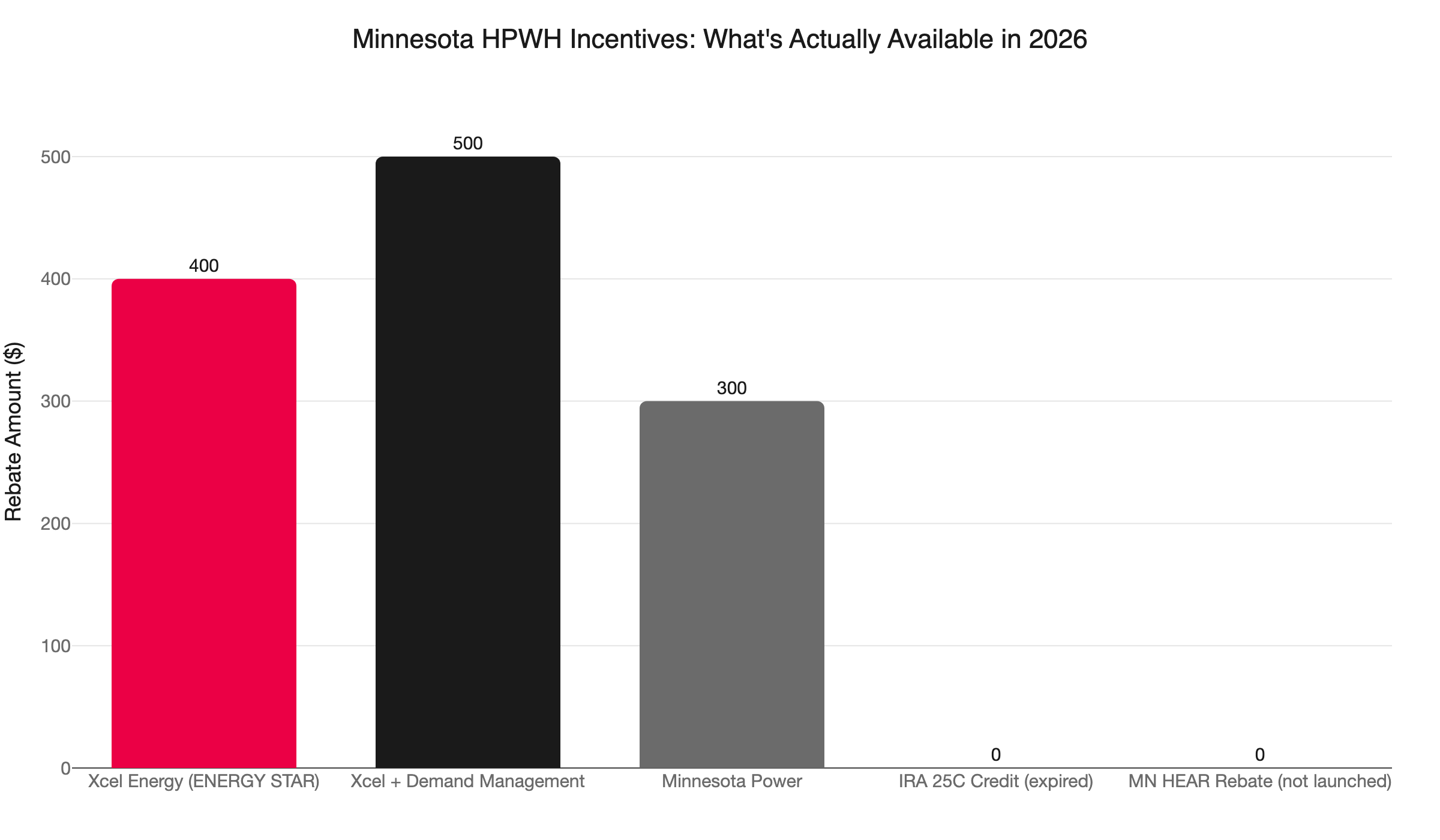
- The IRA Section 25C tax credit for heat pump water heaters expired December 31, 2025. Installations completed in 2026 receive $0.
- Minnesota’s HEAR rebate has no launch date. Installations completed before it launches are not eligible retroactively.
- Utility rebates are live right now: Xcel Energy ($400-$500), Minnesota Power ($300), and Minnesota Energy Resources (bonus rebates through November 2026 for natural gas customers).
- Modern heat pump water heaters operate efficiently down to 35°F. A 55-degree Minnesota basement is mid-range for these machines.
- Payback for an average-usage household replacing an electric resistance tank: 3-5 years with an Xcel rebate applied.
- Most Twin Cities basements have a gas furnace or boiler, which significantly reduces the basement cooling effect.
A heat pump water heater sounds like a straightforward upgrade for a Minnesota home. The reality in 2026 is more nuanced. Two of the biggest incentives homeowners have heard about are either expired or have no launch date. The good news: utility rebates are real, available right now, and the payback math still works for most households.
Is a Heat Pump Water Heater Worth It in Minnesota Right Now?
Short answer: Yes, for most homeowners replacing an electric resistance water heater. Federal credits are gone, but utility rebates close much of the gap. Payback lands between 3 and 7 years for average households. The 55-degree basement concern is real but overstated by the field data.
A heat pump water heater (HPWH) works similarly to your central air conditioner. It pulls heat from the surrounding air and transfers it into your water. That process uses roughly 3-5 times less electricity than a conventional resistance tank. The efficiency gap is the foundation of every payback calculation.
Northern One Hour is locally owned and operated in Ramsey, Minnesota. We install and service HPWHs across the Twin Cities. Our approach is simple: give you the numbers as they actually are, even when the news is inconvenient.
The IRA Credit Is Gone. What That Means for Your Decision.
Until December 31, 2025, the IRA Section 25C credit returned up to $2,000 to homeowners who installed a qualified HPWH. The credit required a Uniform Energy Factor (UEF) of 2.0 or higher. Most ENERGY STAR-certified units clear that bar without difficulty.
The credit expired at the end of 2025. Installations in 2026 receive $0 from that program. Full stop.
Many articles still lead with the $2,000 credit as a reason to act now. That information is outdated or misleading. We are not going to do that to you.
The Minnesota HEAR (Home Energy for All Rebate) program is designed to offer substantial support. When it launches, it could provide up to $8,000 for households below 80% of Area Median Income and up to $4,000 for households at 80-150% AMI. A separate Minnesota Residential Heat Pump Rebate of up to $4,000 is also in the design phase.
As of July 2026, neither program has launched and neither has an estimated start date. Installations completed before the launch date are not eligible retroactively. If your payback math depends on HEAR, your math depends on a program with no timeline.
What is left? Utility rebates. They are real, available today, and worth understanding in detail.
What Utility Rebates Are Actually Available in 2026?
Short answer: Xcel Energy customers can get $400 or $500 with Demand Management enrollment. Minnesota Power customers get $300. Minnesota Energy Resources customers have bonus rebates available through November 2026. These programs are live now, and you can apply after installation.
Here is what each utility is offering:
Xcel Energy: $400 for any ENERGY STAR-certified HPWH. Enroll in their Demand Management program and the rebate increases to $500. Demand Management allows Xcel to adjust the heater’s schedule during peak grid demand periods. Xcel serves most of the Twin Cities metro, so this applies to the majority of Northern One Hour’s service area.
Minnesota Power: $300 for an ENERGY STAR-certified HPWH. Valid January 1 through December 31, 2026. One rebate per unit. It cannot be combined with other Minnesota Power offers.
Minnesota Energy Resources: Bonus rebates stacked on top of standard amounts for qualifying installations between July 15 and November 15, 2026. Applications must be postmarked by December 4, 2026. These are for natural gas customers only. If you are a Minnesota Energy Resources customer, the window closes soon.
The ENERGY STAR qualification bar is not steep. Any modern HPWH worth installing will carry a UEF well above 2.0. That is the same bar the (now-expired) federal credit used, and the same bar Xcel requires for its rebate. The spec sheet will confirm it.
For a broader view of Minnesota incentive programs, see our guide to Minnesota heat pump rebates and tax credits.
Does a Heat Pump Water Heater Work in a 55-Degree Minnesota Basement?
Short answer: Yes. Modern heat pump water heaters operate efficiently from 35°F to 120°F. A 55-degree Minnesota basement is comfortably mid-range for these machines. Below 35°F, the unit automatically switches to standard electric resistance mode. Typical Minnesota basements rarely approach that threshold.
This is the question we hear most from Twin Cities homeowners, and it is a fair one. Minnesota winters are not abstract. A 55-degree basement is realistic when outdoor temperatures are in single digits and the furnace is cycling.
ENERGY STAR addresses this directly: modern HPWHs handle the full range between 35°F and 120°F without any manual intervention. The unit reads ambient air temperature and adjusts automatically. You do not manage this. The machine does.
One real-world data point: a New England homeowner without any heat source in their basement reported basement temps holding at 50-54°F under normal conditions. During -2°F outdoor temperatures with heavy hot water use, the basement dipped to 47°F. The unit ran correctly the entire time.
The Minnesota nuance that matters most: the majority of Twin Cities homes have a gas furnace or boiler in the basement. That changes the equation. The HPWH scavenges waste heat off the furnace jacket and nearby ductwork while those systems run. It captures heat that would otherwise dissipate into the room. The cooling effect in this scenario is much smaller than in a basement without any heat source. No competitor article addresses this clearly, but it is the scenario most Minnesota homeowners are actually in.
Will It Freeze Out Your Basement?
Short answer: No, not in any meaningful way. A Slipstream field study of 81 cold-climate homes found an average basement temperature drop of 2.3°F per HPWH cycle. After four hours of recovery, the basement was only 0.1°F cooler than before the cycle started.
The fear is logical. A HPWH pulls heat from surrounding air and moves it into water. If the basement is already cold, pulling more heat out sounds like a compounding problem.
The Slipstream field study ran real measurements in 81 homes in cold-climate regions with partially conditioned basements. Those conditions are similar to what you find across the Twin Cities. The cooling effect per cycle averaged 2.3 degrees. Temperature recovered almost completely within four hours. On a normal day with typical hot water use, the cumulative impact on basement temperature is negligible.
A Canadian Centre for Housing Technology and National Research Council joint study went further. Under monitored cold-weather conditions, any increase in heating load from HPWH operation was fully offset by the HPWH’s own energy savings. Net impact on whole-home heating costs: effectively zero. HPWHs consumed 3,000 to 35,000 watts less than resistance heaters and delivered 60% energy savings in both winter and summer months.
If you have a gas furnace in that basement, recovery is faster. The furnace runs on its own schedule and continuously returns heat to the basement air.
The Payback Math: Three Scenarios
The right payback number depends on three things: what you are replacing, how much hot water your household uses, and which utility rebates apply to your address.
Scenario 1: Replacing an electric resistance tank, Xcel customer, average usage
This is the clearest win. A HPWH typically costs $800 to $1,500 for the unit, plus $375 to $750 for installation. A resistance tank runs $500 to $900 installed. The premium for the HPWH is real.
A Minnesota homeowner documented their exact numbers: a HPWH cost $1,486 versus $609 for a resistance unit. At $0.11 per kilowatt-hour, payback was approximately 3 years. The unit performed as expected in a Minnesota basement throughout. Add a $400 to $500 Xcel rebate and payback compresses further. For an average-usage household, the range is 3-5 years.
Scenario 2: Replacing a natural gas tank, Xcel customer, average usage
The math is tighter here. A gas water heater already costs less to operate than electric resistance. You are not replacing a $400-$500/year energy cost. You are replacing a $150-$250/year gas cost with a $100-$200/year electricity cost. Annual savings are smaller.
With a $400 rebate applied, payback stretches to 6-9 years. That is still within a typical HPWH’s 10-15 year service life. It is a reasonable investment if you plan to stay in the house.
Scenario 3: Conservative low-usage household, no rebate applied
One detailed cold-climate calculation de-rated winter COP for Minnesota’s seasonal temperatures and estimated annual savings of roughly 1,070 kilowatt-hours. At about $139 per year in savings and low electricity rates, payback without a rebate lands around 14 years.
This is the pessimistic floor. It assumes minimal hot water use, no rebate, and the lowest electricity rates. Most Minneapolis and St. Paul households land somewhere between scenario 1 and scenario 2.
Typical savings versus an electric resistance tank run $300 to $450 per year. With a $400 to $500 Xcel rebate reducing upfront cost, payback for an average household falls to 4-7 years.
If upfront cost is a concern, see our post on HVAC financing options in the Twin Cities.
What About the Heating Penalty in Winter?
Short answer: For most Minnesota homeowners with a gas furnace in the basement, the net effect on total energy bills in winter is close to zero. Field studies show the HPWH’s efficiency savings offset any added heating load. This is measured data, not a theoretical assumption.
The concern is reasonable. If the HPWH cools the basement, the furnace runs slightly more to compensate. That sounds like you give back some of the efficiency gain.
In practice, the Canadian study cited above found the heating penalty was fully offset by HPWH savings under monitored cold-weather conditions. Net impact on whole-home heating: effectively zero. HPWHs still delivered 60% energy savings on water heating even during winter months.
The key variable is your basement. If your furnace is down there, it already leaks heat into that space during every cycle. The HPWH captures that leaked heat before it dissipates. The interaction is more efficient in practice than it sounds in theory.
If your basement is fully unheated and unconditioned, discuss placement with us before installation. In most Twin Cities homes, that is not the situation.
Who Gets the Best Payback from a Heat Pump Water Heater?
Short answer: Homeowners replacing an electric resistance water heater, with above-average hot water use, who qualify for a utility rebate. Those three conditions together push payback below five years and sometimes close to three.
Here is the spectrum, from fastest to slowest:
- Electric tank replacement, Xcel customer, 3+ person household: 3-5 years
- Electric tank replacement, Minnesota Power customer: 4-6 years
- Gas tank replacement, above-average usage, Xcel customer: 5-8 years
- Gas tank replacement, average usage, Xcel customer: 6-9 years
- Any replacement, no applicable utility rebate: add 2-3 years to the above ranges
Single-person households with minimal hot water use are the one group where the math gets genuinely hard. If you fall into that category, we will tell you honestly. Most households do not.
One constant across every scenario: HPWHs are 3-5 times more efficient than electric resistance. That advantage exists in January as much as July. The only question is how large a baseline cost you are replacing.
For more context on how heat pump technology performs in Minnesota conditions, see our guide to heat pumps in Minnesota and whether they are a good fit.
What to Ask Before You Install
Short answer: Confirm your utility and the current rebate amount, your panel readiness for a 240-volt circuit, your available air space around the unit, and the age of your current water heater. Those four items determine your true payback period and installation scope.
A few specifics worth confirming before you commit:
Which utility serves your home? Xcel, Minnesota Power, and Minnesota Energy Resources each offer different rebate amounts with different deadlines and eligibility rules. Confirm yours and the current amount before you select a unit.
Is your electrical panel ready? HPWHs run on 240-volt circuits. If your current water heater is gas, this may require a panel upgrade. That cost belongs in the payback calculation from the start.
How much space surrounds the unit? A HPWH needs adequate surrounding air to operate at rated efficiency. A cramped mechanical room may require relocation or added venting. We assess this before recommending a model.
How old is your current unit? If it is fewer than five years old and running correctly, waiting may make sense. Past 10 years, you are moving toward emergency-replacement territory. Replacing on your schedule is always better than replacing under pressure.
Our team walks through all of this before recommending a unit. We are locally owned, based in Ramsey, and we serve homeowners across Minneapolis, St. Paul, Blaine, Maple Grove, Plymouth, and the broader Twin Cities area. We show up when we say we will. “Always On Time… Or You Don’t Pay a Dime!(R)” is not a tagline we take lightly.
Ready to see whether the numbers work for your home? Call us at (763) 260-6662 or book online. We will review your utility, your current setup, and the rebates available to you before you spend a dollar.
You can also read our breakdown of Xcel and CenterPoint HVAC rebates in Minnesota for the full picture of available incentives.
Frequently Asked Questions
Is the IRA tax credit still available for heat pump water heaters in Minnesota? +
Does a heat pump water heater work in a cold Minnesota basement? +
What rebates are available for a heat pump water heater in Minnesota in 2026? +
What is the payback period for a heat pump water heater in Minnesota? +
Need a technician now?