
Heat Pump Water Heater Cold Basement Minnesota: 2026 Guide
Key Takeaways
- A heat pump water heater (HPWH) needs at least 40°F ambient air to run in heat pump mode. Below that threshold, it switches to resistance heating and draws roughly 10 times as much electricity.
- Most Twin Cities homes have heated basements that hold 60-65°F year-round. That keeps the unit running efficiently through all but the most extreme cold snaps.
- In heat pump mode, an HPWH extracts roughly 1,500-2,000 BTU/hr from basement air. Over a 2-3 hour daily draw cycle, your furnace has to replace 3,000-6,000 BTU/day it would not otherwise lose.
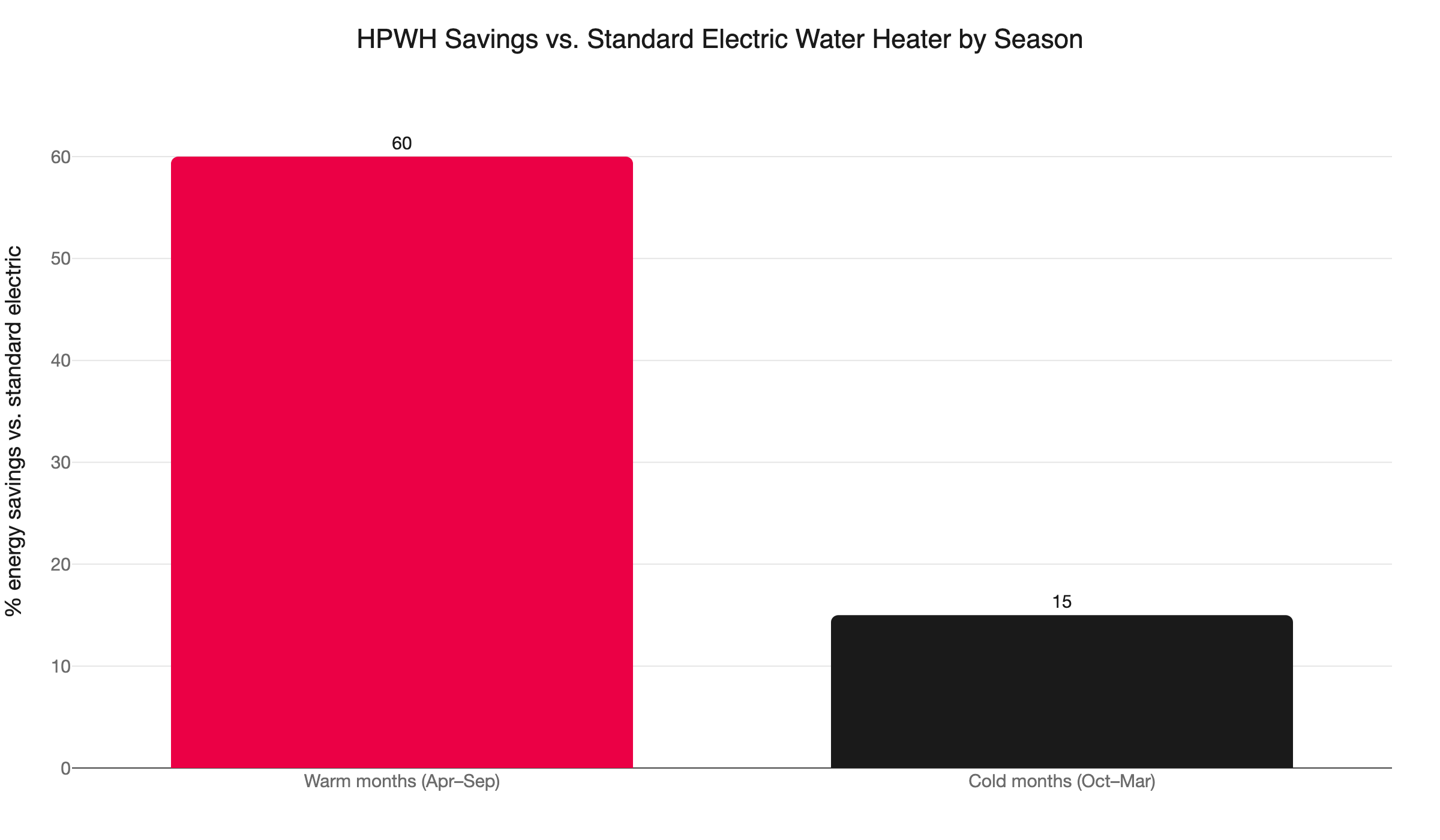
- Annual savings run 60%+ versus a standard electric water heater in warm months, though savings are lower in cold months. The full-year average is still well ahead of resistance heating.
- The federal 25C tax credit ($2,000 for an HPWH) expired December 31, 2025. It is gone. Xcel Energy’s $400-$500 rebate is the primary active incentive for most Twin Cities homeowners.
- Three management moves cut the winter heating penalty without giving up your annual savings.
Does a Heat Pump Water Heater Work in a Cold Minnesota Basement?
Yes, in most Twin Cities homes, with a manageable winter tradeoff. Most Minneapolis-area homes have heated basements that hold 60-65°F through even the coldest months. That is well above the 40°F minimum ambient temperature an HPWH needs to run in heat pump mode, so the unit operates efficiently for the majority of the year.
The catch: the unit extracts heat from that basement air, which adds a small but real load on your furnace. That tradeoff is manageable. The rest of this post gives you the exact numbers and the three moves that prevent the winter penalty from eating your savings.
Two baseline requirements apply to any installation, independent of climate. Energy Star specifies roughly 700 cubic feet of surrounding air - a 10x10x7 space - and most models require a dedicated 240V circuit. Those are installation logistics, not cold-climate problems.
What Temperature Is Too Cold for a Heat Pump Water Heater to Run?
Below 40°F ambient air, an HPWH switches out of heat pump mode and into resistance heating, which draws roughly 5,000 watts versus about 500 watts in heat pump mode. That is a 10x jump in operating cost for every hour it runs in resistance mode.
In a conditioned Twin Cities basement, hitting 40°F indoors is almost impossible. Even during a polar vortex, basement air temperatures in a heated home hold well above freezing. The basement thermal mass and heat loss from adjacent mechanical equipment prevent any freefall toward the minimum.
The risk is real only in unheated or semi-conditioned spaces. An unheated basement under extreme cold and heavy hot water use can drop to around 47°F. That is still above the 40°F cutoff, so the HPWH keeps running, but efficiency gains shrink considerably at those temperatures.
Conditioned vs. Unheated: the Basement Distinction That Changes Everything
Most online guidance on HPWHs in cold climates treats all basements as one category. They are not, and the distinction matters more here than in almost any other state.
Conditioned basement (60°F+): The standard Twin Cities setup. The basement is inside the heated envelope. The HPWH runs in heat pump mode all winter. Heat it extracts from the air is heat your furnace already paid for. The tradeoff is real money, but the net is still positive for the full year.
Unheated or semi-conditioned basement (47-55°F): The floor is a concrete slab, walls may be uninsulated block, and the space gets residual heat from mechanical equipment but no direct supply register. The HPWH still runs in heat pump mode, but it is partly drawing on ground-coupled thermal mass rather than furnace-heated air. That is actually a slightly better interaction from a heating-load standpoint: BTUs extracted from a 50°F ground-coupled slab cost less to replace than BTUs extracted from air your furnace just heated to 65°F.
Unconditioned crawl space (below 47°F in extreme cold): The HPWH is the wrong appliance for this space. Below 40°F, the efficiency gains disappear and you are running a very expensive resistance heater in a location where you cannot benefit from the heat pump operation.
If you are unsure which category your basement falls into, that question is worth a technician visit before you buy anything. The answer shapes not just the water heater decision but whether you should air-seal or insulate the basement first.
How Much Heat Does an HPWH Actually Steal From Your Basement?
Running in heat pump mode, an HPWH extracts roughly 1,500-2,000 BTU/hr from surrounding air. Over a typical 2-3 hour daily draw cycle for a family of four, that is 3,000-6,000 BTU per day your heating system has to replace.
To put that number in perspective: a standard 80,000 BTU/hr gas furnace covers that entire daily deficit in under five minutes of run time. The absolute magnitude is modest. The issue is not the total - it is the timing.
A nine-home Michigan field study measured an average basement temperature drop of 2.3°F per HPWH heating cycle, with near-floor peak drops reaching 4°F during heavy use. After a four-hour recovery period, the net temperature difference was only 0.1°F below baseline. Baseline temperatures in that study ran 62-65°F, consistent with a heated Twin Cities basement.
Your basement will recover. The question is whether you want that heat extraction happening at 7 a.m. on a -10°F January morning.
Why Does the Timing of Your Showers Make This Worse?
Morning shower peaks force the HPWH to run hardest during the coldest outdoor hours, stacking demand on your furnace at exactly the wrong moment. On a January morning in Ramsey or Blaine, your heating system is already near peak output. Adding the HPWH load at the same time compounds both systems’ work.
Minneapolis sits in IECC Climate Zone 6A with roughly 7,400-8,300 heating degree days per year and a 99% design temperature near -16°F. Heat runs approximately 252 days a year here. On a cold January morning, the household showers between 6 and 8 a.m. The HPWH kicks on and runs for two to three hours. Both the furnace and the water heater are competing for the same heated basement air, at the same outdoor conditions, at the same time.
This timing asymmetry is the piece no competitor article on this topic addresses directly. It does not make the HPWH a bad investment. It does mean that scheduling when the unit heats water matters more in Minnesota than it would in a mild-climate state.
The fix is to program the HPWH to pre-heat overnight, between 10 p.m. and 5 a.m. The household is asleep, heating demand is lower, and the insulated tank retains heat for hours. Your morning showers draw from stored hot water rather than triggering an active 2-3 hour heating cycle at 7 a.m. For Xcel Energy customers, that overnight window often aligns with off-peak rates, which adds a second layer of savings on top of the efficiency gain.
Is a Heat Pump Water Heater Suitable for Cold Climates?
Yes, with honest expectations about the winter savings rate. The DOE estimates lifetime savings of roughly $1,800 per household versus resistance electric heating, and those savings hold even in a Minnesota winter.
The honest breakdown: warm-season savings against a standard electric water heater run 60%+. Cold-season savings, when the unit is partly competing with your heating system, drop to 10-20%. Minnesota has roughly six cold months and five to six warm months. Average the full year and you are still well ahead of resistance heating.
For all-electric homes, the math is the cleanest: every BTU the HPWH moves efficiently is a BTU your resistance heater did not have to make. For natural-gas-heated homes, the HPWH saves on the electric bill but adds fractionally to the gas bill in winter. The net is still positive, but the payback period is longer than for all-electric homes.
Water heating is the second-largest energy category in most homes. A 60% reduction on the second-biggest line item adds up quickly over the life of the appliance. A family of four saves approximately $600 per year versus a standard electric water heater, according to Energy Star.
If you are also evaluating a full heat pump system for your home, understanding how cold-climate heat pump models perform in Minnesota winters helps you see how the two investments interact before you commit to either.
Three Moves That Cut the Winter Penalty
You do not have to accept the worst-case heat-steal scenario. These three moves address it directly without requiring you to give up efficiency gains.
Move 1: Switch to resistance mode during polar vortex stretches. When the forecast shows multiple days below -10°F or -15°F, your furnace is already at design limits. Switching the HPWH to resistance mode for 48-72 hours eliminates the basement heat extraction entirely. You pay a higher electric rate for those days - resistance draws roughly 5,000 watts versus 500 watts in heat pump mode - but you remove a competing demand from your heating system at the worst possible time. Most modern HPWHs have app controls or simple mode switches that make this a two-step task.
Move 2: Shift to overnight heating. Set the unit to heat between 10 p.m. and 5 a.m. The furnace runs lighter overnight, the insulated tank retains heat well into the morning, and your household draws from stored capacity rather than a live heating cycle at 7 a.m. If you are on Xcel Energy, the overnight window often aligns with off-peak rates, which compounds the savings.
Move 3: Site the unit near waste-heat sources. A water softener, a chest freezer, or older mechanical equipment all dump heat into basement air. Positioning the HPWH nearby means it is partly recycling heat that was going to dissipate anyway. The unit still extracts from the air, but it is air being heated by appliance waste rather than by your furnace running a full burn cycle. In a conditioned basement, this lowers the effective load impact on your heating system noticeably.
A fourth option worth discussing with your installer: ducting the HPWH’s exhaust into a return air path. The unit discharges cooled, dehumidified air as a byproduct of heating water. Routing that exhaust back into the return plenum rather than into the basement keeps the basement temperature more stable and lets your HVAC system handle any temperature recovery efficiently. This adds some ductwork to the installation but can meaningfully reduce the basement heat extraction penalty during cold months.
For a broader view of how these efficiency upgrades stack with available incentives, the guide to layering Minnesota HVAC rebates covers the current federal, state, and utility landscape.
What Rebates and Tax Credits Are Actually Available in 2026?
The rebate picture changed significantly at the start of this year. The main federal incentive is gone.
The federal 25C tax credit covered $2,000 of the cost of an Energy Star-certified HPWH. It was repealed by the One Big Beautiful Bill, signed July 4, 2025, and expired December 31, 2025. You will still see it cited on competitor sites, older guides, and contractor marketing materials. It does not apply to any installation in 2026. If a source still cites the 25C for a 2026 purchase, that information is out of date.
What remains:
Xcel Energy: $400 for an Energy Star-certified HPWH. If you enroll in Xcel’s Demand Management program, that rises to $500. This applies to Xcel residential customers in the metro. Confirm current amounts directly at xcelenergy.com before purchasing, since rebate program cycles update periodically.
CenterPoint Energy: No rebate for electric heat pump water heaters. CenterPoint’s water heater rebate programs cover gas equipment only.
HEAR/HEEHRA: The Inflation Reduction Act’s High-Efficiency Electric Home Rebate offers up to $1,750 for an HPWH for qualifying households under 150% of area median income. As of June 2026, the Minnesota program had not launched. Check energyrebatecalculator.com/rebates/minnesota for current status before assuming this money is available.
With only the Xcel rebate active for most buyers, plan on net out-of-pocket costs of roughly $800-$1,600 for equipment after rebate, plus installation labor. The DOE’s $1,800 lifetime savings estimate against resistance heating still makes the investment work. It just takes longer to break even than it would have with the 25C credit stacked on top.
The Bottom Line for Twin Cities Homeowners
A heat pump water heater in a cold Minnesota basement is a sound investment for most homes. The heat-steal effect is real: an HPWH in heat pump mode extracts 3,000-6,000 BTU per day from your basement air, concentrated in the early morning hours when your furnace is already working hardest. That is the honest part of the math most guides skip entirely.
The annual savings still favor the HPWH. The warm-season efficiency advantage and a lifetime savings estimate of over $1,800 against resistance heating are not erased by a Minnesota winter. They are trimmed in cold months and fully realized the rest of the year.
Three things determine whether your specific basement is a good fit: the space temperature (above 55°F year-round?), the available square footage (at least 700 cubic feet?), and your electrical setup (240V circuit available?). If all three check out, you are a strong candidate.
For the full year-one payback analysis by fuel type, the detailed HPWH cost breakdown for Minnesota homeowners walks through the numbers against both gas and electric baselines.
Northern One Hour is locally owned and operated in Ramsey, MN. Our team serves Minneapolis, St. Paul, Blaine, Brooklyn Park, Maple Grove, Plymouth, Woodbury, and the broader Twin Cities metro. If you want help assessing your basement conditions or understanding how an HPWH would interact with your current heating system, we are ready.
Call (763) 260-6662 or book online to schedule. We show up when we say we will - “Always On Time… Or You Don’t Pay a Dime!(R)”.
Frequently Asked Questions
What is a good water heater for a cold Minnesota basement? +
Will the 2029 DOE efficiency standards change what I should buy now? +
Need a technician now?