
Heat Pump Covered in Ice This Winter? Here's What It Means
Key Takeaways
- A heat pump covered in ice in winter is almost always in normal defrost mode, not malfunctioning.
- Defrost cycles run every 30-90 minutes in freezing weather and last 5 to 15 minutes each.
- Steam rising off the outdoor unit and a quiet outdoor fan are signs defrost is working correctly.
- Twin Cities Januaries combine sub-freezing temperatures with relative humidity averaging 87-90%. Frost forms nearly every day from December through February.
- Four symptoms point to real defrost board failure: no defrost at all, defrost that won’t terminate, the outdoor fan running during defrost, and solid ice that never fully clears.
- Call Northern One Hour at (763) 260-6662 if solid ice is not clearing after a full defrost cycle.
What Does a Heat Pump Look Like During Defrost Mode?
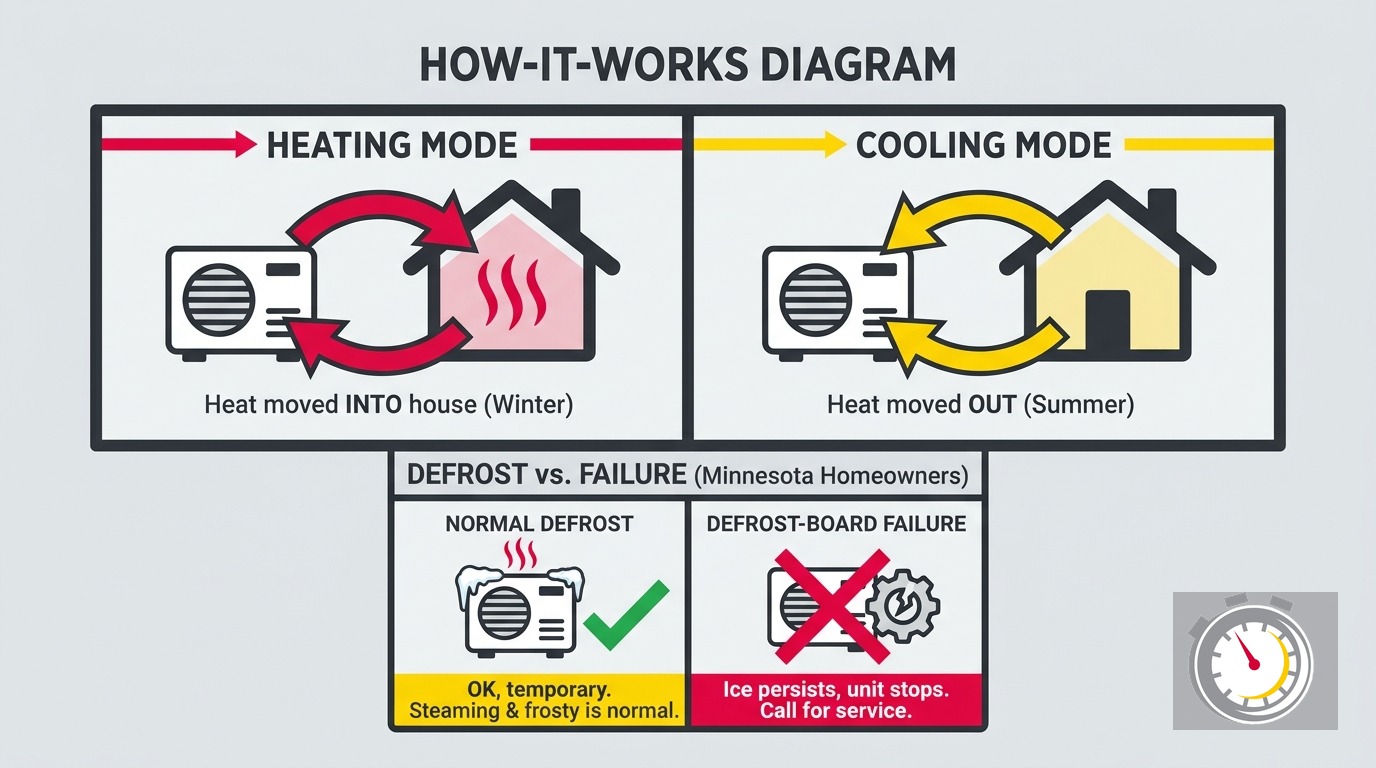
During a normal defrost cycle, light frost or thin ice builds on the outdoor coil, the fan stops, steam rises as the frost melts, and the cycle ends within 5 to 15 minutes. The system then returns to heating.
Here is the full sequence:
- Frost builds on the outdoor coil during cold, humid weather.
- The defrost control board detects the buildup and signals the system to reverse.
- The heat pump switches temporarily to cooling mode, routing hot refrigerant to the outdoor coil.
- The outdoor fan shuts off. Less cold air across the coil means faster melting.
- The frost melts. Steam rises from the unit.
- After 5 to 15 minutes, the board terminates defrost. The system resumes heating.
This happens automatically. You may never notice it from inside the house. From the yard, it can look alarming. It is not.
The thin white frost you see forming between cycles is normal too. It is not the same as solid, clear ice. Thin white frost is expected. Solid ice that builds cycle after cycle without clearing is the red flag.
Is a Heat Pump Covered in Ice in Winter Normal?
Yes. Light frost and thin ice are expected on a heat pump in cold, humid weather. The outdoor coil runs colder than the surrounding air to pull heat from it. When temperatures drop below 40°F and humidity is high, frost forms on the coil. The defrost cycle is the built-in solution.
The physics are straightforward. A heat pump moves heat from outdoor air into your home. The outdoor coil must run colder than the ambient air for that transfer to occur. When the air is cold and moisture-saturated, that moisture freezes on the coil.
This happens on every heat pump in every cold climate. It is an expected operating condition, not a fault. Manufacturers design defrost controls specifically to address it.
The relevant context for Twin Cities homeowners: January in Minneapolis averages a high near 20°F and a low near 7.5°F. Relative humidity in Minneapolis averages 87-90% in January, the highest of any month. Sub-freezing temperatures plus near-saturated air means prime frost conditions nearly every day from December through February. Frequent defrost cycles during that stretch are the expected result. They are not a warning sign.
Why Is Your Heat Pump Steaming?
Steam rises when the defrost cycle melts frost off the outdoor coil. Hot refrigerant flows through the coil, frost melts fast, and water vapor rises in the cold air. This is normal water vapor. It is not smoke and not a refrigerant leak.
“Heat pump smoking in winter” is one of the most common HVAC searches every January. The explanation is simple. Frost melts into steam when it contacts a warm coil in cold, dry air. The visual is dramatic. The cause is not.
If you see actual smoke with a burning smell, that is a different situation. Call us right away. But steam with no odor, during or right after a defrost cycle, is the system doing its job.
The 3-Part Test: Normal Frost or a Real Problem?
You can evaluate your heat pump’s behavior from a window. No need to go outside or touch anything. Apply this three-part test.
1. Duration
Watch how long the unit stays in defrost mode: fan off, steam rising, coil warming. A normal defrost cycle lasts 5 to 15 minutes. Defrost running longer than 20 to 30 minutes with no visible ice clearing warrants attention.
2. Frequency
In freezing, humid weather, defrost cycles repeat roughly every 30 to 90 minutes. Multiple cycles per hour during a January cold snap is normal behavior. If the unit seems to spend more time in defrost than in heating mode, a sensor issue is possible.
3. Full clearance
After each defrost cycle ends, the ice should be fully or nearly fully gone. The coil should look normal before the next cycle begins. Thin white frost reforming quickly is fine. Solid, clear ice persisting after the cycle ends without melting means defrost is not completing. That is the clearest visible indicator of a real problem.
All three checks passing? You are watching a healthy heat pump in a Minnesota winter.
Why Are Your Vents Blowing Cool Air During Defrost?
During defrost mode, the heat pump temporarily switches to cooling mode to warm the outdoor coil. Indoor heating pauses. Auxiliary electric heat strips engage to fill the gap, but they take 30 to 60 seconds to warm up. Brief cool air from the vents during that transition is normal.
ENERGY STAR excludes the first 10 minutes after a defrost cycle from rated performance measurement for cold-climate heat pumps. That exclusion formally acknowledges the warm-up gap as a designed-in part of normal cold-climate operation.
If your heat pump lacks auxiliary heat strips, the vents will blow cooler air throughout the entire defrost cycle. That is a design limitation, not a malfunction. If you find it uncomfortable during extended cold snaps, mention it to a technician.
Your thermostat may show “Aux Heat” or “Em Heat” briefly during or just after defrost. That is the system managing the transition correctly. For guidance on when to switch intentionally to emergency heat mode, see our guide on heat pump emergency heat and when to use it.
What Makes a Heat Pump Covered in Ice in Winter a Real Problem?
Defrost board failure produces four specific, observable symptoms: no defrost cycle despite visible frost buildup, defrost that won’t terminate, the outdoor fan running during defrost, and solid ice that never fully clears after a cycle. These are distinct from normal defrost behavior.
No defrost cycle at all
Frost keeps building and the system never enters defrost mode. The defrost control board or its temperature sensor has likely failed. Ice accumulates slowly over hours. Eventually it can encase the entire outdoor unit. Once airflow is blocked enough, the system trips a safety lockout and shuts down. A failed temperature or pressure sensor is often the root cause.
Defrost that won’t terminate
The system enters defrost and stays there. The outdoor fan stays off. The unit keeps running in reverse-cycle mode for 20, 30, or 60 minutes with no sign of ending. The board is not processing the signal to terminate defrost. A stuck contactor or failed board logic is the typical cause.
Outdoor fan running during defrost
During a normal defrost cycle, the outdoor fan stops. This is intentional. The fan stopping lets the coil warm up faster without cold air blowing across it. If you see steam rising and ice melting but the outdoor fan is still spinning, the board is not sending the fan-off command. That is a control failure, not normal operation.
Solid ice that never fully clears
Normal defrost leaves the coil clean after each cycle. If defrost appears to run but solid, clear ice remains afterward, the system is not completing the melt. Low refrigerant charge or a failing reversing valve can cause this. A malfunctioning defrost board is a frequent culprit.
The performance cost of incomplete defrost is significant. Research cited by NEEP on cold-climate heat pump specifications shows that frost not fully clearing can reduce heating capacity by up to 43.4%. It can also degrade COP by up to 40.4%. A unit running at roughly half its rated output while drawing full power costs you money on every heating cycle.
Defrost board repair typically costs $200 to $450 for parts and labor, depending on brand and board accessibility.
When Should You Stop Watching and Call?
Call a technician if solid ice is not clearing after a defrost cycle, if defrost runs more than 20 to 30 minutes without ice clearing, if the outdoor fan runs during defrost, or if the unit has shut down under heavy ice buildup.
Use this decision guide:
- Light frost forming and clearing every 30 to 90 minutes: normal, no action needed.
- Steam visible and fan quiet during a 5 to 15 minute cycle: defrost working correctly.
- Brief cool air from vents during or just after defrost: normal aux heat transition.
- Solid ice remaining after a full defrost cycle: call for service.
- Outdoor fan running while steam rises: call for service.
- Unit appears to never defrost despite visible frost buildup: call for service.
- Ice so heavy the unit has shut down: call for service immediately.
Northern One Hour is locally owned and operated in Ramsey, MN, serving Minneapolis, St. Paul, Blaine, Maple Grove, Plymouth, Brooklyn Park, Woodbury, Bloomington, and the surrounding Twin Cities metro. We show up when we say we will. That is the Northern One Hour promise: “Always On Time… Or You Don’t Pay a Dime!(R)”
Call (763) 260-6662 or schedule heat pump repair online.
Is a Cold-Climate Heat Pump Worth the Upgrade?
For most Twin Cities homeowners, yes. The key is choosing a unit certified to the NEEP cold-climate standard: a COP of at least 1.75 at 5°F and at least 70% of rated capacity at 5°F. These units are built to defrost reliably and keep heating in Minnesota winters.
The NEEP Cold Climate ASHP specification defines the minimum performance bar. A searchable list of qualifying models is available at ashp.neep.org. When replacing an aging heat pump, this list is the right starting point.
The DOE’s Cold Climate Heat Pump Challenge drew commitments from eight major manufacturers: Bosch, Carrier, Daikin, Johnson Controls, Lennox, Midea, Rheem, and Trane. Minnesota is one of the active DOE field validation sites. These systems are engineered for this climate, not adapted to it as an afterthought.
Homeowners currently heating with electric resistance or fuel oil can see significant savings with a qualifying cold-climate ASHP. Energy consumption can drop by up to 40% compared to those fuel sources. For natural gas users, the math depends on current gas and electricity rates. Our team can run the numbers for your home.
For a full Minnesota-specific overview, see heat pumps in Minnesota: are they a good fit?
What Minnesota Rebates Are Available for Heat Pump Upgrades?
If a defrost board inspection reveals your existing unit is aging and repair costs are approaching replacement cost, available rebates can change the math significantly.
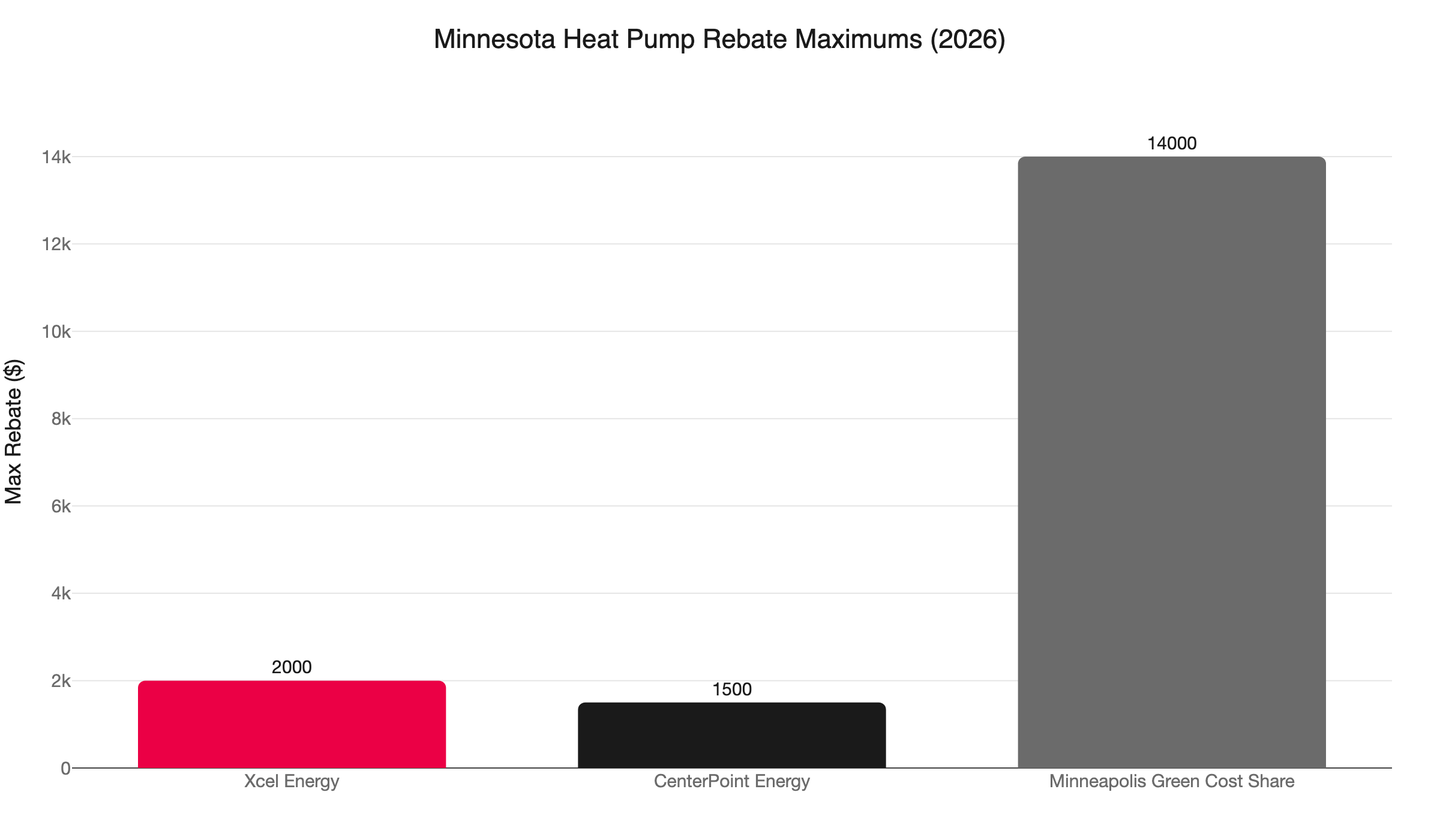
Xcel Energy offers up to $2,000 for qualifying cold-climate heat pumps. Units must meet the COP ≥ 1.75 at 5°F threshold and appear on ashp.neep.org. A $600 bonus is available when the upgrade is paired with insulation or air sealing improvements.
CenterPoint Energy offers up to $1,500 for ducted cold-climate ASHPs. An additional $1,100 is available for dual-fuel system configurations.
Minneapolis Green Cost Share can stack up to $14,000 in additional incentives on top of utility rebates for eligible Minneapolis homeowners. This program is income-qualified and subject to annual funding availability.
One important note on federal incentives: the 25C heat pump tax credit expired December 31, 2025. The state HEAR rebate program had not yet launched as of early 2026. Verify current eligibility directly with Xcel and CenterPoint before making purchase decisions, as program requirements change.
Our team walks clients through rebate eligibility as part of every heat pump assessment. Financing options are available for qualifying systems. If replacement makes sense for your situation, we want to make it as accessible as possible.
For a current breakdown of all available incentives, see Minnesota heat pump rebates and tax credits.
Call (763) 260-6662 or book online to get started. We will be there when we say we will be.
Frequently Asked Questions
Is it normal for a heat pump to be covered in ice in winter? +
Why is my heat pump steaming in winter? +
Why is my heat pump blowing cold air during defrost? +
How long should a defrost cycle last on a heat pump? +
Need a technician now?