
How to Clean a Furnace Flame Sensor (and When to Call a Pro)
Key Takeaways
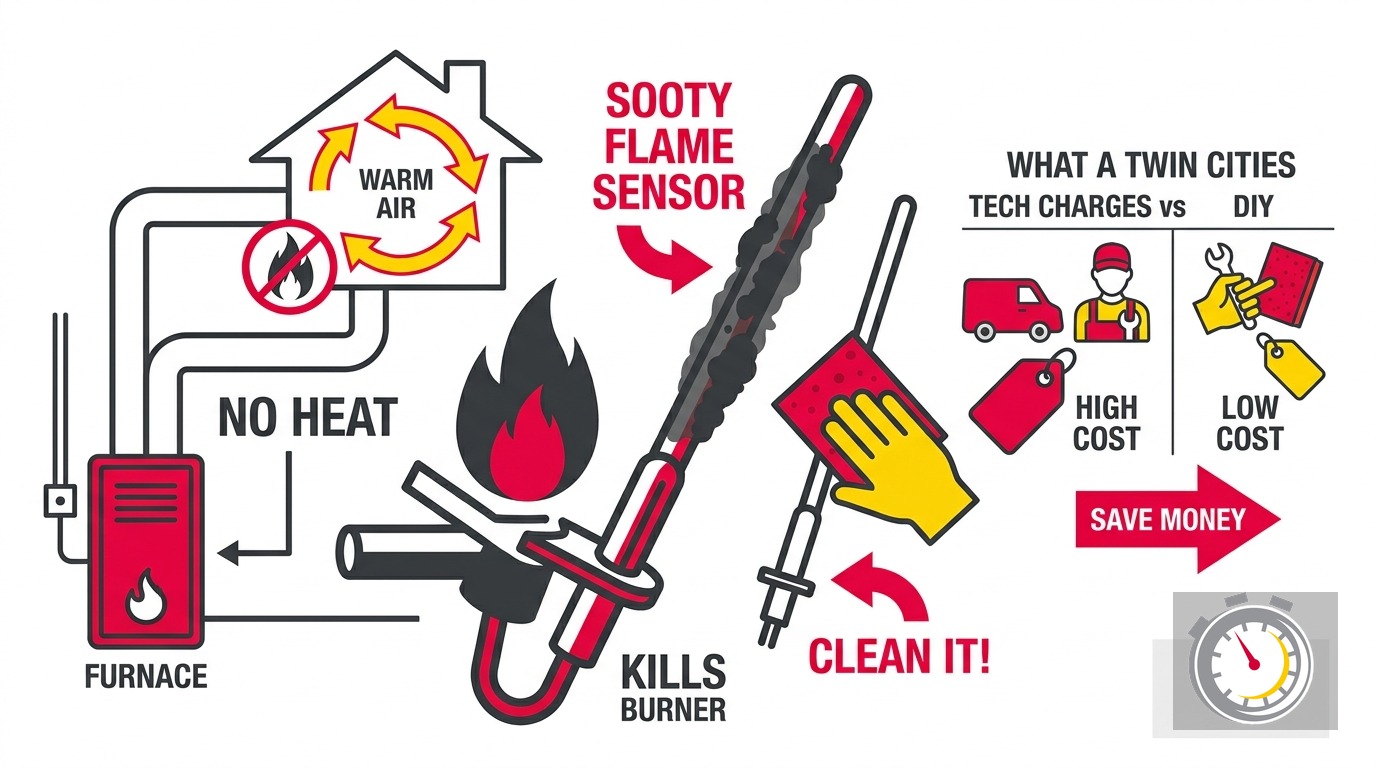
- A dirty flame sensor is the most common reason a furnace lights and immediately shuts off
- The symptom pattern: ignition, 3-10 seconds of heat, burner cutout, repeat, then full lockout
- Cleaning is a 20-minute DIY job with a screwdriver and fine steel wool; a replacement part costs $10-30
- Each abrasive cleaning roughens the rod and accelerates the next failure - one pass per sensor is the practical limit
- Professional service with labor and part runs $75-250; a CenterPoint Home Service Plus tune-up at $139.95 covers the sensor check as part of a full system inspection
- A sensor that fails twice in one season is a symptom of a deeper combustion problem: dirty burners, a cracked heat exchanger, or an improper air-to-fuel ratio
What Is a Flame Sensor and Why Does It Fail?
A flame sensor is a thin metal rod near the burner assembly that confirms your furnace is actually lit. It passes a small electrical current through the flame back to the control board. When soot or oxidation insulates that rod, the control board never receives the confirmation signal. It shuts the gas off even with a real flame present.
Your furnace runs a safety handshake every time it fires. The inducer fan starts. The hot surface ignitor glows. The gas valve opens and the burner lights. Then the control board waits for the flame sensor to report back: “Combustion confirmed.”
The sensor does this through flame rectification. A live burner conducts a small DC current from the rod back to the control board. That current is typically 1.5 to 6 microamps. The board reads the signal and holds the gas valve open. No signal means no confirmed flame, so the valve closes automatically.
This is a safety feature working exactly as designed. You want the gas to shut off if combustion cannot be confirmed.
The problem is contamination. A heating season or two of combustion leaves a thin film of carbon soot on the metal rod. Humidity and combustion byproducts can also produce silica oxidation - a white or greenish crust on the rod that acts as an insulator. The flame is real. The current cannot penetrate the crust. The control board shuts the gas off anyway.
Minnesota furnaces work harder and run longer than in most parts of the country. A system running through a seven-month heating season accumulates contamination faster than one in a mild climate. That is why flame sensor service ranks among the most common mid-season calls our team handles across the Twin Cities.
What Does Short Cycling Look Like?
The furnace starts, runs three to ten seconds, then shuts off. It tries again immediately and does the same thing. After two or three attempts, the control board locks out completely. The house gets no heat until you reset the system or an hour passes.
The pattern is specific enough to recognize from across the room. Here is the full sequence when a dirty flame sensor is the cause:
- The inducer fan starts and runs for about 30 seconds
- The hot surface ignitor glows orange
- The gas valve opens and the burner lights - you hear the “whomp”
- Three to ten seconds pass
- The control board receives no microamp signal and closes the gas valve
- The burner shuts off
- The ignitor glows again and the sequence repeats
- After two or three failed cycles, the board locks out entirely
After lockout, the furnace waits roughly an hour before retrying on its own. You can also reset it at the breaker. If it repeats the same pattern after the reset, nothing has fixed itself.
This differs from short cycling caused by a restricted filter or an oversized system. Those cases usually involve the furnace running for several minutes before the high-limit switch trips. Flame-sensor short cycling is fast - under ten seconds of heat per attempt.
How to Clean a Furnace Flame Sensor: Step-by-Step
This is a 20-minute job on most systems. You need a Phillips screwdriver and fine steel wool or 400-grit emery cloth. Do not use sandpaper coarser than 400 grit. Aggressive abrasion removes too much metal and shortens the sensor’s working life.
Before you start: Turn off the furnace at the thermostat. Flip the power switch off at the unit or trip the breaker. Shut the gas off at the valve near the furnace. Wait five minutes for residual heat to clear.
Step 1 - Locate the sensor. Open the furnace cabinet. The flame sensor is a thin metal rod, usually six to eight inches long, with a white ceramic insulator at the mounting bracket. It sits near the burner assembly and connects to a single wire. Most systems use one Phillips screw to hold it in place.
Step 2 - Remove the sensor. Disconnect the wire from the terminal. Remove the mounting screw and set it somewhere it will not roll away. Gently pull the sensor out. Do not bend the rod.
Step 3 - Inspect the rod. Look at the metal tip. Heavy black soot, a white powdery coating, or a greenish film all point to contamination. A lightly tarnished rod may also be dirty enough to fail. Visually clean does not mean electrically clean.
Step 4 - Clean with light abrasion. Rub the metal rod in one direction using fine steel wool or 400-grit emery cloth. You are removing the contamination layer, not reshaping the rod. Wipe the residue off with a clean, dry cloth. Do not use water or chemical cleaners near the burner assembly.
Step 5 - Reinstall and test. Slide the sensor back into its bracket, replace the screw, and reconnect the wire. Close the cabinet. Restore power, restore gas, and call for heat at the thermostat. The furnace should light and run continuously without cutting out.
If it short-cycles again immediately after cleaning, stop. A second cleaning pass will not fix it. The sensor needs to be replaced or professionally evaluated.
The Abrasion Trap: Why Cleaning Has a Limit
Most homeowners do not know this part. Each abrasive cleaning roughens the metal rod, accelerates corrosion, and shortens the time before the next failure. A new sensor has a smooth, uniform surface. After one cleaning pass it has microscopic scratches. Soot and oxidation grip a rougher surface more easily. The interval between failures gets shorter with each pass.
The practical rule is one cleaning per sensor. If the rod you cleaned fails again in the same heating season, replace it. A second cleaning is a short-term patch on a part that has already degraded.
Replacement parts are inexpensive. A universal or OEM flame sensor costs $10-30, and installation follows the same steps as cleaning. Skip the abrasion step, swap in the new rod, and the job takes the same 20 minutes.
How Do You Test a Flame Sensor with a Multimeter?
Set the multimeter to DC microamps. Connect it in series between the sensor wire and sensor terminal while the furnace fires. A healthy sensor reads 1.5 to 6 microamps. Below 1 microamp means the sensor is failing even if the rod looks clean to the eye.
This test separates a professional diagnosis from a visual guess. A sensor can look nearly spotless and still read 0.8 microamps because silica oxidation is partially transparent. You clean the rod, reinstall it, and get the same short-cycling problem again in 48 hours.
Running the multimeter test after cleaning confirms whether the cleaning actually restored conductivity. If you clean a visibly dirty rod and reinstall it but still read below 1.5 microamps, the sensor needs replacement. A second cleaning pass will not change the reading.
One important note: this test requires the furnace to be running with an active flame. You are working near a live gas burner. If that is not a scenario you are comfortable with, this is a reasonable place to hand the diagnosis to a tech. Paying for a professional visit on a $20 part is frustrating, but misdiagnosing the problem and leaving a gas appliance in a fault state is worse.
What Does It Cost to Clean a Furnace Flame Sensor in the Twin Cities?
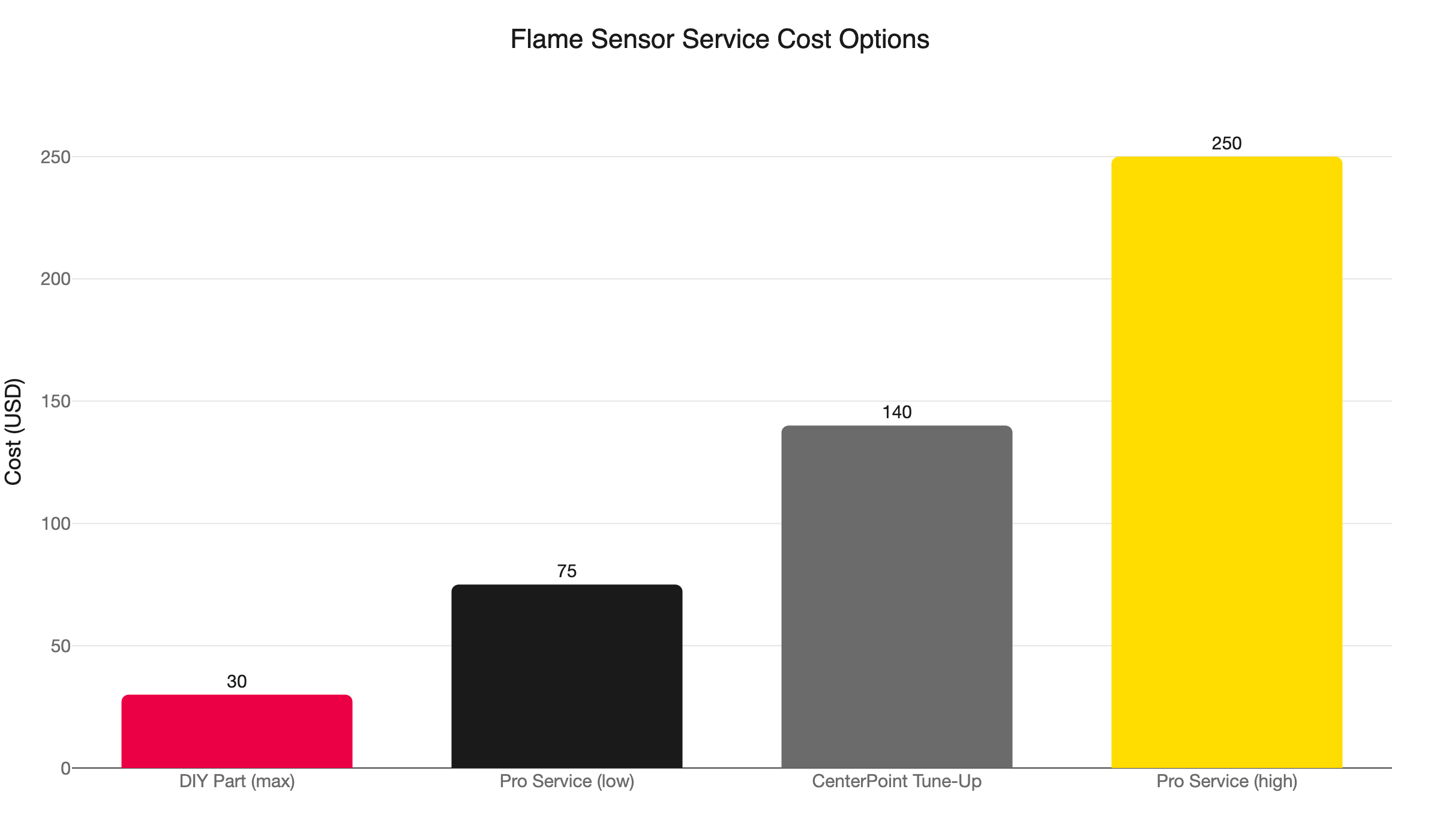
DIY parts run $10-30. Professional service with labor and part runs $75-250. CenterPoint’s Home Service Plus tune-up costs $139.95. It covers a flame sensor inspection as part of a complete furnace check. Minneapolis minor furnace repairs averaged $150-350 in 2026.
Here is how the options compare:
DIY cleaning: Free if you have the tools, about $5 for an emery pad if you do not. Time cost is 20-30 minutes. Best when you can confirm the sensor is the only problem and you are comfortable with the steps above.
DIY replacement: $10-30 for the part, same time investment as cleaning. The right next step when cleaning did not hold through the season.
Professional service call: $75-250 total, covering the visit, labor, and part. Emergency and after-hours calls trend toward the top of that range. Minneapolis minor furnace repairs ran $150-350 in the 2026 market.
CenterPoint Home Service Plus tune-up: $139.95 for a single furnace, available to any Twin Cities or Greater Minnesota homeowner regardless of which gas provider they use. The checklist includes flame sensor condition and replacement recommendation, CO test, burner inspection, heat exchanger visual, and a written report. If you are paying for professional time, a tune-up that addresses the sensor in the context of the whole system is usually a stronger value than a single-component call.
Northern One Hour offers financing on larger furnace repairs and replacements. Ask about it if a service visit uncovers more than a sensor.
When Should You Stop DIYing and Call a Tech?
Call immediately if you smell gas, see soot or scorch marks inside the furnace cabinet, or your CO detector activates. Shut the furnace off and leave the house. Do not attempt any sensor work until a tech has cleared the underlying condition.
Outside those safety thresholds, here is when professional diagnosis earns its cost over continued DIY:
- The furnace short-cycles after a freshly cleaned sensor is reinstalled
- A multimeter reading stays below 1.5 microamps on a cleaned rod
- The furnace has locked out more than twice in a single week
- This is the second flame sensor issue in the same heating season
- The furnace is 15-plus years old and this is a new symptom
That last point matters in Minnesota specifically. Nearly two-thirds of Minnesota homes heat primarily with natural gas. A lot of that equipment has been running since before 2010. An aging furnace with new flame sensor symptoms may be signaling dirty burners or a cracked heat exchanger. A technician can assess those conditions. A sensor rod alone cannot tell you.
A cracked heat exchanger is a safety concern beyond heat loss. If a tech finds evidence of heat exchanger damage during a sensor call, that information matters regardless of how the sensor test resolves.
What If the Sensor Keeps Getting Dirty?
A flame sensor that needs attention more than once per season is a symptom, not the problem. Dirty burners, a cracked heat exchanger, or an improper air-to-fuel ratio each produce excess soot. That soot contaminates the sensor far faster than normal. Clean the sensor without fixing the cause and you will be back in two or three months.
When a technician finds heavy soot on a sensor that was recently cleaned, the evaluation does not stop at the rod. The full assessment covers:
- Burner condition. Dirty or corroded burners produce incomplete combustion. Carbon accumulates faster on everything downstream, including the sensor.
- Heat exchanger integrity. A damaged heat exchanger can disrupt the flame pattern and push the sensor outside its detection zone. Contamination returns sooner than it should.
- Air-to-fuel ratio. A furnace drawing more air than it is calibrated for runs rich on some combustion cycles. More carbon. Faster sensor fouling.
- Filter condition. A clogged filter restricts airflow through the heat exchanger and shifts combustion toward the dirty end of the operating range.
A furnace tune-up addresses the full combustion picture: sensor, burners, heat exchanger, flue, and filter. It is the right tool for a repeat flame sensor problem because it treats the conditions producing the contamination, not just the part that got contaminated.
Book a Furnace Service Before the Next Cold Snap
Minneapolis averages about 13 nights per year below 0°F, with coldest nights reaching -15°F to -20°F. A furnace that short-cycles on a mild January night is an inconvenience. One that locks out during a -15°F stretch is a genuine emergency.
The best time to deal with a dirty flame sensor is before the cold arrives, not at 2 AM with the thermostat reading 58°F.
If your furnace has short-cycled even once this season - even if it reset and ran normally afterward - that is the system telling you something needs attention. A one-time lockout that recovered on its own is not a clean bill of health. It is a warning.
Northern One Hour Heating & Air Conditioning is locally owned and operated in Ramsey, MN. We serve Minneapolis, St. Paul, Blaine, Maple Grove, Plymouth, Brooklyn Park, Woodbury, Bloomington, and the surrounding Twin Cities communities. Every visit is backed by the promise: “Always On Time… Or You Don’t Pay a Dime!(R)” If we say we will be there, we will be there.
Call (763) 260-6662 or schedule a furnace tune-up online. If you are not sure whether the issue is the sensor or something deeper, furnace repair is what our team does. We will diagnose it on the first visit and give you a straight answer on repair versus replacement.
Frequently Asked Questions
How do I know if my furnace flame sensor is dirty? +
Can I clean a furnace flame sensor myself? +
What does a furnace flame sensor do? +
How much does flame sensor service cost in Minnesota? +
Need a technician now?