
Furnace Blinking Light Codes: What Do They Mean?
Key Takeaways
- Carrier, Trane, and Lennox each use a different LED setup. Reading the wrong brand’s guide gives you the wrong answer.
- A slow heartbeat blink on a Trane furnace is normal standby, not an error. Both Lennox LEDs blinking slowly together is also normal.
- Pressure switch codes in a Minnesota winter almost always mean a frozen exhaust vent, not a failed part. Check the pipe outside before calling.
- High-limit codes (overheating) usually clear with a filter change. Reset once, then watch.
- Rollout switch codes are never a DIY reset. They signal a possible CO hazard. Shut the furnace off and call.
- Minnesota law requires CO detectors in all homes with fossil fuel appliances. Test yours before heating season.
- We’re locally owned and operated in Ramsey, MN. Our number is (763) 260-6662.
What Do Furnace Blinking Light Codes Actually Mean?
Your furnace’s control board monitors every major component. When something trips, it stores a fault and flashes an LED in a blink pattern. Each pattern maps to a specific problem - dirty filter, blocked vent, failed sensor - so a tech can diagnose fast without guesswork. Some codes you can fix yourself. Others mean shut it down and call.
Every modern furnace has a control board that watches the whole system. It tracks temperature, airflow, pressure, ignition, and flame. When a sensor trips or a safety switch opens, the board stores the fault and signals it on an LED near the blower door.
Think of it like a check-engine light. The car might still run. But the code is telling you something. The difference is sharper with furnaces: some codes clear on their own or with a simple fix. Others signal a potential carbon monoxide hazard that requires immediate action.
Knowing the difference is what this guide is for.
How Do You Read Your Furnace’s Blinking Light Code?
Open the lower furnace panel and find the LED on the control board. Count the flashes before the long pause, then count the flashes after. That two-number sequence is your code. The legend - which maps codes to fault descriptions - is printed on a sticker inside the blower door on most furnaces.
Here’s the step-by-step process.
Find the LED. Remove or open the lower front panel. The LED is on the control board, usually visible immediately. Most furnaces print the code legend on a sticker inside that same door. If yours doesn’t have one, your model number will get you to the right document online.
Count one full cycle. Let the LED run through flashes, long pause, flashes, long pause. Write the numbers down before you look anything up.
Then confirm which brand’s LED system you have. This is the step most online guides skip entirely, and it’s the reason homeowners misread their own furnaces.
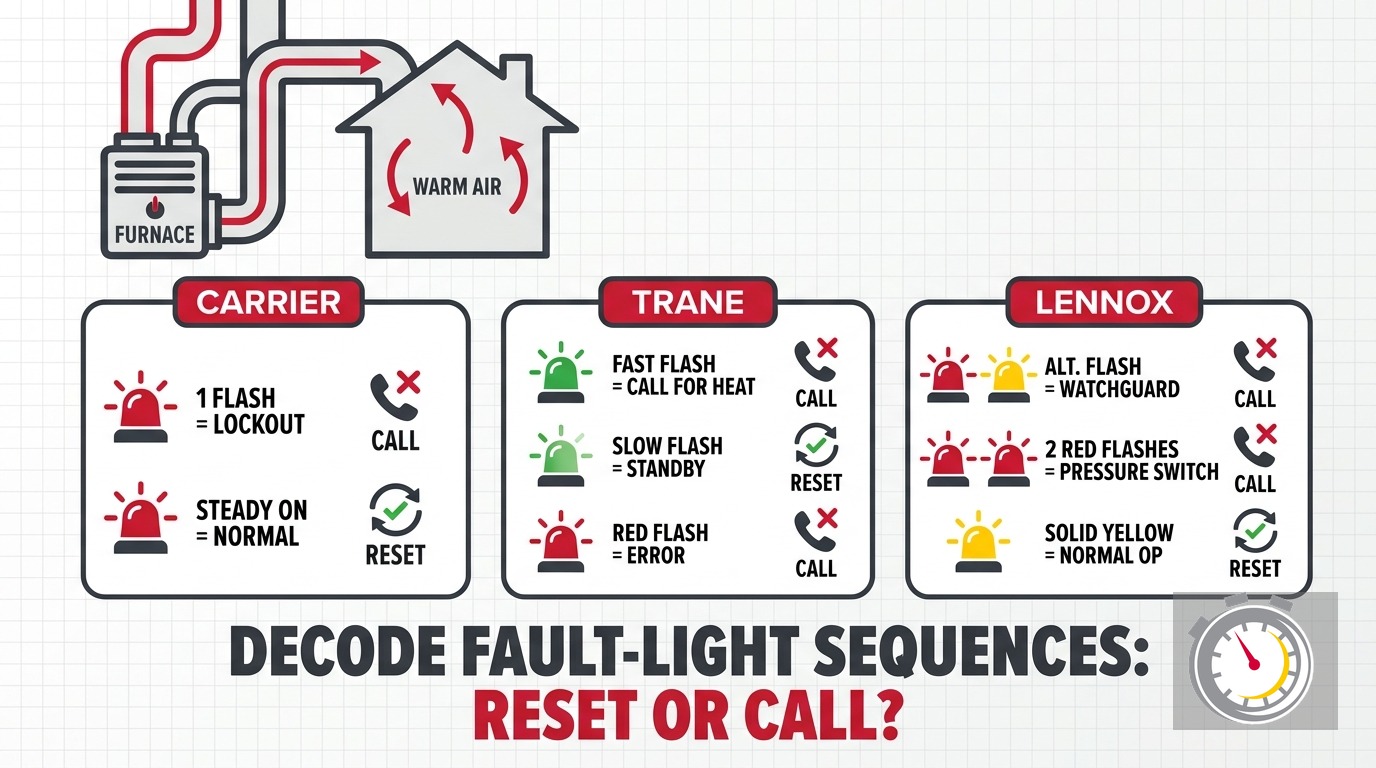
Carrier, Trane, and Lennox Each Use a Different LED System
This is the piece no top-ranking guide covers completely. Using the wrong brand’s code list leads you to the wrong diagnosis.
Carrier uses two LEDs. Yellow flashes are the first digit. Green flashes are the second. Code 33 means 3 yellow flashes, a pause, then 3 green flashes. The full legend is inside the blower door. On Infinity series models, you can pull fault history from the thermostat: Menu > Service > Faults.
Trane uses one red LED. A slow, rhythmic heartbeat pulse is normal standby, not an error code. Many homeowners call for service because they see a blinking light and assume something is wrong. If the blink is slow and steady like a pulse and the house is warm, that’s the furnace doing its job. Actual fault codes blink in counted sequences with a clear long pause between repetitions.
Lennox uses two LEDs - red and green. Here’s the counterintuitive part: both LEDs blinking slowly together means normal operation. It looks like a warning. It isn’t. Any pattern that deviates from that slow, synchronized blink is what you need to read and diagnose.
Carrier Furnace Blinking Light Codes: The Most Common Ones
| Code | Fault | First Step | Call Now? |
|---|---|---|---|
| 13 / 33 | Limit circuit / overheating | Replace filter, open all registers | Only if it repeats |
| 31 | Pressure switch | Check condensate drain and exhaust vent | If vent is clear and code continues |
| 34 | Flame sensor | Clean sensor rod with emery cloth | If it repeats |
| 26 | Rollout switch | Nothing | Yes, immediately |
Code 33 - limit circuit fault. This is the most common Carrier code in Twin Cities homes. A tripped high-limit switch almost always means restricted airflow. Start with the filter. Open every supply register in the house. Switch the furnace power off for 30 seconds, then back on. If the code returns within a day, call.
Code 31 - pressure switch. Before you assume the switch failed, check two things. Look at the condensate drain trap near the base of the furnace - a clogged trap creates the same symptom as a failed switch. Then go outside and look at the exhaust vent. In January, that’s usually where the answer is. More on this below.
Code 34 - flame sensor. The flame sensor is a metal rod that verifies the burner lit. It builds up a mineral coating over time. Clean it with fine emery cloth: gently rub the rod, reassemble, and try again. This is one of the most preventable codes across all three brands, and annual maintenance catches it before it causes a cold-night shutdown.
Code 26 - rollout switch. Flame is detecting outside the combustion chamber. Do not touch the reset button. This is a possible cracked heat exchanger - a CO hazard. Shut the furnace off and call.
Trane Furnace Blinking Light Codes: The Most Common Ones
| Flash Count | Fault | First Step | Call Now? |
|---|---|---|---|
| Slow heartbeat | Normal standby | Nothing | No |
| 3 flashes | Pressure switch / draft inducer | Check vent and condensate drain | If vent is clear and code continues |
| 4 flashes | High-limit / overheating | Replace filter | Only if it repeats |
| 5 flashes | Rollout switch | Nothing | Yes, immediately |
| 9 flashes | High-limit lockout | Nothing | Yes |
3 flashes. Same diagnosis path as Carrier Code 31. Trane high-efficiency furnaces run PVC exhaust vents through low sidewall exits. In cold weather, go outside and look at the pipe before assuming anything is broken.
4 flashes. High-limit trip. Start with the air filter. A dirty or clogged filter is the single most common cause of a 4-flash code. If the filter is fine and the code returns after a reset, you likely have a deeper airflow restriction in the duct system. Call for a diagnostic visit.
5 flashes - rollout switch. Same rule as Carrier Code 26. Possible heat exchanger issue, possible CO. Shut the furnace off and call. Do not reset.
9 flashes - hard lockout. This code requires a professional manual reset after the technician finds and fixes the root cause. Cycling the power repeatedly won’t clear it. Repeated cycling can mask a deeper problem and wear out components faster.
Lennox Furnace Blinking Light Codes: The Most Common Ones
| Pattern | Fault | First Step | Call Now? |
|---|---|---|---|
| Both LEDs slow blink | Normal operation | Nothing | No |
| Red blinking + solid green | Blower motor fault | Call | Yes |
| Red fast + green slow | Reversed polarity | Call | Yes |
| 4 red flashes | High-limit or 24V fuse blown | Replace filter, check fuse | If it repeats |
Both LEDs blinking slowly together. Stop - this is not a fault code. This is Lennox’s normal operating state. The dual-LED system is the most counterintuitive setup of the three brands because both lights blink continuously during normal operation. If both lights blink slowly and the furnace is running, everything is working as designed.
4 red flashes. Overheating or a blown 24V control fuse. Replace the filter first. If the filter is clean, check the 24V fuse on the control board - it looks like a standard car fuse and costs about a dollar at any hardware store. If the fuse keeps blowing after replacement, there’s a short somewhere in the control circuit. Call a technician at that point.
Red blinking + solid green / red fast + green slow. Blower motor and wiring issues. Neither is a homeowner repair. Call.
What Does a Pressure Switch Code Mean in January in Minnesota?
In most cases, it means your exhaust vent is frozen, not that the switch failed. Find the PVC pipe exiting your house. If it’s buried in snow or iced over, clear it carefully. Do not pour hot water on the PVC - thermal shock can crack the pipe and make things much worse.
This is the most Minnesota-specific advice in this guide, and the one that saves the most money on unnecessary service calls.
High-efficiency furnaces vent combustion gases through PVC pipes - usually through a low sidewall exit rather than a chimney. In a Minnesota winter, those pipes sit close to grade where snow accumulates fast. A drift can bury the pipe in hours during a heavy snowfall. An ice cap can form at the opening overnight during a deep freeze.
When that happens, the pressure switch trips. The furnace shuts down. A blink code appears on the LED. But the pressure switch itself is completely fine.
Before you call for service, put your coat on and go look at the pipe. If it’s blocked with snow, clear it by hand or with a broom. If there’s an ice cap, carefully chip it away or let temperatures rise before forcing it. Once airflow is restored, the furnace should restart.
Also check inside: the condensate drain trap. On high-efficiency furnaces, a clogged condensate drain creates the same negative-pressure condition as a failed pressure switch. The drain trap is a small plastic cup or T-fitting near the drain line inside the furnace cabinet. A quick look can save you a substantial diagnostic service call. Check both the vent and the drain before concluding the switch itself has failed.
Should You Reset the Furnace or Call?
Reset once after addressing the root cause - filter changed, vent cleared. Never reset a rollout switch code. Never reset a code that returns immediately after the first reset. If the same code comes back within 24 hours, stop cycling power and call a technician.
Here’s the clean split:
Reset once, then watch:
- High-limit codes - after you’ve replaced a dirty filter and confirmed registers are open
- Pressure switch codes - after you’ve cleared the exhaust vent or condensate drain
- Flame sensor codes - after you’ve cleaned the sensor rod
Do not reset. Call immediately:
- Rollout switch (Carrier Code 26, Trane 5-flash)
- Trane 9-flash hard lockout
- Any code that returns within minutes of a reset
- Any code that coincides with a burning smell or a CO alarm
Repeated resets don’t fix a failing component. They wear out parts faster and can hide a serious safety issue until things fail completely - usually on the coldest night of the year.
When Is a Blinking Light a Carbon Monoxide Emergency?
Rollout switch codes are a possible CO scenario. A cracked heat exchanger can push combustion gases into your living space with no visible sign - no smoke, no smell. If your CO detector sounds, get everyone out immediately. Call 911 first. Then call CenterPoint’s 24-hour gas emergency line.
CenterPoint Energy warns that a cracked heat exchanger can allow carbon monoxide to enter your home without any detectable sign. A rollout switch code - Carrier Code 26 or Trane 5-flash - signals that flame may be escaping the combustion chamber. That’s the condition that leads to heat exchanger damage and CO migration into your living space.
CenterPoint’s 24-hour gas emergency line for the Twin Cities is 612-372-5050 (toll-free: 800-296-9815). If your CO alarm sounds, do not attempt to investigate the source yourself. Get your family outside and call from there.
Minnesota law (Minn. Stat. §299F.50) requires functioning CO detectors in all homes with fossil fuel appliances. Inspectors verify this at permit close. If your detector is more than five years old, test it. If it fails, replace it before heating season.
For a deeper look at what a cracked heat exchanger looks like and how we test for it, see our post on signs of a cracked heat exchanger in Minnesota homes.
Can Annual Maintenance Prevent Most of These Fault Codes?
Yes. Most common codes trace back to root causes a routine tune-up catches: dirty filter, dirty flame sensor, clogged condensate drain, stressed heat exchanger. One annual visit prevents most of the cold-night shutdowns described in this guide.
Our furnace tune-ups include a heat exchanger inspection, flame sensor cleaning, condensate drain check, filter service, and a CO safety check. That one visit catches the conditions behind most of the codes above - before they leave you without heat on the coldest night in January.
It also changes the economics. Replacing a flame sensor during a scheduled tune-up is a very different conversation than replacing it at 11 PM on emergency rates.
What If the Code Points to a Part That Needs Replacing?
If the repair cost is significant and your furnace is 15-plus years old, ask whether repair or replacement makes more sense. Part failures on aging equipment tend to stack. We walk you through both options and current rebate numbers so you can decide with full information.
Some codes - a failed pressure switch, a bad inducer motor, a worn blower motor - do mean a component needs to come out. If the furnace is approaching the end of its useful life, stacking repairs can cost more over three years than a new unit with current rebates applied.
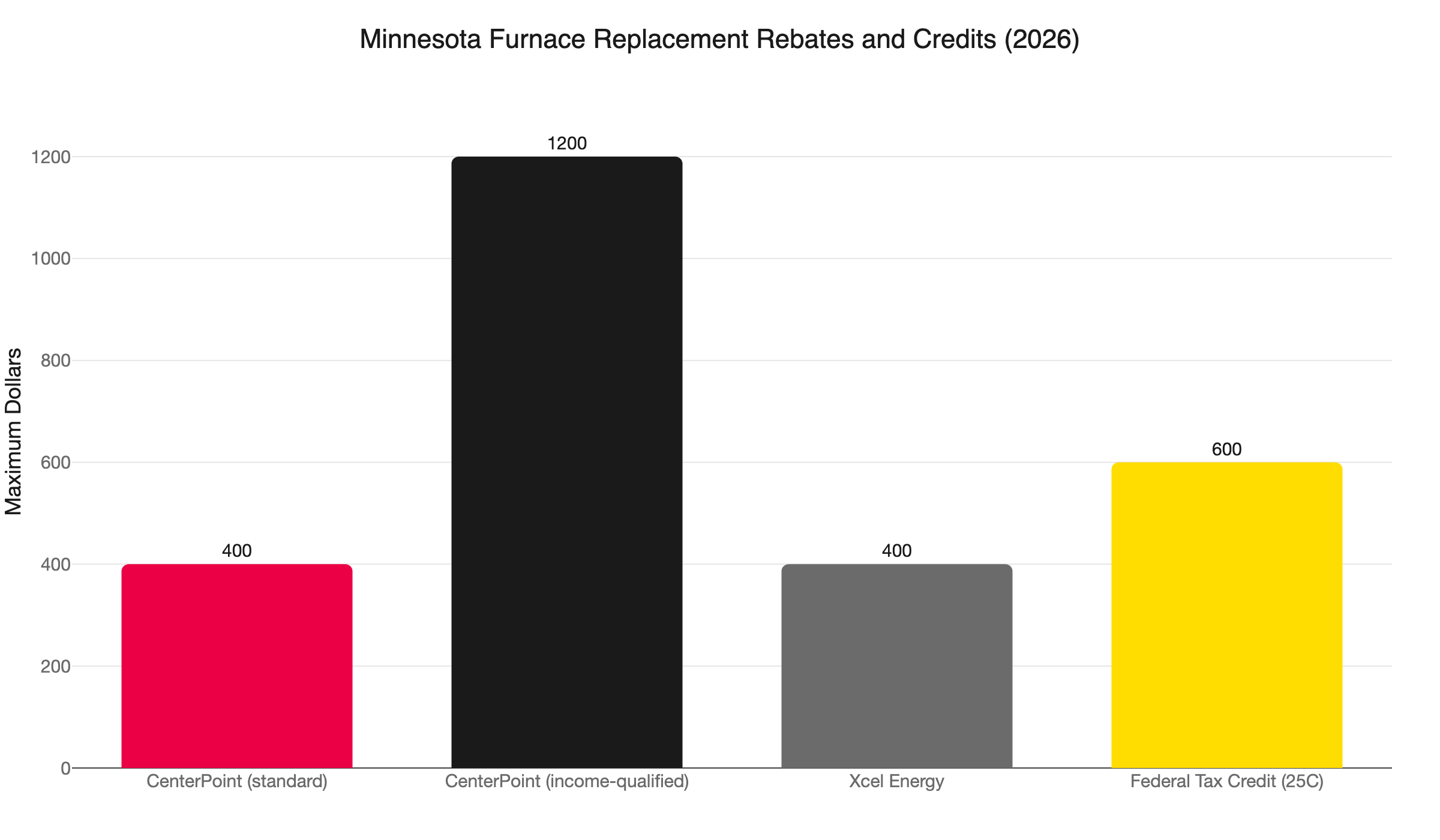
Minnesota homeowners have real money available right now. CenterPoint Energy offers up to $400 on a 95%+ AFUE furnace replacement in 2026, and up to $1,200 for income-qualified households. Xcel Energy offers $200-$400 on qualifying models, and both rebates can stack on dual-fuel systems. The federal Section 25C tax credit covers up to 30% of eligible furnace costs, capped at $600 on your federal return.
We quote every rebate you qualify for when we discuss replacement. Our team serves the Twin Cities from Ramsey - locally owned and operated, with no corporate call center between you and your technician.
For a realistic look at what a new system costs in this market, see our guide on furnace replacement cost in the Twin Cities.
Ready to Stop Guessing About Your Furnace?
If your blink code keeps coming back, if you’re looking at a rollout switch code, or if you simply want a technician to confirm what you’re seeing, we’re ready to help.
We serve Minneapolis, St. Paul, Ramsey, Blaine, Maple Grove, Plymouth, Brooklyn Park, Woodbury, Bloomington, and the surrounding Twin Cities metro area.
Call (763) 260-6662 or schedule a furnace repair visit online. We show up when we say we will. That’s the promise behind “Always On Time… Or You Don’t Pay a Dime!(R)” - and it’s backed by a 100% satisfaction guarantee.
Frequently Asked Questions
Why is my furnace blinking a red light? +
Can I reset a furnace that's showing a blinking error code? +
What does 4 flashes mean on a furnace? +
Need a technician now?