
ERV vs HRV Minnesota: Which Unit Does Your Home Need?
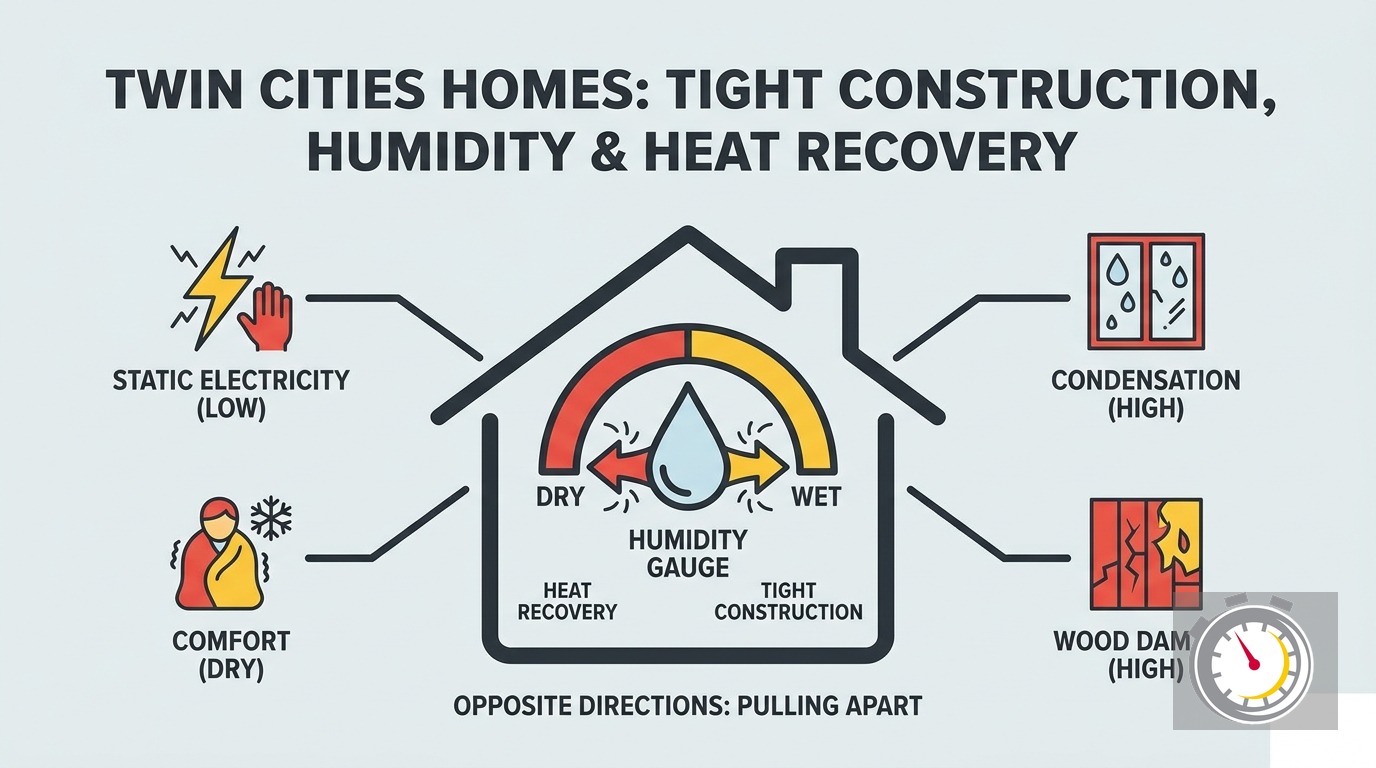
Key Takeaways
- Minneapolis-St. Paul is Climate Zone 6A (cold-humid). Both ERVs and HRVs are designed for this climate. The climate does not pick the winner.
- The real question is not about climate zone. It is about whether your home’s envelope can safely hold indoor humidity above 30% RH during heating season without condensation or frost damage.
- In code-minimum construction with standard double-pane windows, an HRV is the safer choice. It removes excess indoor humidity rather than retaining it.
- In high-performance construction with ACH50 below 2.0 and triple-pane windows, an ERV often makes more sense. It retains moisture in winter and dehumidifies passively in summer.
- Running an HRV and a whole-home humidifier simultaneously is common in Minnesota. It is also self-defeating. Two appliances working against each other.
- At -13°F, an HRV delivers about 60% sensible recovery efficiency. An ERV delivers about 56%. The gap is real but small.
- Minnesota Power offers $300 and Minnesota Energy Resources offers $400 in rebates for qualifying installations.
ERV vs HRV Minnesota: Why Most Contractors Get This Wrong
The ERV vs HRV Minnesota question comes up constantly in new construction and deep-energy retrofits. Most HVAC contractors in the Twin Cities default to recommending an HRV. That is not a bad answer. For most homes, it is probably the right answer.
But the reasoning behind the recommendation matters as much as the recommendation itself. If your contractor cannot explain why an HRV fits your specific envelope, you are not getting the full conversation. The correct unit depends on your home’s construction, not just your zip code.
This post breaks down the real decision framework. It covers what each unit does, where the performance data lands, what Minnesota code requires, and how to figure out which unit actually belongs in your home.
What Is the Difference Between an ERV and an HRV?
Both units do the same core job: they exchange stale indoor air for fresh outdoor air while recovering energy from the outgoing exhaust stream. The difference is what else gets transferred in that exchange.
An HRV - a heat recovery ventilator - transfers sensible heat only. Temperature moves across the core. Moisture does not. When exhaust air leaves your home, it takes indoor humidity with it.
An ERV - an energy recovery ventilator - transfers both sensible heat and latent heat (moisture). Temperature and humidity move across the core together. Indoor moisture stays inside in winter. Outdoor humidity is partially reduced before entering in summer.
That single difference - latent transfer, yes or no - drives the entire decision.
According to Fine Homebuilding’s guide to installing an ERV or HRV, the efficiency gap between comparable units is small. On similar Broan models at 64 CFM, an HRV delivers 68% sensible recovery efficiency at 32°F versus 67% for an ERV. At -13°F, an HRV runs at 60% versus 56% for an ERV. The gap widens in extreme cold. It never becomes decisive.
What separates them is not heat recovery. It is moisture handling.
Why Does Mechanical Ventilation Matter in Minnesota Homes?
Short answer: Tight modern homes trap pollutants. The EPA reports that indoor pollutant concentrations are commonly 2 to 5 times higher than outdoor levels. Minnesota code has required fresh-air ventilation in new residential construction for more than 20 years. Without it, CO2, VOCs, and excess moisture build up inside sealed homes.
Natural infiltration through gaps and cracks once provided adequate air exchange in older homes. Modern construction seals homes tight enough that passive infiltration no longer carries that load.
Climate Zone 6A - where Minneapolis and St. Paul sit - means roughly 7,500 heating degree days and a winter design temperature between -9°F and -16°F. Your mechanical ventilation system runs hard here. Getting the right unit for your envelope is not a small decision.
Minnesota required balanced mechanical ventilation since the early 2000s - well ahead of the national IRC, which only added the requirement for colder zones in 2021 and for Zone 6 in the 2024 code cycle. Minnesota homeowners have been dealing with this choice longer than most.
What Does Minnesota Code Require for Mechanical Ventilation?
Short answer: Balanced mechanical ventilation. The code does not specify an ERV or HRV. Either unit qualifies as long as it delivers the required flow rate: approximately 60 CFM continuous for a 2,500 square foot, four-bedroom home. Your technician sizes the unit to your specific home.
The governing references are IRC Section R403.6.1 for balanced ventilation, Mechanical Code Section M1505.4.3 for ventilation rates, and ASHRAE 62.2 for sizing. Per Fine Homebuilding, a 2,500 square foot, four-bedroom home requires about 60 CFM of continuous balanced airflow under the IRC sizing chart.
The code gives you flexibility. Your home’s design gives you direction.
The Real Decision Gate: Your Home’s Envelope
This is where most ERV vs HRV Minnesota conversations break down. Contractors default to HRV because it is the conservative choice. For most homes, that conservatism is correct. But the reasoning has a boundary.
The question is not: what climate zone am I in? The question is: can my home safely hold indoor humidity above 30% RH during heating season?
At 20°F outdoor temperature with 40% indoor RH, standard windows act as natural dehumidifiers. Moisture migrates toward cold surfaces and condenses. At -35°F - which the Twin Cities has seen during polar vortex events - code-minimum windows will frost shut at elevated indoor RH.
Stack effect makes this worse. Cold-climate physics push interior moisture upward into unconditioned spaces: attics, wall cavities, rim joists. When that moisture contacts cold surfaces, it freezes. Over time, it causes structural damage.
As Northern Built Pro explains in their construction design analysis, an ERV that retains more indoor moisture amplifies this risk when the envelope cannot handle it. The ERV is not a bad unit. It is a unit that requires the right home around it.
Two clear scenarios:
Code-minimum construction: Double-pane windows, ACH50 above 3.0. The home already loses moisture at windows, rim joists, and penetrations. An ERV retaining more of that moisture sends it somewhere you do not want it. An HRV removes the excess and reduces frost and condensation risk. This describes the majority of Twin Cities homes, including many built in the last decade.
High-performance construction: Triple-pane windows, ACH50 below 2.0, continuous air barrier, exterior insulation. The home is tight enough to hold higher indoor RH without fogging windows or loading wall cavities with moisture. In this envelope, an ERV makes sense because the home is designed to support it.
If you are unsure which category your home falls into, our indoor air quality team can assess your situation before making a recommendation.
When Should You Choose an HRV for Your Twin Cities Home?
Short answer: Choose an HRV if your home has standard double-pane windows, was built without aggressive air-sealing measures, or if you already run a whole-home humidifier that works hard all winter. An HRV is the correct tool for the majority of Minnesota residential construction - not a fallback, but the right fit.
The HRV is not a compromise. It manages winter moisture by venting excess humidity with each exhaust cycle. That reduces condensation risk on windows, limits moisture intrusion into wall assemblies, and protects your building envelope over time.
Signs an HRV fits your home:
- Standard double-pane windows throughout
- Visible condensation on windows during cold stretches in January or February
- No blower door test result on file, or ACH50 above 2.0
- The home was not built or marketed as “high performance” or near-passive
- You currently run a whole-home humidifier to keep the air comfortable in winter
For a closer look at how an HRV integrates with your heating system and ductwork, see our post on whole-home HRV ventilation in Minnesota.
When Does an ERV Make Sense for a Minnesota Home?
Short answer: Consider an ERV if your home has triple-pane windows, ACH50 below 2.0, and a continuous air barrier throughout. Also consider it if you want passive summer dehumidification and want to eliminate a separate whole-home humidifier from your equipment plan entirely.
The ERV earns its place in high-performance new builds and deep-energy retrofits. In those homes, the envelope holds higher indoor RH without frost or condensation risk. The ERV keeps that moisture inside in winter rather than expelling it. In summer, it runs in reverse and attenuates incoming outdoor humidity before it enters the conditioned space.
Situations where an ERV is worth a serious conversation:
- The home was built or is being built to passive house or near-passive standards
- ACH50 is confirmed below 2.0 via blower door test
- Triple-pane windows are installed throughout
- A continuous air and vapor barrier is in place
- You want to remove the whole-home humidifier from your equipment plan
The ERV is not a shortcut to comfort. It requires the home to be designed for it. Install an ERV in a code-minimum envelope and you will likely see more condensation on windows in January, not less.
The HRV-Plus-Humidifier Trap
This is the most common avoidable mistake in Minnesota HVAC. A homeowner installs an HRV. The home feels too dry in winter. So they add a whole-home humidifier. Now the HRV exhausts indoor humidity on one end while the humidifier replaces it on the other. Two appliances. Working against each other. Running simultaneously to cancel each other out.
Green Building Advisor’s overview of balanced ventilation with HRVs and ERVs makes this explicit. An HRV transfers sensible heat only. Moisture exits with the exhaust by design. When the home needs indoor RH above 30% for comfort, and the HRV drives it down on every cycle, a humidifier fills the gap.
In a high-performance home, an ERV breaks this cycle. The ERV retains indoor moisture. The humidifier becomes unnecessary. Equipment count drops, maintenance drops, and energy consumption drops.
If you are running an HRV and a whole-home humidifier and both feel essential all winter, that is worth a conversation with your HVAC technician. It may mean the setup is working against itself. Or it may mean your envelope is not tight enough for an ERV to perform as intended. Either way, the answer matters.
Our post on whole-home humidifiers and winter dry air covers how humidifiers interact with your ventilation system and when they are actually necessary versus redundant.
What About Summer Humidity? Does ERV vs HRV Minnesota Performance Change?
Short answer: Yes, significantly. At 89°F with meaningful outdoor humidity, an HRV admits outdoor air with no moisture attenuation. An ERV transfers some incoming humidity back to the outgoing exhaust stream before it enters your home. This reduces the latent load on your air conditioner and keeps indoor air more comfortable without the AC working harder.
The Twin Cities cooling design temperature is roughly 89°F. The summer is warm and meaningfully humid. An HRV admits that air with no pretreatment. Your air conditioner then removes the latent load it carries in.
An ERV runs in reverse in summer. Incoming humid outdoor air gives up moisture to the outgoing drier exhaust stream. Less humidity enters the conditioned space. Your air conditioner works less for the same indoor comfort level.
For homeowners whose homes feel sticky in summer even when the AC is running, your ventilation strategy is worth reviewing. See our post on why your home feels humid in spring and how AC systems help control it for more on latent load and summer comfort management.
Are There Rebates for ERV or HRV Installation in Minnesota?
Short answer: Yes. Minnesota Power offers $300 and Minnesota Energy Resources offers $400 for qualifying installations. The federal 25C tax credit expired December 31, 2025. Minnesota state HEAR and HOMES rebates are pending federal approval and are not yet available as of August 2026.
Rebate details as of August 2026:
- Minnesota Power: $300 for an ERV or HRV with sensible recovery efficiency (SRE) of 60% or higher at 32°F. Must use a participating contractor. Install by December 31, 2026.
- Minnesota Energy Resources: $400 for a qualifying ERV or HRV. Confirm current requirements with a participating contractor before purchase.
- Xcel Energy / CenterPoint: No confirmed ERV or HRV rebate amount in current published materials. Their conservation programs focus primarily on furnaces and heat pumps. Contact them directly to verify.
- Federal 25C credit: Expired December 31, 2025. Not available for 2026 installations.
Stacking a state utility rebate with a well-selected unit can meaningfully offset installation cost. Ask your contractor about current eligibility when you schedule the consultation.
How Do You Choose Between an ERV and HRV for Your Home?
You do not need to resolve every technical detail before calling a contractor. But walking in with three pieces of information puts you in a much better position.
1. Window type. Double-pane or triple-pane? Triple-pane windows can hold higher indoor RH without fogging or frosting in Minnesota winters. This is the most visible signal of envelope performance.
2. Blower door test result. ACH50 above 3.0 indicates a leaky envelope. Below 2.0 indicates a tight one. If you do not have a blower door result from construction, assume standard territory and lean toward an HRV.
3. Existing equipment. Do you run a whole-home humidifier? If yes, and your home is reasonably tight, an ERV conversation is worth having. If the humidifier is running constantly against a leaky envelope, the HRV remains the right call.
The short version: if your builder used the words “high performance,” specified triple-pane windows, and installed a continuous air barrier, ask about an ERV. Otherwise, the HRV is almost certainly the right unit.
Either unit, sized correctly and installed by an experienced team, will improve your indoor air quality, satisfy Minnesota code, and recover a meaningful portion of your heating energy. The difference between them matters most at the edges of construction quality, not in typical installations.
Schedule a Ventilation Consultation
We are locally owned and operated in Ramsey, MN, and we serve homeowners across Minneapolis, St. Paul, Blaine, Maple Grove, Plymouth, Brooklyn Park, Woodbury, Bloomington, and the surrounding Twin Cities area. Our team installs and services both ERV and HRV systems and can assess your home’s envelope before recommending a unit.
Call us at (763) 260-6662 or book online to schedule a consultation. We show up when we say we will - “Always On Time… Or You Don’t Pay a Dime!(R)”
Frequently Asked Questions
What is the main difference between an ERV and an HRV? +
Which is better for Minnesota homes, an ERV or an HRV? +
Are there rebates for ERV or HRV installation in Minnesota? +
Need a technician now?