
Condo HVAC Options Twin Cities: What HOAs Actually Allow
Key Takeaways
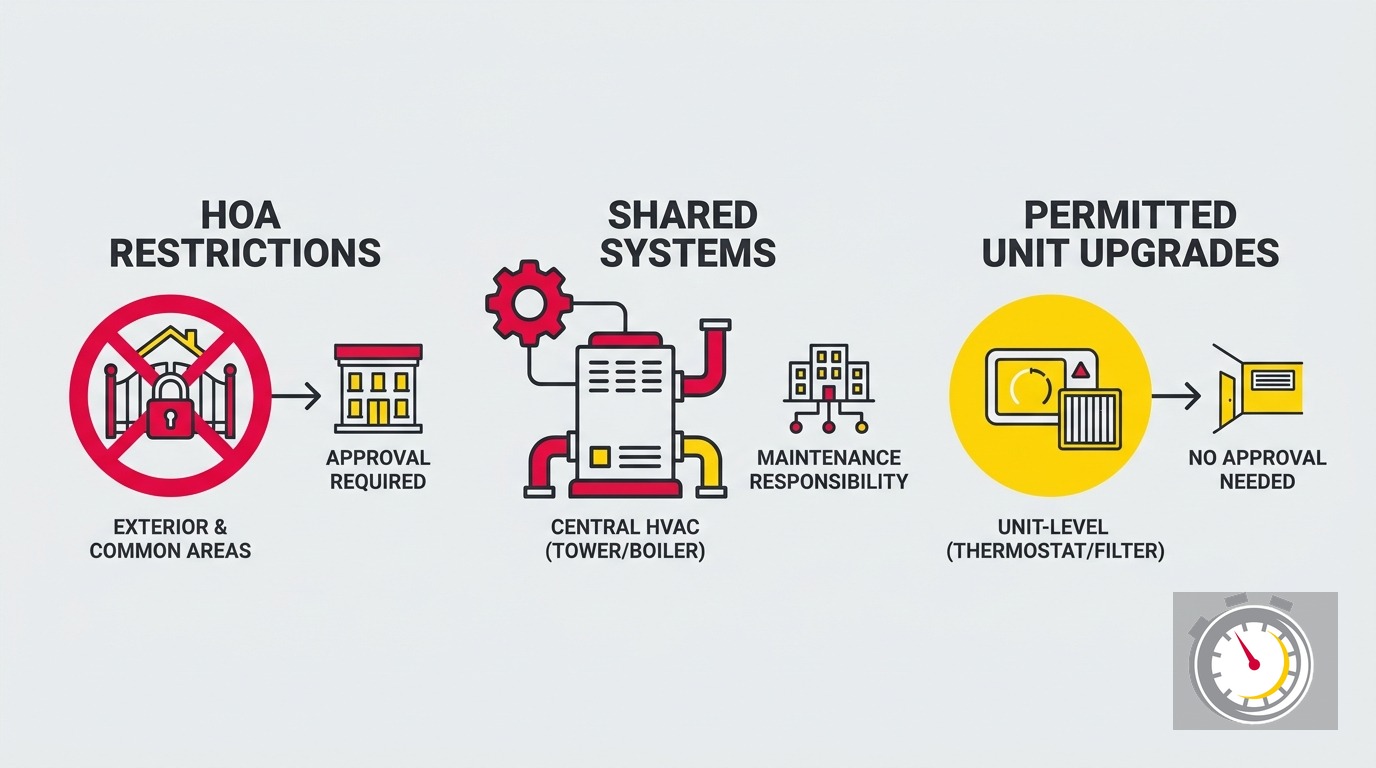
- Equipment inside your unit (furnace, air handler, thermostat, interior ductwork) is almost always the owner’s responsibility. Most HOAs do not require approval for interior mechanical replacements.
- Exterior modifications (condensers, exterior wall penetrations, visible line sets) typically require HOA approval and may be restricted by CC&Rs.
- Window AC units are the most commonly banned HVAC category in condo rules. Interior-only alternatives like ceiling cassette mini-splits sidestep most appearance restrictions.
- Cold-climate mini-splits can maintain rated heating capacity to -13°F when they carry NEEP ccASHP certification. Backup heat is still standard practice for Minnesota’s coldest stretches.
- In 2026, Xcel Energy offers up to $2,000 for a qualifying cold-climate mini-split. This rebate does not require a participating contractor.
- Federal 25C and 25D energy tax credits expired December 31, 2025. Do not build your budget around them.
- Every furnace replacement, AC installation, and heat pump installation in Minnesota requires a mechanical permit, including work in condominiums.
Sorting out condo HVAC options in the Twin Cities is harder than it should be. Your building has restrictions. Your HOA has opinions. And what a board can actually enforce is rarely the same as what it says it can enforce.
This post is written for the unit owner who already knows the building has rules. You want to know exactly what you can do without board approval. You want to know what requires a permit. And you want to know what money is still on the table in 2026.
Who Controls What Inside a Condo?
Most condo declarations follow a clear boundary: what is inside the unit is the owner’s responsibility, and what is outside or shared by the building is the HOA’s. Your furnace, air handler, thermostat, and interior ductwork fall to you. Condensers, exterior wall penetrations, and shared building ductwork fall to the association.
Minnesota condominiums created after June 1, 1994 are covered by Minn. Stat. Ch. 515B, the Minnesota Common Interest Ownership Act. The statute defines the boundary between unit and common element. Older associations may opt in voluntarily. Your declaration should specify exactly where that line falls for your building.
What the HOA typically polices is appearance and noise. Visible exterior equipment and decibel levels are the two areas where boards have clear authority. What is inside the unit, behind drywall, or not visible from the exterior or common areas generally does not require board approval. Unless your declaration explicitly says otherwise.
The practical implication: if you want to replace your furnace with a like-for-like unit, use the same flue pathway, and keep all work within your unit’s walls, you can likely proceed after pulling a mechanical permit. No HOA meeting required. No architectural committee application.
Some associations have CC&Rs written in the 1980s or early 1990s. The language describing “alterations” or “modifications” predates ductless mini-splits, heat pump water heaters, and modern IAQ equipment. A board applying a rule from 1993 may be applying it to technology that did not exist when the rule was written. Knowing the vintage of your governing documents informs how you approach the board conversation.
What Can You Change Without Board Approval?
Interior-only changes that do not alter the building’s exterior or connect to shared systems usually fall within owner authority. A like-for-like furnace replacement rarely requires board approval. The same is true for a thermostat swap or air handler replacement. Complexity starts when the new equipment changes how venting exits the building.
A high-efficiency condensing furnace (90%+ AFUE) requires PVC exhaust venting and condensate drainage that differ from the flue pipe a mid-efficiency unit used. Swapping from an 80% to a 96% furnace is not a like-for-like install; inspectors verify the venting change. If that new venting runs through a shared shaft or penetrates an exterior wall, you may need HOA sign-off before the city issues the permit.
The condensate from a high-efficiency furnace also needs somewhere to go. In a condo, that drain line must run inside the unit or connect to a shared drain. A contractor familiar with condo installations knows how to route condensate without violating building rules or creating moisture problems.
Interior ductwork changes that stay entirely within your unit are generally yours to modify. Changes that touch shared ductwork or a common plenum cross into HOA territory.
The safest approach: pull the permit first. Let the mechanical inspector’s scope define what the work touches. If the work triggers an HOA conversation, you have a clear technical description to bring to the board rather than a vague request.
Condo HVAC Options Twin Cities Owners Can Actually Install
Here is where condo owners across Minneapolis, St. Paul, Ramsey, Maple Grove, Blaine, Plymouth, Brooklyn Park, and Woodbury have more choices than they often realize.
Furnace replacement
If your condo has a gas furnace and a dedicated flue, replacing it with a higher-efficiency unit is usually straightforward. The permit process is the same as in any single-family home. HOA complexity arises only when the new venting path changes something exterior-facing.
Pair a new furnace with a smart thermostat and you gain meaningful efficiency and comfort control without touching anything the HOA can see. See our guide on ductless mini-splits in older Twin Cities homes for context on how building age and layout affect equipment choices.
Ductless mini-splits
A ductless mini-split has two parts: an indoor air handler and an outdoor condenser connected by a refrigerant line set. The line set runs through a small wall penetration, typically two to three inches in diameter.
The HOA generally cannot restrict what is inside your unit. The condenser and the wall penetration are where restrictions apply. But HOA authority over HVAC almost always comes from “exterior modification” or “architectural change” clauses written before ductless systems existed. A board applying a 1998 rule may be applying it to technology it never contemplated.
Concealed configurations reduce or eliminate the exterior-visibility concern:
- Ceiling cassette: Recessed flush into the ceiling. Fully hidden from the street, courtyard, or any common area.
- Floor-mount (recessed): Set low on an interior or rear-facing wall near the floor.
- High-wall unit on interior or rear walls: Not visible from the parking lot, street, or exterior common areas.
A written proposal with photos of the planned configuration and condenser location often resolves HOA concerns faster than a verbal request. Boards respond better to specifics than to general descriptions.
Air handler or fan coil replacement
If your building provides centralized chilled water or hydronic heating, you likely have a fan coil unit inside your unit. Replacing that unit is entirely interior work. No outdoor condenser, no refrigerant permit, no exterior penetration. This is one of the cleanest upgrade paths available in a multi-story condo building.
Indoor air quality (IAQ) upgrades
Whole-unit air purifiers, MERV-13 or better filtration upgrades, and humidity control devices that connect to your existing air handler are all interior-only changes. No HOA approval is needed. These upgrades matter more in a sealed, multi-unit building than in a single-family home. Units share ventilation shafts. Odors and particulates travel. A high-efficiency filter or whole-unit purifier gives you control over the air inside your unit without touching any shared system.
What About Window AC Units?
Window AC units are the most commonly banned HVAC category in condo CC&Rs, and those bans are generally enforceable when the building has any alternative cooling option available. If your building has central cooling or permits ductless systems, the board has standing to enforce a window unit prohibition.
If your building has no cooling at all and you have no alternative, enforcement becomes more complex. That question is for an HOA attorney, not an HVAC technician.
The practical answer for most Twin Cities condo owners: a single-zone ductless mini-split is a cleaner, quieter, and more efficient alternative to a window unit. The concealed configurations described above make it HOA-acceptable even in buildings that prohibit window units outright. You get better cooling performance, no window obstruction, and no seasonal installation and removal hassle.
Will a Mini-Split Work If the HOA Won’t Allow Exterior Equipment?
If your HOA categorically prohibits exterior condensers on the building, a traditional split-system mini-split is not an option. Alternatives include portable air conditioners (self-contained, exhaust through a removable window kit, no wall penetration), fan coil unit upgrades if the building has a central chilled water loop, and heat pump water heaters that reduce cooling load without any outdoor equipment.
Portable AC units are less efficient than mini-splits and considerably louder. But they require no wall penetration and no outdoor equipment. Most HOAs allow them because the window kit is removable and leaves no permanent mark on the building.
If a condenser on an exterior wall is the sticking point but the board has not banned all exterior equipment entirely, ask specifically about rooftop placement, a mechanical room, or a shared equipment pad if the building has one. The answer depends on building design and the governing documents.
Can a Heat Pump Handle Minnesota Winters in a Condo?
Yes, with the right equipment and a backup heat source. Cold-climate heat pumps with NEEP ccASHP certification maintain rated heating capacity to -13°F. Minneapolis-Saint Paul sits in IECC Climate Zone 6 with a 99% heating design temperature of approximately -16°F. Backup resistance or gas heat remains standard design practice to cover that gap on the coldest Minnesota days.
A dual-fuel setup works well for condo owners who have both gas and electric service. The heat pump handles the vast majority of heating hours. The furnace covers the coldest stretches of winter. The system switches automatically based on outdoor temperature.
For more detail on how cold-climate heat pumps perform when temperatures drop well below zero, see our post on heat pump performance in below-zero Minnesota conditions.
The condo-specific consideration is condenser footprint. Heat pump condensers are typically similar in size to a standard AC-only condenser. If your HOA has already approved a traditional AC condenser at your unit, a heat pump condenser should fall under the same approval category. Bring the equipment specifications to your HOA application so the board can compare dimensions directly.
What 2026 Rebates Are Available for Condo Owners?
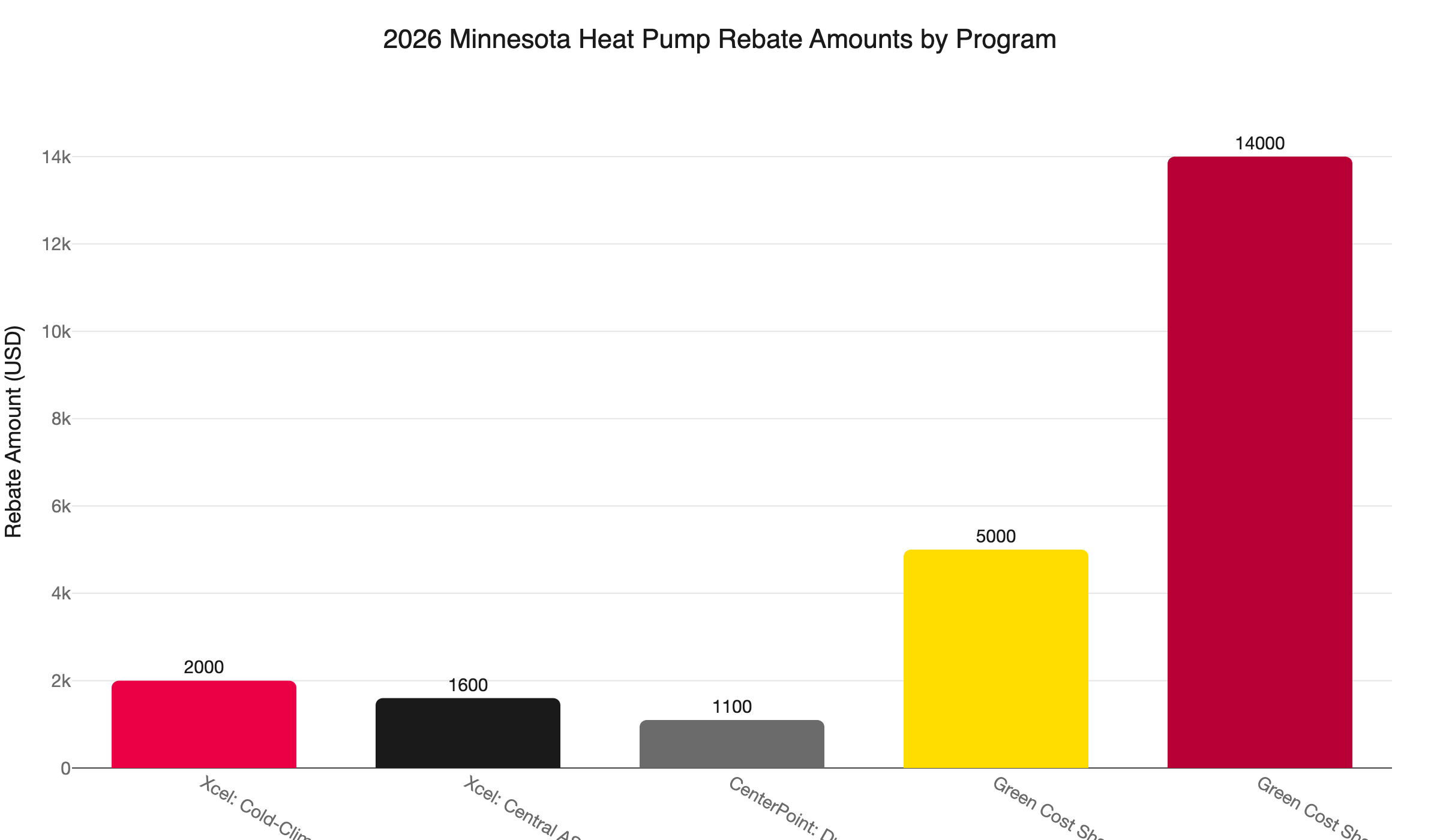
Xcel Energy’s 2026 heat pump rebates offer up to $2,000 for a qualifying cold-climate ductless mini-split, with no participating-contractor requirement. CenterPoint offers $1,100 for a qualifying dual-fuel ASHP with a 92%+ AFUE gas furnace as backup. Minneapolis homeowners can add the Green Cost Share program on top. Federal 25C and 25D credits expired December 31, 2025, and no replacement exists.
Xcel Energy
For Xcel customers, a qualifying cold-climate ductless mini-split earns $2,000. A central cold-climate ASHP earns $1,600 (combo gas and electric customers) or $1,100 (electric-only customers). Critically, the mini-split rebate does not require installation by a participating contractor. Central system rebates do. For condo owners who want full flexibility in contractor selection, that distinction matters.
CenterPoint Energy
CenterPoint’s 2026 program offers $1,100 for a ducted ASHP installed as a dual-fuel system paired with a 92%+ AFUE gas furnace at a 40°F switchover setpoint. CenterPoint does not rebate mini-splits or heat pumps that replace gas heating entirely.
Stacking rebates
If you have both Xcel electric and CenterPoint gas service, a qualifying dual-fuel system can stack both programs for a combined $3,100 before any local programs are added.
Minneapolis Green Cost Share
Minneapolis homeowners can apply the Minneapolis Green Cost Share program on top of utility rebates. The program offers up to $5,000 outside a designated Green Zone, or up to $14,000 inside a Green Zone, for qualifying 1-4 unit residential properties. You must qualify for an Xcel or CenterPoint rebate first. Funding is first come, first served.
What is gone in 2026
Federal 25C and 25D energy tax credits expired December 31, 2025. The One Big Beautiful Bill Act, signed July 4, 2025, ended both credits nine years early. No replacement credit exists for equipment installed in 2026 or later. Older articles referencing a 30% federal credit are out of date.
Xcel gas furnace rebates also ended January 1, 2026. A furnace-only upgrade earns no utility rebate this year.
The Minnesota HEAR program (Save Energy Minnesota) has not launched as of August 2026. No retroactive rebates are permitted. Work completed before the program launches will not qualify.
For a full breakdown of what is currently stackable in Minnesota, see our post on Minnesota heat pump rebates and how they work.
Do You Need a Permit for Condo HVAC Work?
Minnesota law requires a mechanical permit for every furnace replacement, AC installation, heat pump installation, and significant ductwork change, including work in condominiums. This is not optional and is not waived because you are in a multi-unit building. Unpermitted work can block a real estate transaction, trigger an insurance denial, and create complications with your HOA if the installation is ever questioned.
Three specific problems come with skipping the permit:
- Real estate transactions. A failed inspection at resale can require removal of unpermitted equipment or kill the transaction.
- Insurance claims. Insurers can deny a claim if the triggering equipment was installed without a permit.
- HOA documentation. A permit creates a paper trail that the work met code. No permit means no documentation if the board ever challenges the installation.
The permit also protects you during the work itself. A licensed contractor pulls the permit. A city mechanical inspector verifies the installation meets Minnesota’s mechanical code. You get official documentation that the equipment is safe. For high-efficiency condensing furnaces, the inspector specifically checks that PVC exhaust venting and condensate drainage are installed correctly. That matters for your safety and for the equipment warranty.
For a full rundown of what triggers a mechanical permit in Minnesota, see our post on when HVAC permits are required in Minnesota.
How Northern One Hour Helps You Navigate Condo HVAC Options in the Twin Cities
We are locally owned and operated out of Ramsey, MN. We serve Minneapolis, St. Paul, Blaine, Maple Grove, Plymouth, Brooklyn Park, Woodbury, Bloomington, and the surrounding metro communities. When you call us, you are talking to someone who knows what city inspectors in your jurisdiction check, what condo-specific venting challenges look like, and what HOA conversations we have had on similar buildings before.
Condo HVAC in the Twin Cities requires a different approach than a standard single-family job. We size systems correctly for individual units. We handle the permit paperwork. We coordinate with your HOA when approval is required. We schedule around the inspection and stay until the job passes.
The rebate landscape also changes fast. Stack Xcel and CenterPoint rebates on a qualifying dual-fuel system and you reach $3,100 in utility rebates. Add the Minneapolis Green Cost Share on top, and the total can climb significantly higher. We will walk through every program that applies to your specific address before you commit to a system.
Our promise: “Always On Time… Or You Don’t Pay a Dime!(R)” Backed by a 100% satisfaction guarantee and transparent, upfront pricing, we aim to make an already-complicated situation as straightforward as possible.
Ready to talk through your options? Call us at (763) 260-6662 or book online to schedule your assessment. We will give you a clear path forward.
Frequently Asked Questions
Can a condo owner replace their furnace without HOA approval in Minnesota? +
Does Xcel Energy rebate ductless mini-splits in 2026? +
What HVAC work requires a permit in a Minnesota condo? +
Are federal tax credits available for condo HVAC upgrades in 2026? +
Need a technician now?