
Why Does My AC Smell Bad? Your Twin Cities Odor Guide
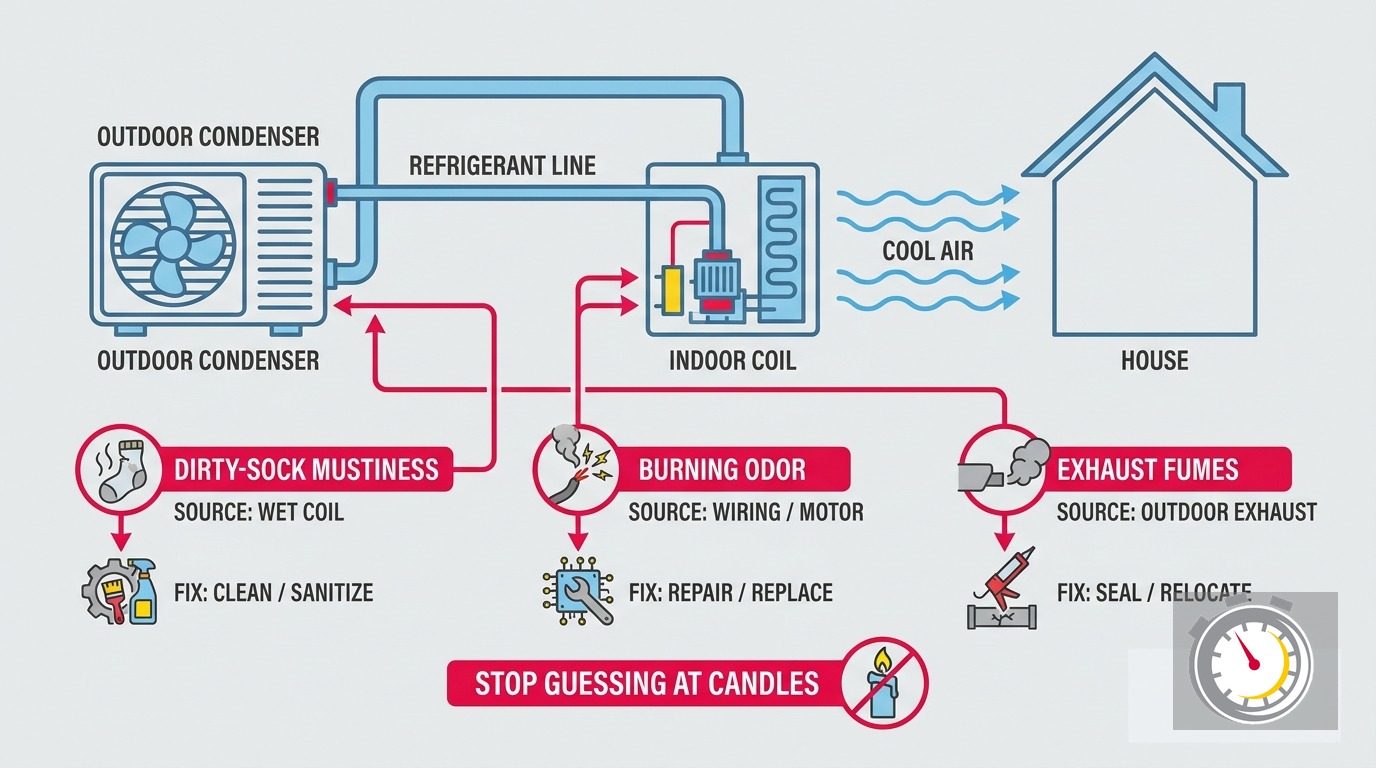
Key Takeaways
- A musty or dirty-sock smell means mold or bacteria on your evaporator coil or condensate pan. Schedule a professional coil cleaning.
- A dusty burning smell on the first run of the season is normal. It clears within 20 to 30 minutes.
- A burning plastic, rubber, or chemical smell that lingers past one run cycle means a motor, capacitor, or wiring problem. Shut the system off and call.
- A sharp, strong burning smell with possible smoke or a buzzing sound is a fire hazard. Shut off at the thermostat and the breaker. Call immediately.
- A sweet or faintly chemical smell, like nail polish remover or ether, usually signals a refrigerant leak. Shut off, ventilate, and call an EPA-certified technician.
- Minneapolis summer humidity regularly averages 70 to 82%, which makes coil mold more likely here than in most of the country.
What Is That AC Smell Trying to Tell You?
Your nose is a better diagnostic tool than most people realize. Each AC odor maps to a specific component. Each component has a specific urgency level. Some smells clear on their own in under 30 minutes. Others mean shut the system off before you finish reading this.
This guide gives you the direct answer for each odor: which part is responsible, why it smells that way, what Minnesota’s climate does to make it worse, and the one action to take in the next 60 seconds.
Why Does My AC Smell Musty or Like Dirty Socks?
That sour, locker-room odor from your vents is mold or bacteria growing on your evaporator coil or in the condensate drain pan underneath it. The EPA identifies HVAC cooling coils and condensate drain pans as prime sites of microbial amplification. Running the system longer does not clear it. A professional coil cleaning does.
The component responsible: the evaporator coil
Your indoor air handler holds the evaporator coil. Refrigerant flowing through it gets cold. Warm household air passes over the coil. Moisture condenses onto the coil surface and drips into a drain pan below.
That warm, dark, wet environment is ideal for microbial growth. When the blower runs, air moves across the contaminated coil and carries the odor into every room. This is not a cosmetic nuisance. Mold on HVAC coils can produce allergens, irritants, and potentially toxic mycotoxins, per EPA mold guidance.
Why the smell peaks in spring: dirty sock syndrome
The first cooling cycles of the season are almost always the worst. Over winter, organic matter accumulates on the coil. Dust, skin cells, and pet dander build up on the coil surface while the system sits idle.
Then spring arrives. Condensation begins again. That warm, wet environment triggers a bloom of mold and bacteria in the accumulated organic layer. HVAC technicians call this dirty sock syndrome.
An oversized system makes this significantly worse. A unit that is too large for the space short-cycles. It drops air temperature quickly, shuts off before completing a full dehumidification cycle, and leaves the coil damp almost continuously. Mold keeps growing. The smell keeps returning. If yours is a recurring, year-over-year problem, oversizing may be the actual root cause.
The Minnesota angle on musty AC smells
The EPA recommends keeping indoor humidity below 60%, ideally between 30 and 50%, to prevent mold and bacterial growth. Hitting that target in a Twin Cities summer is a real challenge.
Minneapolis averages 67% relative humidity annually. Summer daily averages run 70 to 82%, with morning peaks near 90% on heavy dew-point days. Summer 2026 has brought near-tropical dew points to the metro. Your AC is pulling a serious dehumidification load every time it runs.
On the most humid days, the evaporator coil may never fully dry between cycles. Microbial conditions stay favorable all season.
What to do about a musty smell
Do not mask it with candles or air freshener. The odor signals a live microbial problem. The particles that cause it are moving through your vents and into your lungs.
Schedule a professional coil cleaning. A technician will clean the evaporator coil surface, flush the condensate drain pan, and inspect the drain line for blockages. If the drain line is backed up, standing water in the pan accelerates mold growth. Our guide on fixing a clogged AC condensate drain line covers what that looks like and how it is repaired.
For recurring mold problems, a whole-home dehumidifier is the most effective long-term answer. Holding indoor humidity in the 30-to-50% range year-round slows regrowth between service visits and makes the whole house more comfortable during Minnesota’s humid summers.
Why Does My AC Smell Like It’s Burning?
Burning smells fall into three distinct tiers. Tier one is harmless dust burn-off that clears in under 30 minutes. Tier two is a motor or capacitor problem that needs a technician before the next run. Tier three is melting wire insulation: a fire hazard. Shut the system off at the thermostat and breaker. Call immediately. The character and persistence of the smell tell you which tier you are in.
Tier 1: Dusty burning smell on the first run of the season
If you switch the AC on for the first time after months of disuse and catch a faint, dusty burning odor, you are almost certainly in tier one. Dust settles on the blower wheel and internal components over the off-season. When the system runs, that layer burns off.
The smell typically clears within one complete run cycle. That is roughly 20 to 30 minutes. If it is gone by then, no action is needed. Open a window if the smell bothers you. Do not shut the system off in an attempt to stop it. That just delays the same burn-off until the next startup.
Tier 2: Lingering plastic, rubber, or chemical burning smell
If the smell does not clear after one cycle, or if it smells more like melting plastic than dusty heat, the source is likely the blower motor or the run capacitor. A motor running hot due to worn bearings emits a plastic-adjacent smell. A failing capacitor often produces a chemical, rubbery odor before it gives out.
This smell does not resolve on its own. Running the system risks turning a part replacement into a full component failure. See our guide on bad AC capacitor symptoms and costs in the Twin Cities for what the early warning signs look like and what repairs typically run. Shut the system off until a technician checks it.
Tier 3: Sharp burning smell with smoke or buzzing - emergency
A sharper, stronger burning smell, possibly accompanied by visible smoke, a buzzing or crackling sound, or a tripped circuit breaker, points to electrical wiring. Wire insulation melts before it ignites. The window between a warning sign and a house fire is short.
The Fire Marshals Association of Minnesota is explicit: a burning or rubbery smell from an appliance warrants a call to a professional. Electrical distribution equipment is the top source of direct property damage from residential structure fires in Minnesota. Electrical fires account for 7.9% of all Minnesota structure fire causes.
Shut the system off at the thermostat. Go to the electrical panel and shut off the circuit for the air handler. Then call. Do not reset the breaker and try again.
Why Does My AC Smell Sweet or Like Chemicals?
A sweet, faintly chemical odor, often described as nail polish remover, ether, or a chemistry-classroom smell, is the signature of a refrigerant leak. This is not a schedule-it-when-convenient situation. Refrigerant displaces oxygen in a confined space and at elevated concentrations has serious health consequences. Shut the system off. Open windows and doors to ventilate. Then call a technician.
The component: refrigerant lines and the evaporator coil
Refrigerant circulates between the outdoor condenser unit and the indoor evaporator coil in a sealed loop under pressure. When that loop develops a crack or fitting failure, refrigerant escapes as a gas.
The compound itself is nearly odorless in trace quantities. Contaminants and decomposition byproducts give it a distinct sweet-chemical character. Not everyone describes it identically. Some say it smells faintly sweet. Others say it smells like cleaning chemicals or airplane glue. If it is unfamiliar and slightly sweet, treat it as a refrigerant leak until a technician confirms otherwise.
Health effects you need to know
R-410A, the refrigerant in most systems installed before 2025, has documented health effects at elevated concentrations. According to the R-410A Safety Data Sheet, when oxygen is displaced to between 12 and 14% in a confined space, symptoms include loss of coordination, rapid pulse, and deeper respiration. At high concentrations, cardiac arrhythmia is a documented risk.
Ventilate first. Open windows and exterior doors. Get anyone showing symptoms outside. Then shut off the system.
What the law says about refrigerant
Refrigerant venting is illegal. The U.S. Department of Energy is clear: only EPA-certified technicians may service refrigerant systems. Do not attempt to locate, seal, or work around a refrigerant leak yourself. It is not a DIY repair.
Other signs a refrigerant leak is the culprit
A leak rarely shows up as an odor alone. Watch for:
- Ice on the refrigerant lines or on the indoor evaporator coil
- Reduced cooling output even with the system running continuously
- Higher-than-expected electricity bills
- Longer run cycles to reach setpoint
These symptoms plus an unusual sweet smell are a strong cluster. Call our team and describe what you are seeing. We can help you triage over the phone before dispatch.
Is It Safe to Keep Running My AC When It Smells?
It depends entirely on which smell. The dusty burn-off during the first 20 to 30 minutes of the season is safe to run through. Every other persistent odor in this guide, including musty, lingering burning, and sweet-chemical, means stop and call before running the system again.
Running a system with a refrigerant leak concentrates the gas indoors and risks destroying the compressor. Running a system with a burning electrical smell is a fire risk. Running a system with mold on the coil pushes allergens and mycotoxins into your living space with every cycle.
None of those risks are worth a warm house for a day or two while you wait for a technician. When you are unsure which category applies: shut the system off. It is always the lower-risk choice.
Why Is This Problem Worse in a Minnesota Summer?
Minneapolis and the Twin Cities metro run some of the highest summer humidity in the continental United States. That sustained moisture load keeps evaporator coils wet longer, feeds dirty sock syndrome, and makes it harder for any AC system to hold indoor humidity in the safe 30-to-50% range, even a well-maintained one.
Minneapolis summer daily humidity averages 70 to 82%, with morning peaks near 90% on heavy dew-point days. Your evaporator coil is pulling a heavier dehumidification load than it would in most other U.S. markets.
The practical consequence is that annual coil cleaning is not optional maintenance for most Twin Cities homes. It is the baseline that keeps indoor air quality in a safe range. If your system was oversized at installation, short-cycling means the coil never completes a full dehumidification pass. The coil stays damp. Dirty sock syndrome returns every spring. More cleaning helps, but right-sizing at replacement is the actual fix.
Pair annual maintenance with a whole-home dehumidifier and you hold indoor humidity in the safe zone year-round. That reduces mold growth, improves comfort on the heaviest humidity days, and takes strain off the AC itself.
How Do I Know If I Need Repair or Replacement?
For most odor-related problems, the answer is a repair: a coil cleaning, a capacitor swap, a motor replacement, or a refrigerant recharge. Replacement enters the conversation when a technician finds multiple simultaneous failures, a coil that cannot be cleaned to an acceptable standard, or a system old enough that the repair cost approaches what a new unit would run.
If replacement is realistic, Minnesota homeowners have strong incentives available right now. Xcel Energy offers up to $450 for a new central air conditioner rated SEER2 16 or above, and up to $2,000 for a qualifying ductless mini-split. Those can stack with CenterPoint Energy rebates, the federal tax credit, and Minnesota Department of Commerce income-qualified grants, according to the homeenergybasics.com Minnesota rebate guide.
Financing is available for larger installs. You should not have to choose between a functioning AC and a monthly payment you can manage. Our team walks you through all the stacking options at the appointment.
What Should I Do Right Now?
Northern One Hour Heating and Air Conditioning is locally owned and operated out of Ramsey, Minnesota. We serve Minneapolis, St. Paul, Blaine, Maple Grove, Plymouth, Brooklyn Park, Woodbury, Bloomington, and the surrounding Twin Cities metro.
We know what a Minnesota summer does to HVAC equipment. We work in these conditions every day. When you call us, we show up when we say we will. That commitment is backed by our guarantee: “Always On Time… Or You Don’t Pay a Dime!(R).”
If your AC is putting out a smell you cannot place:
- Call (763) 260-6662 for same-day or next-day service.
- Or schedule AC repair online and we will confirm your appointment fast.
If you are not sure whether the smell is urgent, call and describe it. We can help you sort out whether to shut the system off now or wait for a scheduled visit. We would rather you call and find out it was dust burn-off than not call and deal with something worse.
Key Takeaways
- Musty or dirty-sock smell: mold and bacteria on the evaporator coil or condensate pan. Schedule a professional coil cleaning. Minnesota’s high summer humidity makes this more likely and more persistent than in most markets.
- Dusty burning at first startup: normal. Burns off in 20 to 30 minutes. No action needed if it fully resolves in that window.
- Lingering plastic or rubber burning smell: motor or capacitor problem. Shut the system off and schedule service before running it again.
- Sharp burning smell with smoke or buzzing: electrical wiring emergency. Shut off at the thermostat and breaker. Call now.
- Sweet or chemical smell: refrigerant leak. Shut off. Ventilate. Call an EPA-certified technician. Do not run the system.
- When you are not sure which category applies: shut the system off first. It is always the lower-risk call.
Frequently Asked Questions
Is a burning smell from my AC always an emergency? +
Why does my AC smell like dirty socks only when I first turn it on in spring? +
Can I keep running my AC if it smells sweet or like nail polish remover? +
How do I stop a musty AC smell from coming back every summer? +
Need a technician now?