
What to Expect on HVAC Installation Day in Minnesota
Key Takeaways
- A standard furnace or AC replacement takes 7-8 hours with a 2-3 person crew.
- Drop cloths and shoe covers go down before any equipment moves.
- Minnesota requires a mechanical permit for every furnace, AC, and heat pump replacement. A municipal inspector visits after the crew leaves, not during the install, to verify the work.
- Minneapolis and St. Paul require a minimum 90% AFUE furnace for replacements. Upgrading from 80% to 90%+ means the vent material switches from metal to PVC, and that is a standard part of the job.
- Xcel Energy and CenterPoint Energy both offer rebates. Some require pre-approval before installation. Waiting until after the job is done may disqualify you.
- We are locally owned and operated in Ramsey, MN. “Always On Time… Or You Don’t Pay a Dime!(R)”
What’s Coming on Install Day
Most homeowners search this topic the night before the crew shows up. That is fine. Knowing what to expect on HVAC installation day makes the job easier for everyone.
This guide covers the full picture: the timeline, how your home gets protected while the crew works, and two things no other guide covers. The first is the permit card that goes on your door and the separate inspector visit that follows days later. The second is why your vent pipe material changes if you are upgrading to a high-efficiency furnace, and why that change is a normal part of the job in the Twin Cities.
How Long Does HVAC Installation Take?
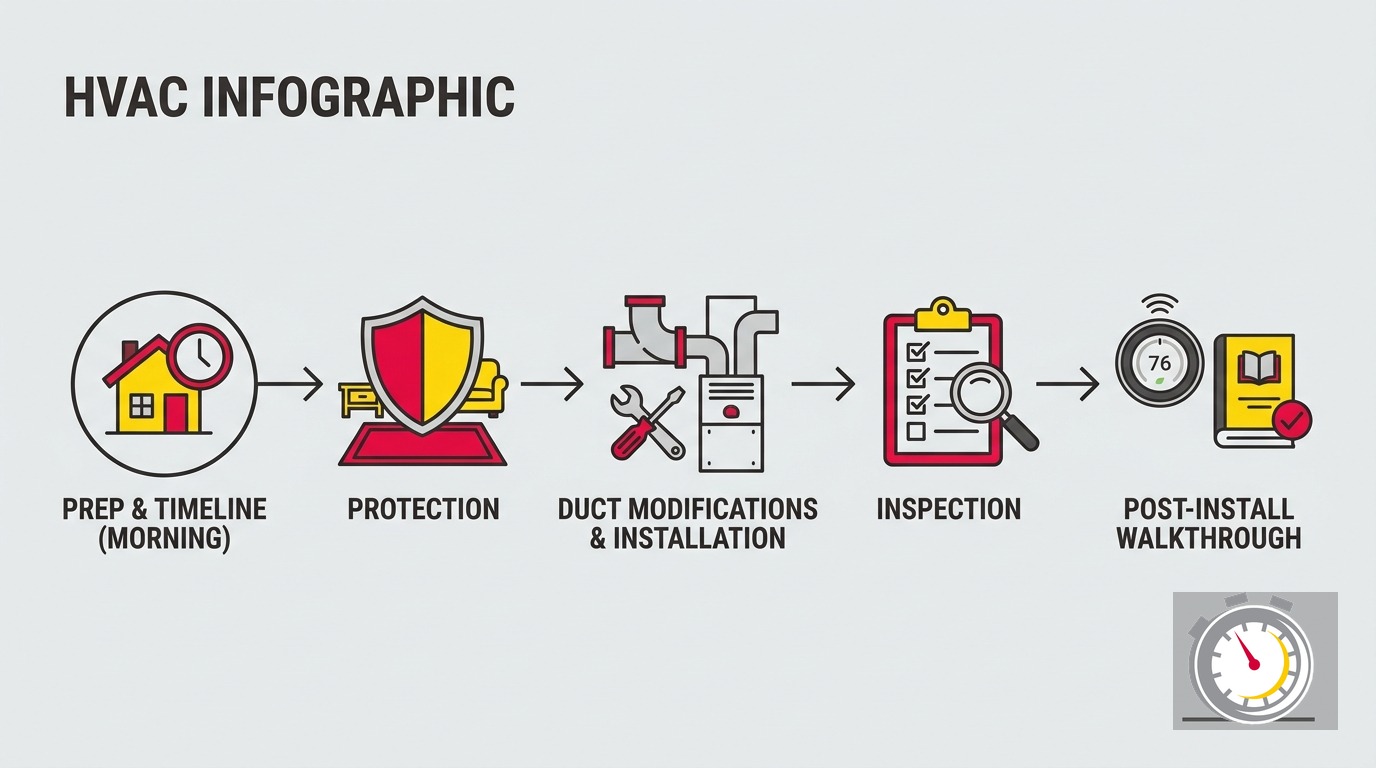
The short answer: A standard central HVAC replacement takes 7-8 hours with a 2-3 person crew. A full system swap covering both indoor and outdoor units runs toward the longer end. Your technician will give you a time estimate at the start of the job.
Here is how the day breaks down by phase:
Arrival and assessment (30-60 minutes). The lead technician walks the job before any tools come out. They confirm the equipment matches the permit specification, note any access constraints, and walk through the scope with you. This is the right window for questions.
Old unit removal (1-2 hours). For AC replacements and heat pumps, refrigerant recovery from the old system is legally required before removal begins. Only EPA Section 608-certified technicians may handle refrigerants, and refrigerant cannot be vented to the atmosphere. Once the refrigerant is captured, the crew disconnects and removes the old equipment.
New indoor unit installation (2-3 hours). The air handler or furnace goes in. Connections to the duct system, gas line, and electrical are made and verified. If the venting material changes, the new PVC penetrations happen during this phase.
New outdoor unit (1-2 hours). The condenser or heat pump is placed on isolation pads to reduce vibration and operating noise. Refrigerant lines and electrical connections follow.
Technical commissioning (about 1 hour). Commissioning includes electrical verification, airflow measurement, refrigerant pressure and temperature readings, gas pressure and combustion analysis, thermostat verification, and a safe operation inspection. The system does not get signed off until every check passes.
How Should You Prepare Before the Crew Arrives?
The short answer: Clear a path from your front door to the equipment room. Secure your pets. Plan to be home the entire day. Confirm your rebate pre-approval status with your contractor the day before the install.
A few specific steps:
Clear the working path. Move furniture, boxes, or stored items from the route between the front door and the equipment room. If the outdoor unit is being replaced, clear a walking path to the pad. A clear path saves time and reduces the chance of damage to walls or furnishings.
Secure your pets. The crew will be moving heavy equipment and may leave exterior doors open briefly. A crate or a closed room keeps pets safe and keeps the crew moving.
Dress for a less comfortable house. The system will be off for most of the day. On a cold Minnesota day, that adds up fast. On a hot summer day, open a window on the shaded side of the house. Plan for it either way.
Call your contractor about rebate pre-approval. Some utility rebate programs require pre-approval before installation to lock in the rebate amount. The day before install is the time to verify this is handled. Missing the pre-approval step can disqualify you even if your equipment qualifies.
What Happens During the Installation?
The short answer: The crew protects your home first, removes the old equipment, installs the new system connection by connection, then runs a full commissioning sequence before calling the job done. Every step is verified before moving to the next.
The home protection comes first. Drop cloths cover every floor surface in the travel path. Shoe covers stay on inside. This is standard practice, not a courtesy. Old refrigerant lines and equipment carry oil and particulates that stain carpet and hardwood. The protection comes off when the job is done.
Old equipment comes out next. For furnace replacements, the gas line, flue connection, and electrical disconnect before the unit moves. For AC replacements, refrigerant recovery happens first. Heat pump replacements involve both sequences.
Duct connections are inspected during removal. If the existing duct collar is in good shape, the new unit connects to it directly. If a modification improves airflow or fits the new equipment better, the crew handles it now. If you have had persistent hot or cold spots, ask the technician about duct adjustments during the removal phase. A small change at install time can fix a comfort problem that has been there for years.
The new system goes in following a consistent sequence: indoor unit, duct and utility connections, outdoor unit, refrigerant lines, electrical, controls. Each connection is tested before the next step begins.
For context on how equipment sizing affects long-term comfort, our post on HVAC sizing and Manual J calculations explains what should happen before install day to make sure the equipment is right for your home.
Does HVAC Replacement Require a Permit in Minnesota?
The short answer: Yes. Replacing a furnace, boiler, or central AC in Minnesota requires a mechanical permit in virtually all jurisdictions, including every Twin Cities suburb. This applies even to a direct equipment swap with no other changes.
Here is what the permit process looks like in practice:
The permit is pulled before work starts. A licensed contractor obtains the permit from the municipality and begins work only after it is issued. The permit must be posted on-site throughout the project. You will see a permit card on or near the equipment when the crew arrives on install day.
The permit fee is usually included in your quote. A standard furnace replacement permit costs $75-$175 in Minneapolis and St. Paul, and $50-$150 in suburban Twin Cities. Confirm this is included before signing your contract.
An inspector visits after the crew leaves. The inspection does not happen on install day. A municipal inspector schedules a separate visit, usually within a few days to a week. This is a required step, not a sign that something went wrong. The inspector is verifying that the work was done correctly.
Skipping the permit creates real problems downstream. Unpermitted HVAC work can result in insurance claim denial for CO or fire incidents, failed home sale inspections, and mandatory retroactive permitting with fines. Any reputable contractor pulls the permit without being asked. If yours hesitates on this point, that is worth paying attention to.
Minnesota law requires all gas appliance installation to be performed by a licensed HVAC contractor. State licensing requires a $25,000 bond filed with the Department of Labor and Industry, plus public liability and workers’ compensation insurance. When you work with Northern One Hour, you are working with a fully licensed, bonded, and insured local team.
What Does the Inspector Actually Check?
The short answer: The inspector verifies that venting is properly connected and sealed, gas connections are leak-free, electrical connections meet code, condensate drainage is correctly routed, and the installed equipment matches the permit specification. Most inspections take 20-30 minutes.
Here is what the inspector reviews in detail:
- Venting. Is the flue or PVC vent connected, sealed, and properly pitched? For condensing furnaces, is the PVC routed correctly and the condensate line draining as designed?
- Gas connections. Is every connection leak-free? Inspectors use a combustible gas detector at all new gas connections.
- Electrical. Do the connections meet code? Is the disconnect properly installed and labeled?
- Condensate drainage. Is the line routed to an appropriate floor drain or condensate pump, and free of kinks or improper traps?
- Equipment match. Does what was installed match the equipment specification listed on the permit?
The inspector leaves a pass or correction card. If a correction is required, your contractor handles it and the inspector returns. This is uncommon when the work is done by a licensed crew following a properly permitted scope.
Will Your Venting Change If You’re Upgrading to a High-Efficiency Furnace?
The short answer: Yes. Moving from an 80% AFUE furnace to a 90%+ model requires switching from metal flue pipe to PVC. The crew modifies the wall penetration on install day. This is a normal part of a high-efficiency furnace replacement, not an unexpected add-on.
Here is the reason: An 80% AFUE furnace exhausts combustion gases at a high temperature. Those gases are hot enough to travel safely through a metal flue. A condensing furnace (90%+ AFUE) extracts so much heat from the combustion process that the exhaust exits cool. At that lower temperature, moisture in the exhaust condenses into liquid. PVC handles that cool, moist exhaust safely. Metal pipe cannot.
Why this matters for Twin Cities homeowners specifically:
Minneapolis and St. Paul both require a minimum 90% AFUE furnace for replacements. If you live in either city and your current furnace is 80% AFUE, the replacement will almost certainly be a condensing unit. That means PVC venting is part of the scope, not a choice. Most suburbs follow the statewide 80% AFUE minimum, but many homeowners choose 90%+ anyway for lower operating costs. If you go high-efficiency anywhere in the metro, the same venting change applies.
What to expect on install day: The crew removes the old metal flue from the furnace connection, caps the old exterior penetration, and runs new PVC pipes through the wall or rim joist. Before they cut, ask the technician to show you the planned route. It takes a few minutes and you will know exactly what is happening and where the pipe exits the house.
If you are weighing a heat pump against a furnace replacement, our post on heat pump performance below zero in Minnesota covers how cold-climate units hold up when temperatures drop to the single digits.
How Do Twin Cities Rebates Factor In?
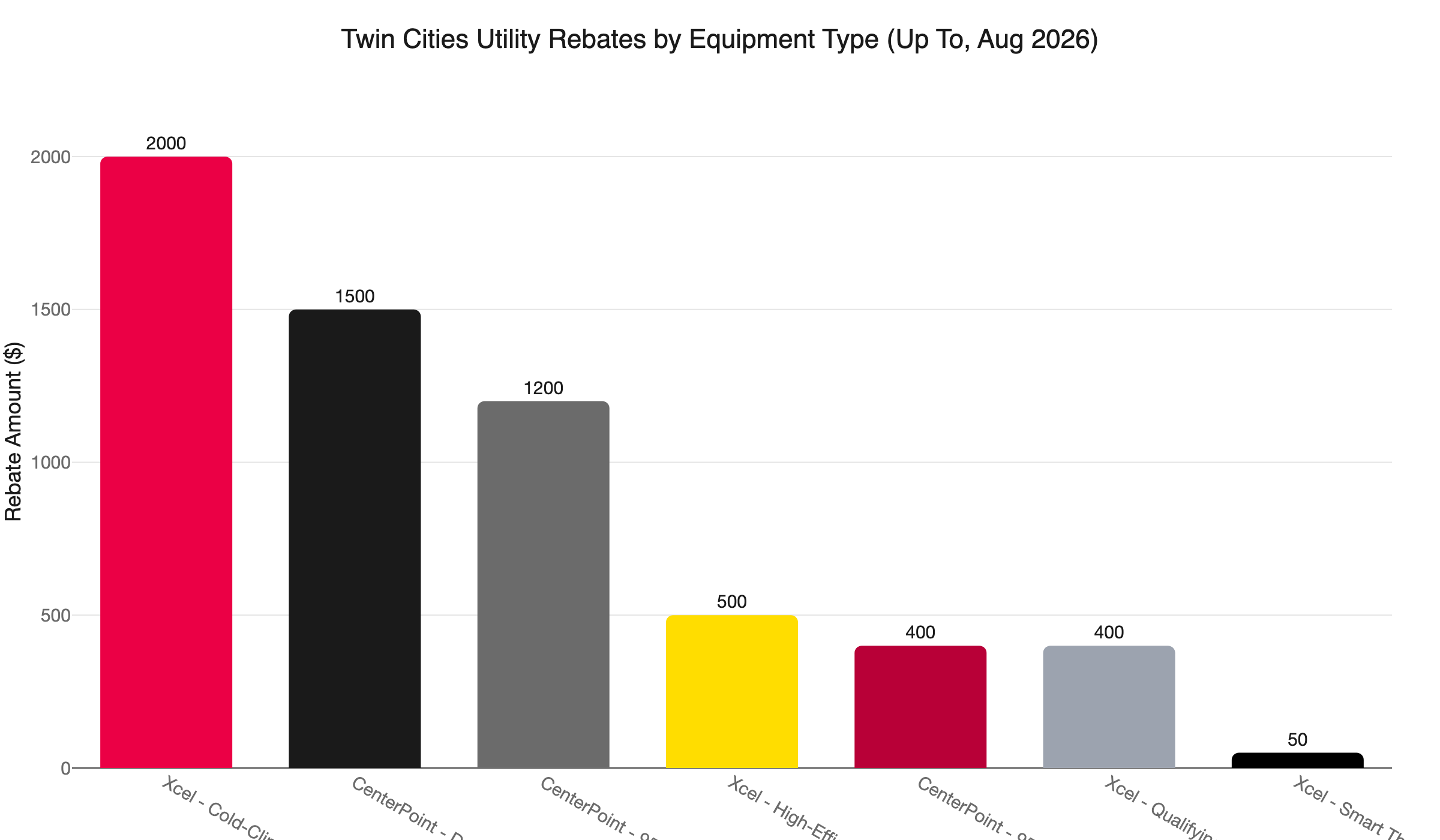
The short answer: Xcel Energy and CenterPoint Energy offer rebates from $50 to $2,000 depending on equipment type. Some programs require pre-approval before installation. Waiting until after the install to apply can cost you the rebate entirely.
Here is what is available as of August 2026:
Xcel Energy:
- Up to $2,000 for cold-climate heat pumps
- Up to $500 for high-efficiency gas furnaces
- Up to $400 for qualifying central AC
- $50 for an ENERGY STAR smart thermostat
- $600 bonus if the heat pump follows qualifying insulation and air-sealing upgrades
CenterPoint Energy:
- Up to $1,500 for ducted air-source heat pumps
- Up to $400 standard, or up to $1,200 income-qualified, for 95%+ AFUE gas furnaces
One federal note: the 25C heat pump tax credit ended December 31, 2025. No federal credit applies to 2026 installs as of this writing. The utility programs listed above are the primary incentives available right now.
For a full breakdown of how to claim these programs, see our post on Minnesota heat pump rebates and tax credits.
The Post-Install Walkthrough
Before the crew loads the truck, your lead technician will walk you through the new system. This is the handover. Pay attention and ask questions.
Where is the filter, and what size does it take? Write it down and set a calendar reminder. A clean filter is the single highest-return maintenance task for any HVAC system. Skipping it costs you efficiency and lifespan.
Where does the condensate line drain? Know where the line exits and what to do if it backs up. A clogged condensate drain is one of the most common service calls after a new install. Knowing where the line runs makes a DIY fix straightforward when it matters.
What are the normal operating sounds for this unit? New systems sound different from old ones. Ask the technician what is normal so you are not calling in for something that is working exactly as designed.
When is the inspector coming, and do you need to be home? Get a timeline. Many inspectors do not require the homeowner to be present. Confirm either way before the crew leaves.
How do you register the warranty? Most manufacturers require registration within 30-60 days of installation to activate the full warranty term. Ask your technician for the registration details and do it before the deadline passes.
Where is the rebate paperwork? If your technician is handling the utility rebate submission, confirm they have the equipment documentation and serial numbers. If you are submitting it yourself, collect everything before the crew pulls away.
Schedule Your Installation with Northern One Hour
We are locally owned and operated in Ramsey, MN. Our team serves homeowners across the Twin Cities metro: Minneapolis, St. Paul, Blaine, Maple Grove, Plymouth, Brooklyn Park, Woodbury, Bloomington, and the surrounding communities.
Every installation includes permit coordination, a licensed EPA-certified crew, and a technician who walks you through the system before they leave. We handle the paperwork, show up when we say we will, and back every job with a 100% satisfaction guarantee. “Always On Time… Or You Don’t Pay a Dime!(R)”
Call us at (763) 260-6662 or book your furnace replacement online.
Frequently Asked Questions
How long does an HVAC installation take in the Twin Cities? +
Do I need to be home during my HVAC installation? +
Does HVAC replacement require a permit in Minnesota? +
What does the inspector check after an HVAC installation? +
Need a technician now?