
Slab Foundation Home HVAC Ductwork Minnesota: 3 Paths
Key Takeaways
- Thousands of Twin Cities slab homes carry under-slab sheet metal or transite ducts that are now corroding, flooding, or blocked after 50-plus years in the ground.
- Three paths exist: spray-in-place liner with no concrete cutting, jackhammer and replace, or abandon the slab runs and reroute overhead (or convert to ductless).
- Minnesota Energy Code requires R-3.5 insulation plus a vapor retarder on any duct installed inside or below a concrete slab.
- Full overhead ductwork rerouting runs $6,500-$13,000 installed in the Twin Cities. Spray liner avoids concrete work but requires a camera inspection first to confirm eligibility.
- Cold-climate mini-splits work in Minnesota but require a backup heat source and careful load sizing. An oversized unit causes temperature swings and humidity problems.
- Xcel Energy’s cold-climate mini-split rebate is $2,000 in 2026. The federal $2,000 heat pump tax credit expired December 31, 2025 and is not available for current installs.
If you own a slab foundation home in Minnesota and a tech just told you your HVAC ductwork is flooded, rusted, or blocked, you are not alone. Thousands of Twin Cities ranch homes built in the 1960s and 1970s are hitting this exact point. This post covers your three repair paths, what Minnesota code requires, what each option costs in 2026, and what rebate money is available if you convert to a heat pump.
Why Under-Slab HVAC Ductwork Fails in Twin Cities Slab Foundation Homes
The problem starts with location. Ducts buried under a concrete slab sit at soil level, where groundwater, rain, and nearby plumbing leaks collect for months before a homeowner notices. Sheet metal rusts from the outside in. Joints corrode. Duct walls thin and eventually fail.
Twin Cities freeze-thaw cycles add a second layer of stress. Seasonal ground movement cracks seams and joints on subterranean ducts. A hairline crack in October becomes an open gap by April. Soil, insects, and rodents enter through the openings.
Not all original under-slab ducts were metal, either. Transite, a cement-asbestos composite, and fiber “Sonotube” ductwork were standard in 1960s-70s slab construction. Both materials decay over time. Transite in particular must be handled as an asbestos-containing material during any disturbance. If your home predates 1980 and you do not know what material is under the slab, that question needs an answer before any work begins.
How Do You Know Your Under-Slab Ducts Have Failed?
A video camera inspection is the only way to confirm the extent of damage. But several symptoms at surface level point there first. Look for musty smells from floor registers, rooms that won’t reach setpoint regardless of runtime, and visible rust or moisture inside register covers.
Watch for these signs:
- Rooms served by floor registers that stay cold or warm no matter how long the system runs
- Musty, earthy, or mildew smells coming from floor registers when the system is on
- Rust staining or visible moisture inside floor register covers
- A recent water event near any floor register: plumbing leak, basement flooding, or heavy snowmelt
- Energy bills that keep climbing with no change in usage or weather pattern
Any one of these, in a slab home over 40 years old, is a reason to schedule an inspection. Two or more together is urgent. A camera run through the system shows exactly where the damage is before you commit money to a repair approach that may not fit the actual problem.
What Are My Options for HVAC Ductwork in a Minnesota Slab Home?
Three paths exist: spray-in-place liner, jackhammer and replace, and abandon the slab runs with overhead rerouting or ductless conversion. Each fits a different severity, budget, and home layout. The camera inspection tells you which one applies.
Think of the three paths as a spectrum from least to most invasive. More invasive does not always mean more expensive once you account for the full scope of each option. The sections below explain where each path makes sense and where it does not.
Path 1: What Is the Spray-In-Place Liner?
A polymer coating is sprayed into existing ducts through the current floor registers, with no concrete cutting required. Best when ducts are structurally present but corroded or leaking at seams.
Duct Armor’s spray liner has been in production since 2003. The system enters through existing supply and return openings. One documented homeowner reported a clean five-year video inspection post-install. The product carries a 15-year warranty.
The liner only works when ducts are structurally intact and still connected throughout. Collapsed sections, major blockage, or missing runs rule it out entirely. That is why the camera inspection is not optional. A contractor who recommends spray liner without a camera run first is skipping the step that determines whether the approach is even appropriate for your system.
The liner addresses corrosion and minor seam leaking. It does not restore structural integrity to a crushed or disintegrated run. When a liner is appropriate, it is typically the lowest-cost and least disruptive path of the three. Pricing varies by lineal footage and duct geometry. Get a written quote with the camera inspection listed as its own line item.
Path 2: When Does Jackhammer and Replace Make Sense?
When damage is severe but localized - one or two failed runs in an otherwise intact system. Cutting the slab to replace those sections is faster and less expensive than rerouting everything overhead.
Cutting the slab, replacing the damaged sections, and re-pouring concrete is the most disruptive of the three paths. The concrete work adds cost, mess, and days out of normal floor use on top of the duct labor and material. It also carries the highest per-lineal-foot cost because of the concrete component.
Where this path makes sense: the camera inspection finds one or two completely failed runs while the rest of the system remains structurally sound. A targeted repair costs less than rerouting everything overhead and avoids the ceiling work.
Where it does not make sense: widespread corrosion throughout the system. When most of the under-slab runs are compromised, a partial repair trades short-term disruption for a fix you will revisit in five years. A full overhead reroute costs more upfront and solves the problem once.
If a contractor recommends jackhammer and replace on a system with widespread corrosion, ask them specifically why overhead rerouting is wrong for your home. The answer should address your layout, ceiling access, and load requirements.
Path 3: Should I Abandon the Slab Ducts and Reroute Overhead?
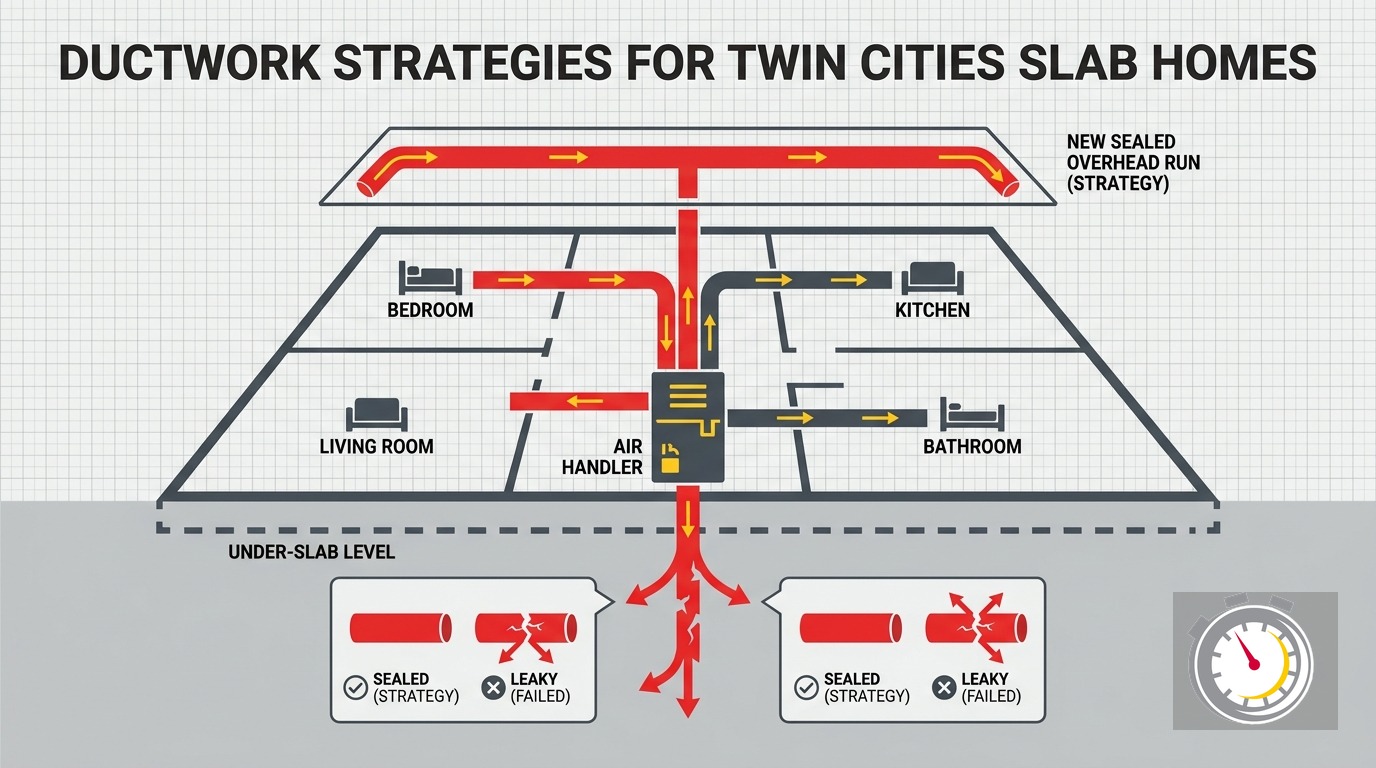
Yes, in most cases of widespread failure. Seal the old runs permanently at both ends, then run new ductwork through the attic, dropped ceiling soffits, or wall chases. This gives you a full new duct system that is accessible, inspectable, and built to current code.
Abandoning under-slab ducts entirely means sealing every dead run at two points: at each floor register AND at the HVAC unit connection. Both caps are required. An open slab duct still connected to a running air handler draws radon, pests, and soil gas directly into conditioned space. Do not skip the unit-side seal.
New overhead ductwork runs through one of three configurations, each with real tradeoffs:
Attic runs are the least expensive to install in most home layouts. They stay hidden above the living space. Minnesota code (MN Revisor Rule 1322.0403) requires R-8 insulation plus a vapor retarder on any duct in an unconditioned attic. Attic routing is not exempt from insulation requirements.
Dropped soffits along the ceiling perimeter keep ductwork inside conditioned space, which improves thermal efficiency year-round. They add a visible box along one or more walls, typically six to twelve inches deep. Most homeowners adapt quickly. Some use the soffit line as a design feature with lighting or trim detail.
Wall chases are the most labor-intensive option. They preserve full ceiling height with no visible soffit, but routing ductwork through interior walls requires careful planning and more hours on the job. Used selectively where a ceiling soffit would be too prominent.
For a look at what degraded or leaking ductwork costs in actual operating dollars, see our post on leaky ductwork and home energy loss.
What About Ductless Mini-Splits? The Honest Answer for Minnesota
Ductless mini-splits are a real option for Minnesota slab homes, but not a universal replacement for forced air. They need a backup heat source and careful load sizing. An oversized unit causes temperature swings and humidity problems year-round.
When a homeowner decides to abandon slab ducts and skip new overhead ductwork, mini-splits come up as an alternative. No duct system at all. The appeal is clear.
The honest picture is more layered.
The smallest ductless units produce 6,000 Btu, with a minimum turndown around 1,500 Btu/hr. In a well-insulated room that needs only a few hundred Btu/hr on a mild spring day, that unit short-cycles: it blasts to setpoint, shuts off, blasts on again. Short cycling hurts humidity control, creates temperature swings, and stresses the compressor. Engineer Allison Bailes makes this point directly in Fine Homebuilding Issue 330 (April/May 2025): whole-house ductless without a load calculation matched to each zone is a reliable source of comfort complaints.
The backup heat requirement is the separate critical issue. Cold-climate mini-splits hold rated capacity at surprisingly low outdoor temperatures, but Twin Cities winters regularly deliver sustained stretches at -10 to -20 degrees Fahrenheit. At those temperatures, capacity drops. A backup heat source, most commonly a gas furnace in a dual-fuel arrangement or electric resistance strips, is a code and comfort requirement, not an optional upgrade.
Mini-splits work well as zone supplements in a forced-air system: a sunroom, a room addition, a basement finishing, a space with no practical duct path from the overhead system. For a typical 1970s slab ranch in Crystal, Richfield, or Roseville, a properly designed forced-air system with new overhead ductwork is usually the cleaner path to whole-home comfort.
What Does Minnesota Code Require for Slab Replacement Ductwork?
R-3.5 insulation plus a vapor retarder for any duct in or below a concrete slab. R-8 plus a vapor retarder for any duct in an unconditioned attic. A duct blaster pressure test is required when ductwork exits the conditioned building envelope.
Minnesota Energy Code Rule 1322.1103, Table R403.2.1 is explicit: ducts within a cement slab or within the ground require a minimum of R-3.5 plus a vapor retarder. This applies to any new under-slab installation and is relevant to spray liner jobs where existing insulation does not meet the current threshold.
For overhead reroutes into an unconditioned attic, Rule 1322.0403 requires R-8 plus a vapor retarder. Attic runs are a better thermal environment than ground contact, but the code still mandates meaningful insulation. An attic reroute that skips insulation fails inspection.
Minnesota Mechanical Code Chapter 1346 requires a duct blaster pressure test when ductwork exits the conditioned building envelope. If new overhead runs stay inside conditioned space - inside a wall, a conditioned soffit, or a conditioned attic - no test is required. If the runs extend into an unconditioned attic, a post-installation pressure test is required before the permit closes. Ask your contractor about this at bid time. A permitted installation with a proper inspection protects you at resale and confirms the work was done right.
What Does Each Path Cost in the Twin Cities?
Full overhead rerouting runs $6,500-$13,000 installed for a typical Twin Cities home. Spray liner is typically less when ducts qualify, but varies by system size. Jackhammer and replace carries the highest per-lineal-foot cost because of the concrete cutting and re-pour component.
Here is the honest breakdown for 2026:
Spray liner: Cost varies by lineal footage and duct geometry. The camera inspection is a required first step and should appear as a visible line item on the estimate. When ducts qualify structurally, this is typically the lowest-cost and least disruptive of the three paths.
Jackhammer and replace: Duct material and labor run in line with a comparable partial duct replacement, plus the cost of concrete cutting, removal, and re-pour. The concrete component adds substantially, making this the highest per-lineal-foot cost. Best reserved for isolated, severe failures in an otherwise sound system.
Abandon and reroute overhead: Full new ductwork for a Twin Cities home runs $6,500-$13,000 installed. Simple layouts with direct attic access fall toward the lower end. Homes that need dropped soffits, wall chases, or have complex floor plans push toward the upper end. Combining the overhead reroute with a new furnace or heat pump replacement is often the right call. Financing is available to spread that cost over time.
After-hours or emergency scheduling adds $180-$270 per hour on top of standard labor rates. If your system is already down, budget for that reality when you call.
Can I Stack Rebates When I Convert to a Heat Pump?
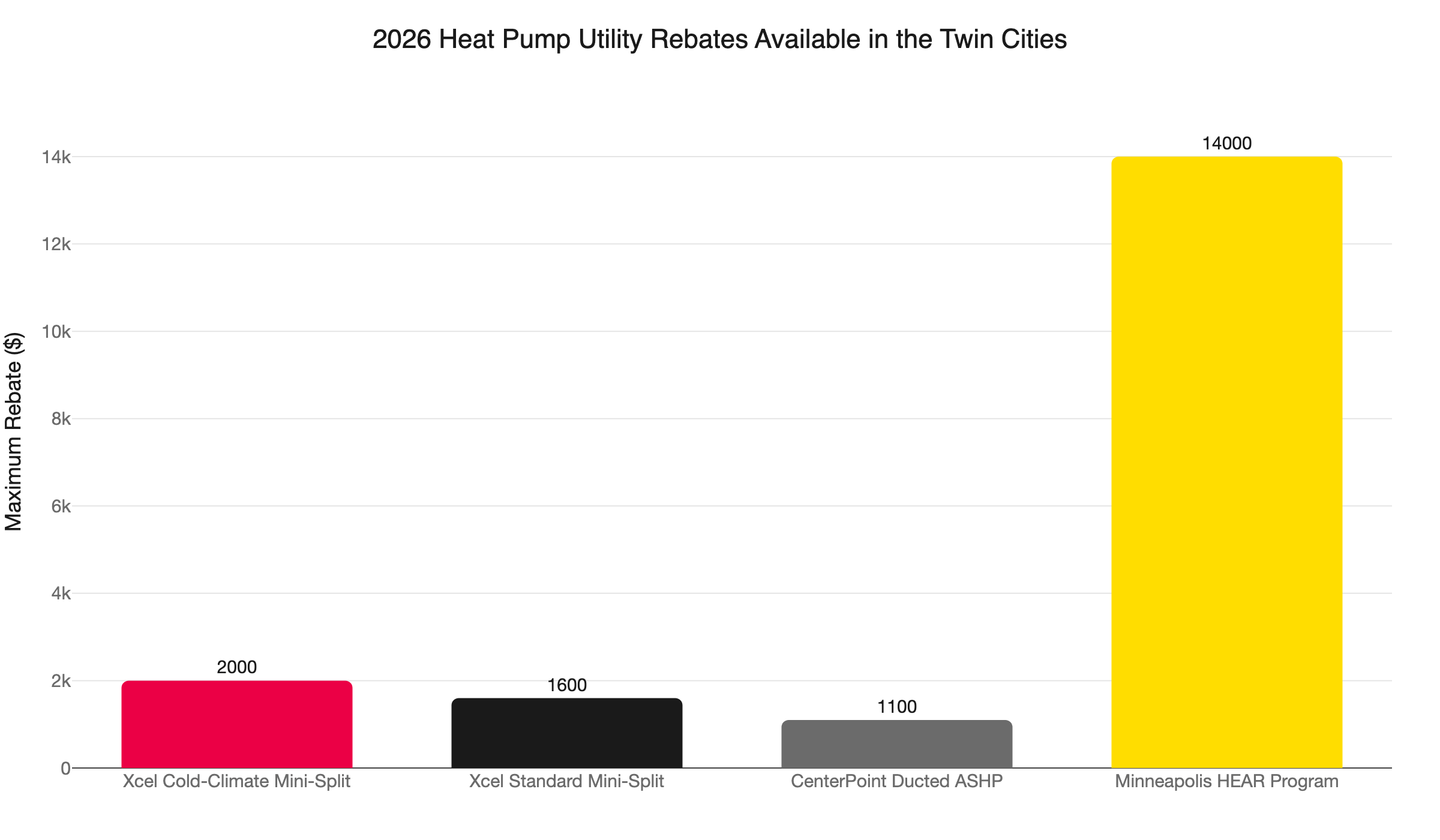
Yes, and the combination can be meaningful in 2026. Xcel Energy offers up to $2,000 for a cold-climate mini-split. CenterPoint offers $1,100 for a ducted heat pump in dual-fuel configuration. But the federal $2,000 heat pump tax credit expired December 31, 2025 and is not available for current installs.
If Path 3 leads to a heat pump - ducted or ductless - here is the 2026 rebate picture:
Xcel Energy: Cold-climate mini-split heat pump, minimum 16 SEER2 and 9.5 HSPF2: $2,000 rebate. Standard mini-split: $1,600. Rebates are mailed checks, not bill credits. An additional $600 insulation bonus is available when qualifying insulation is added at the same time.
CenterPoint Energy: Ducted air-source heat pump in a dual-fuel configuration (92%+ AFUE gas furnace backup, switchover programmed at 40 degrees F or lower): $1,100 rebate. Income-qualified households may receive up to $1,200.
Minneapolis HEAR program: Minneapolis homeowners specifically may qualify for up to $14,000 in city rebates. Check eligibility before committing to any large HVAC project.
Federal tax credit: The $2,000 heat pump credit under the Inflation Reduction Act expired December 31, 2025. It is not available for equipment installed in 2026.
For the complete stacking guide on what is still available, see our post on combining HVAC rebates in Minnesota.
Choosing the Right Path for Your Home
The camera inspection is the document that drives the decision. No contractor should recommend a path before seeing what is actually under the slab. Once you have those results, here is the honest framework:
Choose spray liner when: The camera shows ducts that are structurally present and connected throughout the system. Corrosion and minor seam leaking are the primary findings. You want to avoid concrete work and ceiling disruption entirely. Verify the liner warranty covers your expected timeline.
Choose jackhammer and replace when: The damage is severe but confined to one or two runs. The rest of the system is intact and the camera confirms it. A targeted repair costs less and disrupts less than a full reroute, and it makes no sense to reroute overhead just to fix a localized problem.
Choose overhead reroute when: Corrosion or failure is widespread throughout the under-slab system. The camera shows damage the liner cannot address. You are already replacing the furnace or planning a heat pump anyway. This is the most work upfront, but it gives you a full new duct system built to code, visible, and serviceable for the next 30-plus years.
Add mini-splits selectively when: Specific zones have no practical duct path from the overhead system, a sunroom or an addition with unusual geometry. Not as a wholesale replacement for forced air unless the load calculation and backup heat plan are both specific to your home and in writing.
Northern One Hour is locally owned and operated out of Ramsey, Minnesota. We serve homeowners across the Twin Cities: Minneapolis, St. Paul, Richfield, Roseville, Crystal, Brooklyn Park, Blaine, Maple Grove, Plymouth, and the surrounding metro. Our team gives you a straight assessment of what your system actually needs. We do not push the most expensive path when a simpler one does the job.
Call us at (763) 260-6662 or book online to schedule a camera inspection. We will walk you through exactly which path fits your home and provide a written estimate before any work begins. “Always On Time… Or You Don’t Pay a Dime!(R)” - that is the commitment we make every time we take a call.
Frequently Asked Questions
Can under-slab ductwork be repaired without breaking concrete? +
What is the cheapest way to fix failed under-slab ducts in a Minnesota home? +
Are there rebates available if I convert my slab home to a heat pump? +
Need a technician now?