
Heat Recovery Ventilator Minnesota: Fresh Air, No Heat Loss
Key Takeaways
- Modern Minnesota homes are built airtight to meet state energy codes. That design is good for your heating bill. It traps whatever is already in your air.
- Indoor pollutant concentrations are often 2 to 5 times higher indoors than outdoors. Tight construction without mechanical ventilation makes this worse.
- A heat recovery ventilator (HRV) pulls stale air out and brings fresh air in. It transfers 70 to 80 percent of the heat from the exhaust stream to the incoming air, so your furnace’s work is not thrown away.
- For Minnesota’s cold climate, an HRV is the right choice over an ERV. It transfers heat only, not moisture, which keeps winter humidity manageable.
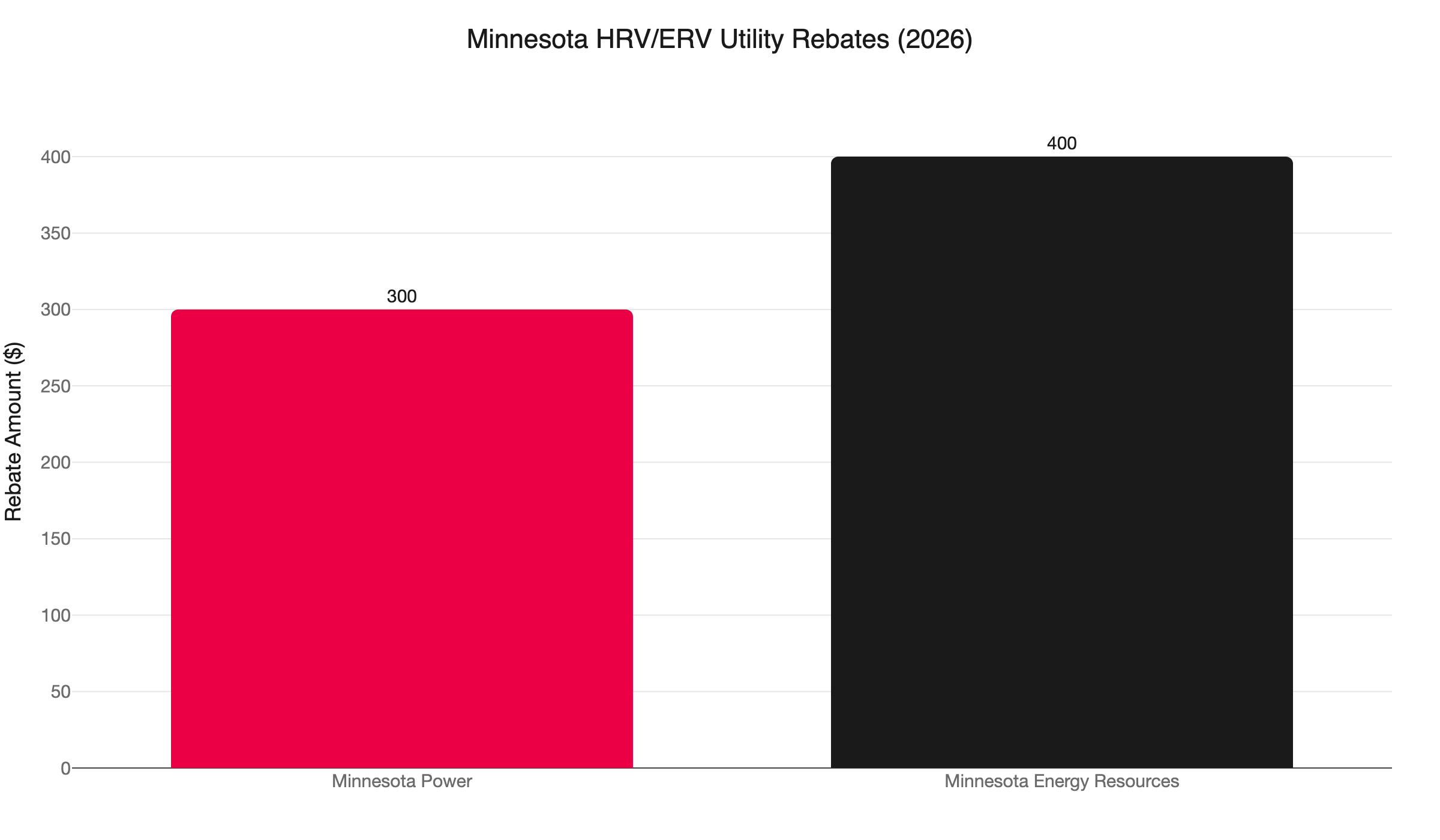
- Minnesota Power offers a $300 rebate on qualifying installations. Minnesota Energy Resources offers $400. Xcel Energy runs ventilation incentives through its Conservation Improvement Program.
- Northern One Hour is locally owned and serves the Twin Cities metro. Call (763) 260-6662 or book online to schedule a consultation.
Why Are Minnesota Homes Getting More Airtight?
Short answer: State building codes push new construction toward tight, low-leakage envelopes. That design is excellent for heating bills. It is less excellent for air quality, because the same envelope that holds heat in also holds contaminants in.
A generation ago, older Twin Cities homes leaked enough air that the house ventilated itself by accident. Gaps around windows, unsealed framing bypasses, and loose attic details let stale air drift out and fresh air drift in. Energy bills were higher, but the house was breathing.
That changed as energy codes tightened. Minnesota falls in IECC Climate Zones 6 and 7, the coldest residential classifications in the continental United States. Design heating temperatures in northern Minnesota reach -30°F or below. Building to those conditions means sealing every gap and layer.
The state also requires residential gas furnaces to meet a minimum 92% AFUE, which is above the federal floor. A 92% furnace pays off only if the home is tight enough to hold the heat it produces. Builders tighten accordingly. Both forces push construction toward increasingly sealed envelopes.
The consequence for ventilation is direct. Minnesota’s code documentation specifies that HVAC permits for tight new-construction homes must include mechanical ventilation equipment type, design airflow rates, and ASHRAE 62.2 compliance calculations. On a code-compliant tight build, an HRV is not a nice-to-have upgrade. For many homes, it is a permit requirement.
What Happens to Air Quality Inside a Sealed Home?
Short answer: Pollutants build up. The EPA documents that homes designed to minimize air leakage can have significantly higher indoor pollutant levels, with symptoms that are easy to mistake for a cold, a virus, or everyday fatigue.
Americans spend about 90 percent of their time indoors. Indoor pollutant concentrations are often 2 to 5 times higher than typical outdoor concentrations. The EPA specifically links this increase to “energy-efficient building construction when it lacks sufficient mechanical ventilation to ensure adequate air exchange.”
The pollutants building up are not exotic chemicals. They are the everyday byproducts of living in a home: CO2 from breathing, volatile organic compounds from cleaning products and new materials, cooking fumes, pet dander, dust mites, and moisture from bathing and laundry. In a leaky old house, these disperse on their own. In a tight new house, they accumulate.
The most common symptoms of poor indoor air quality include:
- Eye, nose, and throat irritation
- Persistent headaches or dizziness
- Unexplained fatigue, especially after time indoors
- Aggravated asthma or allergy symptoms
These symptoms are easy to dismiss. A kid who always has a headache by dinner. A household where allergy symptoms never quite clear. A house where everyone seems to catch a cold every few weeks from October through April. In a sealed home with no fresh air exchange, the air itself may be the underlying cause.
Cracking a window is not a practical answer in Minnesota. Letting -10°F air into your living room in January means your furnace runs flat out to compensate. You lose the heat your system just paid to generate. That is exactly the problem an HRV is built to solve.
How Does a Heat Recovery Ventilator Work?
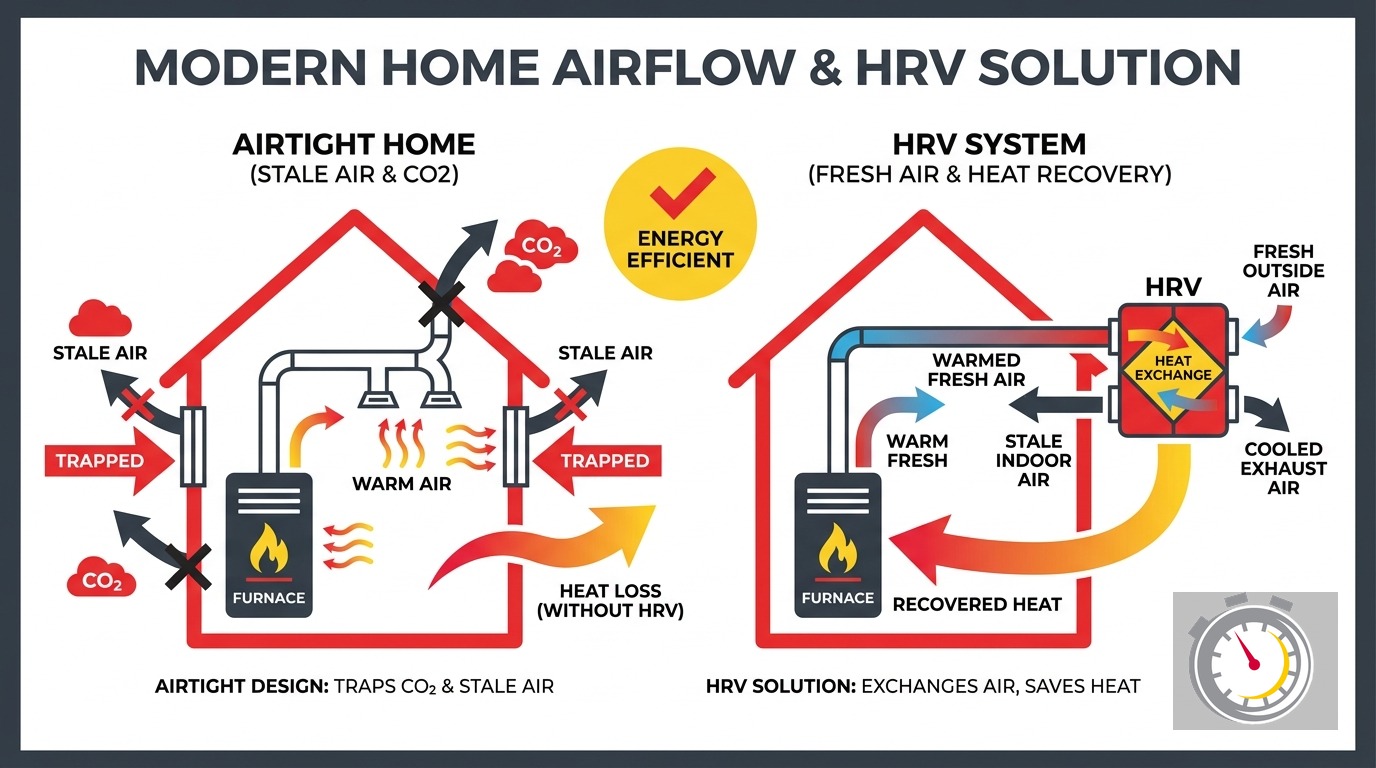
Short answer: An HRV uses two separate air streams that never mix. Stale indoor air exhausts through one channel. Fresh outdoor air enters through another. A heat-exchanger core inside the unit transfers warmth from the outgoing stream to the incoming stream, so the fresh air arrives pre-warmed.
Think of the heat exchanger as a thermal tollbooth. Your indoor air in January might be 70°F. The outdoor air might be 0°F. Without an HRV, exchanging that air costs you 70 degrees of thermal loss every time you ventilate. The HRV inserts a core between the two streams. Warm outgoing air passes through one side; cold incoming air passes through the other. Warmth transfers across the core material. The two streams never touch and never mix, but the heat crosses over.
HRV and ERV systems recover approximately 70 to 80 percent of the energy in exhaust air and transfer it to incoming supply air. You are not discarding your furnace’s work every time you ventilate. You are reclaiming most of it.
The HRV connects to your existing ductwork. Stale air is drawn from high-pollutant zones: kitchens, bathrooms, and laundry rooms. Fresh air is delivered to living areas and bedrooms. The system runs at a low, continuous rate, quiet enough that most homeowners are not aware of it during normal operation. You get steady, gradual air exchange rather than the uncomfortable blast of an open window.
Is an HRV the Right Choice for Minnesota?
Short answer: For most Minnesota homes, yes. The key difference between an HRV and an ERV is moisture. In Minnesota’s long heating season, homes already struggle to maintain adequate humidity. An HRV lets moisture leave with the exhaust air, which is the correct behavior for a cold climate.
There are two types of recovery ventilators, and understanding the difference matters:
An HRV transfers heat only. The outgoing air passes its warmth to the incoming air inside the core, then exits. The moisture in the exhaust stream leaves the house along with the stale air.
An ERV transfers both heat and moisture. Outgoing humid air passes some of its water vapor back to the dry incoming air before it enters the home.
In humid summer climates, an ERV can make sense. It prevents incoming dry air from lowering indoor humidity too far. In Minnesota, the problem runs in the opposite direction. We run furnaces for six months or more. Extended heating pulls moisture out of the air. Many Twin Cities homeowners already run a whole-home humidifier just to keep comfort levels reasonable.
An ERV would push moisture back into a home that already struggles to manage it in winter. That raises the risk of condensation inside a tight envelope over time. An HRV lets moisture exit cleanly. It gives you control over humidity without recycling the problem back into the living space.
There are exceptions. A very dry home in an extreme northern Minnesota climate might benefit from some moisture recovery. But for the Twin Cities metro and surrounding communities, an HRV is the standard recommendation.
Does an HRV Replace My Furnace or AC?
Short answer: No. An HRV handles ventilation only, which means controlled air exchange. Your furnace still heats the air. Your air conditioner still cools it. The HRV ensures that the air being conditioned is fresh, not just recirculated stale air.
This is a common point of confusion. “Heat recovery” sounds like the unit generates heat. It does not. It recovers the heat that would otherwise be lost when exhaust air leaves the house and transfers it to the incoming stream. The furnace still does the conditioning work.
Think of it this way: a properly maintained furnace heats your home effectively. But if the air it is conditioning has been cycled six times today with no fresh air coming in, the furnace’s efficiency does not solve your air quality problem. The HRV solves the air quality problem so the furnace can focus on what it does best.
The two systems complement each other. HRV handles exchange. Furnace handles temperature. Together, they produce a home that is both comfortable and healthy.
If your home also deals with winter dry air, an HRV and a whole-home humidifier work well together. Because the HRV controls exactly how much air is being exchanged, you know precisely how much moisture is leaving the house. That makes humidity targeting more accurate than in a home that relies on random air leakage.
What Does HRV Installation Cost in Minnesota?
Short answer: Installed HRV systems in Minnesota typically run $2,000 to $3,500, depending on the unit’s efficiency rating, your ductwork layout, and the complexity of the exterior penetrations. Utility rebates of $300 to $400 reduce the out-of-pocket cost. Financing is available for qualifying homeowners.
The total breaks into three components:
Equipment. HRV units vary by brand and Sensible Recovery Efficiency (SRE) rating. Higher SRE costs more upfront but qualifies for better utility rebates and runs at lower operating cost. Matching the unit to your utility’s rebate threshold is worth the conversation before you buy.
Labor. Connecting an HRV to existing ductwork requires running dedicated supply and exhaust ducts, penetrating an exterior wall for the intake and exhaust ports, and balancing airflow after installation. On a straightforward job with accessible ductwork, this is typically a half-day of work.
Ductwork modifications. If your existing system needs adjustments to support balanced HRV airflow, that adds to the scope. A technician will identify this during the initial assessment so there are no surprises.
For reference: installed pricing in the metro starts around $2,600 for a professionally installed unit with a lifetime warranty on the heat-exchange core.
Financing is available for qualifying homeowners. For a larger indoor air quality investment, spreading the cost over time makes the upgrade accessible for more families.
What Minnesota Rebates Are Available for Heat Recovery Ventilators?
Short answer: Minnesota Power offers $300 and Minnesota Energy Resources offers $400 for qualifying HRV installations. Xcel Energy runs a Conservation Improvement Program with ventilation incentives. All programs require licensed installation and documentation of the unit’s SRE rating.
Here are the confirmed programs as of August 2026:
Minnesota Power: $300 rebate Minimum efficiency: 60% SRE at 32°F / 0°C Deadline: Must be installed by a participating contractor by December 31, 2026 Source: mnpower.com HRV/ERV Rebate
Minnesota Energy Resources: $400 rebate Minimum efficiency: 65% SRE Source: Minnesota HVAC rebate guide
Xcel Energy Xcel operates a Conservation Improvement Program under Minnesota Statutes that includes ventilation incentives. Confirm current HRV-specific amounts directly with Xcel before budgeting, as the exact dollar figure changes with program funding cycles.
To claim a rebate, you typically need a receipt showing the unit model and SRE rating, proof of licensed installation, and a completed rebate application. We provide the documentation you need at the time of installation so you are not scrambling for paperwork later.
If you are on the border between utility service areas or are unsure which program applies to your address, ask us when you call. We can help you identify the right program before we install anything.
Signs Your Home Needs a Heat Recovery Ventilator
Not every home presents obvious air quality problems. These are the patterns Minnesota homeowners most commonly report before an HRV installation:
Persistent headaches or fatigue indoors. The EPA links poor indoor air quality to symptoms including headaches, dizziness, and fatigue. If you consistently feel better after spending time outside, your indoor air is worth investigating.
Condensation on windows in winter. Excess moisture has to go somewhere. When it cannot leave a sealed house, it condenses on the coldest surface available, usually glass. Regular condensation in winter is a clear sign of poor air exchange.
Musty or stale odors. A house that smells “closed up” is not exchanging air. Stale odors concentrate when the same air is recirculated without replacement.
Allergy or asthma symptoms that worsen at home. Allergens like dust mites and pet dander accumulate when air does not circulate. If symptoms are consistently worse indoors than outdoors, the air quality inside your home is worth examining.
A newer home or recent gut renovation. Post-2015 construction in Minnesota is significantly tighter than older builds. If your home was recently built or fully renovated to current code, it may have been designed with the expectation that an HRV would complete the system. Some tight homes come off the permit desk with mechanical ventilation listed as a follow-up requirement.
Upgraded filtration that is not solving the problem. A high-efficiency HVAC filter captures airborne particles, but it does not exchange the air. If you have upgraded your filtration and still notice symptoms, the issue may be insufficient fresh air rather than insufficient filtration. The two problems need different solutions.
What to Expect From HRV Installation
Installation is a single-visit job for most Twin Cities homes with accessible ductwork. Here is how the process goes:
Assessment. A technician reviews your home’s layout, existing ductwork, and the best exterior wall location for the intake and exhaust penetrations. If your home requires ASHRAE 62.2 compliance documentation, the technician identifies the correct design airflow rates at this stage.
Unit selection. We match the HRV to your home’s square footage, ventilation needs, and your utility’s rebate threshold. If you want to qualify for the $300 or $400 rebate, the unit needs to meet the corresponding SRE rating, so that decision happens before we order equipment.
Installation. The unit is typically mounted in a mechanical room or utility space near the furnace. Dedicated supply and exhaust ducts run to the appropriate zones. Two ports are cut through an exterior wall for the fresh air intake and stale air exhaust.
Balancing. After installation, the technician measures and balances airflow. Balanced ventilation means the same volume of air is leaving the house as entering: no pressure imbalances, no back-drafting, no over-ventilation that wastes energy.
Documentation. We provide everything you need to file your utility rebate: model number, SRE rating, installation date, and licensed contractor documentation.
The exterior penetrations are sealed and weatherproofed before we leave. Most installations are complete in half a day or less.
We serve homeowners across the Twin Cities metro and surrounding communities: Minneapolis, St. Paul, Ramsey, Blaine, Maple Grove, Plymouth, Brooklyn Park, Woodbury, and Bloomington. We are locally owned and operated, not a national call center. When you call, you reach our team.
Ready to Breathe Easier?
A heat recovery ventilator Minnesota homes need is not complicated equipment. It is a direct fix for a code-driven problem. Modern construction sealed your home to save energy. That is a good thing. It stops being a good thing when there is no mechanical system refreshing the air inside.
If your home was built or renovated in the last decade, if your family notices symptoms that improve after time outdoors, or if you simply want confidence in the air your family breathes, an HRV is worth the conversation.
Northern One Hour is locally owned and operated in Ramsey, MN. We serve the Twin Cities metro and the communities around it. We give you honest, upfront pricing before any work begins. No surprises when the truck arrives.
And we stand behind every visit with our on-time promise: “Always On Time… Or You Don’t Pay a Dime!(R)”
Call (763) 260-6662 or schedule your consultation online. We will assess your home, walk you through unit options and efficiency ratings, and confirm which utility rebates apply to your address before we recommend anything.
Frequently Asked Questions
How much does a heat recovery ventilator cost in Minnesota? +
Do I need an HRV or an ERV in Minnesota? +
Can I get a rebate on a heat recovery ventilator in Minnesota? +
Need a technician now?