
High Efficiency Furnace Condensate Drain Frozen: The Fix
Key Takeaways
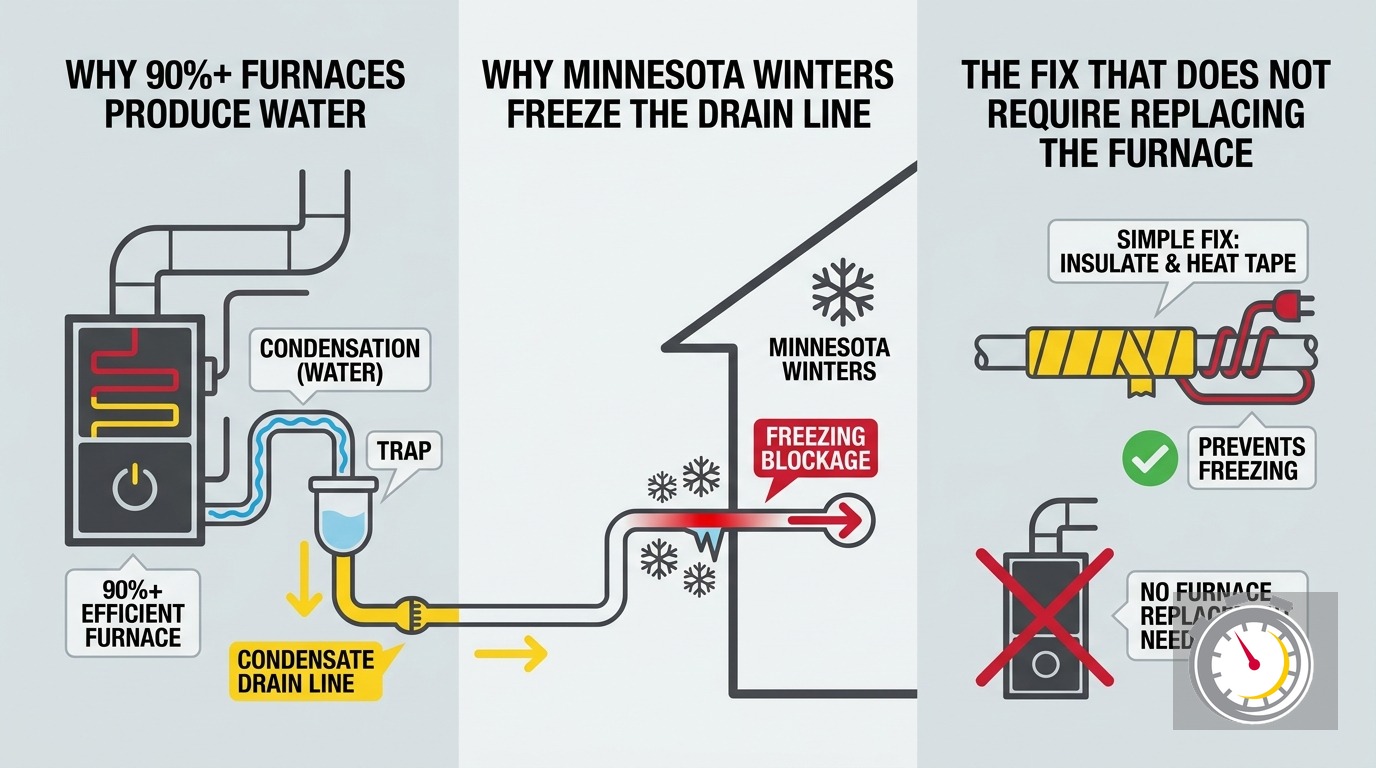
- A 90%+ furnace produces 2-5 gallons of acidic water every day your heating system runs. That water exits through a PVC drain line. When that line runs through a cold garage, crawl space, or exterior stub, it freezes.
- A frozen drain triggers a safety lockout. Your furnace stops running until the drain clears.
- The emergency fix is a careful warm-water thaw. It restores heat for one cycle. It does not prevent the next freeze.
- The permanent fix is self-regulating heat cable or rerouting the drain to a heated interior space. Neither fix requires a new furnace.
- Minnesota Rules 1322.1103 requires condensate piping in unconditioned spaces to be insulated. An uninsulated run through an unheated garage is a code violation, not a gray area.
- If this freeze started a replacement conversation, CenterPoint Energy and Xcel Energy both have active 2026 rebate programs for 95%+ AFUE furnaces. Federal tax credits apply too.
Why Does a High-Efficiency Furnace Produce Water?
A 90%+ furnace runs combustion exhaust through a second heat exchanger, cooling the gas past the dew point. Water vapor condenses into liquid. That liquid is the condensate. It has to drain somewhere, and the drain line is where it goes.
An 80% furnace vents exhaust at several hundred degrees. The hot gas exits straight up a metal flue and out of the house. That wasted heat is where the 20% inefficiency goes.
A high-efficiency furnace adds a secondary heat exchanger. It strips the remaining heat from the exhaust before those gases vent. That second pass cools the exhaust below the dew point, typically around 130 degrees Fahrenheit. Water vapor in the combustion gases condenses into liquid and releases latent heat in the process. That latent heat release accounts for the extra 10-18% efficiency gain over an 80% unit.
The Department of Energy defines AFUE (Annual Fuel Utilization Efficiency) as the ratio of useful heat delivered to energy consumed. A 90% AFUE furnace produces 90 BTUs of heat for every 100 BTUs of gas burned. The remaining 10 BTUs escape through the exhaust flue, but the furnace recovers what the 80% unit would have wasted entirely.
That condensation is not a flaw. It is the mechanism behind the efficiency gain.
During an active Minnesota heating season, a condensing furnace produces 2-5 gallons of condensate per day. The water is mildly acidic. Dissolved carbon dioxide forms carbonic acid in the condensate. That chemistry is why the drain line must be PVC, not metal. Metal corrodes. PVC handles the acidity without degrading.
Why Is Minnesota So Much Harder on Condensate Drain Lines?
Most furnace troubleshooting guides are written for national audiences. Minneapolis is not a national climate. It is one of the harshest residential heating environments in the contiguous United States, and a condensate drain configuration that is an edge-case problem elsewhere is a near-certain failure point here.
Minneapolis averages 16.2 degrees Fahrenheit in January. That is the coldest January average of any major US metro. During extended cold snaps, the Twin Cities routinely strings 10 or more consecutive days below zero. This is not unusual. It is a routine design condition.
Minneapolis accumulates approximately 8,000 to 9,000 heating degree days per year. Kansas City, by comparison, runs around 4,500. A Twin Cities furnace works roughly twice as hard over a heating season. The condensate drain runs continuously for months, not occasionally.
In a mild climate, a condensate line through an unheated garage might freeze once every several years during an unusual cold spell. In the Twin Cities, that same installation is almost certain to freeze during any sustained stretch of cold. The question is not whether it will freeze. The question is when.
Minnesota falls in climate zones 6 and 7, the most demanding residential heating zones in the lower 48. Freeze protection for condensate lines is not an optional upgrade here. It is the design condition the installation should be built around from day one.
Why Does the High Efficiency Furnace Condensate Drain Freeze?
The drain line runs through or past a cold surface. When outdoor temperatures drop far enough, condensate inside the pipe loses heat faster than it flows. It freezes in place, blocks the line, and triggers a safety shutdown.
The most common freeze points:
- Exterior termination. Many installations run the PVC drain through the rim joist to a stub outside. Below about 20 degrees, even a short exterior section can freeze solid.
- Unheated garage or crawl space crossing. Any uninsulated PVC section in a space that drops below 32 degrees is a freeze risk. The longer the cold section, the greater the risk.
- Inadequate slope. Minnesota Rules 4714.0814 requires condensate drains to slope at not less than 1/8 inch per foot. A flat or back-pitched run lets condensate pool. Pooled water freezes faster than flowing water and takes longer to drain after a thaw.
- Long cold runs. The longer the pipe travels through a cold space, the more heat the condensate loses in transit. A slow trickle moving through 10 feet of unheated garage has a much harder time making it out than one covering 2 feet.
Any one of these factors can cause a freeze. Two or three in combination make it nearly certain at Twin Cities temperatures.
What Happens When the Condensate Drain Freezes?
Condensate backs up into the trap and secondary heat exchanger. The furnace control board detects the fault and triggers a safety lockout. Your furnace stops running until the drain clears.
The shutdown is intentional. The furnace cannot drain, so it cannot safely operate. The result is no heat.
Common symptoms:
- Furnace runs a short cycle and shuts off
- No heat after an extended cold spell
- Water pooling at the base of the furnace
- Error code flashing on the control board
A frozen condensate drain is one of the more common reasons a furnace stops turning on during a Minnesota winter. The furnace is not broken. It is locked out by a legitimate fault condition. It will not restart until the drain clears.
On most modern high-efficiency furnaces, the control board shows an error via blinking LEDs. The number of blinks maps to a specific fault code. A pressure switch or drainage fault during a cold snap often traces back to a frozen drain. Check the drain line before replacing components.
What Should You Do Right Now?
If your furnace shut down during a cold snap, locate the drain line and apply gentle, sustained heat to the frozen section. Warm water or a portable space heater works. Do not use a heat gun, torch, or boiling water on PVC.
Here is the step-by-step:
Step 1: Find the drain line. It is a white or gray PVC pipe, usually 3/4 inch or 1 inch in diameter. It runs from the furnace to a floor drain, utility sink, or exterior wall.
Step 2: Find the freeze point. In winter, the most likely spot is where the line exits the conditioned space. Check the garage, the rim joist area, and any section that crosses through an unheated crawl space.
Step 3: Apply heat carefully. Options that work:
- Direct a portable space heater at the frozen section. Give it 20-30 minutes.
- Wrap warm (not boiling) wet towels around the frozen section. Rewarm them every few minutes.
- If the exterior stub is accessible, pour warm (not boiling) water slowly over it.
Step 4: Avoid high heat. PVC begins to soften at around 140 degrees Fahrenheit. A heat gun or propane torch can warp or melt the pipe. That creates a worse problem than the freeze itself.
Step 5: Reset the furnace. Once the drain clears, cycle the power at the furnace disconnect switch or circuit breaker. Wait 30 seconds before restoring power. The furnace should start its ignition sequence normally.
If the thaw takes more than an hour or you cannot find the freeze point, call us. A Minnesota January without heat is not a situation to wait out overnight.
Can You Fix a Frozen Condensate Drain Without Replacing the Furnace?
Yes. The permanent fix for a frozen high efficiency furnace condensate drain does not require a new furnace. It requires rerouting the drain to a heated interior space, adding self-regulating heat cable to the exposed run, or both.
The emergency thaw buys you one cycle. It does not solve anything. Any unheated pipe section that froze once will freeze again when temperatures drop.
Two permanent options cover most situations:
Option 1: Reroute the drain indoors. If the line currently terminates outside or passes through an unheated garage, routing it to an interior floor drain or utility sink removes the cold exposure entirely. One visit, one fix, no ongoing maintenance. This option requires a service call and is only practical if a suitable interior drain is reachable within a reasonable run.
Option 2: Self-regulating heat cable. When rerouting is not feasible, heat cable applied to the exposed section keeps condensate above freezing regardless of outdoor temperature. This is the more common solution for short exterior stubs and garage crossings. It requires a service call for installation and a standard 120V outlet near the pipe.
Both options are legitimate permanent fixes. Neither one involves buying a new furnace.
How Does Self-Regulating Heat Cable Work?
Self-regulating cable automatically adjusts its heat output based on pipe temperature. As the pipe gets colder, the cable draws more power. As the pipe warms up, it backs off. No thermostat needed. No overheating risk.
This is the key distinction from older-style heat tape. Standard resistance tape runs at a fixed wattage whether the pipe is at 35 degrees or 60 degrees. It can overheat if it overlaps itself or gets buried in insulation. Self-regulating cable does not have that problem. The output changes continuously with temperature.
Two installation configurations cover most condensate drain situations:
- External cable (such as Paladin by Heatline): wraps around the outside of the PVC pipe, then gets covered with pipe insulation. Works on any accessible exterior run or unheated section.
- Internal cable (such as Retro-Line Mini by Heatline): threads inside the pipe through a compression fitting. Useful when the exterior surface is not accessible, such as a run buried in a wall or through a finished ceiling.
Self-regulating cable is sold by the foot and cut to length on-site. Installation is a single service call, not a multi-day project. A tech can install the cable, test the drain flow, and confirm proper slope in one visit.
Power draw is minimal. A 6-foot exposed run at peak output during a polar vortex draws less than 30 watts. Over a full season, the cost is negligible compared to a no-heat service call in January.
What Does Minnesota Code Actually Require?
Minnesota code does not treat freeze protection as optional. Condensate piping in unconditioned spaces must be insulated under the state mechanical code. An uninsulated PVC condensate drain running through an unheated garage is a code violation in Minnesota, not a judgment call.
Minnesota Rules 1322.1103 covers the Minnesota Mechanical Code’s requirements for condensate and hydronic piping. It explicitly requires insulation for piping in unconditioned spaces. That includes condensate drain lines from high-efficiency furnaces and boilers.
The slope requirement adds a second layer. Minnesota Rules 4714.0814 sets a minimum slope of 1/8 inch per foot for condensate drain piping. A flat run or one that dips and rises is a code violation. It is also the most common cause of winter blockage, because water pools in the low spots instead of draining.
Many older installations in the Twin Cities do not meet current code on either point. The installer ran the line through the garage and moved on. A service call that includes heat cable installation or rerouting can bring the system into compliance in a single visit. That is worth doing regardless of whether the drain froze this season.
When Does a Frozen Drain Signal a Bigger Problem?
A one-time freeze in a line with clear cold exposure is a mechanical problem with a clear fix. A drain that freezes repeatedly, or one that froze despite an apparently adequate installation, may indicate something else going on.
Watch for these patterns:
- Wrong slope. If a tech installs heat cable and the drain freezes again the following month, slope is the likely culprit. Water pooling in a low section freezes faster and takes longer to drain after a thaw. Slope problems require repiping, not additional cable.
- Cracked or missing condensate trap. A damaged trap allows air to back-flow through the drain. Reduced flow velocity means condensate spends more time in the cold section of the pipe.
- Short-cycling. A partially frozen drain reduces condensate flow without fully blocking it. The furnace runs a cycle, trips a fault, resets, and repeats. That pattern puts wear on the heat exchanger over time. If you are already looking at furnace short-cycling, rule out a partial condensate obstruction before chasing igniter or pressure switch issues.
- Freeze on a recently installed furnace. A new furnace produces more condensate than an older unit because it runs longer, more efficient cycles. If a drain that never froze under the old furnace is now freezing, the higher condensate volume may have exposed a marginal slope or insulation problem that was below the failure threshold before.
Recurring freezes after the first repair are a signal to dig deeper. The cable is not the problem. The installation is.
Should You Consider Upgrading the Furnace?
If you have an 80% furnace and a frozen condensate drain is the first real winter problem you have had, fixing the drain is almost certainly the right move. If the furnace has had four or five breakdowns in the past three seasons, the math may point somewhere else.
A frozen condensate drain is usually fixable without a new furnace. But if you are running an 80% unit and this freeze is prompting the conversation, the efficiency context is worth knowing.
The Department of Energy finalized a rule requiring all new non-weatherized residential gas furnaces to meet 95% AFUE starting in late 2028. Every new furnace sold after that date will produce condensate. Understanding how condensate management works is relevant whether you replace this year or wait five more.
If the freeze has you thinking about a replacement, both major Twin Cities utilities have active 2026 programs:
- CenterPoint Energy: $200-$400 for a qualifying 95%+ AFUE furnace. Applications due December 31, 2026.
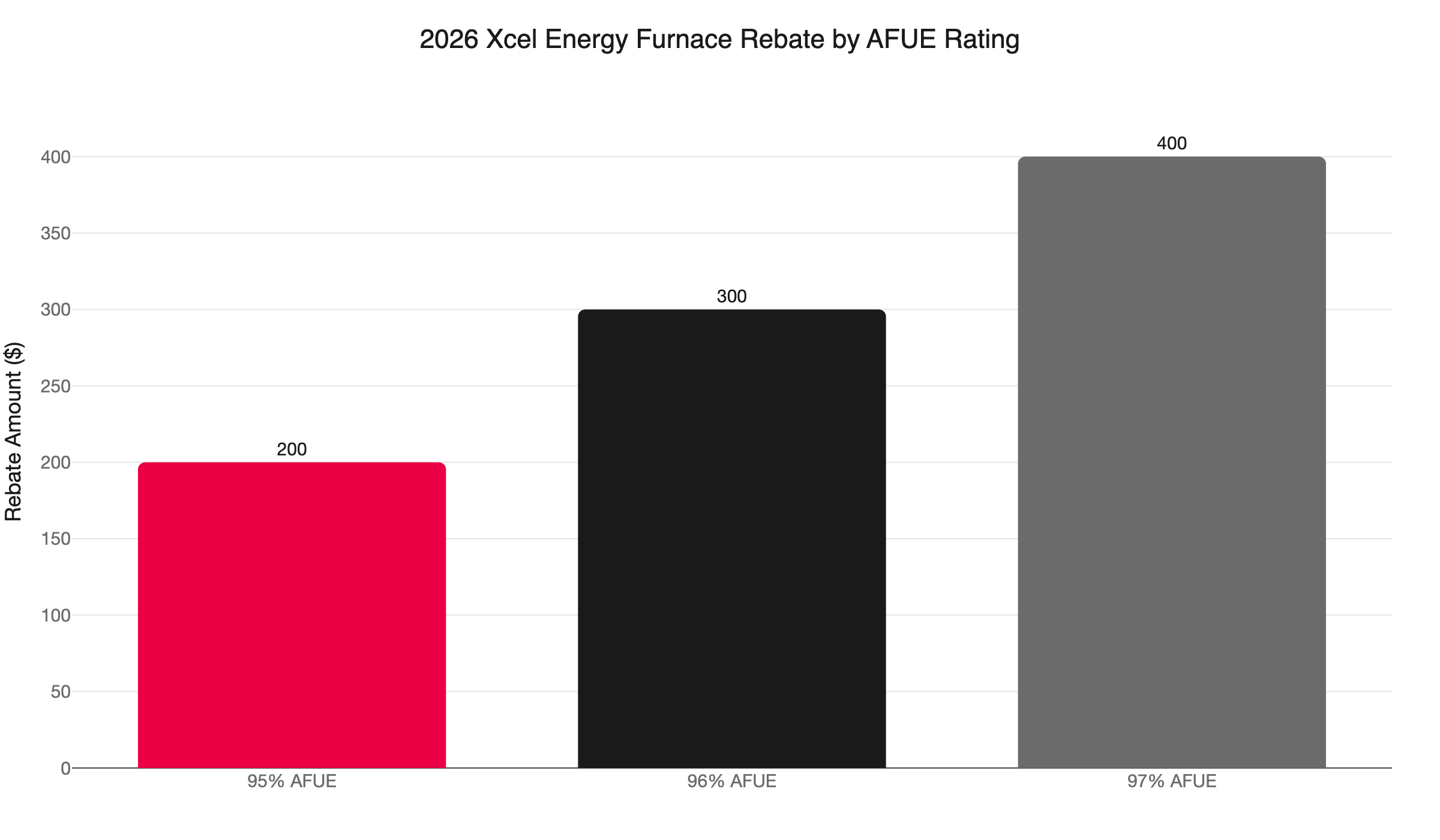
- Xcel Energy: $200 at 95% AFUE, $300 at 96%, and $400 at 97%.
The federal ENERGY STAR 25C tax credit adds another layer: 30% of installation cost up to $600 for a qualifying 95%+ AFUE furnace.
Financing is available for qualifying replacement jobs. For a full breakdown of what a furnace replacement costs in the Twin Cities, see our furnace replacement cost guide. If you want a straight read on whether to repair or replace, our furnace repair team can walk you through both options on-site, without pressure in either direction.
Call Northern One Hour
We are locally owned and operated in Ramsey, Minnesota. We serve Minneapolis, St. Paul, Blaine, Maple Grove, Plymouth, Brooklyn Park, Woodbury, Bloomington, and the surrounding Twin Cities area.
When your high efficiency furnace condensate drain is frozen and the temperature is still falling, you need a tech who shows up when they say they will. That is the one thing we guarantee: “Always On Time… Or You Don’t Pay a Dime!(R)”
Call us at (763) 260-6662 or book online. We will thaw the drain, inspect the installation for code compliance, and give you straight options for a permanent fix.
Frequently Asked Questions
Why is water coming from my high-efficiency furnace? +
Is a frozen condensate drain dangerous? +
Can I fix a frozen condensate drain myself? +
Does Minnesota code require insulated condensate lines? +
What are the Xcel and CenterPoint rebates for a new high-efficiency furnace? +
Need a technician now?