
Furnace Blower Motor Replacement Cost in Minnesota
Key Takeaways
- Furnace blower motor replacement cost: $500-$1,200 installed for a single-speed PSC motor; $900-$2,500 for a variable-speed ECM motor.
- Capacitor replacement: $150-$300 installed. A weak capacitor left alone often burns out the motor. A $175 fix becomes a $1,500 repair.
- Diagnostic service call: $75-$150, typically credited toward the repair if you move forward.
- Minnesota reality: The Twin Cities averages about 8,000 heating degree days per year, nearly double the national average. A blower motor that might last 20 years in a mild climate realistically reaches end-of-life at 12-15 years here.
- Symptom guide: Hum with no airflow points to the capacitor. Screeching points to bearings or a belt. Grinding means the motor is close to failure. Clicking at startup is the capacitor. Quiet, weak airflow: check the filter and blower wheel first.
- Motor vs. full replacement: If your motor fails on a furnace 15-plus years old, run the numbers. Utility rebates and the federal 25C tax credit can shift the math in favor of a new system.
What Does Furnace Blower Motor Replacement Cost?
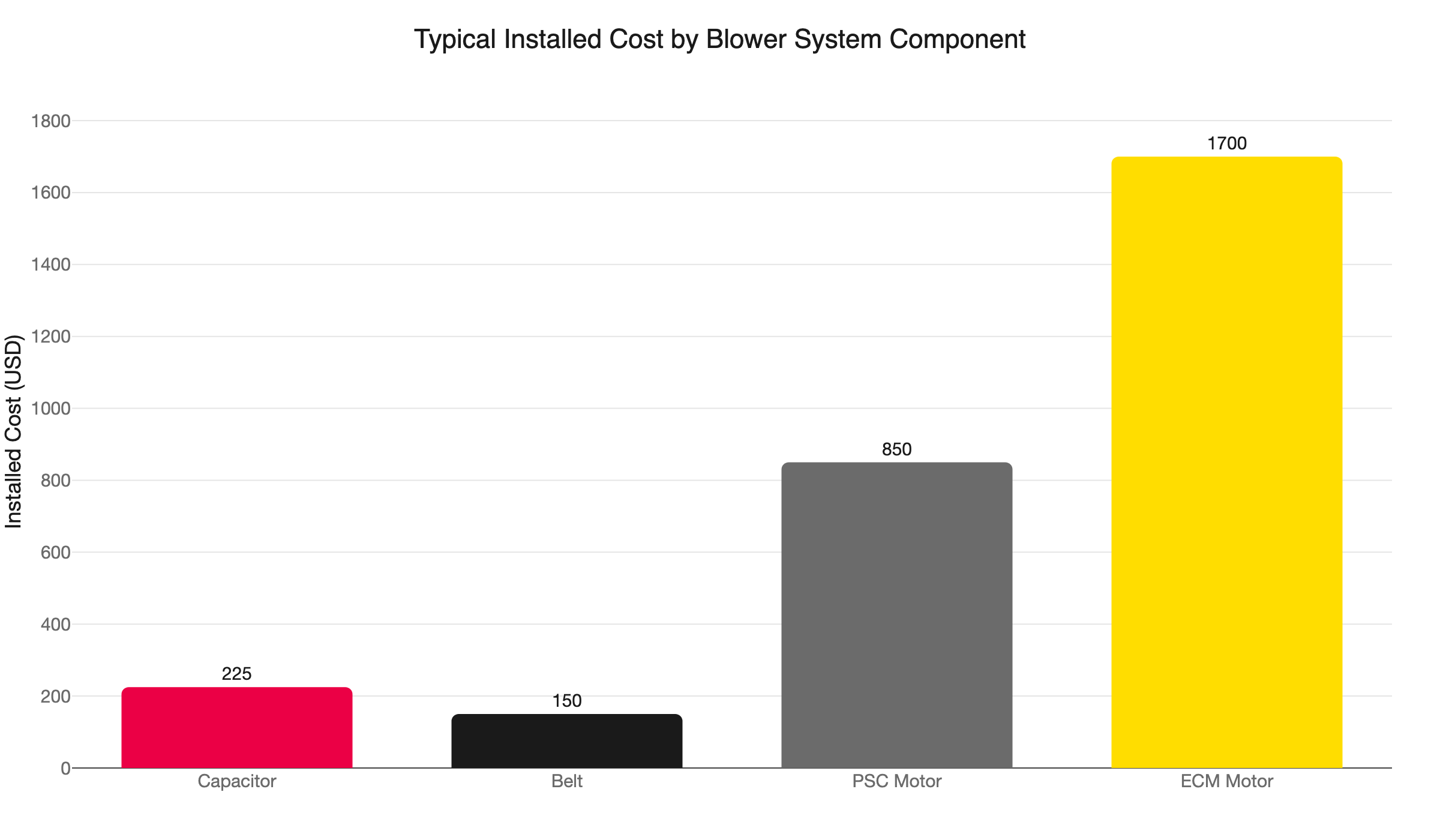
For a single-speed PSC motor, plan on $500-$1,200 installed. A variable-speed ECM motor costs $900-$2,500 installed. A diagnostic service call runs $75-$150 and is usually credited toward the repair. The actual total depends on which motor type your furnace has and whether related parts need replacement at the same time.
The cost gap between PSC and ECM comes from the part, not the labor. An ECM motor and its control module cost significantly more than a PSC unit. Labor is similar for both: one to three hours to access and swap the motor inside the air handler.
According to This Old House and United HVAC Motors, here are the typical installed cost ranges by motor type:
- PSC (single-speed) motor: $500-$1,200 installed
- ECM (variable-speed) motor: $900-$2,500 installed
Other blower system components have their own cost ranges, per This Old House:
| Component | Part Cost |
|---|---|
| Blower motor bearing | $20-$200 |
| Belt (belt-driven systems only) | $5-$150 |
| Capacitor | $10-$450 |
| ECM control module | $220-$830 |
| ECM repair kit | $20-$60 |
| Blower wheel (squirrel cage) | $25-$300 |
Add labor to each line. The capacitor stands out. The part itself is $10-$45, but the installed cost runs $150-$300. More importantly, a weak capacitor left unaddressed can burn out the motor, converting that $175 repair into a $1,500 one.
One Minnesota note: blower motor replacement is classified as a repair under state building code, not equipment replacement. No mechanical permit is required. A full furnace swap does require one, with permit fees typically running $75-$175 in Minneapolis and St. Paul, and $50-$150 in suburban Hennepin, Ramsey, Dakota, and Washington counties.
What Are the Symptoms of a Bad Furnace Blower Motor?
The main warning signs are no airflow, weak airflow, or unusual noise from the furnace cabinet. Each symptom combination points to a different component at a different cost. The sound your furnace makes, or doesn’t make, is the most useful diagnostic clue you have before a tech arrives.
Here is how to read what your furnace is telling you.
Hum with no airflow
Your furnace lights. Burners run normally. No air moves through the vents.
The blower motor is trying to start but can’t get moving. The capacitor is the first thing to check. It delivers the startup charge the motor needs. When the capacitor fails, the motor hums but stalls.
A tech can confirm this quickly. If they give the blower shaft a gentle push and the motor takes off, the capacitor is the problem, not the motor. That’s a $150-$300 fix. If the shaft won’t move at all, the motor is seized and needs replacement.
Screeching or squealing on startup
Screeching at startup usually means dry motor bearings on a direct-drive furnace, which most modern systems use, or a worn belt on an older belt-driven furnace, typically pre-1990.
Bearings are cheaper to address early. Left alone, dry bearings accelerate wear until the motor fails. If your furnace is newer than 1990, it almost certainly doesn’t have a belt. The screeching is the bearings.
Grinding noise
Grinding means the bearings have already failed, and motor failure is close. Keep running a grinding blower motor and the windings can overheat. An overheated motor can also damage the control board, adding $200-$600 to the bill on top of the motor cost. Address grinding immediately.
Clicking at startup, then shutdown
The furnace tries to start, delivers a click, and shuts off. This cycle may repeat several times. This is a classic capacitor failure pattern. The capacitor can’t deliver the startup charge the motor needs. The system gives up and shuts off to protect itself. Replace the capacitor before repeated failed starts burn out the motor.
Weak airflow with no unusual noise
Before calling this a motor problem, check two things first. The air filter: a clogged filter restricts airflow and makes the motor work against resistance. The blower wheel: also called the squirrel cage, it accumulates dust and debris over time. A clogged squirrel cage can cut airflow significantly and look exactly like a failing motor. It’s a cleaning issue, not a replacement.
Short cycling
The furnace runs for a few minutes, shuts off before the house warms up, and starts again. The blower motor may be overheating and tripping its thermal overload protector. It shuts down to protect itself, cools, then restarts. A weak capacitor or restricted airflow is the usual trigger. Running a motor this way accelerates wear. A filter change or capacitor swap is often the fix.
Is It the Capacitor, the Belt, or the Motor?
Start with the symptom. A hum with no airflow is a capacitor until proven otherwise ($150-$300 installed). Screeching usually means bearings or a belt, both far cheaper than a motor. Grinding means the motor is near failure. Quiet, weak airflow after confirming the filter is clean is when a tech needs to look deeper.
This is the triage decision tree that every national cost guide skips. They assume you already know which part has failed. Most homeowners don’t.
Hum, no air from vents. The capacitor is most likely. A tech pushes the shaft: if the motor runs, the capacitor goes, not the motor. If the shaft won’t move, the motor is seized.
Screeching on startup. Pre-1990 furnace: likely a belt ($100-$200 installed). Post-1990: bearings. Parts run $20-$200 and catching them early is far cheaper than a motor replacement.
Grinding. Bearings have already failed. Schedule service before the motor seizes and adds a control board replacement to the bill.
Clicking at startup, then shutdown. Capacitor failure pattern. Replace it before repeated failed starts burn out the motor.
Weak airflow, no noise. Check the filter. Check the blower wheel. If both are clean and airflow is still low, a tech should inspect the motor and capacitor.
Short cycling, furnace shuts off early. Check the filter first. If it’s clean, a tech should inspect the capacitor and check for airflow restrictions.
How Long Does a Blower Motor Last in Minnesota?
The generic national estimate is 10-20 years. In the Twin Cities, plan for 12-15 years. Minnesota furnaces run 7-8 months per year under heavy demand. That runtime accelerates wear significantly compared to the national averages that generic lifespan estimate was built around.
The Twin Cities averages roughly 8,000 heating degree days per year, one of the highest figures for any major U.S. metro and nearly double the national average of about 4,500 HDD. In a polar vortex year, that number exceeds 9,500.
Heating degree days measure how hard a heating system works. More HDD means more runtime, more motor starts and stops, and more heat cycling through the bearings and windings. A motor installed in a Minneapolis home does roughly 75% more work per year than the same motor in Charlotte, NC.
If you moved here from a warmer state, your previous experience with furnace lifespan doesn’t transfer directly. A system that ran 4-5 months per year in your old home runs 7-8 months here.
What shortens blower motor life in Minnesota:
- Skipped filter changes that force the motor to work against restricted airflow
- A weak capacitor that strains the motor on every startup
- Ignoring early warning sounds like screeching or grinding
What extends it:
- Annual furnace tune-ups that include a blower inspection
- Replacing filters on schedule, every 1-3 months depending on filter type
- Addressing early symptoms before they compound into larger failures
Catching a failing capacitor or dry bearings during a tune-up costs far less than an emergency call in January when the motor finally quits.
PSC vs. ECM Motors: Does the Type Matter?
Yes, especially for energy costs over time. PSC motors run at one speed and are 55-65% efficient. ECM motors modulate speed and operate at 90% efficiency or better. In a Minnesota winter, where the furnace runs 7-8 months per year, that difference shows up on your utility bill every season.
Most furnaces installed before the mid-2010s have PSC motors. Furnaces installed after 2019 almost certainly have ECM motors. The Department of Energy made ECM the efficiency standard for residential furnace fans.
The upfront cost gap is real: a PSC motor swap runs $500-$1,200 installed, while an ECM motor plus its control module runs $900-$2,500. But field tests show ECM motors use 30-40% less electricity during the heating season compared to PSC. The DOE estimates $340-$500 in lifetime electricity savings when choosing ECM over PSC.
In Minnesota, where that heating season stretches from October through April, the efficiency advantage runs for eight months out of twelve.
If you’re replacing a PSC motor in a furnace under 12 years old that’s in good condition, a like-for-like swap makes sense. If your furnace already has an ECM and the control module fails, the repair is expensive, but the motor system is worth preserving.
ECM motors also ramp up gradually instead of starting at full blast. In a Minnesota winter, that means no cold-air surge at startup. Homeowners notice the difference.
Should You Replace Just the Motor or the Whole Furnace?
If the furnace is under 12 years old and running well, motor replacement makes sense. If it’s 15 or more years old, run the replace-vs.-repair math before committing. The cost of a motor repair on an aging furnace, plus the remaining repair calls as other components age, often approaches the cost of a new system with rebates applied.
This is the decision most cost guides skip. They quote motor prices without noting that a $1,500 motor repair on a 17-year-old furnace leaves you with a 17-year-old furnace. The heat exchanger, control board, and inducer assembly are still aging. The new motor goes in alongside them.
The questions to answer before deciding:
- What does the repair cost, all in?
- How old is the furnace? Fifteen-plus years is end-of-life territory for a Twin Cities system.
- What other repairs has it had in the last two to three years?
- What would a new furnace cost, minus available rebates?
Our post on when it’s time to replace vs. repair your furnace walks through that full framework. The general guide: if the repair cost exceeds 50% of replacement cost and the system is past the midpoint of its expected life, replacement usually wins on total cost over the next five years.
For current replacement cost ranges in the Twin Cities, see our furnace replacement cost guide.
Financing is available for larger repairs and replacements. Ask when you call.
Minnesota Rebates and Tax Credits
When a motor failure tips the math toward a full furnace replacement, there is real money available to offset the cost.
Xcel Energy: Xcel offers $50-$150 for a 96%+ AFUE gas furnace replacement. Add a smart thermostat and there’s an additional rebate. Rebates are processed post-installation and typically take 6-8 weeks. Verify current amounts at xcelenergy.com, as program amounts vary year to year.
CenterPoint Energy: CenterPoint offers $50-$200 for a 95%+ AFUE gas furnace. Check current amounts at centerpointenergy.com before making a purchase decision.
Federal 25C tax credit: The Inflation Reduction Act’s 25C credit covers 30% of equipment cost, capped at $600 per year for gas furnaces. Minnesota is a northern climate zone, which means the furnace must meet 97% AFUE to qualify, not the 96% threshold that applies in milder regions. This is a non-refundable credit and applies to primary residences only.
One important note: the larger federal heat pump credits, which went as high as $2,000, expired December 31, 2025. The 25C furnace credit remains active.
If you want help calculating whether repair or replacement makes more financial sense, call us. We’ll walk through the numbers and discuss financing options if a new system is the right call.
What to Expect When You Call Northern One Hour
We are locally owned and operated in Ramsey, MN, serving Minneapolis, St. Paul, Blaine, Maple Grove, Plymouth, Brooklyn Park, Woodbury, Bloomington, and the surrounding Twin Cities area.
When you call about a blower motor issue:
- A tech comes out and diagnoses the problem: capacitor, belt, bearings, or motor. The service call runs $75-$150 and is credited toward the repair if you move forward.
- You get a clear price before any work starts. No surprises.
- If the repair makes sense, we complete it same-visit when parts are available.
- If the diagnosis points toward replacement, we give you the comparison and let you decide.
We back every service call with “Always On Time… Or You Don’t Pay a Dime!(R)”. If our tech isn’t there in the agreed window, you don’t pay. That’s the promise.
For furnace repair service, call (763) 260-6662 or book online.
Frequently Asked Questions
How much does furnace blower motor replacement cost in Minnesota? +
How do I know if it's the blower motor or the capacitor? +
How long should a furnace blower motor last in Minnesota? +
Need a technician now?