
AC Not Blowing Cold Air? A Twin Cities Diagnostic Guide
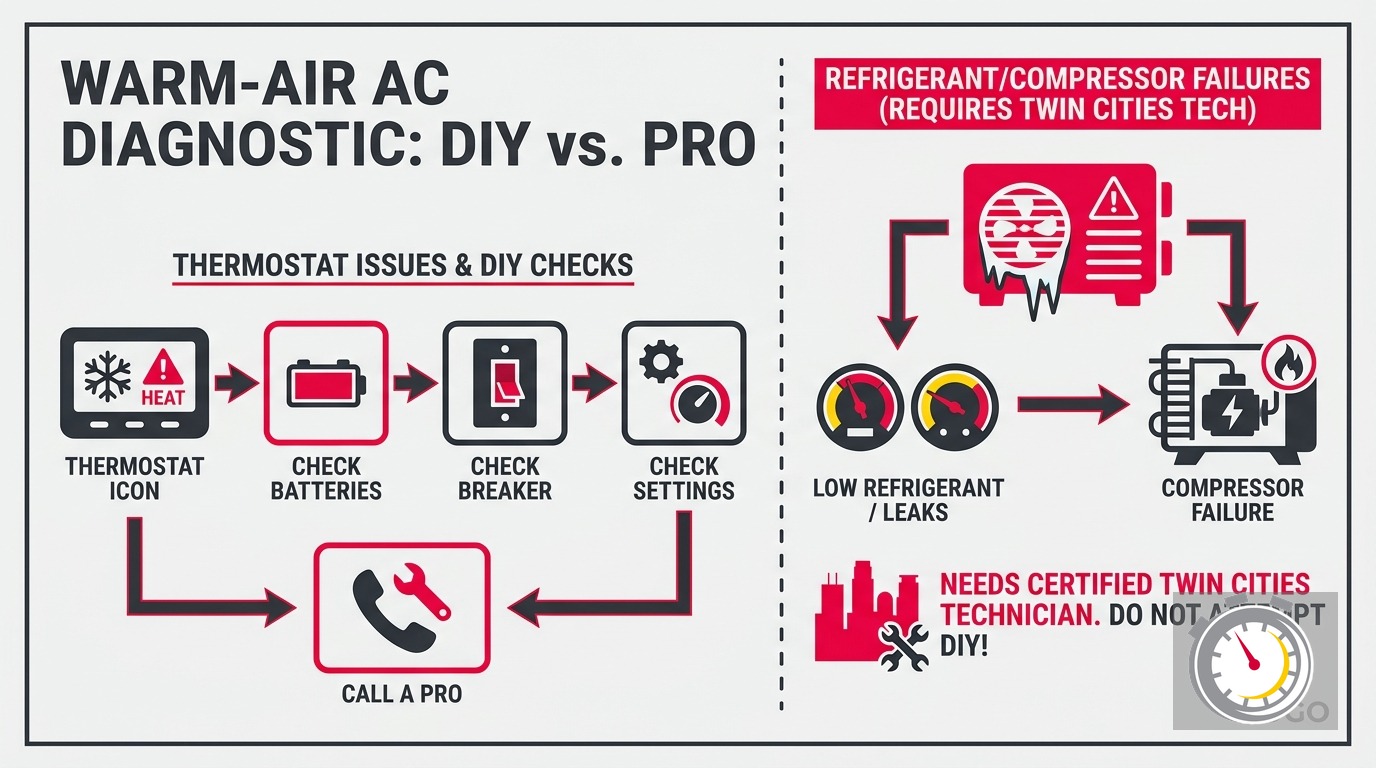
Key Takeaways
- Your AC can run but still blow warm. The cause is usually blocked airflow, a low refrigerant charge, or a failed electrical part.
- Four checks are safe for a homeowner: the thermostat, the air filter, the breaker, and the outdoor condenser.
- Refrigerant is not a DIY job. Federal law under EPA Section 608 requires certification to handle it.
- A frozen indoor coil means turn the system off now. Keep running it and you risk the compressor.
- AC replacement in Minnesota needs a mechanical permit. Xcel Energy offers a rebate that lowers the real cost.
Why Is My AC Not Blowing Cold Air?
When your AC is not blowing cold air on a 95-degree Twin Cities afternoon, you want a fast, clear answer. We are Northern One Hour Heating & Air Conditioning, a locally owned and operated shop in Ramsey. This guide splits the problem into two tiers.
A warm-air AC is one of the most common service calls we run in the Twin Cities. The good news: you can safely rule out about half the causes yourself, in under an hour, with no tools. This post gives you that order.
The key is sequence. Do not open the unit. Do not touch refrigerant lines. Work through the safe checks below first. If your AC still blows warm after that, the problem lives in the licensed-tech tier, and we explain exactly why you should stop there.
Is This an AC Emergency?
Short answer: Call us at (763) 260-6662 if you smell burning odors, hear hissing indoors, or get no airflow from any vent. These can signal an electrical fault, a refrigerant leak, or a seized blower. Turn the system off first.
Most warm-air calls are not emergencies. But three signs are, and you should not wait for a diagnostic walk-through. First, a burning or electrical smell can mean a wire or motor is overheating. Shut the breaker off and call. Second, a hissing sound near the indoor coil can point to a refrigerant leak, which a certified tech must handle. Third, if no air moves from any vent, the blower may have failed. Or the system may have tripped into a safety lockout.
In those cases, skip the steps below and call. Otherwise, keep reading.
DIY-Safe Checks: Start Here If Your AC Is Not Blowing Cold Air
These five checks are safe for any homeowner. Each takes about five minutes. Do them in order, because the cheap and simple ones come first. If one fixes the problem, you are done.
1. Confirm the Thermostat Is Actually Calling for Cool
It sounds basic, but thermostats cause a surprising share of warm-air calls. Set the system to Cool, not Heat or Auto. Drop the setpoint at least five degrees below the current room temperature. Listen for the click that says the thermostat is calling.
If the screen is blank, the thermostat may have dead batteries or lost power. Swap the batteries. If you have a smart thermostat, check that it did not flip to an away schedule. Many summer calls trace back to a thermostat left on Heat from the spring. Or a schedule that drops the temperature only at night.
2. Check and Replace the Air Filter
A clogged filter is the single most common cause of weak cooling, and the cheapest to fix. Hold the filter up to a light. If you cannot see light through it, replace it. A dirty filter starves the system of air, which cuts cooling and forces longer runtimes.
The impact is measurable. Airflow problems from a dirty filter or a weak blower can cut system efficiency by up to 15 percent. That means slower cooling, higher bills, and more wear on the equipment. Swap in a clean filter, wait about 20 minutes, and feel the air again.
Use the filter size printed on the old one’s cardboard edge. When in doubt, snap a photo and bring it in, or just measure it. Good filter habits also extend equipment life over the long run.
3. Reset the Breaker
Find the breaker for the indoor air handler and the outdoor condenser. They are usually separate. If either tripped, flip it fully off, then back on. A tripped breaker often points to a brief power blip, but repeated tripping means a real electrical fault. Do not keep resetting a breaker that trips again. That is a fire-safety issue, and it belongs to a technician.
4. Clear the Outdoor Condenser
The outdoor unit needs to breathe. Pull leaves, grass clippings, and mulch away from the sides. Trim shrubs back so there is at least two feet of clearance on all sides. Dirt and debris on the condenser coils reduce cooling and force longer runtimes. They also raise energy costs and shorten equipment life, per Energy Star.
You can gently hose the outside of the coil from the side. Do not use a pressure washer. Bent fins block airflow, and a pressure washer bends them fast. If the fins look matted, that is a job for a tech with a fin comb.
5. Confirm Both Fans Are Running
With the thermostat calling for cool, go outside and look at the outdoor fan. It should be spinning. Then go to a supply vent inside and feel the airflow. If the outdoor fan is still but the unit hums, the capacitor may be bad. If the indoor air is weak but the outdoor fan spins, the filter or blower is the suspect.
If the air at the vent feels cool now, you likely fixed it with steps one through four. If it still feels warm, or feels cool but weak, you have crossed into the licensed-tech tier.
Why Can’t I Just Add Refrigerant Myself?
Short answer: Because federal law forbids it. Under Section 608 of the Clean Air Act, only a certified technician may add or remove refrigerant. That rule even covers attaching hoses and gauges. You cannot legally buy a can and recharge your own system. Low refrigerant also means a leak.
This is the part most national guides gloss over. They say “call a professional,” as if that were marketing. It is not. It is the law. Under Section 608 of the Clean Air Act, anyone who services or repairs refrigerant equipment must hold EPA certification. The rule covers adding or removing refrigerant, and even attaching hoses and gauges. That means hooking up a gauge set without certification is restricted.
There is also a physical reason. Refrigerant is not used up like fuel in a car. A sealed system holds the same charge for decades. If your charge is low, you have a leak. The U.S. Department of Energy notes that a trained technician must repair the leak and recharge the system. Adding refrigerant without fixing the leak just postpones the same failure, and vents more of a regulated gas into the air.
So if the air is still warm after the five DIY checks, the next move is a service call. Not a hardware-store run. Our air conditioning repair team handles the refrigerant side end to end.
Licensed-Tech Problems: When Your AC Is Not Blowing Cold Air
Short answer: Low refrigerant, a leak, a failed compressor, a bad run capacitor, or a dirty evaporator coil all require a technician. None are safe or legal for a homeowner to fix. These parts hold electrical charge or system pressure, and one wrong move can ruin the compressor.
Once you cross this line, stop. Here is what is likely going on, and why each one is a job for a certified tech.
Low refrigerant or a leak. As above, low charge means a leak. A tech finds the leak, repairs it, and recharges to the exact manufacturer charge. Too much or too little refrigerant makes the system less efficient and shortens its life, Energy Star confirms.
A failed compressor. The compressor is the heart of the outdoor unit. If it fails, the system may hum but cool nothing. A compressor failure is the most expensive single repair, and it sometimes tips the math toward replacement on an older unit.
A bad run capacitor. The capacitor starts the compressor and the outdoor fan. When it fails, you may hear a click and a hum with no spin. A capacitor can hold a charge after the breaker is off, which is a shock hazard. This is exactly why we tell homeowners not to poke inside the electrical compartment.
A dirty evaporator coil. The indoor coil can collect a layer of dust and grime that blocks the cooling loop. Cleaning it requires pulling access panels and sometimes a chemical flush, which is technician work.
A plugged condensate drain. The drain carries away the water your AC pulls from the air. If it plugs, water can back up into the house and raise indoor humidity, Energy Star warns. Some systems shut down on a float switch to prevent flooding, which looks like the AC quit.
Why Does the Indoor Coil Freeze, and Why Is a Capacitor Dangerous?
Short answer: A frozen coil usually means low airflow or low refrigerant. Turn the system off right away, because running a frozen coil can damage the compressor. A run capacitor can hold a charge even with the breaker off, so never touch the capacitor terminals. Both are tech-only jobs.
Two hazards deserve their own callout. First, the indoor coil can freeze into a block of ice. You might see frost on the copper line or feel weak, damp air at the vents. The cause is usually a dirty filter, a weak blower, or low refrigerant. The fix is not to scrape the ice. Turn the thermostat from Cool to Off, set the fan to On, and let the coil thaw. Then call us. Running a frozen coil forces the compressor to work far harder than it should, and that is how compressors die early.
Second, the run capacitor. It stores a charge to start the compressor and fan motors. Even after you flip the breaker off, that charge can sit in the capacitor for a long time. Touching the terminals can deliver a serious shock. Licensed techs use a tool to discharge capacitors before working near them. This is the clearest line between safe homeowner checks and work that needs a pro.
What Does AC Replacement Cost in Minnesota?
Short answer: Replacement cost varies by equipment and home. Two local factors change the real number. One is a required mechanical permit. The other is an Xcel Energy rebate up to $450. We pull the permit and process the rebate for you, so you do not chase paperwork.
When a diagnostic turns up a dead compressor or a system past its useful life, replacement enters the picture. Two Minnesota specifics matter here, and most national guides never mention either.
First, the permit. In Minneapolis, most heating, air conditioning, ventilation, refrigeration, and gas piping work requires a permit. A mechanical permit is required to legally perform HVAC work. That reflects the statewide Minnesota Mechanical Code, and most Twin Cities suburbs carry the same rule for AC replacement. Skipping the permit can void warranty coverage and complicate a future home sale.
Second, the rebate. Xcel Energy Minnesota offers up to $450 for eligible high-efficiency central AC. The current program runs through September 30, 2026. Xcel’s AC Rewards and Saver’s Switch programs also give a bill credit for trimming AC use during peak demand. That rebate directly lowers what an efficient replacement really costs you.
One more trust signal. Minnesota does not state-license mechanical contractors, but it requires a $25,000 mechanical contractor bond. A bonded local contractor has real skin in the game. For the full cost picture, see our guide to AC replacement cost in Minnesota.
How Do I Keep This From Happening Next Summer?
Short answer: Book a spring tune-up. A tech cleans the coils, checks the charge, tests the capacitor, and clears the condensate drain. That catches most warm-air failures before the first heat wave strands you. Maintenance is your best hedge against a summer breakdown.
Minnesota AC sits idle for eight or nine months. The first heat wave surfaces failures that built up all winter. A dried-out capacitor, chewed wiring, or a slow leak all show up then. A spring visit catches those early. Our spring AC prep guide explains why May is the sweet spot.
If your system runs constantly but never quite cools, that is its own warning sign. Read our piece on why your AC keeps running but your home still feels warm before the next stretch of 90-degree days.
When to Call Northern One Hour
You have done the safe checks. The filter is clean, the thermostat is set right, the breaker is on, and the condenser is clear. If the air is still warm, it is time to call a licensed Twin Cities tech. We would like that to be us.
Northern One Hour Heating & Air Conditioning is locally owned and operated in Ramsey. We back our work with the on-time promise homeowners across the Twin Cities rely on: “Always On Time… Or You Don’t Pay a Dime!(R)”. We pull the permit, process the Xcel rebate, and give you straight, upfront pricing before any work starts.
Call (763) 260-6662 or book online. We serve Minneapolis, St. Paul, Ramsey, Blaine, Maple Grove, Plymouth, Brooklyn Park, Woodbury, Bloomington, and the surrounding area. On-time, every time.
Frequently Asked Questions
Why is my AC running but not blowing cold air? +
Can I recharge my home AC myself? +
Do I need a permit to replace my AC in Minnesota? +
Need a technician now?