
AC Replacement Cost Minnesota: What to Expect in 2026
Key Takeaways
- Typical installed range: $5,800-$8,000 for most Minnesota homes at 16-17 SEER2 source
- Best efficiency sweet spot: 16-17 SEER2 hits the Xcel rebate threshold without the premium price of 18-20+ units
- Federal tax credit: Gone. The Section 25C credit expired December 31, 2025. It does not apply to 2026 installs. source
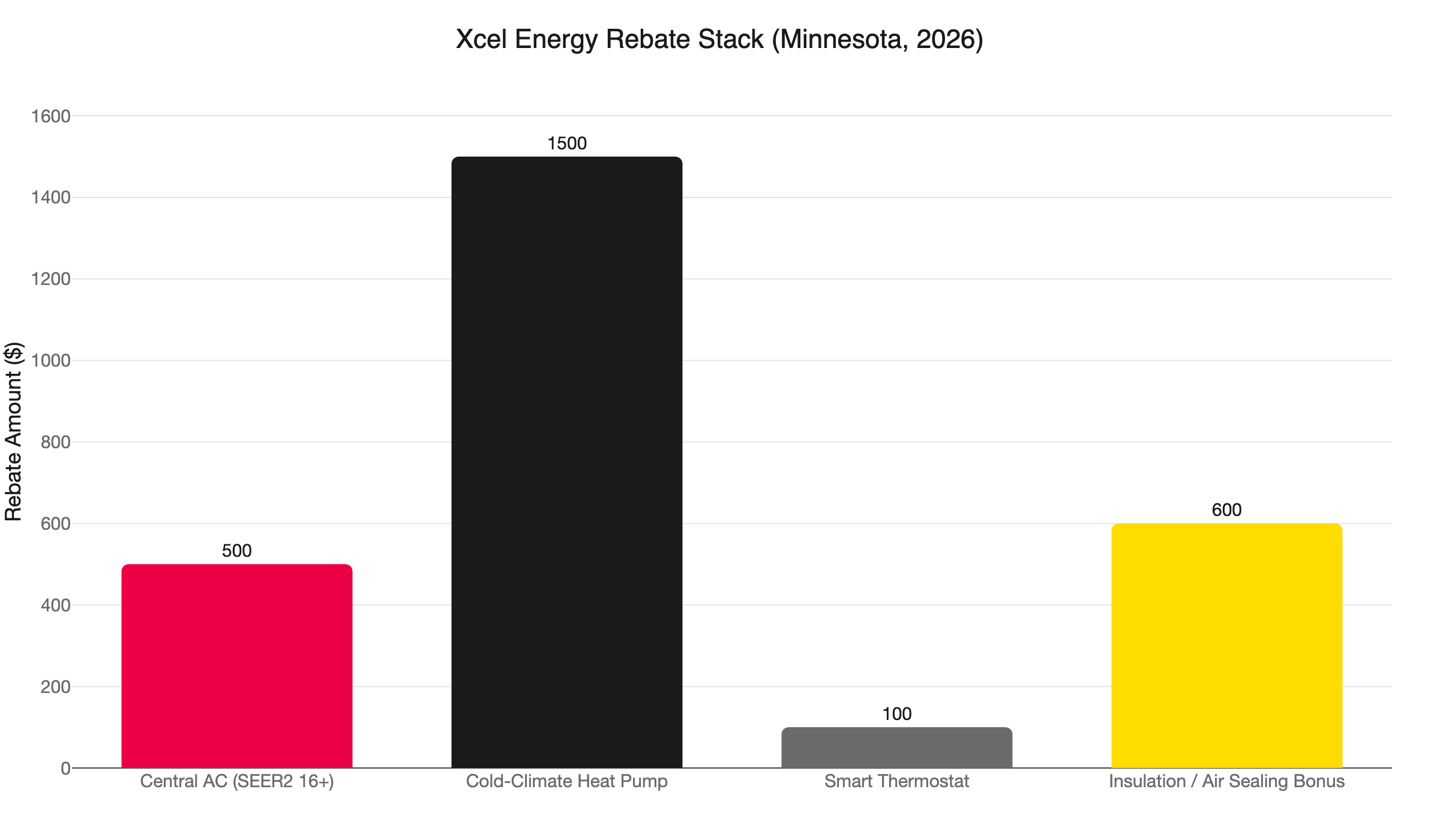
- Xcel rebates still active: Up to $500 for qualifying central AC, up to $1,500 for a cold-climate heat pump, up to $100 for a smart thermostat source
- Refrigerant trigger: If your system uses R-22, replace it. Do not repair it.
- Permit required: Every AC replacement in Minnesota needs a local mechanical permit. No-permit offers are a red flag.
- Repair-versus-replace rule: If the unit is 10 or more years old and the repair quote is close to half of replacement cost, replace it.
What Does AC Replacement Cost in Minnesota?
Most Twin Cities homeowners spend $5,800 to $8,000 installed for a mid-tier central air conditioning system. The full range runs $4,200 to $11,500 depending on efficiency rating, home size, ductwork condition, and whether you replace the furnace at the same time. source
Minnesota labor runs 10 to 20 percent above the national average. Cold-climate equipment specs and strict state licensing requirements drive that premium. source A quote that comes in well below these ranges is worth scrutinizing. Ask whether it includes permits, refrigerant, and disposal before you compare numbers.
What Drives the Price Up or Down?
The biggest driver is the SEER2 efficiency tier you choose. Other factors include home size, whether you bundle a furnace, ductwork condition, and whether you go with a heat pump. For most Minnesota homes, the installed cost lands between $5,800 and $8,000 at the most common efficiency tier.
Efficiency rating
The DOE 2023 rule set the federal minimum for new AC equipment in the Northern region at 14.3 SEER2. Here is how the tiers break down on installed price:
- 14-15 SEER2: $4,200-$6,500 installed. Meets the minimum requirement. Not eligible for Xcel Energy rebates. source
- 16-17 SEER2: $5,500-$8,500 installed. Qualifies for up to $500 in Xcel rebates. This tier covers the majority of Twin Cities residential installs. source
- 18-20+ SEER2: $7,000-$11,500 installed. Highest efficiency available. No federal tax credit applies in 2026. source
System size (tonnage)
Most Minnesota homes need 2 to 4 tons of cooling capacity. A median Minneapolis home of roughly 1,867 square feet typically needs a 3-ton unit. source Tonnage affects both equipment cost and how long the install takes.
Bundling with a furnace
Replacing the AC and furnace at the same time costs more upfront but usually saves money compared to two separate installs. Expect $10,500 to $14,000 for most bundled replacements, with premium systems reaching $18,000. source If your furnace is approaching end of life, bundling now avoids a second round of labor costs in a few years.
Ductwork condition
Older homes sometimes need duct repairs or modifications before a new system can be installed and balanced correctly. This can add $500 to $2,000 or more to the project. A thorough contractor will inspect the duct system before quoting and flag anything that needs attention upfront.
Central AC versus heat pump
A high-efficiency central AC at 18-20+ SEER2 runs $8,500-$12,000 installed. An inverter-driven system runs $10,500-$14,000. source Cold-climate heat pumps carry a higher upfront price, but the Xcel rebate for a qualifying heat pump is up to $1,500, which meaningfully narrows that gap.
Which SEER2 Rating Makes Sense for a Twin Cities Home?
For most Minnesota homeowners, 16-17 SEER2 is the right call. It qualifies for Xcel Energy rebates, avoids the premium pricing of the 18-20+ tier, and delivers a real efficiency improvement over an aging 10-12 SEER system already past its prime. source
Here is the context most online guides skip. Minnesota’s cooling season is significantly shorter than in southern states. You run your AC heavily for four to five months, then barely at all. That changes the payback math. A jump from 16 to 20 SEER2 recovers its premium cost much faster in Houston or Phoenix than in Minneapolis, where the cooling load is simply lower. source
That does not mean 18-20 SEER2 is never worth it. If your home is large, your household runs the AC aggressively, or you plan to stay in the house 15 or more years, the numbers can still favor a higher tier. Ask your technician to model the payback against your actual utility bills. The honest answer depends on your specific home.
For more on getting your cooling system ready for the season, see our post on preparing your AC for spring and the cooling season ahead.
Is the Federal Tax Credit Still Available for 2026 Installs?
No. The Section 25C Energy Efficient Home Improvement Credit expired December 31, 2025. Equipment installed in 2026 does not qualify, even if it was purchased in 2025. source
The “One Big Beautiful Bill Act,” signed July 4, 2025, accelerated the expiration of this credit. source Many articles still reference a 30% federal credit worth up to $600 on central AC. That information is outdated. Do not factor it into your savings estimate, and do not let a contractor reference it to justify a price quote.
This matters most for homeowners who were waiting to upgrade. The credit is gone under current legislation. Utility rebates through Xcel and CenterPoint are still active and can still reduce your net cost in real dollars. But the federal piece no longer applies to any 2026 install.
What Rebates Can Minnesota Homeowners Stack?
Xcel Energy offers up to $500 for a qualifying central AC, up to $1,500 for a cold-climate heat pump, and up to $100 for a smart thermostat. CenterPoint customers can get up to $1,500 for a heat pump. Combined with an insulation bonus, the potential stack reaches $2,600.
Xcel Energy source
- Central AC, SEER2 16 or higher: up to $500
- Cold-climate heat pump (NEEP-listed): up to $1,500
- ENERGY STAR smart thermostat: up to $100
- Insulation and air-sealing bonus, paired with a heat pump: up to $600
Xcel pays rebates as checks after the install is complete. You have 90 days to submit with your contractor invoice and the equipment serial number. Your contractor may submit on your behalf. Confirm that arrangement before work starts.
CenterPoint Energy source
- Ducted air-source heat pump: up to $1,500
- Dual-fuel heat pump system: $1,100
- Rebate form CNP-1375; the dealer typically submits by December 31 of the installation year
Stacking the Xcel AC rebate ($500), the smart thermostat rebate ($100), and the insulation bonus on a heat pump install ($600 on top of $1,500) can reach $2,600 in total utility rebates. That is a meaningful offset against the installed cost. Verify current amounts at xcelenergy.com/programs_and_rebates before finalizing equipment selection. Rebate amounts are set annually and can change.
Should You Repair or Replace Your Air Conditioner?
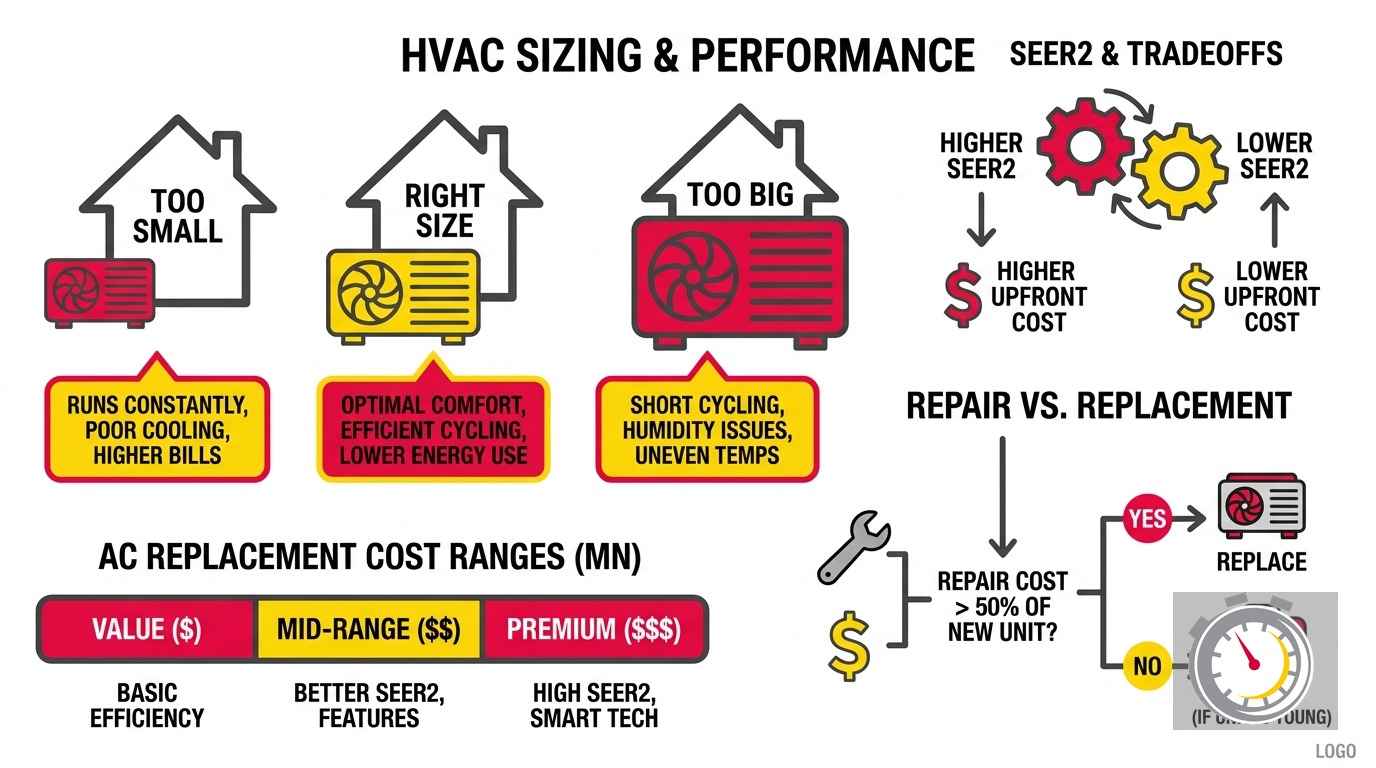
The rule of thumb: if the unit is 10 or more years old and the repair quote is close to half the cost of replacement, replace it. At that point, you are spending money to extend a diminishing asset when a new system would give you better efficiency, better comfort, and a fresh manufacturer warranty. source
Minnesota central AC units last 12 to 15 years with regular maintenance. source Age alone does not decide the question. Here are the signals that point toward replacement:
- Unit is 10-plus years old and a major component has failed: compressor, evaporator coil, or a refrigerant leak in the coil
- Repair quote approaches or exceeds half the price of a new install
- The system uses R-22 refrigerant (see the next section)
- You have had two or more significant repairs in the past few years
- The unit short-cycles, leaves rooms feeling humid, or cannot hold your set temperature on the hottest summer days
Repair makes sense when:
- The unit is under 8 years old and the failure is not refrigerant-related
- The repair involves a minor component: capacitor, contactor, or blower motor
- The repair quote is well under $1,000 and no coil or compressor work is involved
For a complete look at this decision across your full HVAC system, see our guide on repair versus replacement for heating and cooling equipment.
The Refrigerant Trigger: An Automatic Replace Case
If your AC uses R-22 refrigerant, replace it. R-22 was phased out under federal law years ago. Supply is severely constrained, and recharging or repairing an R-22 system in 2026 costs far more than the outcome is worth. source The money is better applied toward a new system.
R-410A systems are next in the transition. The EPA is phasing down R-410A production and imports under the AIM Act. Parts and refrigerant costs will rise as supply tightens over the coming years. source A newer R-410A system under 8 years old is not an automatic replace case. But factor the direction of service costs into your decision when weighing a significant repair.
New systems manufactured since January 1, 2025, use R-454B refrigerant. This is the current EPA-approved transition refrigerant and is future-proofed against the supply disruptions that R-22 and R-410A owners are navigating today.
Not sure what refrigerant your system uses? Check the label on your outdoor condenser unit. Your technician can confirm it on any service call.
How Do You Know Your Home Is Getting the Right Size AC?
A reputable contractor runs a Manual J load calculation before recommending a unit size. If a contractor quotes a system without measuring your home, asking about insulation levels, and accounting for window area and sun exposure, that is a problem. Push back. source
The old rule of thumb: one ton of cooling per 500 square feet. That rule routinely produces oversized systems. Modern Manual J calculations land closer to one ton per 600 to 1,000 square feet for a well-insulated Minnesota home. source
Oversizing creates real comfort and durability problems:
- The unit hits the set temperature quickly but does not run long enough to pull humidity out of the air
- Your home feels cool and clammy at the same time on sticky July afternoons
- Short cycling puts accelerated wear on the compressor
- You paid a premium for capacity you will never use
Undersizing is less common but equally frustrating. An undersized unit runs constantly, struggles on the hottest Minnesota days, and ages faster under the sustained load.
A correctly sized system runs in sustained cycles, reaches your set temperature reliably, and manages humidity. In Minnesota summers, where a stretch of July afternoons can feel as muggy as anywhere in the country, correct sizing affects your daily comfort as much as the efficiency rating does.
What About Permits and Contractor Licensing?
Every AC replacement in Minnesota requires a local mechanical permit. There is no single statewide permit. Your city or county issues it, and your contractor should pull it before work starts. source Typical permit cost runs $150 to $450. Some contractors include this in their quote; others do not. Ask before you sign anything.
A no-permit offer is a significant red flag. Unpermitted HVAC work can void homeowner’s insurance claims tied to related damage. It also creates complications when you sell the house because a buyer’s inspector will flag it.
All HVAC contractors in Minnesota must hold a state mechanical contractor license. Verify any contractor before you hire at dli.mn.gov. source A licensed contractor will pull the permit and schedule the inspection as a standard part of the job.
We are locally owned and operated in Ramsey, MN. Our technicians are state-licensed, pull every required permit, and treat the inspection as part of the job rather than an afterthought. If you want to verify our license before booking, we encourage it.
What Does a Full AC Replacement Day Look Like?
For most Minnesota homes, a central AC replacement takes four to eight hours. The day covers removal of the old system, installation and leak-testing of the new unit, commissioning, and a full walk-through of your new equipment. Larger homes, ductwork modifications, or a line-set replacement can extend the timeline.
Here is what a standard install covers:
- Assessment: The technician reviews the existing equipment, confirms sizing against your home, and walks you through the scope before any work begins
- Removal: The old system is decommissioned and refrigerant is handled per EPA regulations
- Installation: The new condenser goes outside; the new evaporator coil goes inside; all connections are inspected and secured
- Line-set check: The existing refrigerant line set is inspected for corrosion and compatibility and replaced if needed
- Pressurize and leak-check: The system is tested under pressure before refrigerant is charged
- Commissioning: The technician verifies temperatures, airflow, and control operation
- Walk-through: You get a full explanation of the new equipment, thermostat settings, and any rebate paperwork you need to submit
At Northern One Hour, the on-time promise applies to every job. “Always On Time… Or You Don’t Pay a Dime!(R)” When we give you an arrival window, we show up in it.
Once the new system is in, regular maintenance protects your investment. Our post on five AC maintenance habits that extend system life covers what to schedule and when.
Ready to Get a Real Number for Your Home?
The ranges in this guide cover most Twin Cities homes. Your specific number depends on square footage, insulation quality, ductwork condition, existing equipment, and which rebates you qualify for. A phone call or an in-home visit gives you a real answer.
Our team serves the Twin Cities and surrounding communities: Minneapolis, St. Paul, Ramsey, Blaine, Maple Grove, Plymouth, Brooklyn Park, Woodbury, Bloomington, and the broader metro area.
To get a straight estimate with no pressure, call us at (763) 260-6662 or schedule your AC replacement estimate online. We will assess your home, confirm the right size and efficiency tier for your situation, walk you through available rebates, and give you a clear price before any work starts.
If you are weighing a straight AC replacement against a heat pump upgrade, our guide on heat pumps in Minnesota explains when the switch makes financial sense for a cold-climate home.
Frequently Asked Questions
How much does it cost to replace a central AC in Minnesota? +
Is the federal tax credit available for a new AC installed in 2026? +
What Xcel Energy rebates are available for AC replacement in Minnesota? +
Need a technician now?