
Two Stage vs Single Stage Furnace: The Twin Cities Guide
Key Takeaways
- A single-stage furnace runs at 100% capacity every cycle. A two-stage furnace runs at roughly 65-70% on most days, switching to full output only during deep freezes.
- AFUE and staging are separate specs. You can buy a single-stage 96% AFUE furnace or a two-stage 80% AFUE furnace. Do not conflate them.
- Minneapolis and St. Paul log roughly 7,000-8,000 heating degree days per year. That is more annual burner hours than almost any other major U.S. metro.
- CenterPoint Energy offers up to $1,000 for furnaces rated 97%+ AFUE. Xcel Energy offers up to $200 for qualifying high-efficiency units with a variable-speed blower.
- The federal 25C tax credit for HVAC equipment expired December 31, 2025. Any article still citing it is outdated.
- Furnaces manufactured after December 18, 2028 must be at least 95% AFUE. Buying an 80% unit today means buying the last generation of that product.
When you start researching a two stage vs single stage furnace, most of what you find is written for generic cold climates. Many articles still cite a federal tax credit that expired December 31, 2025. Almost none run the actual math for a Minneapolis or St. Paul home.
This guide closes those gaps. It separates AFUE efficiency from staging, because they are different decisions. It uses current Minnesota gas prices to show what the numbers actually look like. And it covers the 2028 federal rule that gives the 80% furnace a defined end date.
Minneapolis runs the furnace roughly six months a year. That run time is where the staging choice pays off. Here is how to make it.
What Is the Difference Between a Two Stage vs Single Stage Furnace?
A single-stage furnace has one output level: full power. A two-stage furnace has two. The lower stage, typically 65-70% of full capacity, handles most winter days. Full power kicks in only when temperatures drop hard and hold there.
A single-stage unit fires at 100%, runs until the thermostat is satisfied, then shuts off. The cycle is short and frequent. Between cycles, room temperature drifts down until the furnace fires again. That repeated swing around your setpoint is what many homeowners experience as “the house never feels even.”
A two-stage furnace starts at low output. On a 20-degree day, it may never leave low stage. On a hard-cold January day in the Twin Cities, it bumps to full capacity and stays there until temperatures recover. According to C&M Heating and Air, two-stage furnaces run at low stage approximately 80% of Minnesota winter days.
That extended low-stage runtime has two real effects. First, the blower runs longer, which circulates heat throughout the home before the thermostat is satisfied. Second, more air passes through the filter and any whole-home air cleaner each day. That matters for households with allergy concerns or anyone running an IAQ system.
One clarification before we go further: staging describes the burner’s output levels. A variable-speed blower, also called an ECM (electronically commutated motor) blower, is a related but separate feature. A two-stage furnace can ship with a standard PSC blower or an ECM blower. That distinction matters significantly when we address the older energy-use research below.
Does a Two-Stage Furnace Save Money on Gas in Minnesota?
For most Twin Cities homes, yes. Upgrading from 80% to 96% AFUE cuts fuel use by roughly 16.7%. Add two-stage operation and a CenterPoint rebate of up to $1,000, and the break-even window shrinks from seven years to closer to three for high-efficiency units.
Let’s run the numbers using real Minnesota inputs.
A mid-size Twin Cities home, roughly 1,800-2,200 square feet, might consume 700-900 therms per heating season. Minnesota Energy Resources customers pay approximately $0.82 per therm. Xcel Energy customers pay roughly $1.04 per therm after a January 2026 rate increase.
At the Xcel rate on 800 therms, that is $832 in annual heating fuel. Switching from an 80% AFUE furnace to a 96% AFUE unit cuts fuel use by about 16.7%. That saves roughly $139 per year on gas alone. Over a 20-year furnace lifespan, that is approximately $2,780 in fuel savings from the AFUE upgrade before accounting for staging.
Two-stage operation compounds that benefit in our climate. The Minneapolis-St. Paul area logs roughly 7,000-8,000 heating degree days annually. That is more annual burner hours than nearly any other major U.S. metro. More hours running at low stage means more savings from extended, quieter cycles compared to frequent full-power blasts.
On premium and payback: a two-stage furnace typically costs 10-30% more installed than a comparable single-stage unit, per PickComfort. On a $6,000-$8,000 installed project, that is roughly $600-$2,400 extra. In cold-climate conditions like ours, payback typically runs 3-7 years. A $1,000 CenterPoint rebate on a 97%+ AFUE unit pushes that window toward the shorter end.
Two Stage vs Single Stage Furnace: Why AFUE Is a Separate Decision
This is the most common point of confusion in furnace shopping.
AFUE stands for Annual Fuel Utilization Efficiency. It measures what percentage of every fuel dollar becomes useful heat. An 80% AFUE furnace turns 80 cents on the dollar into warmth. A 96% AFUE furnace turns 96 cents. The U.S. Department of Energy’s Energy Star program defines AFUE as the standard efficiency metric for residential gas furnaces.
Staging is a separate question entirely. It describes how many output levels the burner has: one (single-stage), two (two-stage), or a continuous range (modulating). These specs are independent. A single-stage 96% AFUE furnace exists. A two-stage 80% AFUE furnace exists. A modulating 98% AFUE furnace exists.
When you are replacing a furnace, you make both decisions. If you are upgrading from 80% to 96% AFUE, the efficiency jump delivers the largest fuel savings. Stepping up to two-stage at the same AFUE tier adds a comfort and run-time benefit on top of that efficiency gain.
A practical rule of thumb: if your home is large, multi-story, or has uneven temperature complaints, two-stage gives you something the AFUE number alone does not. If your primary goal is restoring heat fast on a limited budget, single-stage at the right AFUE is a fully reasonable choice. Neither is wrong in the abstract. Both depend on your home size, budget, and how much your current comfort situation bothers you.
What About the Research Showing Two-Stage Furnaces Use More Energy?
That finding comes from a 2006 ASHRAE study, conducted before ECM variable-speed blower motors were common. Modern two-stage furnaces with ECM blowers draw 25-75% less electricity at low speed. The energy math has changed substantially since 2006. The study was real and accurate for its time. Its conclusions do not apply to current equipment.
The 2006 ASHRAE research found two-stage furnaces consumed about 11% more energy than single-stage units. The mechanism was straightforward: longer blower run times at low stage consumed more motor electricity than the gas savings recovered. The study also found that supply air temperature at 75% output was only 7-10 degrees lower than at full output, questioning whether the comfort improvement was meaningful.
That was accurate for PSC blower motors, which were standard at the time. PSC motors draw nearly the same electricity at low speed as at full speed. Twice the run time meant twice the motor energy cost.
ECM motors work differently. They adjust their electricity draw to match the load. At reduced speed, they use 25-75% less electricity than at full speed. Running an ECM blower at low stage for two hours costs less in electricity than running a PSC blower at full speed for one hour.
When you pair a two-stage burner with an ECM blower, the extended run time produces a net energy benefit. More air moves through the system per dollar of electricity. Heat distributes more evenly across longer, quieter cycles.
The practical takeaway: when comparing specific models, ask whether the unit includes an ECM blower. That feature determines whether the 2006 research applies to your purchase. Mid- and upper-tier two-stage furnaces from major manufacturers typically include ECM blowers today. Entry-level two-stage models may still use PSC motors.
What Are the Current Minnesota Rebates for a New Furnace?
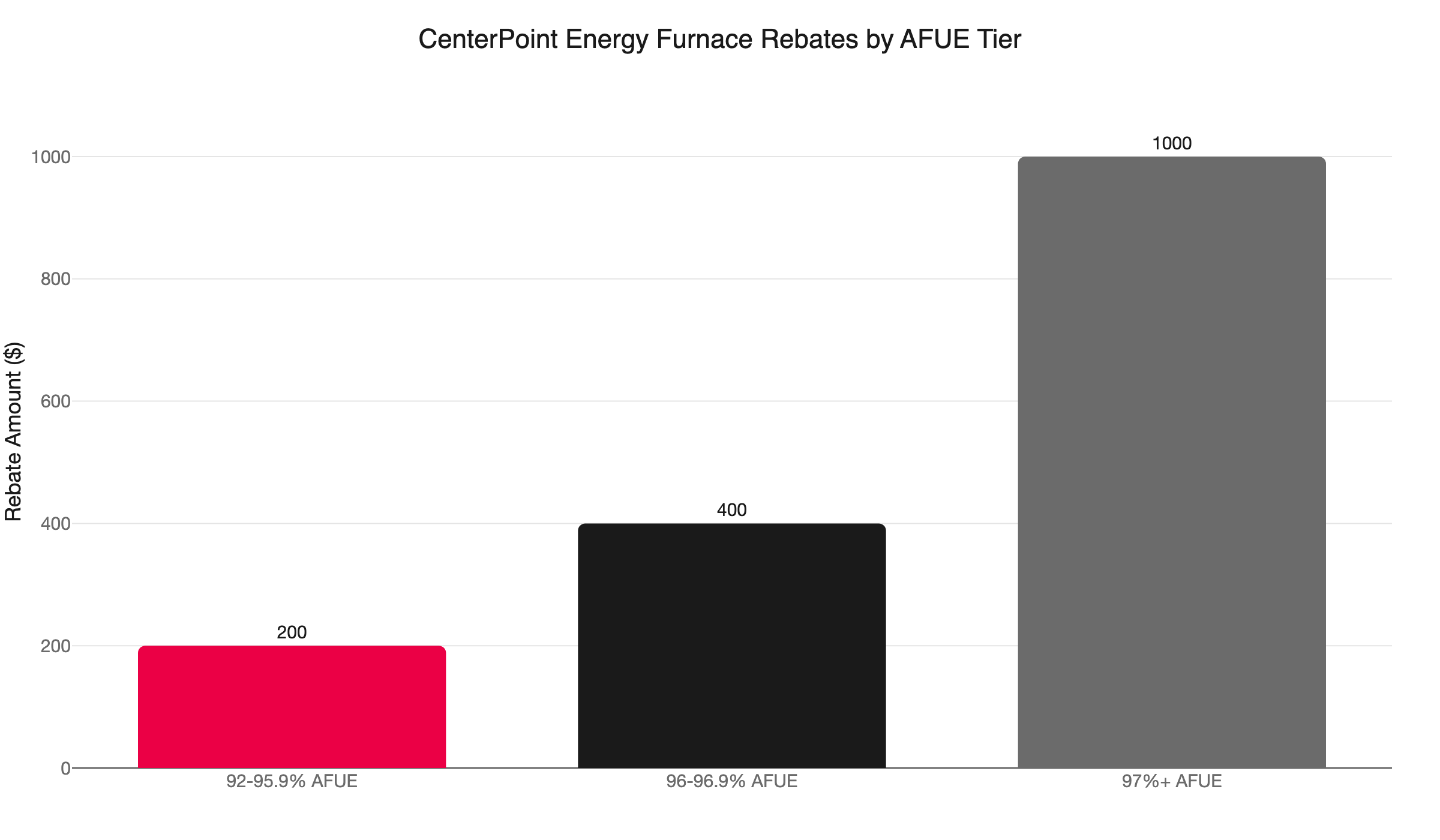
CenterPoint Energy’s program is among the most generous residential furnace rebate programs in the country. CenterPoint customers can receive up to $1,000 for a 97%+ AFUE furnace. Xcel Energy customers can receive up to $200 for a qualifying high-efficiency unit with a variable-speed blower. Both programs apply regardless of staging type.
CenterPoint Energy’s current residential furnace rebates break down by AFUE tier:
- $200 for furnaces rated 92-95.9% AFUE
- $400 for furnaces rated 96-96.9% AFUE
- $1,000 for furnaces rated 97%+ AFUE
Xcel Energy offers up to $100 for a 95%+ AFUE unit and up to $200 for a 96%+ AFUE unit with a variable-speed blower. Verify current amounts at xcelenergy.com/saveenergy before committing, since rebate programs update periodically.
These rebates are based on AFUE tier, not on staging. A two-stage 96% furnace and a single-stage 96% furnace qualify for the same CenterPoint rebate. Where staging helps your rebate case is when the specific two-stage model is rated 97%+, which is the top tier.
Modulating furnaces often hit 97-98% AFUE and can maximize the CenterPoint rebate. If you are investing in a high-efficiency replacement, confirm the exact AFUE of the specific model before signing anything. That number determines your rebate tier, and a difference of half a percentage point can mean $600 in the wrong direction.
What Happened to the Federal 25C Tax Credit?
It expired. The One Big Beautiful Bill Act, signed July 4, 2025, ended the Section 25C Energy Efficient Home Improvement Credit for HVAC equipment placed in service after December 31, 2025. Any article claiming the 30%-up-to-$600 credit is available in 2026 is citing outdated information.
This matters because several top-ranking articles on furnace comparisons still reference the federal credit as active. If you want primary-source confirmation, check irs.gov. Our team can also clarify what incentives are currently available when you call.
The good news is that state utility rebates are still live and, for high-AFUE units, are worth more than the old federal credit anyway. A $1,000 CenterPoint rebate on a 97%+ AFUE furnace exceeds the $600 cap the expired credit offered. The shift from federal to utility-level incentives is real, but the math still works in your favor if you choose the right unit.
The 2028 Rule: Why the 80% Furnace Has an Expiration Date
In December 2023, the Department of Energy finalized a rule requiring all new residential gas furnaces manufactured on or after December 18, 2028 to meet a 95% AFUE minimum. The rule effectively mandates condensing furnace technology for all new equipment. The current federal minimum is 80% AFUE, set in 2007, and you can still buy an 80% furnace today.
The rule has had a complicated legal path. The D.C. Circuit upheld it in November 2025. In June 2026, the Supreme Court remanded the rule after DOE conceded a legal error. The compliance date still stands as of this writing, though DOE is reviewing whether to extend it to January 1, 2030.
What this means practically: an 80% furnace bought today is the last generation of that product. Service and parts will remain available for the life of the unit. But new 80% furnaces will eventually stop being manufactured.
There is a legitimate case for an 80% furnace in specific homes. Some older construction lacks a suitable condensate drain. Some venting configurations make installing a condensing furnace difficult or expensive. In those situations, the 80% unit may be the only practical option this season.
For most Twin Cities homes in standard construction, those constraints do not apply. If you are unsure whether your home has a venting or drainage constraint, that is exactly what to assess as part of a furnace replacement consultation. The practical direction for most homeowners replacing a furnace in 2026 points toward 95-96% AFUE or higher.
Who Should Buy a Two-Stage Furnace?
Most Twin Cities homeowners replacing a furnace in 2026 will benefit from two-stage operation. The strongest cases are two-story homes with comfort complaints, homes where someone deals with allergies or uses air purification equipment, and any installation where the furnace will be paired with an ECM variable-speed blower.
Two-stage is the right default for most new installations in our climate. Here is when the advantage is most clear.
Two-story and larger homes. Single-stage furnaces satisfy the thermostat quickly on milder days. Rooms farther from the thermostat sensor get less heat before the burner shuts off. A two-stage unit runs longer cycles, pushing conditioned air deeper into the home. If you have dealt with uneven temperatures and cold spots in December, staging is often a meaningful part of the answer.
Homes with allergy or IAQ concerns. More blower hours per day means more air passes through your filter or whole-home air purification system. A two-stage unit with an ECM blower can run nearly continuously at low speed on mild days. That is a material difference in daily filtration volume, not a marginal one.
Homeowners upgrading from 80% AFUE. When you are already investing in a full replacement, the incremental cost to step up to a two-stage 96%+ model is modest relative to the total project cost. The utility rebate closes much of the remaining gap.
When single-stage is the right call. Small homes under 1,200 square feet where the furnace already satisfies quickly. Budget-constrained situations where the premium cannot realistically be recovered. Homes with installation constraints that force a lower-efficiency unit anyway.
Whatever you choose, the staging decision is only as good as the sizing underneath it. An oversized furnace, single-stage or two-stage, will short-cycle regardless. A Manual J heat-loss calculation is the prerequisite to every efficiency decision that follows.
Getting the Right Furnace for Your Home
A proper replacement starts with a load calculation. That assessment tells a technician exactly how much heating capacity your home actually needs. Right-sizing is what makes the staging choice pay off.
For a detailed look at what a replacement project costs in the Twin Cities, including equipment tiers and installation variables, see our furnace replacement cost guide. It covers what to ask before you commit to a price and what separates a good installation from one that causes headaches later.
We are locally owned and operated in Ramsey, serving Minneapolis, St. Paul, Blaine, Maple Grove, Plymouth, Brooklyn Park, Woodbury, Bloomington, and the surrounding metro. When we schedule a service window, we show up. “Always On Time… Or You Don’t Pay a Dime!(R)” is not a marketing line. It is the standard we hold on every call.
If your furnace is due for replacement, or you want an honest read on whether repair still makes sense, call us at (763) 260-6662 or book online. We will walk you through the staging and AFUE decision for your specific home, help you claim every rebate you qualify for, and get the work done when we said we would.
Frequently Asked Questions
Is a two-stage furnace worth the extra cost in Minnesota? +
What is the difference between a two-stage and single-stage furnace? +
Can I still claim the federal 25C tax credit for a new furnace in 2026? +
What is the 2028 furnace efficiency rule? +
Need a technician now?