
Oil Furnace to Gas Conversion Minnesota: Costs and Rebates
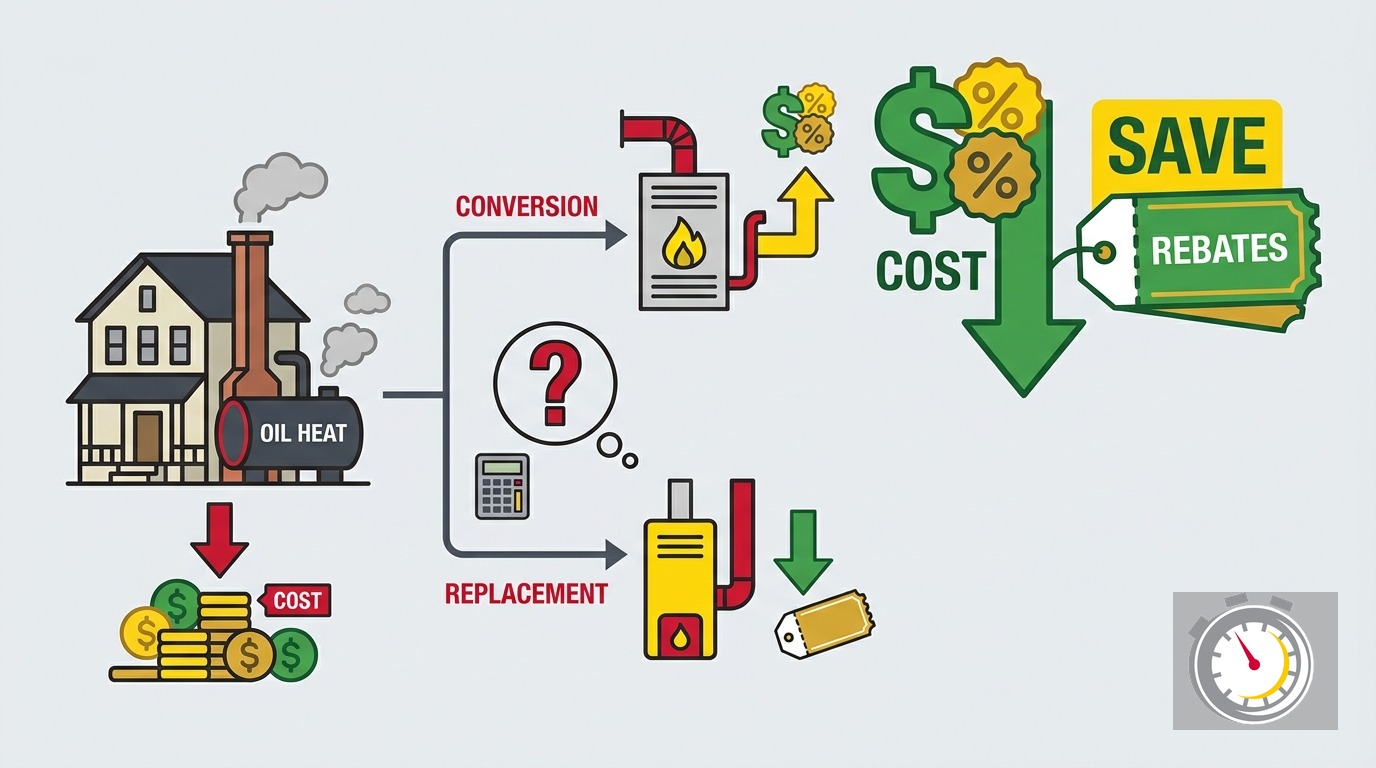
Key Takeaways
- Full oil furnace to gas conversion in Minnesota runs $6,500-$19,500 for most homes. Equipment cost, gas line distance, and oil tank removal are the three main drivers.
- CenterPoint Energy offers up to $400 for a 95%+ AFUE gas furnace in 2026 (up to $1,200 for income-qualified households). The federal IRA Section 25C tax credit adds up to $600 on top.
- Minnesota’s Save Energy MN rebate program (HOMES/HEAR) has not launched as of mid-2026. Do not count on that money yet.
- Underground oil tanks are a cost wildcard. If the tank has leaked and contamination is found, remediation costs cannot be predicted upfront.
- A burner conversion kit does not qualify for utility rebates or the IRA tax credit. It also leaves an aging heat exchanger in place. Full furnace replacement is the right call for units 15 years or older.
- Every fuel-switching install in Minnesota requires a mechanical permit under MN Rules Chapter 1346. Unpermitted work can block a home sale.
- Minnesota logs roughly 7,600 heating degree days per year, about 40% more than the national average. That makes annual gas savings larger here than generic payback calculators show.
Thousands of older Twin Cities homes still heat with oil. If yours is one of them, you have probably thought about oil furnace to gas conversion in Minnesota at least once. Oil prices have been volatile. Old oil furnaces wear out. And natural gas offers a more predictable, locally supplied fuel that most of your neighbors already use.
This guide covers what conversion actually costs in the Twin Cities, which rebates stack in 2026, what most national guides miss for Minnesota specifically, and how to figure out whether the project makes financial sense for your home.
What Does Oil Furnace to Gas Conversion in Minnesota Actually Cost?
The short answer: Most Twin Cities homeowners spend between $6,500 and $19,500 total for a full oil-to-gas conversion. Gas line distance, oil tank type, and equipment efficiency tier are the three main variables. Your project can land well below or well above that range depending on site conditions.
Here is what drives each piece.
New gas furnace
A new high-efficiency gas furnace installation typically makes up a significant portion of the overall conversion cost. Unit size, efficiency tier, and brand drive the spread. A two-stage or modulating furnace at 98% AFUE costs more than a single-stage 95% unit, but it earns better rebates and runs more evenly through a Minnesota winter. See our furnace replacement cost guide for the Twin Cities for a fuller breakdown by equipment tier.
Gas line
If your home already has natural gas service for a water heater or range, running a branch line to the furnace location costs $500-$2,000. If CenterPoint Energy or Minnesota Energy Resources needs to extend service from the street main, budget $2,000-$5,000 or more. The key variable is distance. In older, denser Twin Cities neighborhoods, the main is often at the curb. On larger lots or rural-edge properties, it can be hundreds of feet away.
Oil tank removal
Above-ground tanks run $400-$2,800 to remove. Underground tanks can cost significantly more to remove than above-ground tanks. That does not include environmental remediation if contamination is found. More on buried tanks below.
Chimney liner
High-efficiency gas furnaces vent through PVC pipe, not a masonry chimney. If your water heater or another appliance still uses the existing chimney, a liner will add to your project cost.
Permits and inspections
Twin Cities municipalities charge $50-$175 for a mechanical permit. Your contractor pulls it and schedules the inspection. That fee is nonnegotiable and worth every dollar, as the section on permits below explains.
A home with existing gas service and an above-ground tank can come in at the low end of the range. A property that needs a new gas main extension plus underground tank removal can climb well past $19,500. Add soil remediation and the number grows further.
Burner Kit or Full Replacement: Which Is the Right Move?
The short answer: If your oil furnace is 15 years old or older, replace the whole unit. A burner conversion kit costs less upfront but leaves an aging heat exchanger in place, does not qualify for rebates, and does not improve efficiency. Full replacement is the financially and mechanically sound choice for most Minnesota homes.
A burner conversion kit ($300-$600 in parts) replaces the oil burner on your existing furnace with a gas burner. The heat exchanger, blower motor, and controls stay in place. It sounds like a bargain. Here is why it usually is not:
- Rebate eligibility. CenterPoint’s 2026 rebate program requires a new qualifying furnace. A burner kit on an old furnace does not qualify. Neither does it qualify for the federal IRA Section 25C tax credit.
- Efficiency. Older oil furnaces often run at 70-80% AFUE. A burner swap changes the fuel but keeps the same efficiency floor. A new 95%+ AFUE gas furnace cuts fuel consumption dramatically by comparison.
- Safety. A conversion kit leaves the heat exchanger untouched. A cracked heat exchanger allows combustion gases, including carbon monoxide, to enter your living space. On a furnace 15 or more years old, that risk is real and growing.
There is a narrow case for a burner kit: a well-maintained oil furnace under 10 years old, in excellent condition, with a recently verified heat exchanger. Outside that window, full replacement is almost always the right call. The rebate savings alone often close much of the cost gap between a kit and a new unit.
What Rebates and Incentives Apply to Oil Furnace to Gas Conversion in Minnesota?
The short answer: Stack CenterPoint (up to $400, or $1,200 income-qualified) and the federal IRA credit (up to $600) for a combined offset exceeding $1,000 on a qualifying high-efficiency furnace. The state HOMES/HEAR program has not launched yet, so do not build it into your budget.
Here is the full rebate picture for 2026.
CenterPoint Energy (serves Minneapolis, St. Paul, Ramsey, Blaine, Maple Grove, Plymouth, and most of the Twin Cities metro):
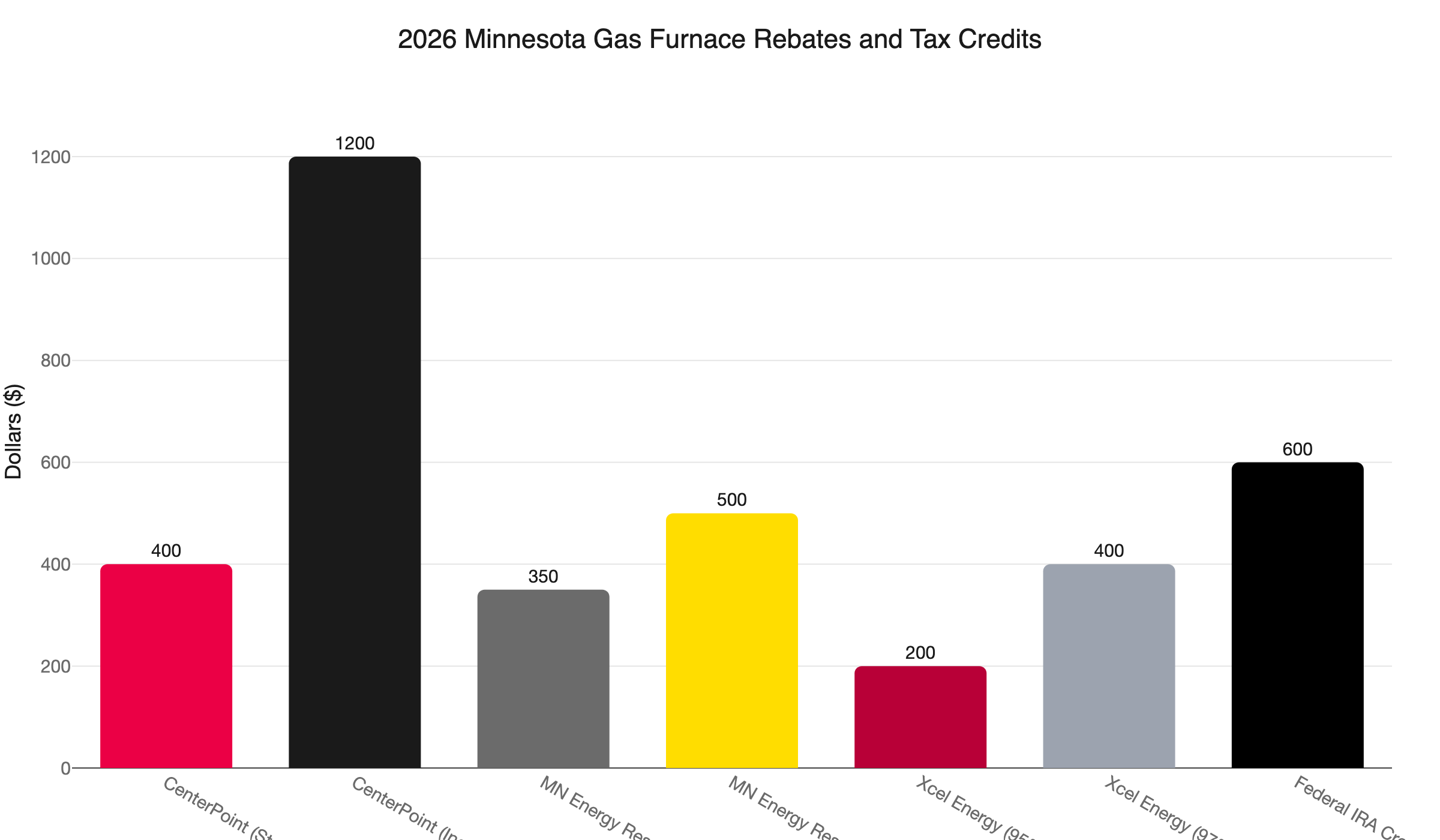
- 95%+ AFUE gas furnace: up to $400
- Income-qualified households: up to $1,200
- Dual-fuel heat pump paired with a 92%+ AFUE backup furnace: $1,100
Minnesota Energy Resources (serves exurban and some rural areas outside the CenterPoint footprint):
- 95% AFUE furnace: $350
- 97% AFUE furnace: $500
Xcel Energy (electric utility; many CenterPoint-served homes also have Xcel for electricity):
- 95% AFUE furnace: $200
- 96% AFUE furnace: $300
- 97% AFUE furnace: $400
Federal IRA tax credit: 30% of equipment and labor costs, capped at $600 for a qualifying high-efficiency gas furnace. This is a dollar-for-dollar tax credit, not a deduction. You claim it when you file your federal return.
Save Energy Minnesota (HOMES/HEAR): Many sources list this federal pass-through program as an available rebate. It is not yet. Minnesota’s mn.gov program page shows the state is still awaiting U.S. Department of Energy approval, with no estimated launch date. Do not factor it into your project budget until it actually opens.
Income-qualified homeowners may also access the Energy Assistance Program for heating bill help and the Weatherization Assistance Program for free efficiency upgrades through MN Commerce.
For a deeper look at stacking utility incentives across programs, see our guide to Xcel and CenterPoint HVAC rebates in Minnesota.
What About That Underground Oil Tank?
The short answer: Buried storage tanks are common in pre-1980 Twin Cities homes and are the biggest cost wildcard in a conversion. Know what you have before signing a contract. A leaking tank can add remediation costs that no contractor can quote in advance.
Many homes built before natural gas was widely available used underground tanks to store heating oil. These tanks corrode over decades. When they fail, petroleum moves into surrounding soil and can reach groundwater.
Above-ground tank removal typically takes a single day. Underground tank removal requires excavation and a state-required environmental assessment if contamination is found. If the tank has leaked, soil remediation costs are not predictable without testing. The Minnesota Pollution Control Agency (MPCA) oversees contamination cases and has resources for affected homeowners, but timelines extend well beyond a normal HVAC project.
Before signing a conversion contract, ask your contractor to help identify whether your property has a buried tank. Check old heating records, pull the permit history, and set aside a contingency in your budget. A buried tank that has leaked is not a reason to abandon the project. It is a reason to know the full scope before you commit.
Does the Math Work Out in Minnesota’s Climate?
The short answer: For most Twin Cities homeowners, yes. Minnesota’s heavy heating season produces annual fuel savings that are meaningfully larger than national payback calculators show. Typical payback at current oil prices runs 6-10 years, compressing to 4-5 years when oil climbs hard.
Standard payback at current oil prices (around $3.44 per gallon nationally) runs 6-10 years. When oil climbs above $4.50 per gallon, as it did in 2022, payback compresses to 4-5 years. Minnesota’s Midwest residential heating oil prices, tracked by the EIA, have often come in below the national average. That can stretch payback slightly compared to generic estimates.
What those calculators do not account for is Minnesota’s heating load. The state averages roughly 7,600 heating degree days per year, about 40% more than the U.S. average. More heating days means more gallons burned each season. Switch that demand from oil to natural gas and the annual savings are proportionally larger than the national figure suggests.
Gas price volatility also matters. Heating oil is a global commodity priced on international markets. Natural gas is primarily priced on North American supply. The 2022 oil spike hit oil-heated Minnesota homes hard. Many homeowners who converted before that spike saw immediate budget relief. Some converted specifically to reduce exposure to future price swings, independent of any payback calculation.
What Permits and Codes Apply to Oil-to-Gas Conversion in Minnesota?
The short answer: Every fuel-switching furnace install in Minnesota requires a mechanical permit under MN Rules Chapter 1346. Your licensed contractor pulls it. Work done without a permit can block or delay a home sale when a buyer’s inspector catches it.
Minnesota operates under the 2020 Minnesota Mechanical and Fuel Gas Code (MN Rules Chapter 1346). It adopts the 2018 International Mechanical Code and 2018 International Fuel Gas Code with state-specific amendments.
On a fuel-switching install, the inspector verifies:
- Venting is correctly sized and routed for the new appliance type
- Gas piping passes a pressure test
- Combustion air supply is adequate for the equipment and space
- Condensate drain is correctly installed on high-efficiency units
- All clearances meet code requirements
Only a Minnesota-licensed HVAC contractor can perform the installation. The statewide minimum efficiency is 80% AFUE, but 95% or better is required for rebate eligibility. You want to be well above that floor anyway.
Permit fees of $50-$175 may seem minor. The consequence of skipping the permit is not. Home inspectors find unpermitted work consistently. An unpermitted furnace conversion surfaces in the inspection report, triggers disclosure obligations, and can force a price renegotiation or kill a sale. Pull the permit. It is not optional.
How Does the Conversion Process Work, and How Long Does It Take?
The short answer: A full oil-to-gas conversion takes a few days to one week from tank removal to final inspection. The one timeline wildcard is gas service extension from the street, which can add several weeks if CenterPoint needs to run a new main.
Here is the sequence, step by step.
- Initiate gas service, if needed. If your home does not have natural gas, call CenterPoint at 612-342-5123 (local) or 1-800-342-4166 to request service. If the street main needs to reach your home, this step can take several weeks. Start it early, before scheduling the furnace install.
- Pull the mechanical permit. Your contractor handles this with the municipality.
- Remove and dispose of the oil tank. Above-ground tanks come out in a day. Underground tanks require excavation and, if contamination is found, an environmental assessment before work continues.
- Remove the old oil furnace.
- Install the new gas furnace. The contractor runs the gas line from the service point to the unit, installs the furnace, and converts venting to PVC on high-efficiency models.
- Test and inspect. The inspector checks gas pressure, venting, combustion air supply, condensate routing, and clearances. System runs.
- Submit rebate documentation. Your contractor provides the equipment specs CenterPoint, MN Energy Resources, or Xcel needs to process the rebate.
Gas service extension is the only step with an unpredictable timeline. Everything else moves quickly once gas is on site. If you are planning a fall or early-winter conversion, start the CenterPoint conversation in late summer.
When Should You Replace the Furnace Instead of Just Converting the Burner?
For any oil furnace 15 years old or older, the answer is almost always: replace the whole unit. A furnace at that age has served most of its useful life. A burner kit conversion preserves a heat exchanger that may already be near failure. It does not earn rebates. It does not move the efficiency needle.
Full replacement resets the clock. A new gas furnace carries a manufacturer warranty and typically runs 15-20 years. It operates at 95-98% AFUE instead of a 70-80% oil baseline. It qualifies for utility rebates and the IRA tax credit. And it gives you a new system with new components, not a converted-over old one.
If your oil furnace is under 10 years old and in verified good condition, a burner kit is worth a conversation. Outside that window, full replacement is the better investment nearly every time.
Ready to Make the Switch?
Northern One Hour Heating & Air Conditioning is locally owned and operated in Ramsey, and we serve homeowners across the Twin Cities metro: Minneapolis, St. Paul, Blaine, Maple Grove, Brooklyn Park, Plymouth, Woodbury, and Bloomington.
Our team handles oil-to-gas conversions from start to finish. That means coordinating with CenterPoint on gas service, pulling the mechanical permit, removing the old oil furnace, installing the new unit, passing inspection, and submitting your rebate documentation. We know the Twin Cities utility rebate landscape, the permit process by municipality, and the underground tank questions to ask before any project starts.
We operate on one promise: “Always On Time… Or You Don’t Pay a Dime!(R)” Your technician arrives within the time window you select. If not, you do not pay for the service.
Call (763) 260-6662 or schedule your consultation online to get a straight quote on your oil furnace to gas conversion. We will walk through your home’s gas access, tank situation, and rebate eligibility before recommending anything.
Frequently Asked Questions
How much does oil furnace to gas conversion cost in Minnesota? +
What rebates are available for oil-to-gas furnace conversion in Minnesota? +
Do I need a permit to switch from oil to gas heat in Minnesota? +
Does oil-to-gas conversion pencil out financially in Minnesota? +
Need a technician now?