
Best Garage Heater for Minnesota Winters: 3 Options Compared
Key Takeaways
- Minneapolis has an ASHRAE 99% heating design temperature of -16°F. Size your heater to that number, not a national rule of thumb.
- A typical uninsulated 2-car garage (about 440 sq ft) needs roughly 45,000 BTU. A well-insulated one drops to around 30,000 BTU.
- Minnesota Mechanical Code Chapter 1346 bans unvented infrared heaters unless mechanical exhaust is electrically interlocked at 4 cfm per 1,000 BTU/hr of input.
- All enclosed garages require both a CO detector and an NO2 detector under MN Rules Chapter 1346.
- Forced-air gas unit heaters warm up the fastest and cost the least per hour to run at current CenterPoint gas rates.
- A cold-climate mini-split operates at -22°F and costs roughly $130 per season at 2026 Xcel rates.
- The federal 25C heat pump tax credit expired December 31, 2025. Xcel Energy still offers up to $2,000 for qualifying cold-climate mini-splits.
- A standard gas unit heater installation typically wraps in a single day if gas line and electrical are already nearby.
What Is the Best Garage Heater for Minnesota Winters?
For most attached Twin Cities garages, a forced-air natural gas unit heater is the most practical choice. It warms up fast, costs the least to run per hour, and is code-compliant with a proper vent. A cold-climate mini-split is the strongest alternative when you want no combustion in an attached garage. Unvented infrared heaters require mechanical exhaust that most garages do not have.
The right answer for your garage depends on four things: attached or detached, insulated or bare, gas line present or not, and how often you use the space. All three options have a real use case in Minnesota. None of them are plug-and-play without a permit.
How Many BTUs Does a Minnesota Garage Need?
A typical uninsulated 2-car garage (about 440 sq ft, 8-ft ceiling) needs roughly 45,000 BTU. Add insulation and that drops to around 30,000 BTU. Minnesota Mechanical Code Chapter 1346 requires ACCA Manual J sizing, and oversizing cannot exceed 40% of the calculated load.
The reason sizing matters here is the actual design temperature. Minneapolis sits at an ASHRAE 99% heating design temperature of -16°F. That is not the -20°F shorthand you sometimes hear. The -20°F figure applies to Duluth. But -16°F is still extreme, and generic national BTU charts do not account for it.
A rough field calculation works like this:
- Step 1: Measure your garage. Length x width x ceiling height = cubic feet.
- Step 2: Multiply cubic feet by the air change factor: roughly 0.133 for a well-sealed garage, 0.25 for a leaky one.
- Step 3: Multiply by the temperature difference: your target (65°F) minus -16°F = 81°F.
- Step 4: That result is your approximate BTU/hr load.
A licensed HVAC technician will run a proper Manual J calculation. It accounts for wall insulation, window area, door type, and infiltration rate. MN code requires it. A competent installer will not skip it.
Forced-Air Gas Unit Heaters: The Workhorse Option
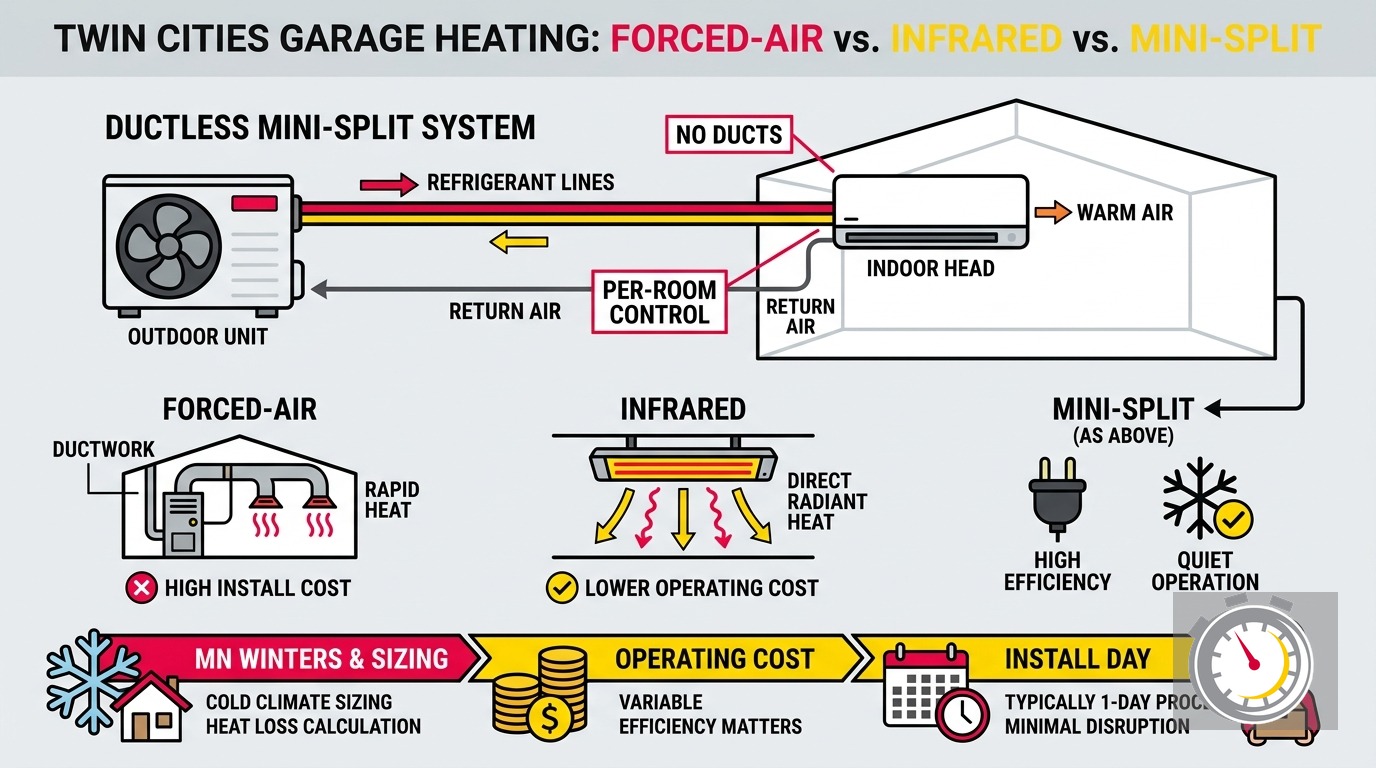
Forced-air unit heaters are the most common garage heater in Minnesota. They push high volumes of warm air quickly. That matters when you open the overhead door in February and lose your heat in under a minute.
Key characteristics:
- BTU range: 30,000 to 75,000+, covering any residential garage
- Fuel: natural gas or propane
- Venting: power-vent or direct-vent required; no unvented gas heaters under MN code
- Warm-up speed: fastest of the three options
- Operating cost: lowest per-hour fuel cost at current CenterPoint gas rates
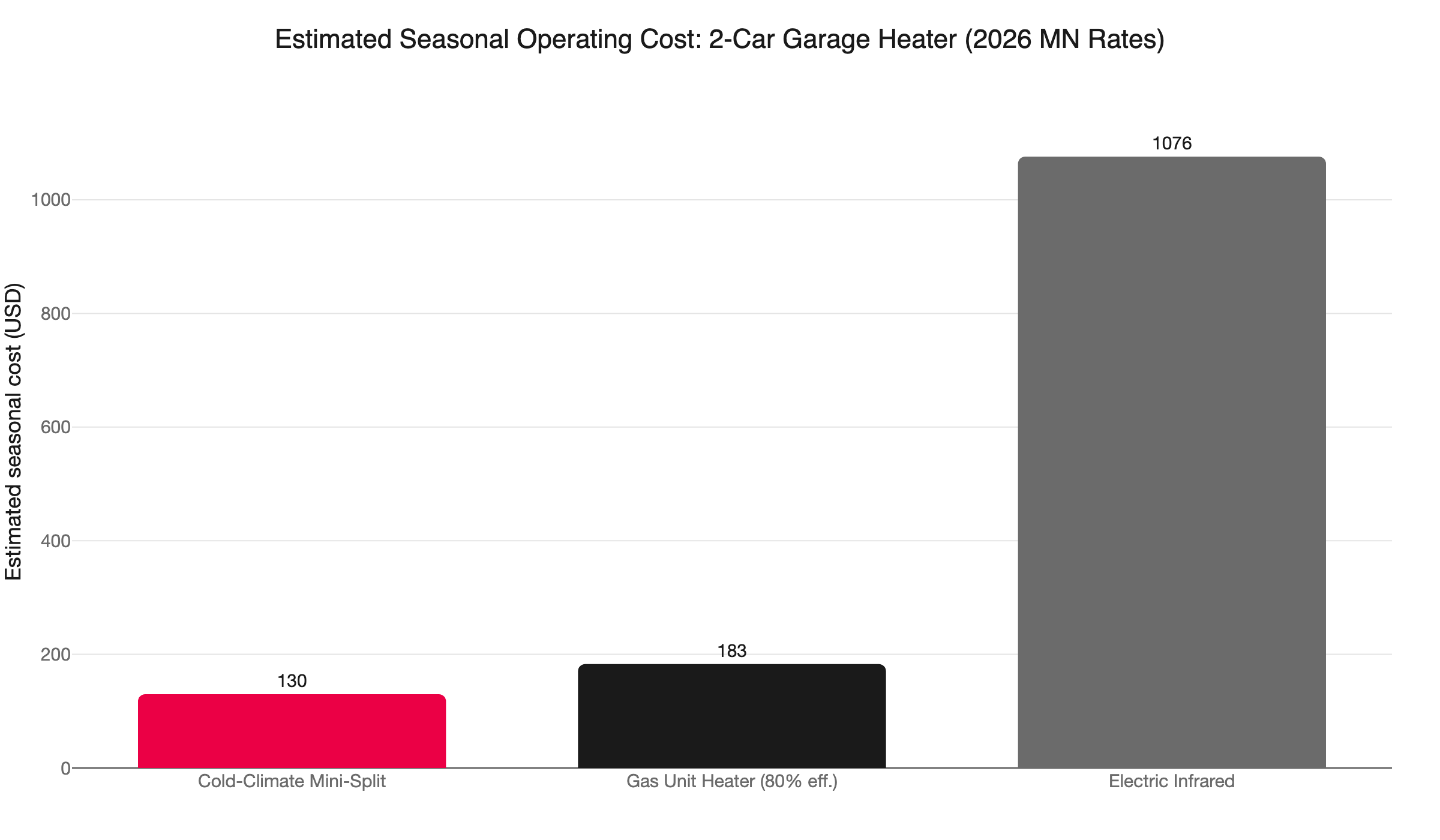
CenterPoint Energy’s current commodity gas rate runs approximately $0.40 per therm during normal periods, with a delivery charge of about $0.279 per therm. A 30,000 BTU unit heater at 80% efficiency uses roughly 0.375 therms per hour. At six hours per day across a 120-day heating season, fuel cost lands around $183 for the season.
The trade-off is installation complexity. A gas unit heater needs a gas line stubbed to the unit location, a vent pipe run through the wall or roof, and an electrical connection for the blower and controls. All of that requires a mechanical permit and on-site inspections.
For a detailed look at what the installation process involves, see what to expect on HVAC install day in the Twin Cities.
What Does Minnesota Code Say About Infrared Heaters?
Unvented infrared heaters are not a plug-and-play option in Minnesota. MN Rules Chapter 1346, Section 901.5 bans unvented room heaters and unvented infrared heaters in any occupancy. There is one narrow exception: unvented infrared is allowed only if mechanical ventilation exhausts at least 4 cfm per 1,000 BTU/hr of input, electrically interlocked so the heater cannot run without the exhaust running.
Infrared heaters work differently than forced-air. They heat objects and surfaces, not the air itself. That is an advantage in spaces with high air turnover. A shop with a frequently-opened overhead door loses less heat with infrared than with forced-air. You are warming the floor and walls, not the air that escapes every time the door opens.
The catch in Minnesota is the exhaust requirement. Most residential garages do not have a continuous mechanical exhaust system. Installing one adds cost and complexity. If you are considering an infrared heater for a high-turnover space, talk to a licensed HVAC tech about whether the interlock is practical for your garage.
MN code also requires CO and NO2 detection in any enclosed garage. Section 404.1 of MN Rules 1346 mandates a CO detector (UL 2075 listed) and an NO2 detector. Mechanical ventilation must activate automatically at 25 ppm CO or 3 ppm NO2. This applies regardless of which heater type you choose. Our post on carbon monoxide safety during furnace season explains what those detectors are actually measuring and why the thresholds matter.
Are Cold-Climate Mini-Splits a Real Option for Garage Heating?
Yes, and they are underrated for attached garages. A cold-climate mini-split produces no combustion, requires no gas line, and operates efficiently well below zero. ENERGY STAR’s cold-climate heat pump program requires a COP of at least 1.75 at 5°F for qualification. The Fujitsu Orion XLTH+ retains 90% heating capacity at -15°F. The Mitsubishi Hyper-Heat FX series operates to -22°F. At 2026 Xcel rates, running a 12,000 BTU unit costs roughly $130 per season.
The case for a mini-split is strongest when CO risk is the primary concern. An attached garage shares a wall with your living space. A combustion appliance adds CO load to that shared environment. A mini-split eliminates that risk entirely. It also cools in summer, which a gas unit heater cannot do.
The trade-offs:
- Upfront cost: Higher than a gas unit heater, typically $3,000 to $6,000+ installed, depending on unit size and electrical work required.
- Warm-up speed: Slower than forced-air in a very cold, uninsulated space. Mini-splits work best in insulated garages.
- Electrical: Requires a dedicated 240V circuit. If your panel is near capacity, add panel work to the budget.
- Efficiency advantage: At a COP of about 2.0 at -5°F, a mini-split delivers twice the heat per dollar compared to electric resistance.
Xcel Energy’s 2026 Minneapolis residential electricity rate averages $0.1698 per kWh. A 12,000 BTU mini-split running six hours per day for four months, at COP 2.0, costs roughly $130 for the season. That is the lowest operating cost of the three options.
For a deeper look at mini-split performance in Minnesota’s climate, see heat pumps in Minnesota: are they a good fit?.
What Will You Actually Pay to Run Each Type?
A cold-climate mini-split costs the least to operate at roughly $130 per heating season. A gas unit heater runs around $183 per season in fuel. Electric infrared is the most expensive by far: over $1,000 per season at 2026 Xcel rates.
A few notes on what those numbers assume:
- All estimates use a 2-car garage (440 sq ft, well-insulated, 30,000 BTU load), six hours per day, and a 120-day heating season.
- Gas rate: $0.679 per therm all-in (CenterPoint commodity plus delivery, normal-period pricing). Xcel’s natural gas rates rose 6.8% effective January 1, 2026. CenterPoint saw similar upward pressure.
- Electricity: $0.1698 per kWh (2026 Minneapolis Xcel rate).
- Mini-split COP: 2.0 at -5°F, blended across the season.
- Gas unit heater efficiency: 80%, typical for a non-condensing unit heater.
- Electric infrared: straight resistance, no heat pump multiplier, COP 1.0.
The operating cost gap between electric infrared and the other two options is wide enough to pay back a mini-split’s higher installed cost within a few years of heavy garage use.
What Rebates Are Available in 2026?
The federal 25C heat pump tax credit expired December 31, 2025. It does not apply to 2026 installs. Xcel Energy offers up to $2,000 for a qualifying cold-climate mini-split. The MN HEAR program offers additional support for income-qualified households.
Here is what is actually available this year:
- Xcel Energy: Up to $2,000 rebate for a qualifying cold-climate heat pump, including ductless mini-splits, for residential customers.
- CenterPoint Energy: $200 to $400 rebate for a high-efficiency gas furnace at 95%+ AFUE. No specific residential unit heater rebate was confirmed; contact RebateCenter@CenterPointEnergy.com or 612-399-1545 to verify your equipment.
- MN HEAR program: State rebates active in 2026. Income-qualified households may receive up to $14,000+ for qualifying heat pump installs.
- Federal 25C: Expired. If a contractor’s quote references it, ask them to confirm the applicable tax year.
What Does Garage Heater Install Day Look Like?
A standard gas unit heater installation typically wraps in a single day if the gas line and electrical are already nearby. Gas line extension, electrical panel upgrades, or venting through a masonry wall adds time. A mechanical permit must be pulled before work begins.
Here is the typical sequence:
Before the crew arrives:
- Mechanical permit pulled. The city reviews the plans and approves before issuing.
- Equipment ordered and staged: unit heater, vent components, gas fittings.
Day of install:
- Rough-in: Gas line stubbed to the heater location. Vent chase cut through the wall or roof. Electrical run to the unit.
- Equipment mount: Unit heater hung from ceiling joists or wall-mounted per manufacturer specs.
- Vent pipe connected: Sealed and tested for draft.
- Controls wired: Thermostat or remote control installed and wired.
- CO/NO2 detectors installed: Required by MN Rules 1346. Your installer handles placement.
- Test and balance: Tech fires the unit, verifies ignition, checks gas pressure, and confirms vent draft.
- Final inspection: Building official signs off. You get a copy of the record.
For a mini-split, the sequence adds refrigerant line set installation, outdoor unit placement, and refrigerant charge verification by an EPA 608-certified technician.
If your panel needs a circuit upgrade for a mini-split’s 240V requirement, that work requires a separate electrical permit. Plan for that to add a day or coordinate an electrical subcontractor in advance.
One note on timing: the new 2026 NEC takes effect in Minnesota on August 17, 2026. Permits filed on or after that date must comply with the 2026 NEC. If electrical work is part of your install, confirm with your contractor which code cycle applies to your permit.
Putting It Together: Which Option Is Right for You?
The best garage heater for Minnesota winters comes down to three questions.
Do you have a gas line in or near the garage? If yes, a forced-air unit heater is almost always the fastest, most cost-effective path. Pull the permit, run the vent, and you are done in a day.
Is the garage attached to your living space and is CO risk a priority? A cold-climate mini-split eliminates combustion entirely. At roughly $130 per season to run versus $183 for gas, the fuel savings are modest. The peace of mind is not. It also qualifies for up to $2,000 in Xcel rebates.
Are you heating a detached shop where the overhead door opens constantly? Infrared makes the most sense here because it heats surfaces, not the air that escapes. But confirm the MN code exhaust requirement before you buy. Unvented infrared needs an interlocked mechanical exhaust at 4 cfm per 1,000 BTU/hr of input.
Whatever you choose, the right size starts with a Manual J load calculation for your specific garage. Our team does that calculation before recommending any equipment.
We are locally owned and operated in Ramsey, MN, serving Minneapolis, St. Paul, Blaine, Maple Grove, Plymouth, Brooklyn Park, Woodbury, and the surrounding Twin Cities area. When you call, you talk to someone who works here. We show up when we say we will. “Always On Time… Or You Don’t Pay a Dime!(R)”
Call us at (763) 260-6662 or schedule a garage heater consultation online. We will size it right, pull the permit, and have you warm before the next cold snap.
Frequently Asked Questions
What is the best garage heater for a Minnesota winter? +
How many BTUs do I need to heat a 2-car garage in Minnesota? +
Does the federal 25C heat pump tax credit apply in 2026? +
Do I need a permit to install a garage heater in Minnesota? +
Need a technician now?